A customer hasn't paid for completed work, a supplier says your business breached its contract, or a partner wants out but you still need to keep the company running. For owners in Atascocita, Humble, and northeast Harris County, the first question is often how to resolve the dispute without spending more time and money than the issue is worth.
Business dispute resolution isn't a single process. It's a sequence of choices, from a direct conversation to mediation, arbitration, or a court case. The right next step depends not just on who's right, but on what you can realistically recover, how soon you need a decision, and whether the other side can pay.
Business Dispute Resolution Options Compared
Business dispute resolution is the set of ways companies, owners, partners, and contractors settle disagreements, from a direct conversation to a court judgment. The options differ in who makes the decision, how the process works, whether the result binds the parties, and how much of the process stays private.
| Path | Who Decides | Typical Time | Binding Result | Privacy |
|---|---|---|---|---|
| Negotiation | The two parties themselves | Days to weeks | Only if both sign a settlement | Private |
| Mediation | The parties, with a neutral mediator's help | One session, often scheduled over time | Only if both sign a settlement | Confidentiality depends on applicable Texas ADR rules and the mediation agreement |
| Arbitration | A private arbitrator or panel | Depends on the contract, rules, and dispute | Yes, with very limited appeal | Generally private |
| Litigation | A judge or jury in a public court | Depends on the case and court schedule | Yes, with appeal rights | Public record |
The table is a starting point, not a guarantee of duration or cost. A straightforward negotiation may resolve a disagreement quickly, while an unproductive exchange can postpone a necessary filing. Court cases and arbitrations also vary with the evidence, procedural disputes, contract terms, and collection issues.
One distinction matters at the outset: negotiation and mediation end in an agreement only if both sides sign one. The mediator helps the parties talk but doesn't decide the outcome. Arbitration and litigation, by contrast, can end in a decision the other side is required to follow, though collecting on that decision can still take additional work.
No path is best by default. The option that looks cheapest at first can become the most expensive if it fails and you then have to start over elsewhere. A business dispute may also be affected by the contract's forum or arbitration clause, so check that language before choosing a path. For a closer look at the tradeoffs between private arbitration and court, review arbitration versus litigation for business disputes.
Start by identifying two paths that fit the dispute's size and the relationship at stake. Then consider what each would mean for your bargaining power, privacy, timing, and ability to collect.
How Each Business Dispute Method Works

A disagreement over an unpaid invoice can move through several stages. The owner might first ask for payment and propose terms. If that fails, a neutral mediator could help the parties work out a written settlement. An arbitration clause may instead require an arbitrator to decide the dispute, while a court case may be needed if court procedures or relief are required. At each stage, weigh likely recovery after fees, time, and the risk that the other side cannot pay.
Negotiation starts with direct communication. For example, two business owners might compare their records, identify the disputed invoice amount, and propose a payment schedule. Neither side can force agreement. To make a settlement enforceable, put its terms in writing and have both parties sign.
Mediation brings in a neutral person to guide the discussion. A mediator can help clarify priorities and test proposed terms, but the parties decide whether to settle. If they agree, the written terms can cover payment, deadlines, and other responsibilities. If they do not, they must decide whether to try another process, and the time and cost already spent affect the net value of continuing.
Arbitration puts the dispute before an arbitrator, who issues a decision. A contract clause and the applicable rules can shape how the hearing works. The process may allow more flexibility than court, but the parties still have to prepare and pay for it. After the award, challenges are limited, and collecting the amount awarded may take additional work.
Litigation asks a judge, or sometimes a jury, to decide the dispute under court rules. The parties may exchange evidence, make public filings, and face the possibility of an appeal. These procedures can help resolve contested issues, though preparation and time add to the cost. A judgment also does not guarantee payment.
A structured process can still lead to agreement
A formal process may still end in settlement. WIPO reports that 70% of its mediation cases and 33% of its arbitration cases concluded in settlement (WIPO's caseload information). The organization has also reported involvement in more than 5,200 intellectual-property, innovation, and technology disputes. These figures describe WIPO's work, not the likely result for a Texas business. They show that parties may reach agreement even after beginning a structured process.
If mediation does not produce a signed agreement, the parties return to their options, with time and fees already spent. An arbitration award or court judgment may settle the legal question, but the winner still needs to consider whether the other party has reachable assets.
A settlement is only as strong as the signed agreement behind it.
Write down payment dates, each party's responsibilities, and what happens if someone defaults. A handshake can signal progress, but without clear terms in writing, the central disagreement may remain unresolved.
Choosing the Right Path for Your Situation
A supplier owes your business money, but you also need that supplier next month. The best first step may differ from the best final step. Choose a sequence that fits the claim, contract, relationship, and urgency, then compare each option by what you might recover after fees, time, and the risk that the other party cannot pay.
| Situation | Usually Start With | Why It Fits |
|---|---|---|
| Partner buyout between owners who must keep working together | Mediation with an arbitration backstop | Confidential discussion can help preserve the working relationship and allow flexible payment terms. An agreed next step provides a route forward if talks fail. |
| Supply or licensing dispute with an arbitration clause | Arbitration, as the contract requires | The clause may determine the forum and set the procedures. |
| Dispute with a supplier or buyer in another country | Negotiation, then consider arbitration | Cross-border disputes require attention to where and how an outcome could be enforced. |
| Trade secret theft or a threat to move assets | Seek prompt legal advice about court relief | Evidence or value may be at risk, and a mediator cannot issue an emergency order. |
| Claim where the other side is unlikely to pay | Check collectability before filing | A judgment does not guarantee payment. |
Match the process to the claim: mediation can help resolve a partner buyout just as well as a $2,000 invoice dispute. A formal process may also fit a smaller business, but the amount at stake alone does not tell you which path makes sense. Consider the expected recovery after legal and process costs, how long resolution may take, and whether the other side has resources to pay. WIPO's 2025 dispute summary reports participation figures for disputes administered by its Center, but those figures do not determine the right choice for an individual dispute.
Consider staging instead of committing at the start
A staged approach gives you room to adjust. Begin with focused negotiation, move to mediation if direct talks stall, then consider targeted arbitration or court action if the earlier steps do not resolve the dispute. This sequence gives both sides a chance to agree while preserving the option of a formal decision. At each stage, reassess likely recovery against added costs, time, and the other party's ability to pay.
Mediation has limits. A mediator can't force a settlement or award money. Confidentiality rules and the mediation agreement may restrict how discussions can be used later, but the protection depends on the circumstances and applicable law. Before sharing sensitive information, ask counsel what the agreement and relevant rules cover. Attending mediation alone does not guarantee privacy or prevent later litigation.
Timelines and Costs in Texas and Harris County
A business owner with a $5,000 claim might spend $6,000 pursuing it and win, yet still end up financially behind. That simple example shows why the choice of process should turn on expected net recovery, not just the headline cost or chance of winning. Local timing and expense depend on the dispute, the process, and whether the other party pays.
The World Bank's commercial-dispute data reports that contract cases may take less than 10 months in economies such as New Zealand, Norway, and Rwanda, but nearly four years in Bangladesh. The same data says attorney fees account for approximately two-thirds of enforcement costs on average. The World Bank's commercial-dispute data offers an international comparison, not a timeline or cost estimate for a Texas or Harris County case.
For a local dispute, estimate each stage separately. A demand and direct negotiation may take days or weeks; mediation adds scheduling and preparation. Arbitration or court proceedings can require more time and legal work, with appeals and collection adding further stages if the dispute continues. The contract, chosen forum, contested issues, and the other party's response all affect the estimate.
| Stage | What to estimate |
|---|---|
| Demand and negotiation | Attorney review and preparation, plus time spent exchanging offers |
| Mediation | Mediator fees, any shared expenses, preparation, and time to schedule |
| Arbitration or court case | Filing and administrative charges, attorney work, discovery, and hearing or trial preparation |
| Appeal | Additional attorney work and any bond costs |
| Collection | Enforcement expenses, time, and the likelihood that the other party can pay |
Calculate Your Net Recovery
A ruling is not the same as payment. The World Bank's contract-enforcement methodology follows the process through enforcement and payment, rather than ending at judgment. The World Bank's contract-enforcement methodology helps illustrate why the estimate should account for the full path to collection.
Start with the amount you expect to collect. Then subtract attorney fees, court or process charges, enforcement expenses, and the value of management time. Finally, account for the risk that the other party cannot or will not pay. Those costs and risks can change the value of pursuing a claim.
For example, if you pursue a $5,000 claim and spend $6,000 on the case and collection, a win leaves you $1,000 behind before counting management time. This is an arithmetic example, not a forecast of a Texas case. Ask counsel to estimate the likely cost and collection options at each stage before choosing how to proceed.
Dispute Resolution Clauses to Check in Your Contracts
The dispute-resolution provisions near the end of a contract can shape the forum, timing, and cost before anyone makes a demand. Read them before a disagreement escalates. A business contract review can help identify what the terms require and which details deserve attention.
| Clause | What It Does | What to Check |
|---|---|---|
| Governing law | Chooses which state's law interprets the contract | Whether Texas law applies, and why if another state is named |
| Forum selection | Names the county or court for disputes | Whether the chosen place is Harris County or the other party's home city |
| Tiered or escalation clause | Requires negotiation, then possibly mediation, before suit | Deadlines and who must attend |
| Arbitration clause | Sends disputes to a private arbitrator | Seat, rules, number of arbitrators, and emergency-relief carve-outs |
| Jury waiver | Gives up a jury trial | Whether the waiver is conspicuous and knowingly accepted |
| Attorney fee provision | Addresses payment of legal fees | Whether the term applies to both sides |
| Notice and cure | Requires written notice and time to fix a breach | Notice address and the time allowed to respond |
| Interim-relief carve-out | Preserves a route to seek emergency court orders | Whether it covers urgent issues such as alleged trade-secret theft |
In Texas, a jury waiver must be conspicuous and knowingly made. A contract may also require the parties to complete a notice or mediation step before filing suit, so missing a deadline or failing to include a required attendee can create avoidable problems. Check any unexplained choice of another state's law, because it may affect how the contract is interpreted.
An arbitration clause should clearly identify the seat, rules, number of arbitrators, and whether a party can seek emergency relief in court. Changing these provisions after signing usually requires a new written agreement, so review them while there's still time to negotiate.
Before you sign, ask four questions: Who pays attorney fees if we win? Must we mediate first? Where do we file? Can we go to court for an emergency order?
How Local Business Disputes Play Out in Northeast Harris County
The following composite examples are illustrative, not reports of actual client matters. They show how a dispute's practical details can guide the first step.

An Atascocita landscaping company finishes a commercial job, but the property manager stops paying. The owner gathers the signed work order, photos of the completed work, and payment records, then sends a written demand. When the balance remains unpaid, the owner considers whether the claim fits the local justice-court process and whether the customer has assets to pay. The owner chooses a documented demand and a court path after checking the likely recovery. The lesson: organize the evidence and assess collection before escalating. For local procedural information, see the page about Harris County justice court and small claims for Atascocita residents.
Two Humble owners of a medical billing office decide to part ways. They're concerned that a public fight could expose sensitive business information and distract from running the office. In a composite scenario, they use mediation to discuss a buyout and agree in writing to monthly payments. They choose a negotiated resolution, with the signed contract setting out the terms.
The lesson: when the owners need a workable continuing arrangement, mediated discussion may help them design terms a court might not create for them.
A Kingwood equipment supplier signs a supply agreement with an out-of-state buyer that requires arbitration in a neutral city. Payments stop, so the supplier reviews the contract before choosing where to bring the dispute. The clause identifies the forum, and the supplier considers where the buyer holds assets before deciding whether the process is worth pursuing. The lesson: for a cross-border contract, check both the dispute clause and the practical route to enforcement.
A short overview can help owners recognize questions to ask before choosing a process:
These examples don't predict how another dispute will turn out. A contract term, the evidence, and the other party's ability to pay can change the right next step.
Frequently Asked Questions About Business Dispute Resolution
Is a mediated settlement enforceable?
It can be, when both sides sign a written agreement that spells out payment terms, responsibilities, deadlines, and what happens if someone defaults. The signed agreement records what each party has promised to do. Before signing, check that the wording matches the deal, much as you would check an invoice before paying it. Section 3 explains how mediation fits into choosing a resolution path.
What if our contract does not mention attorney fees?
Texas Civil Practice and Remedies Code Chapter 38 may allow recovery of reasonable attorney fees for certain claims, including some claims for breach of contract, if its requirements are met. Whether it applies depends on the claim and the case details, so a win does not automatically mean the other side pays your legal bill. Review the contract's fee terms as discussed in Section 5, then ask a Texas attorney whether a statute may apply.
Do we need a lawyer for a justice court claim?
In Harris County, a business owner preparing a justice court claim should check the precinct court's filing instructions, forms, and hearing procedures. The details can affect how you submit records and present your claim. An attorney can review the demand, contract, and evidence before the hearing, helping you spot gaps such as an invoice that does not match the amount claimed.
Can a losing party appeal an arbitration award?
Appeal rights are very limited. Courts generally set aside an award only on narrow grounds, so the arbitrator's decision is usually final. Before agreeing to arbitration, read the clause and applicable rules, including what relief the arbitrator may grant. Also weigh the likely recovery after fees, time, and collection risk. A lower filing cost may not leave more money in hand if enforcement is difficult.
Prepare Your Dispute Before You Escalate
A dispute can feel like a single decision: settle or sue. In practice, it usually moves through stages, and each stage affects the amount you may ultimately recover. Prepare the facts and records first, then weigh likely fees, time, and collection risk before choosing how far to escalate. A lawyer or mediator can use a clear file to assess the matter more efficiently.
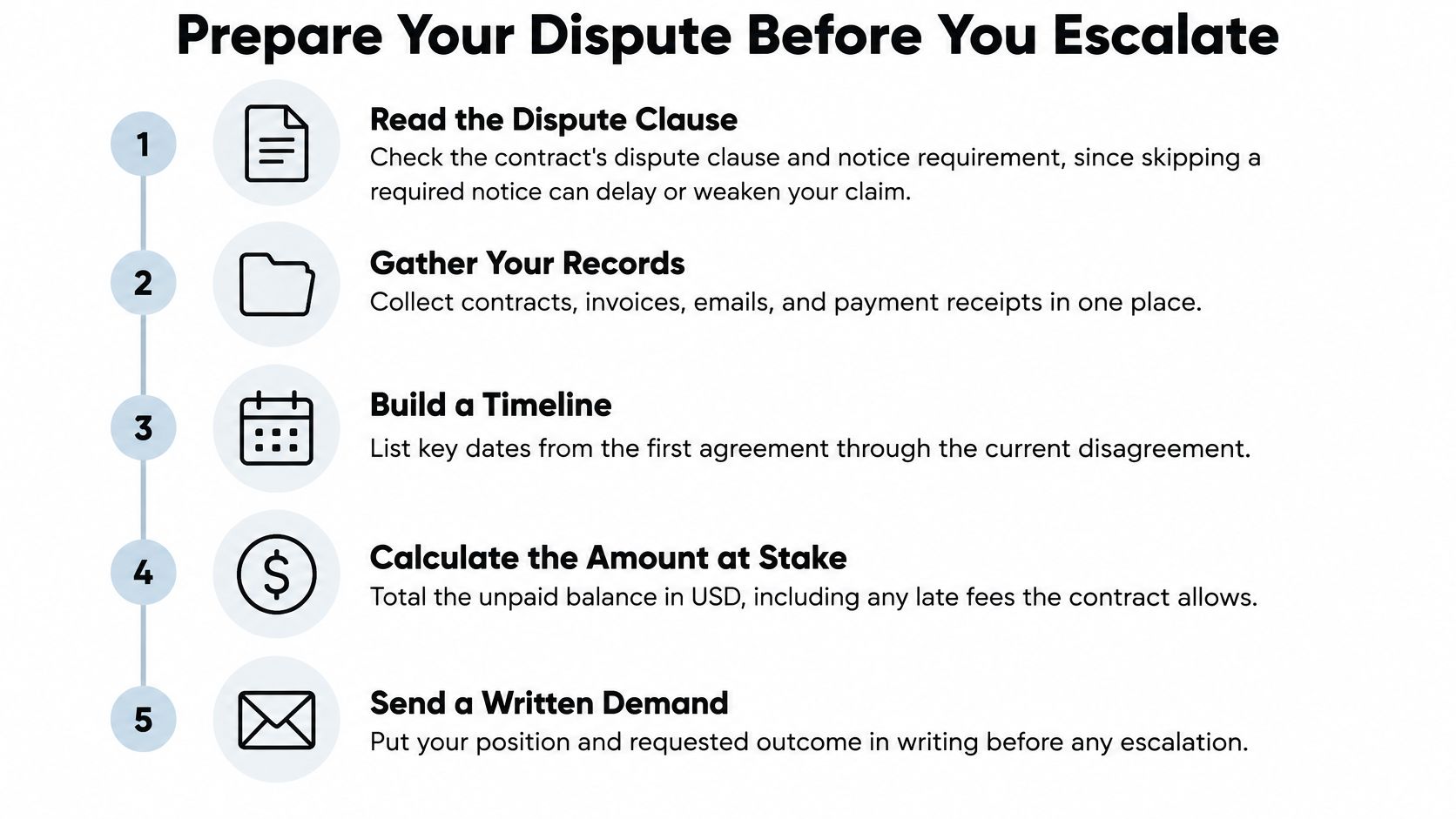
Read the contract and notice terms. Locate the dispute clause, notice address, cure period, and any required negotiation or mediation step. These terms are like a checklist for the process. Missing a required notice can delay a claim or give the other party a reason to argue that you did not follow the agreement.
Gather the records. Collect the contract, purchase orders, invoices, work records, relevant emails and texts, and payment history. Keep original files where possible, and organize copies by issue. That way, you can connect each part of your position to a document rather than relying on memory.
Build a one-page timeline. List key dates, what happened, and who said what. A short timeline can show where both sides agree, where their accounts differ, and which records support your version.
Calculate your net exposure. Start with the principal you say is owed, then check whether the contract allows interest or fees. Estimate the potential expense of negotiation, mediation, arbitration, court, and collection. Also consider whether the other party can pay. A low-cost path may still produce little recovery if collection is unlikely, while a more expensive step may not be worthwhile if fees consume the amount at stake. Treat cost and timing figures as estimates to confirm with counsel.
Send a focused written demand. State the key facts, what amount or action you seek, the contract term you rely on, and a clear response deadline. A period of 10 to 30 days can serve as a practical planning range, not a rule for every claim. Check the contract for any required deadline or method of notice before sending it.
Preserve relevant evidence. Where appropriate, suspend auto-delete and keep texts, voicemails, accounting records, and files related to the dispute. If a lawsuit appears likely, preserving relevant material is a practical litigation hold. Ask counsel what to retain and how to handle confidential information.
Check the deadline to sue. Limitation periods depend on the claim and its facts. As a general rule to confirm with counsel, many written contract claims in Texas have a four-year limitations period, though a shorter contractual period may apply. Negotiation may not pause the deadline, so ask a lawyer promptly which time limit governs your claim.
Choose a starting path. Use the earlier situation table as a guide, then check the contract's requirements. If mediation seems suitable, consider a mediator with experience in the type of dispute and a process both parties can accept.
Prepare your settlement limits. Before mediation, set an opening offer, a target, and a walk-away point. Base each figure on the evidence, the chance of collecting, and the cost of continuing. A settlement's headline amount matters less than what remains after fees, delay, and collection risk.
Keep communications measured. Angry emails and public posts can become exhibits later, and may make a reasonable resolution harder. A calm, factual message is more useful than an accusation written in the heat of the moment.
Your working file should include the contract, supporting records, timeline, financial calculation, notice history, and questions that need answers. The Law Office of Bryan Fagan in Atascocita can review a business contract and help assess a staged dispute plan, from negotiation through mediation or court, with attention to potential costs, timing, and realistic recovery.
If a business dispute is affecting your operations in Atascocita, Humble, or northeast Harris County, contract review and a staged plan can help clarify the next step and what recovery may remain after the costs and risks of pursuing it.