You're in the final stretch of a divorce in Atascocita. The decree says your former spouse will receive a share of your 401(k), so you both assume the retirement plan will send the money. Then the plan administrator says it can't act on the decree alone. That surprise is stressful, but the process becomes easier to manage once you know what the plan needs and who must approve the order.
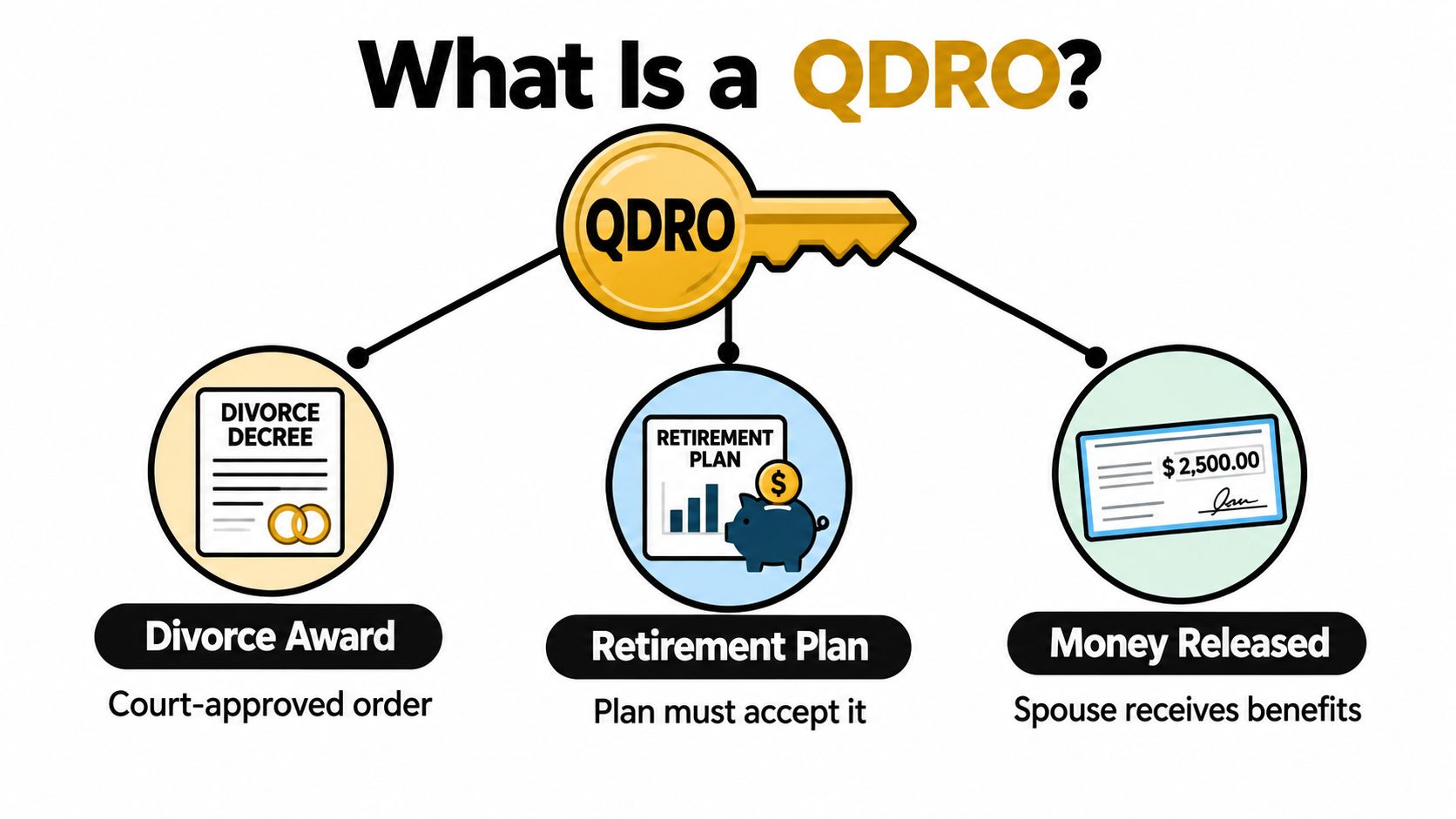
A qualified domestic relations order, or QDRO, is the plan-specific legal instrument that can put a retirement division into effect. The work doesn't always end when the judge signs the divorce decree. For many plans, the transfer has two stages: the divorce court awards a share, then the plan administrator reviews and qualifies an order before distributing benefits.
Why a Divorce Decree Alone May Not Protect Your Retirement
Consider a couple in Humble who agree to divide a workplace retirement account in their divorce. Their decree awards one spouse a share, and both leave court believing the plan will take care of the rest. When the former spouse contacts the plan to request payment, the administrator asks for a qualified order. The decree may establish the parties' rights between themselves, but the plan still needs an order it can administer under its rules.
This isn't an obscure issue reserved for complicated estates. Retirement accounts and pensions can be part of the property being divided in a divorce, alongside a home, savings, or other assets. Texas property-division questions can be easier to understand when you first learn how community property works in Texas, but a retirement plan has its own procedures for carrying out an award.
The practical distinction: The decree states what the spouses have agreed to or what the court has ordered. The QDRO gives a covered plan the instructions it needs to recognize and pay an alternate payee.
That second stage matters. A plan administrator reviews the order against federal requirements and the plan's own written procedures. If the order is incomplete or conflicts with the plan's rules, the administrator may not approve it as drafted. A spouse can then be left with a right recognized in the divorce case but no direct payment from the plan until the order is corrected and qualified.
The subject can sound intimidating because it combines family law, retirement-plan rules, and tax considerations. It becomes more manageable when you approach it in stages. First, learn what a QDRO does. Then check its required terms, identify whether the retirement system is private or public, follow the submission and review process, consider valuation and survivor-benefit choices, and address tax and timing before the transfer is complete.
What a Qualified Domestic Relations Order Actually Is
Think of the divorce decree as the award and the QDRO as the key the retirement plan needs to carry it out. A plan generally can't rely on an ordinary divorce judgment alone to pay retirement benefits to a former spouse. The order must meet the rules that allow the plan to recognize someone other than its employee or member as entitled to a share.
That recipient is called an alternate payee. Under the Retirement Equity Act of 1984, an alternate payee may be a spouse, former spouse, child, or other dependent. A QDRO doesn't create a new retirement benefit or add money to an account. It legally recognizes and allocates some of the participant's existing or future plan benefit to the alternate payee.
Congress established the QDRO framework in the Retirement Equity Act of 1984, enacted as Public Law 98-397 on August 23, 1984. The statute amended ERISA, the Employee Retirement Income Security Act of 1974, to create a limited exception to the federal rule generally protecting retirement benefits from assignment or transfer. The QDRO provisions took effect on January 1, 1985. The Social Security Administration describes the law as requiring plans to pay distributions ordered under a QDRO despite ERISA's spendthrift protections (background on the Retirement Equity Act and QDROs).
The formal provisions are section 206(d)(3) of ERISA and section 414(p) of the Internal Revenue Code. Those names confirm the legal framework, but the practical point is simpler: the order must qualify before a covered plan can pay the assigned benefit to an alternate payee.
A QDRO can address retirement benefits awarded for family-law purposes such as marital property division, child support, or alimony, as recognized by the governing rules. The details matter, especially for federal employee benefits that may follow different procedures. For a useful overview of divorce and the Thrift Savings Plan, see Sherpa's federal employee divorce resource.
Required Elements and Common Drafting Mistakes
A plan administrator needs clear instructions, not a general promise that one spouse will receive a fair share. Federal requirements make the order specific enough for the plan to identify the people involved, determine the benefit being assigned, and administer payment without guessing.
A carefully drafted order should include:
- The participant and alternate payee's identities: Use each person's name and last known mailing address. A reference to “the employee” and “the former spouse” without the required identifying information may not be enough.
- The plan being divided: Name each covered retirement plan. “The retirement account” can be ambiguous when someone has more than one plan.
- The share being assigned: State a dollar amount, percentage, or calculation method. “A fair share of retirement” doesn't tell the administrator how to calculate a payment.
- The payments or time period: Specify the number of payments or the time period covered. An order that leaves the duration unclear may not tell the plan when its obligation begins or ends.
The order also has limits. It can't require the plan to offer a form of benefit or payment option that the plan doesn't provide. It can't increase benefits on an actuarial-value basis, and it can't assign the same benefits twice to different alternate payees.
A useful drafting test is whether a plan administrator could apply the order without asking the former spouses to interpret what they meant.
That test is one reason to obtain the plan document, summary plan description, written QDRO procedures, and current participant benefit statement before drafting. The plan's terms may affect which payment methods are available and how a proposed formula works. A judge's signature doesn't change those plan rules.
Family cases may also involve separate safety concerns. For information about Protective Orders in Atascocita, including protective orders in domestic violence and family safety matters, consult a lawyer about the issues specific to your situation. Keeping those questions distinct from retirement-plan drafting can help each part of the case get the attention it needs.
ERISA Plans Versus Texas Public Retirement Systems
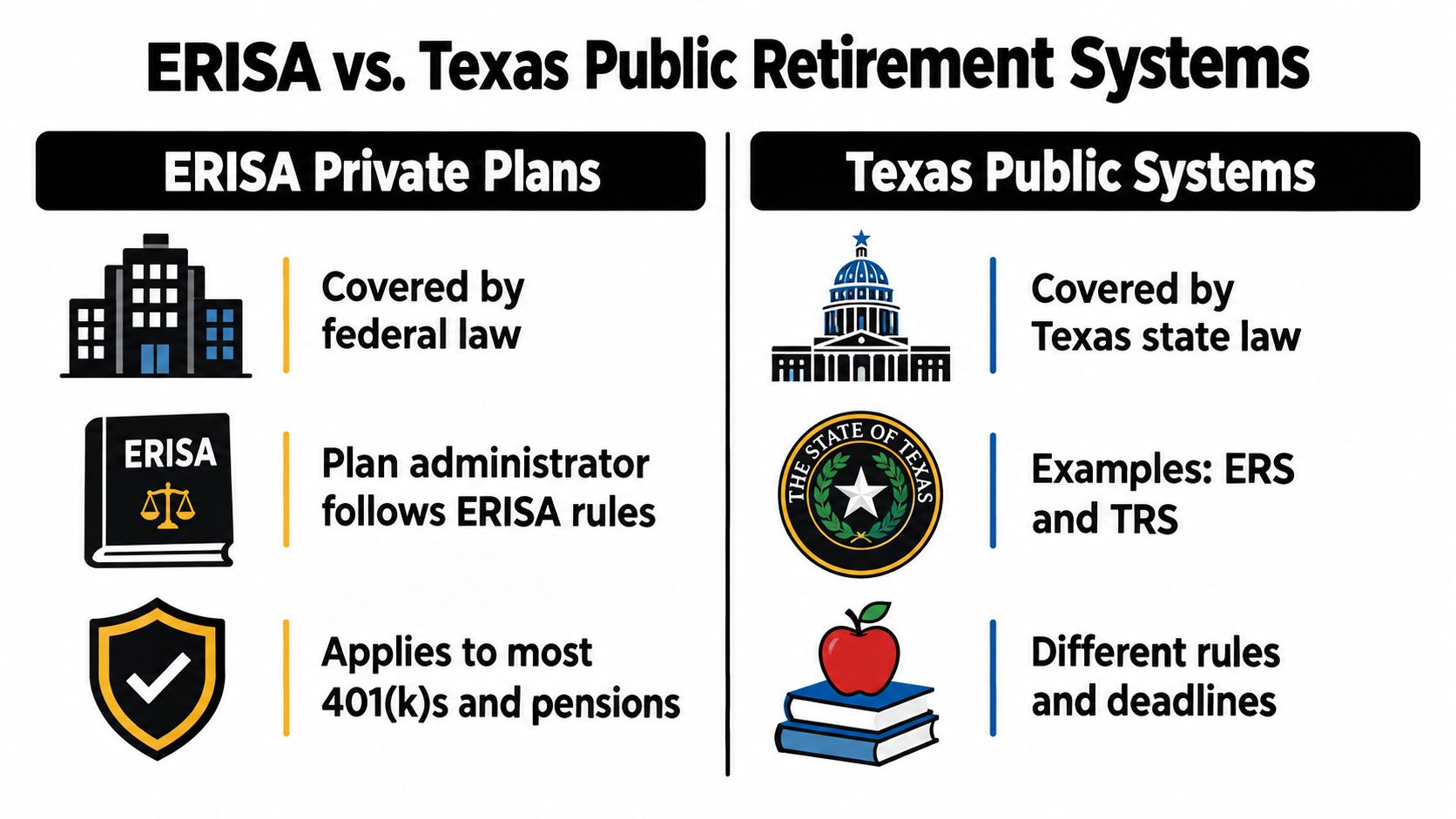
The word QDRO can make it sound as though every retirement plan follows one identical path. It doesn't. Private plans covered by ERISA use a federal qualification framework, while public retirement systems such as the Employees Retirement System of Texas (ERS) and the Teacher Retirement System (TRS) apply their own rules and procedures.
| Private ERISA plans | Texas public systems |
|---|---|
| Federal ERISA rules govern qualification for covered plans. | State-system rules and procedures apply. |
| The plan administrator reviews the order under the plan's written QDRO procedures. | ERS and TRS apply their own requirements to domestic-relations orders. |
| Plan documents help determine the payment options available. | System-specific forms and payment conditions can affect when benefits are paid. |
For a private employer's 401(k) or pension, start with that specific plan's procedures and documents. A QDRO that works for one plan may not work for another because each plan has its own operational terms. Couples dividing a workplace account can also review practical information about dividing a 401(k) in an Atascocita divorce.
TRS illustrates why public-system rules need their own review. The system, not the judge, determines whether a domestic-relations order qualifies, and TRS requires its form QDRO when an order is submitted. It won't pay an alternate payee until a benefit or amount becomes payable to the member, retiree, or beneficiary. That could occur through a refund of accumulated contributions and interest, retirement, or the participant's death. A court order therefore doesn't necessarily mean an immediate payment.
ERS also limits when benefits may be redirected. Its rules allow redirection in connection with a change in family relationship, including divorce or child support. If you're assessing a couple's retirement property alongside other assets, NY divorce asset valuation tips offer a separate perspective on valuing property in divorce. The rules discussed there don't replace the applicable Texas system's requirements.
For a teacher, state employee, or other public worker in Harris County, identify the system before using a template. The retirement system determines what it can approve and pay, so the order should be prepared for that system rather than copied from an unrelated private-plan case.
Step-by-Step QDRO Process for Harris County Families
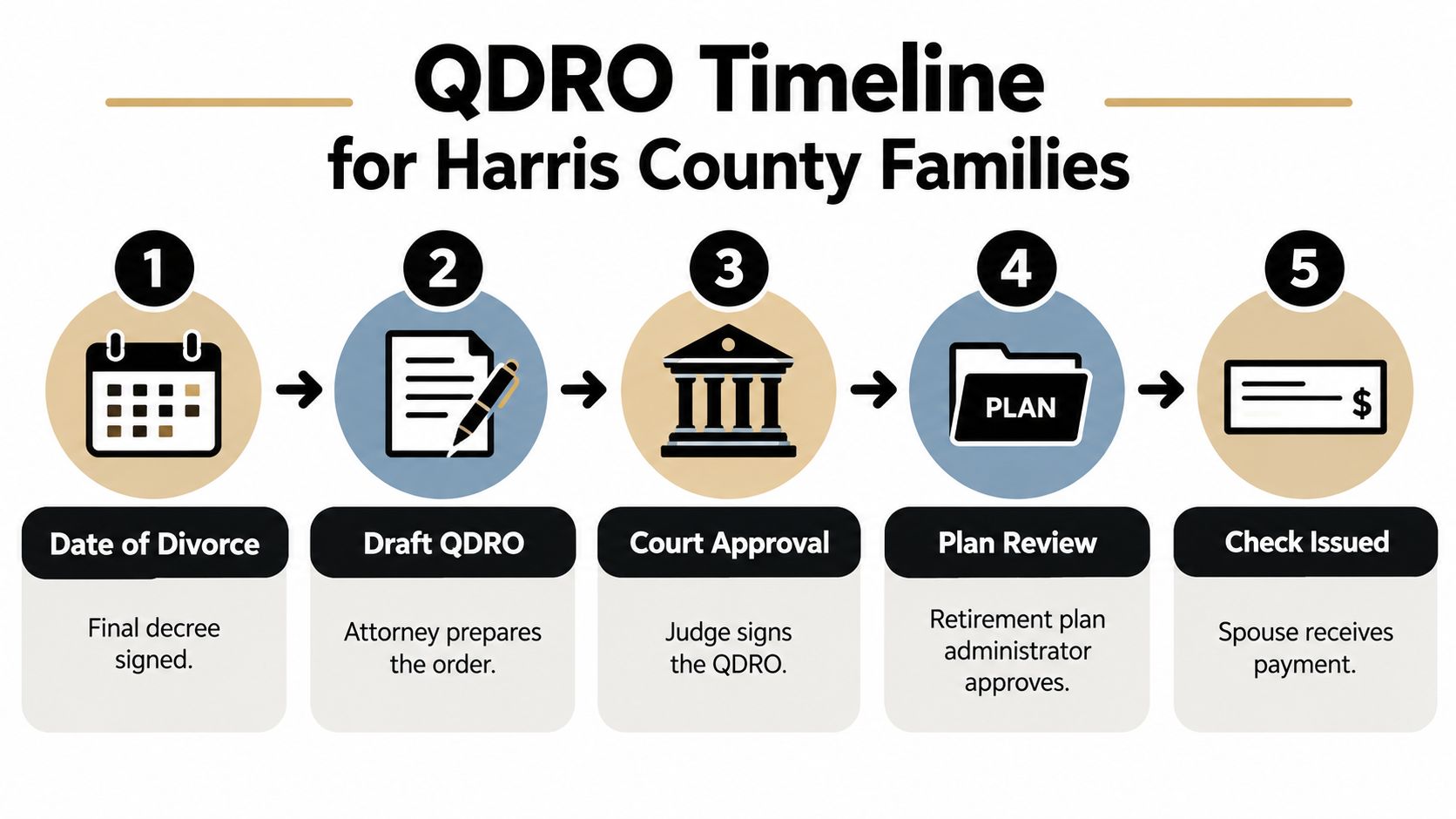
The process is easier to track if you think of it as a sequence that begins before drafting and ends only after the plan makes its decision. A couple in northeast Harris County might use this checklist to keep the work moving.
- Gather the plan materials. Obtain the plan document, summary plan description, written QDRO procedures, and current participant benefit statement. These materials help counsel understand the plan's terms before proposing language.
- Prepare a plan-specific draft. The order should state the parties' identities, identify the plan, and describe the award in a form the plan can administer. A generic template may not address the plan's own payment rules.
- Obtain the court's signature. Once the proposed order is prepared for the family-law case, it must be signed through the court process. Court entry is a necessary step, but it doesn't replace the plan's review.
- Submit the order and confirm receipt. Send the signed order to the plan administrator using the plan's stated procedures. Keep a record of submission and confirm that the administrator received it.
- Track the qualification decision and fix defects. The U.S. Department of Labor explains that the administrator must promptly notify the participant and each named alternate payee after receiving an order, provide the written qualification procedures, and decide qualification within a reasonable period under those procedures. The alternate payee may designate a representative to receive relevant notices and plan information. Each covered plan must maintain written, reasonable procedures for reviewing and administering QDROs (Department of Labor guidance on QDRO administration).
If the administrator rejects the draft, read the determination carefully, identify the specific issue, and correct it promptly. A delay can affect the amount available under a percentage-based award if the account's value changes while the order is being reviewed. Don't assume that a decree has already triggered payment.
A retirement transfer may also affect broader family financial planning. For matters involving wills, trusts, and estate plans for Atascocita families, review how changes in asset ownership fit with the rest of the plan. The key is to keep track of who has received each notice, when the administrator received the order, and what remains necessary before payment.
Valuation Dates, Formulas, and Survivor Benefits
The percentage or dollar figure in a QDRO can look simple while leaving important financial questions unanswered. For a defined-contribution account, such as a 401(k), the order commonly assigns a share of the account as of a stated valuation or assignment date. That date helps determine which balance the plan uses, but the order may also need to address contributions, investment gains or losses, fees, loans, and withdrawals during the period before distribution.
Consider two spouses who agree to divide an account equally. If the order uses a fixed dollar amount, the alternate payee's award may not move with later changes in the account balance. A percentage formula can track the account's value, but its result depends on the date and calculation method stated in the order. The spouses should understand which one bears the effect of market changes and account activity during the wait for payment.
Account division and pension payments
A separate-interest approach gives the alternate payee a distinct share that can be administered separately, if the plan allows it. A shared-payment approach divides payments when the participant receives them. These approaches don't produce the same practical result, and the plan's rules determine which options are available.
Defined-benefit pensions raise different questions from account-based plans. The order may need to address when payments begin and whether the former spouse receives a survivor benefit if the participant dies. For Texas public employees, TRS payment rules mean the alternate payee generally won't be paid until a benefit becomes payable to the member, retiree, or beneficiary. A Humble spouse awarded part of a pension should understand whether payment depends on the participant retiring or another benefit event occurring.
A division that looks equal on paper can feel very different in practice if one spouse receives an account interest that can be paid under the plan while the other receives part of a pension payable later. The correct formula depends on the plan and the parties' agreement, not on a universal template. Questions about survivor benefits in an Atascocita divorce can help focus the discussion on what happens if the participant dies before or after payments begin.

Tax Traps, Penalty Avoidance, and Timing
A judge's signature on the divorce decree doesn't, by itself, finish the retirement transfer. The order must meet the applicable qualification requirements before a covered plan can administer the benefit. That distinction matters not only for payment, but also for understanding how a distribution may be taxed.
Under the Internal Revenue Code, a distribution made directly to an alternate payee under a properly qualified QDRO is generally exempt from the 10% early-withdrawal penalty that would otherwise apply to a participant under age 59½. Ordinary income tax may still apply to the distribution. The penalty exception depends on the order qualifying, so a drafting or submission problem can delay the transfer and complicate a planned withdrawal.
Timing can also affect what the alternate payee receives. If a percentage-based account award remains unprocessed while the balance changes, the assigned share may change with it. A defined-benefit pension presents a different concern: if the participant hasn't begun receiving payments, the alternate payee may need to wait for the plan's payment conditions to be met.
Before the order is submitted, ask how the plan will calculate the assigned share, when it can pay, and what tax treatment may apply to the distribution you're considering. For general background on understanding taxes in retirement planning, remember that tax planning information doesn't replace advice about the specific plan and distribution. A lawyer handling division of community property and complex assets for Atascocita divorces can help connect the retirement award to the larger property division.
How the Law Office and Firm Can Help
A QDRO is more than a document to prepare after the rest of the divorce is finished. The order needs to reflect the divorce award, the retirement plan's terms, and the administrator's review process. Families in Atascocita, Humble, and Harris County can work through the pieces in a deliberate order:
- Start with the plan information. Identify the retirement system and gather its documents, procedures, and benefit statement. This helps clarify what the plan can administer.
- Draft for the specific plan. State the parties' identities, the plan, and the assigned benefit with enough precision to follow the plan's rules. The language may also need to address valuation, payment timing, and survivor-benefit choices.
- Coordinate court entry and plan submission. Obtain the required court signature, submit the order to the administrator, and confirm receipt. Keep track of notices and the determination.
- Respond to the administrator's decision. If the plan identifies a defect, review its explanation and work on corrections rather than assuming the decree will make the plan pay.
- Consider what happens after approval. Once funds are released, the alternate payee may need to make rollover or tax decisions. The parties may also need to revisit estate-planning documents to reflect changed ownership of retirement assets.
QDRO work often connects with other family-law issues. If a former spouse doesn't follow a divorce decree or custody order, families can learn about Enforcement of Court Orders in Atascocita. That's a separate process from qualifying a retirement order with a plan, but both may matter when a family is trying to carry out court-ordered terms.
For example, an Atascocita or Humble couple may have agreed in court to divide a workplace account, only to discover that the plan needs clearer terms before it can make payment. Working through the plan documents, court order, administrator review, and later financial decisions can help the parties understand what remains to be done. The Law Office of Bryan Fagan – Atascocita TX Lawyers handles family-law matters, including divorce and property division, and also provides estate-planning services.
The Law Office of Bryan Fagan – Atascocita TX Lawyers can help Atascocita and Humble families review retirement-plan requirements, prepare and submit a plan-specific QDRO, and address a rejection or follow-up questions. To discuss your divorce and retirement benefits, schedule a free consultation at the Atascocita office by visiting Law Office of Bryan Fagan – Atascocita TX Lawyers.