Skip to content
If you're reading this from Atascocita or Humble, you may be sitting at the kitchen table with a stack of account statements, trying to answer one question that suddenly feels much bigger than it used to. What happens to the 401(k) in a divorce?
For many families, that account isn't just a line on a statement. It's years of payroll deductions, employer matches, and the quiet hope that retirement would someday feel secure. When divorce enters the picture, people often worry that everything they've saved will be split without context or that a simple mistake will trigger taxes and penalties they didn't see coming.
That fear is understandable. Dividing 401k in divorce Atascocita Texas cases can be technical, but it doesn't have to stay confusing. If you understand what counts as marital property, how the account is valued, and why the court order matters so much, you can make better decisions and protect your future.
Navigating Divorce and Your Retirement in Atascocita
A common local situation looks like this. One spouse has worked for the same employer for years, steadily building a 401(k). The other spouse may have paused a career to raise children, handled the household, or earned less while the family built a life in Atascocita or Humble.
When divorce starts, the house gets attention first. So do custody schedules, vehicles, and monthly bills. Then someone notices the retirement account, and the tone changes. The 401(k) may be one of the largest assets in the marriage.

That moment creates a lot of questions.
What people usually ask first
Some of the most common concerns sound like this:
- Was it all earned during the marriage
- What if part of the account existed before the wedding
- Does a Harris County judge always split it equally
- Can we trade another asset instead
- What paperwork transfers the money
Those are the right questions. A 401(k) doesn't get divided by guesswork or by a casual agreement between spouses.
Practical rule: Your divorce decree may say who gets what, but retirement accounts usually need extra legal steps before the plan administrator will act.
Texas law gives families a framework for this. It doesn't mean every dollar in the account is automatically shared. It means the court looks carefully at when the funds were built, what part belongs to the marital estate, and what process must be followed to divide it correctly.
Why local context matters
Families in northeast Harris County often deal with the same practical problems. Old statements are missing. Accounts have been rolled over from one employer to another. One spouse assumes the account is entirely separate because it's only in one name. The other assumes half of everything is guaranteed.
Neither assumption is safe.
In real life, retirement division is often part legal analysis, part document hunt, and part careful drafting. The goal isn't just to reach a settlement. The goal is to reach one that a court can enforce and a plan administrator can carry out.
If you're dealing with dividing 401k in divorce Atascocita Texas issues right now, the path forward is usually calmer once you break it into stages. First, identify what portion is marital. Next, value it correctly. Then use the right order to transfer it without avoidable tax damage.
Understanding Your 401k and Texas Community Property Law
Texas follows a community property system. According to the explanation of Texas divorce law in this discussion of how a 401(k) is divided in a Texas divorce, Texas is one of only nine community property states in the country, and assets acquired during marriage are generally presumed to belong to both spouses and divided under a "just and right" standard. For a 401(k), that means the portion built during the marriage is usually the part under review.
Separate property and community property
A 401(k) can contain two different legal categories at the same time.
| Part of the 401(k) | Likely classification |
|---|---|
| Balance already in the account before marriage | Separate property |
| Contributions made during marriage | Community property |
| Employer match earned during marriage | Community property |
| Investment growth tied to marital contributions | Community property |
| Traceable inheritance or gift funds, if applicable | Separate property |
Many people often struggle with this concept. They look at one account and assume it has one label. In many divorces, it has both.
If you entered the marriage with retirement savings already in place, that earlier balance may still be yours alone. But you must be able to prove it. If you added to the account during the marriage, that later portion is usually part of the marital estate.
A simple example
The same Texas resource gives a useful example. If a spouse had $200,000 in the 401(k) before marriage and the account was worth $500,000 by divorce after a decade, roughly 60% ($300,000) may be treated as community property if the records support that tracing.
That example helps show why this area gets technical fast. The account owner doesn't necessarily keep everything just because the account is in their name. On the other hand, the other spouse doesn't automatically receive half of the entire account balance either.
If you can't clearly trace the separate portion, the court may treat much more of the account as community property than you expected.
"Just and right" doesn't always mean identical
People often hear "community property" and think "perfectly equal split." That's not always how a Texas court approaches it.
Courts often begin with the idea of a 50/50 division of the community portion, but they can adjust based on things like marriage length, fault, earning differences, and financial need, as described in the same Texas community property discussion. In a short marriage, the divisible portion may be limited to only the growth and contributions after the wedding. In a longer marriage, the marital share may be much larger.
That distinction matters in Harris County divorces because retirement accounts often reflect years of mixed history.
Why records matter so much
The legal issue isn't just what happened. It's what you can document.
You may need:
- Pre-marriage statements to establish the starting balance
- Statements during the marriage to show contributions and growth
- Rollover records if the account moved between employers
- Gift or inheritance records if separate funds entered the account
If you're trying to understand the broader framework behind marital property, this overview of community property in Texas is a helpful companion.
And if you've seen disclosure forms from other states and wondered why property division paperwork can feel so document-heavy, resources like Mastering California's Form FL 142 Guide show how detailed financial tracing becomes when retirement assets are involved. The forms differ by state, but the underlying lesson is the same. Good records protect your position.
How to Value the Marital Portion of Your 401k
Once you know that only the marital portion is on the table, the next challenge is putting a number on it. This is the part where many divorcing spouses in Atascocita get frustrated, because a 401(k) doesn't stand still. Contributions change. Investments rise and fall. Old records may be incomplete.
The valuation process needs structure.

A Texas retirement division analysis explains that valuing a 401(k) starts by separating community and separate property, gathering statements from the marriage date forward, and sometimes using tracing methods more reliable than simple subtraction, including time-weighted rate of return calculations. It also notes that plan-specific compliance issues later in the process can lead to QDRO rejection rates as high as 15% to 25% if the order doesn't match the plan's rules, which is one reason the valuation phase needs to be done carefully from the start. You can review that discussion in this article on dividing retirement accounts in a Texas divorce.
Step one, gather the right statements
Start with the statement closest to the wedding date. Then gather statements covering the marriage through the chosen valuation point.
If possible, collect:
The pre-marriage statement
This helps establish the separate property baseline.Statements during the marriage
These show contributions, employer matches, and account changes over time.Documents for any rollover
If funds moved from one plan to another, the paper trail matters.Loan records
If there was a plan loan, it can affect how the account should be viewed in settlement talks.
Why simple subtraction may not be enough
People often try a quick formula. Current value minus pre-marriage value. Sometimes that gives a rough starting point. Sometimes it creates a distorted result.
Pre-marriage money may have grown on its own during the marriage. Marital contributions may also have grown. Those two streams can overlap in ways that make basic subtraction misleading.
When a forensic accountant may help
In a straightforward case, good records may be enough. In a more complicated case, a forensic accountant may help trace which growth belongs to separate property and which belongs to the community estate.
That can be especially useful when:
- The marriage lasted many years
- The account includes multiple investment changes
- Several rollovers occurred
- The pre-marital balance was substantial
- The records are incomplete or messy
A forensic review doesn't change the law. It helps apply the law with better precision.
The more mixed the account history becomes, the more valuable careful tracing becomes.
The valuation date matters
Even when spouses agree on what part of the account is marital, they still need to decide the date used to value that marital share. That date might be tied to filing, mediation, or another point in the divorce process.
This isn't a minor detail. Investment accounts move with the market. A delay between negotiation and final transfer can change the account's value, which is why settlement language needs to be precise.
Two ways people approach valuation language
| Approach | Effect |
|---|---|
| Fixed dollar amount | Gives certainty on a number, but may not reflect later market movement |
| Percentage of marital portion | Moves with gains or losses until division if drafted that way |
Neither approach is automatically right for every family. The better fit depends on the plan, the settlement terms, and how the order is drafted.
A practical document checklist
Before mediation or court, it helps to organize the retirement file in one place.
- Account statements in date order
- Marriage date and filing date confirmation
- Plan administrator contact information
- Any model QDRO language from the plan
- Notes on account loans or unusual transactions
That preparation saves time. It also reduces the chance that someone makes assumptions about balances that should have been documented instead.
For many families in Harris County, valuation is the stage where the case starts to become clearer. Once the marital portion is identified and supported with records, settlement talks become more grounded. You're no longer arguing over the entire account. You're dealing with the part the law deems divisible.
Securing Your Share with a Qualified Domestic Relations Order (QDRO)
The QDRO is where many divorce cases either move smoothly or get stuck for months. A Qualified Domestic Relations Order, usually called a QDRO, is the court order that tells the retirement plan exactly how to divide the account.
Without it, a divorce decree alone usually won't get the 401(k) split.
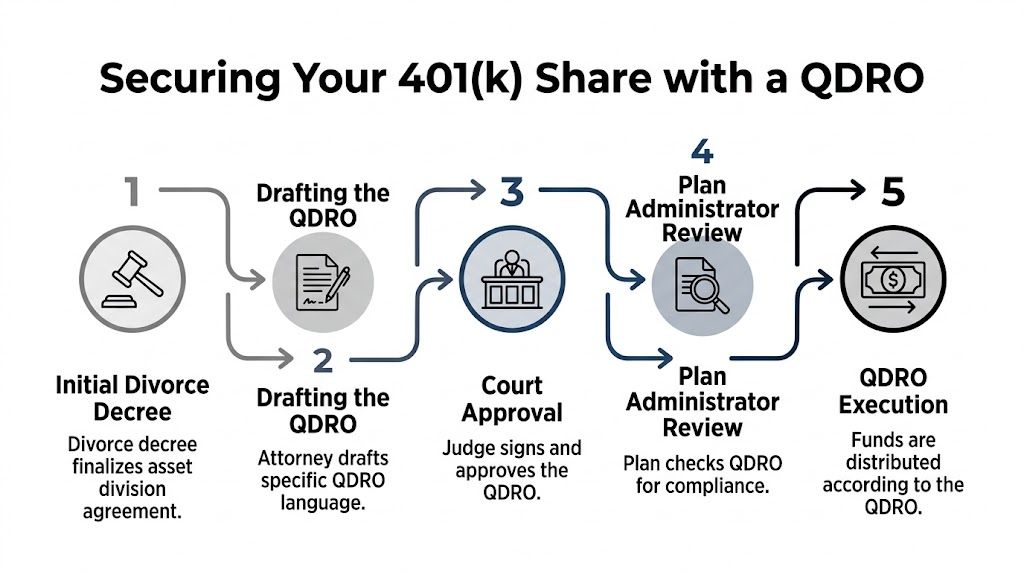
A practical visual overview can help if this process feels abstract.
A detailed discussion of QDRO execution explains that after the divorce decree, an attorney drafts the QDRO, the judge signs it as a separate order, and the plan administrator then reviews it. That review can take 30 to 90 days. If the order qualifies, the alternate payee can receive the awarded share by rollover IRA or direct distribution without the 10% early withdrawal penalty. The same source notes that about 25% of QDROs are first rejected because of drafting errors such as incomplete survivor benefit language, causing delays of 3 to 6 months, and reports 92% successful executions with specialists compared with 65% overall. You can read that discussion in this article on what happens to a 401(k) in divorce.
What the QDRO actually does
Think of the divorce decree as the agreement or ruling about division. The QDRO is the implementation document.
It usually needs to identify:
- The exact retirement plan
- The participant and alternate payee
- The percentage or amount awarded
- The valuation terms
- Any gains and losses treatment
- Required plan-specific language
This is not a generic family law form. It has to fit both the divorce terms and the retirement plan's rules.
The QDRO life cycle
In many Harris County cases, the process unfolds in a sequence like this.
Decree first, order second
The divorce decree says how the 401(k) will be divided. Then the QDRO is drafted to match that language precisely.
If the decree is vague, the QDRO becomes harder to prepare. If the QDRO doesn't match the decree, the plan administrator may reject it.
Court signature
The judge signs the QDRO as a standalone order. That matters because the plan administrator needs a qualifying order, not just settlement notes between spouses.
Plan administrator review
After the judge signs, the order goes to the plan administrator. Plan-specific wording then becomes critical.
Some plans provide model language. Some have narrow formatting requirements. Some focus closely on survivor benefits or account identification details.
A retirement plan doesn't grade on effort. It reviews for compliance.
Why generic templates cause trouble
A template pulled from the internet may look polished, but retirement plans don't accept documents because they look familiar. They accept them because the language fits their rules.
Common reasons for rejection include:
- Terms that don't match the decree
- Missing survivor benefit language
- Incorrect plan name
- Vague treatment of gains and losses
- Failure to follow the administrator's model format
That's one reason many people use attorneys or dedicated QDRO professionals. The Law Office of Bryan Fagan handles retirement division matters for clients in this area, and families comparing options can also review this page on division of retirement accounts in Atascocita divorce cases.
One point that surprises many spouses
The spouse receiving funds becomes the alternate payee. Once the transfer is completed according to the order and plan rules, that spouse may have options about how to hold or distribute the awarded share.
That detail matters because the legal division and the financial handling are related, but they aren't the same step.
If you're focused on dividing 401k in divorce Atascocita Texas matters, the QDRO is not paperwork to leave for later. It is the document that turns a settlement into an actual retirement transfer.
Navigating Tax Implications and Avoiding Costly Penalties
Many couples spend so much energy negotiating the split that they overlook the tax side until it's too late. That's where expensive mistakes happen.
A Texas discussion focused on this issue explains that taking a withdrawal from a 401(k) before age 59½ outside a QDRO triggers a 10% early withdrawal penalty plus ordinary income tax on the full amount, which can create a total tax hit of 30% to 40% or more. That same discussion notes that a properly executed QDRO can allow the receiving spouse to roll the awarded share into an IRA and defer taxes. You can review that explanation in this article on how 401(k)s are divided in divorce in Texas.
Why the wrong shortcut costs so much
People sometimes think a simple cash payout will save time. It usually doesn't save money.
If one spouse pulls money out informally to satisfy the settlement, that transaction may be treated as an ordinary withdrawal. That can shrink the value of the settlement in a hurry.
The amount awarded in a divorce and the amount a person keeps after taxes are not always the same thing.
Comparison table
| Metric | With a QDRO (Rollover to IRA) | Without a QDRO (Cash Payout) |
|---|---|---|
| Financial Outcome for a $100,000 401(k) Share | $100,000 moved for continued retirement use, with taxes deferred if rolled into an IRA | $100,000 distribution may trigger immediate tax consequences |
| Early withdrawal penalty before age 59½ | Avoided if handled through the QDRO process and transferred properly | 10% penalty may apply |
| Income tax at distribution | Deferred with a proper rollover | Ordinary income tax applies on the distributed amount |
| Potential total tax impact | Deferred rather than imposed immediately | Can reach 30% to 40% or more depending on the recipient's tax bracket |
| Long-term retirement effect | Funds can stay in a retirement account | A large portion may be lost before the money can be reinvested |
A better way to think about the tax issue
The QDRO doesn't erase taxes forever. It helps avoid turning the divorce transfer itself into a needless tax event.
If the receiving spouse rolls the awarded share into an IRA, taxes are generally deferred. If that spouse instead takes cash, tax consequences may follow based on the type of distribution and timing.
Questions to raise before signing anything
- Will the awarded share stay in retirement form or be cashed out
- Does the settlement assume a rollover to an IRA
- Who is responsible for taxes if someone chooses immediate distribution
- Does the language in the decree and QDRO line up with that plan
Those questions matter for people near retirement and for younger spouses rebuilding after divorce. The legal award on paper may sound fair, but the after-tax result is what shapes your real financial future.
Common 401k Division Pitfalls and How to Protect Yourself
The problems that hurt people most in retirement division usually aren't dramatic. They're small drafting issues, missing statements, and assumptions nobody tested.

Pitfall one, treating the whole account as marital
A spouse sees a large balance and assumes all of it is divisible. That can be wrong if part of the account existed before marriage.
The fix is simple in concept, though not always easy in practice. Find the oldest statements you can, especially the one closest to the wedding date.
Pitfall two, relying on a generic online form
This happens often. Someone downloads a template, changes the names, and assumes the plan will accept it.
That approach can fall apart if the plan requires specific language on survivor benefits, valuation terms, or how gains and losses are handled between decree and transfer.
Pitfall three, forgetting that the market moves
A settlement may say one spouse receives part of the marital portion, but if the language doesn't explain what happens as the account rises or falls before transfer, a later dispute can follow.
Short phrases matter here. The order should say enough to avoid uncertainty.
Good drafting protects both spouses from later arguments about what the original agreement meant.
Pitfall four, overlooking loans and account details
A 401(k) loan can affect how people think about value. Plan-specific details can also change how the order should be written.
When you're preparing for mediation or final drafting, review the account carefully. Don't assume the statement tells the full story without context.
How to protect yourself
A careful approach usually includes these habits:
Start the document hunt early
Old statements often take time to locate.Match the decree and the QDRO
Inconsistent language creates rejection risk.Ask for plan requirements in writing
Model language can save months of delay.Review the full asset picture
Sometimes a negotiated offset is cleaner than splitting the account.Get focused legal help before signing
A mistake in retirement division can outlast the divorce itself.
If you're also working on the broader question of safeguarding finances during the case, this guide on how to protect assets during divorce gives practical context.
For many Atascocita families, the safest mindset is this. Slow down long enough to get the retirement language right. A rushed agreement can create a much longer problem.
Your Next Steps with The Law Office of Bryan Fagan
A 401(k) often represents years of discipline and planning. In divorce, it deserves more than a rough estimate or a handshake agreement. You need to know what part of the account is marital, what part may remain separate, how the value is calculated, and how the transfer will occur.
For families in Atascocita, Humble, and the surrounding parts of northeast Harris County, local procedure matters too. Court-approved language, accurate records, and a properly prepared QDRO can make the difference between a clean division and a costly delay.
If you're facing dividing 401k in divorce Atascocita Texas questions, the best next step is usually a case-specific review. What makes sense for one couple may not fit another. The age of the account, the date of marriage, missing records, offset options, and tax planning all shape the answer.
You don't have to sort through that alone. A careful conversation can bring a lot of clarity very quickly.
If you're dealing with a divorce in Atascocita, Humble, or elsewhere in Harris County and need help understanding how a 401(k) may be divided, schedule a free consultation with Law Office of Bryan Fagan – Atascocita TX Lawyers. Our team can help you review the marital portion of the account, identify documentation issues, and discuss the next legal steps for protecting your financial future.