Skip to content
A lot of people in Atascocita don’t think about retirement accounts until divorce puts every account statement under a microscope.
You may be sitting at your kitchen table in Eagle Springs, Walden, or nearby Humble, looking at a 401(k), an IRA, or a pension summary and wondering one simple question. Is this mine, theirs, or ours? For many families, that retirement balance is one of the largest assets in the marriage.
That’s where the stress starts. One spouse may have built a workplace plan over many years. The other may have paused a career to raise children, support relocations, or go back to school. Both may feel protective of the future they thought they were building together. When divorce begins, retirement money often becomes one of the most emotional parts of the case because it represents security, not just dollars.
The good news is that the process is manageable. The legal rules are detailed, but they aren’t impossible to understand. If you know how Texas treats marital property, how different retirement accounts are valued, and when a QDRO is required, you can make far better decisions and avoid expensive mistakes.
For readers searching for guidance on division of retirement accounts atascocita divorce, this guide is meant to feel local and practical. It focuses on the steps residents in Atascocita, Humble, and northeast Harris County take, from gathering old statements to dealing with plan administrators and court paperwork.
Facing Divorce in Atascocita Your Retirement Is a Key Asset
A common moment in divorce occurs.
One spouse pulls up an online account portal. The other opens a folder with old tax returns and benefit statements. They both realize the same thing at once. The retirement account they barely discussed during the marriage may now be central to the property division.
In Atascocita divorces, that surprise is common. Many couples spend years focusing on mortgage payments, school schedules, car notes, and family routines. Retirement savings grow in the background through payroll deductions, employer matches, and investment growth. Then divorce forces everyone to slow down and ask where the money came from and how the law treats it.
Why this asset causes so much confusion
Retirement accounts don’t look like ordinary property.
A house has an address. A vehicle has a title. Retirement funds are different. They may include pre-marriage savings, marital contributions, employer money, and gains that built up over time. Some accounts can be split with court orders. Others require different language in the divorce decree. Some are easy to value. Others are not.
That’s why people often get tripped up by two legal ideas right away:
- Community property means some or all of the account may belong to the marital estate even if only one spouse’s name is on it.
- QDRO means a special court order is often needed to divide certain workplace retirement plans correctly.
Retirement division feels intimidating because the account statement shows one number, but the law may treat that balance as several different pieces.
A practical local mindset
If your case is in Harris County, the best first move usually isn’t arguing over percentages. It’s gathering records and understanding what kind of account you’re dealing with.
That shift matters. When people focus first on documentation, the process becomes clearer. You stop seeing retirement as one giant mystery and start seeing it as a series of manageable questions.
Understanding Community Property and Your Retirement Savings
In an Atascocita divorce, retirement accounts usually have to be sorted into two buckets. One bucket is separate property. The other is community property. That sounds simple until you look at a real account statement and realize one balance may reflect years of deposits made before marriage, during marriage, and after a separation date.
Texas law starts with a basic rule. Property acquired during marriage is generally part of the community estate, even if the account is held in only one spouse’s name. Retirement savings often follow that rule, which means a 401(k), pension, or IRA may be partly yours alone, partly shared, or a mix of both.

A clearer way to picture the split
A retirement account works a lot like a long-running savings ledger.
The first entries on that ledger may have been made before the marriage. Those early entries may remain separate property. Then the marriage begins, payroll deductions continue, an employer may add matching funds, and investments rise or fall over time. The entries added during the marriage are usually the ones the court treats as part of the community estate.
That is why lawyers and courts do not look only at the name on the account or the current balance. They look at timing.
Separate property versus community property
This distinction drives many retirement disputes in Harris County divorce cases.
Separate property usually includes the portion of the account built before marriage. It can also include certain inherited funds or gifts, if they were kept identifiable.
Community property usually includes the portion built during the marriage. In a defined contribution plan such as a 401(k) or IRA, that often means:
- employee contributions made during marriage
- employer matching contributions tied to those deposits
- investment growth connected to the marital portion
One point causes confusion over and over. A retirement account in one spouse’s name is not automatically that spouse’s separate property. Title matters far less than the history of the funds.
Why records matter so much in Harris County cases
If you end up in the Harris County court system, the judge will want proof, not guesses.
That usually means gathering account statements from around the date of marriage, statements near the date of divorce, plan summaries, beneficiary records, and documents showing any rollover from an older account. For Atascocita residents, this is often the most practical first task because local cases move more efficiently when the paper trail is organized early.
A good analogy is a measuring cup. If you want to know how much water was already in the cup before the marriage, you need a mark on the side showing the starting level. Without that mark, it becomes much harder to prove which part should stay separate.
Practical rule: The spouse claiming a separate property share usually needs records that clearly trace it.
“Just and right” does not always mean a 50-50 split
Texas courts divide community property in a way the court considers just and right. Sometimes that leads to a roughly even division. Sometimes it does not.
A judge may consider the broader facts of the marriage, including differences in earning ability, financial need, or future employment prospects. Retirement accounts are part of that larger picture, not a stand-alone math problem. If you want a plain-English overview of the rule behind this, this guide on what is community property in Texas gives helpful background.
Where Atascocita spouses often get tripped up
Many people focus on the latest account statement because it feels concrete. But divorce law asks a different question. When was this money earned, contributed, or grown?
That shift in focus matters. A $200,000 account is not automatically a $200,000 marital asset. Part of it may date back to before the marriage. Part may have grown from marital contributions. Part may even involve a rollover that requires extra tracing.
For someone filing in or around Atascocita, that is the practical takeaway. Start with the timeline, gather the statements, and identify the account type before arguing about percentages. That approach usually turns a confusing issue into a series of manageable steps.
Valuing Different Types of Retirement Accounts for Divorce
Not all retirement accounts are valued the same way.
Some plans are built around a current balance you can see on a statement. Others promise future payments that need deeper analysis. In Atascocita and across Harris County, the type of account often shapes the entire strategy.
Four accounts people commonly deal with
Most divorce cases involving retirement assets include one or more of these:
- 401(k) or 403(b) plans through an employer
- Traditional or Roth IRA accounts
- Pensions, also called defined benefit plans
- Military retirement benefits
Each one creates a different practical problem. One asks, “What was in the account on the marriage date?” Another asks, “What is the present value of future benefits?” That difference matters when you negotiate or prepare for trial.
Retirement Account Division at a Glance
| Account Type | What is Divided | Division Method | Key Challenge |
|---|---|---|---|
| 401(k) and 403(b) | The marital portion of contributions and related growth during marriage | Usually divided through a QDRO for employer-sponsored plans | Tracing pre-marriage balance, loans, and investment changes |
| Traditional and Roth IRA | The marital portion held in the IRA | Usually divided by transfer incident to divorce through decree language, not a QDRO | Tax character may differ between accounts, so equal balances may not mean equal after-tax value |
| Pension | The community portion of future retirement benefit | Usually requires specialized order and often deeper valuation work | Future monthly payments can be harder to measure in present terms |
| Military retirement | The divisible marital share of military retirement under federal rules | Requires a military-specific order rather than a standard ERISA QDRO | Federal rules add complexity and timing issues |
401(k) and 403(b) plans
These are often the easiest accounts to identify and the hardest to divide casually.
They usually come with regular statements, online access, and transaction histories. That helps with valuation. But the statement total still isn’t automatically the amount subject to division.
If one spouse started the job before the marriage, the account may contain a separate property base plus marital additions. The analysis usually focuses on the balance at marriage, the balance at divorce, and the records that show contributions and growth in between.
A plan loan can also complicate the picture because it may reduce the amount that’s available for division.
IRAs
IRAs often look simpler because they aren’t tied to a company plan administrator in the same way a 401(k) is.
Still, they can create confusion. A spouse may have rolled money from prior accounts into the IRA. The account may include pre-marriage funds, marital contributions, or transfers that need careful tracing. A Traditional IRA and a Roth IRA can also feel similar on paper while carrying different tax consequences.
That’s why lawyers don’t just compare account balances. They look at source, timing, and tax character.
Pensions
Pensions are different because they usually promise a future stream of payments rather than a visible account balance.
That creates a valuation issue. The marital portion may depend on years of service earned during marriage and the formula used by the plan. In some cases, the parties divide future payments when they are paid. In others, they negotiate an offset using other property.
Pensions often require more technical work than bank-style retirement accounts because you’re valuing something that hasn’t fully paid out yet.
A pension case may look quiet on the surface, but it often requires the most careful drafting.
Military retirement
Military retirement follows its own set of federal rules, not the ordinary framework people expect from civilian employer plans.
That means families in Atascocita with service backgrounds should be especially careful before agreeing to decree language. The terminology, payment rules, and enforcement process can differ from what applies to a 401(k) or a private pension.
What to gather before anyone negotiates
Before serious talks begin, it helps to assemble the right documents:
- Recent statements: Collect the most current statement for each account.
- Marriage-date records: Find statements or summaries showing the balance near the start of the marriage.
- Plan documents: Keep summary plan descriptions, benefit statements, and any administrator contact information.
- Loan records: If a workplace plan has an outstanding loan, gather that information early.
- Rollover history: If money moved from one account to another, keep the paper trail.
For people dealing with the division of retirement accounts atascocita divorce, valuation usually gets easier when you stop asking, “What’s the account worth?” and start asking, “What type of account is this, and what records explain its history?”
The QDRO Process A Step-by-Step Guide for Atascocita Residents
For many employer-sponsored retirement plans, the divorce decree alone doesn’t move the money.
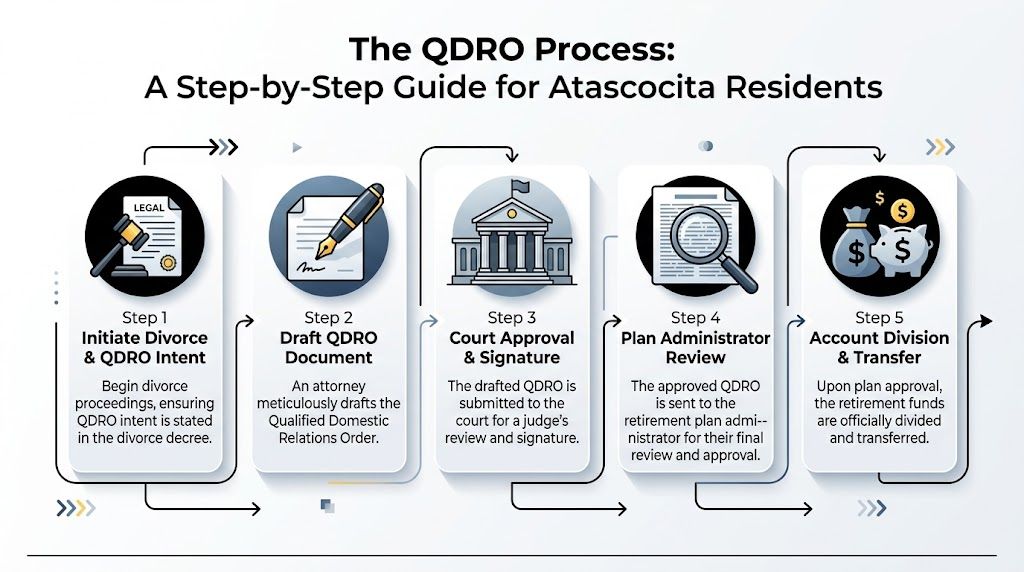
A Qualified Domestic Relations Order, or QDRO, is a specialized federal court order used to divide most employer-sponsored retirement plans without triggering tax penalties or immediate taxation. Under the standard process, spouses first negotiate the percentage or dollar amount to divide and place that agreement in the divorce decree, then an attorney drafts plan-specific QDRO language, and the draft is sent to the plan administrator for pre-approval before implementation, as outlined in this explanation of the Texas QDRO process and retirement plan division.
Step one starts in the divorce decree
Many people think the QDRO comes first. Usually, it doesn’t.
The division terms need to be decided in the divorce case itself. That means the decree should clearly identify the account and state what share the other spouse receives. Vague language creates problems later.
If you’re negotiating in mediation or informal settlement talks in Harris County, this is the moment to slow down and get precise. “A fair share” isn’t enough. The decree needs language the later order can implement.
The draft must match the plan
A QDRO is not a fill-in-the-blank form.
Each retirement plan has its own requirements. One administrator may want specific naming conventions. Another may require exact definitions for earnings, gains, losses, or loan treatment. If the language doesn’t match the plan’s rules, the administrator may reject it.
That’s one reason people run into trouble when they try to handle retirement division as an afterthought. Good drafting is technical because the order has to satisfy both the divorce court and the plan.
Pre-approval can prevent bigger problems
Many plans allow or expect pre-approval review before the order is finalized for implementation.
That step matters because it gives the administrator a chance to flag language problems before funds are divided. If an issue is caught early, it’s usually easier to correct than if everyone assumes the order is done and only later learns the plan won’t honor it.
The plan administrator is not just a bystander. That office decides whether the order meets the plan’s rules.
A practical five-part roadmap
In real life, Atascocita residents often move through the process like this:
Identify the plan early
Confirm whether the account is an employer-sponsored plan that needs a QDRO.Set the division terms in the decree
Decide whether the non-employee spouse receives a percentage, a stated portion, or some negotiated alternative.Draft the QDRO carefully
The language should mirror the decree and comply with the specific plan.Get review and court signature
Depending on timing, the order may go through plan review and then back for signature, or follow the sequence required by the local practice and plan.Send the signed order for implementation
The administrator processes the division once the order is accepted.
IRAs follow a different path
This often causes confusion for readers.
IRAs typically do not use a QDRO. Instead, Texas law allows a tax-free transfer incident to divorce when the Final Decree of Divorce uses proper language. That means the paperwork route for an IRA is different from the route for a 401(k).
So if you have both a 401(k) and an IRA, you may need two different methods in the same divorce.
What local residents should do before filing paperwork
If you’re preparing for this process in Atascocita, Humble, or elsewhere in northeast Harris County, focus on these practical tasks:
- Get the plan name right: The legal name of the plan matters.
- Request administrator procedures: Many plans have model language or internal review guidelines.
- Keep decree wording consistent: The decree and the order should not contradict each other.
- Track every submission: Save emails, mailed copies, and acknowledgment letters.
- Don’t move funds early: Transfers or withdrawals made at the wrong time can create avoidable damage.
Why timing matters
Some people finalize the divorce and then wait too long to handle the retirement order.
That creates risk. Jobs change. Plans merge. Administrators update forms. Participants retire. Records become harder to retrieve. The legal right may still exist, but enforcing it becomes more difficult when the paperwork lags behind the decree.
A QDRO isn’t mysterious once you break it down. It’s a specialized implementation document. The divorce decree says what should happen. The QDRO tells the plan how to do it without breaking the rules.
Navigating Negotiation and Litigation in Harris County
Most retirement division disputes don’t begin with a courtroom speech. They begin with missing records, different assumptions, and one hard question about fairness.
In Harris County family cases, spouses usually resolve retirement issues in one of two ways. They either negotiate a settlement, often with mediation, or they ask the court to decide. The right path depends less on personality and more on documentation, trust, and how far apart the parties are.
When negotiation makes sense
Negotiation works best when both spouses are willing to exchange records and discuss the account history openly.
That doesn’t mean everyone has to agree immediately. It means the parties have enough information to evaluate options. For retirement assets, useful negotiation usually starts with account statements, contribution histories, and evidence showing what existed before the marriage.
A practical settlement may involve one spouse receiving a share of the retirement account. It may also involve an offset, where one spouse keeps more retirement funds and the other keeps more equity in another asset. The key is understanding value before trading anything away.
If your case may benefit from a calmer resolution path, this overview of divorce mediation and related family law options can help you think about how negotiated outcomes are built.
What strong preparation looks like
People negotiate better when they arrive organized.
Bring a timeline. Bring the statements. Bring questions about whether the account includes pre-marriage money, rollover funds, or loans. Retirement disputes often cool down when both sides can point to actual documents rather than memory.
Helpful preparation often includes:
- Account statements in sequence: These help show when balances changed.
- Employment benefit records: Plan summaries and HR materials can clarify account type.
- Marriage-date evidence: This is often the backbone of any separate property claim.
- Notes about proposed tradeoffs: If a spouse wants to keep the house or another asset, that should be discussed alongside retirement.
A settlement is usually stronger when both sides know exactly what they are settling.
When litigation becomes necessary
Sometimes negotiation stalls because the documents are incomplete, one spouse won’t cooperate, or the parties disagree about classification.
When that happens, Harris County litigation may involve formal discovery. Lawyers can request records, issue subpoenas, and bring in financial professionals where needed. In more complex matters, pension valuation or tracing questions may require specialized analysis.
Court is often less flexible than mediation, but it can provide structure when one side controls the information or refuses to engage.
What local residents should expect in court-focused cases
Litigation doesn’t mean chaos. It means the judge becomes the decision-maker if settlement fails.
That usually involves a sequence of document exchange, hearings, deadlines, and testimony. If retirement accounts are a major issue, the court will want clarity about what is separate, what is community, and what evidence supports each claim. In practice, the spouse with better records often starts from a stronger position.
For residents handling the division of retirement accounts atascocita divorce, the true choice isn’t “peaceful or aggressive.” It’s this: Can this issue be resolved with reliable records and informed negotiation, or do you need the court’s authority to get a fair result?
Common Pitfalls and Costly Tax Implications to Avoid
Retirement division can go wrong even when the spouses agree on the big picture.
The trouble usually comes from shortcuts. A couple thinks they’ve solved everything because the decree says one spouse gets part of the 401(k). Then they learn the plan won’t transfer anything without the right order, or a withdrawal creates taxes and penalties nobody expected.

The most expensive mistakes usually look small at first
For ERISA-governed plans such as 401(k)s, 403(b)s, and pensions, a QDRO is required to divide the account without triggering tax penalties or immediate taxation. Without a proper order, transfers can cause a 10% early withdrawal penalty and full distribution taxes that may reach up to 37% federal plus state, and the plan administrator pre-approval stage often takes 2 to 4 weeks on average according to this explanation of retirement account division, QDROs, and tax consequences in Texas divorce.
That’s why “we’ll fix the paperwork later” is such a risky mindset.
Four traps to watch for
Cashing out too early
A spouse may think it’s simpler to withdraw funds and split the money. For many plans, that creates tax consequences that a proper court-ordered division could have avoided.Ignoring account differences
Two retirement accounts can show similar balances but carry different tax treatment. That matters when you negotiate offsets.Failing to trace separate property
If you claim part of the account is yours alone, you need records. Without them, your argument weakens fast.Leaving the QDRO for later
Delay creates administrative problems and can make enforcement harder if the plan changes or the participant retires.
Loans and pensions need special attention
Two recurring issues deserve extra caution.
First, an outstanding plan loan may reduce what is available to divide. Second, defined-benefit pensions often need more than a quick statement review because the value of future benefits may require specialized analysis.
That’s why retirement division isn’t just a math exercise. It’s part tax issue, part drafting issue, and part evidence issue.
If you’re still in the planning stage, this guide on how to prepare for divorce financially can help you organize the broader financial picture before negotiations harden.
Tax problems sometimes spread beyond the account itself
Divorce and taxes often overlap in ways people don’t expect.
If retirement transfers, filing issues, or old joint returns raise broader tax concerns, it may help to understand related relief options such as Innocent Spouse Relief. That won’t solve a QDRO problem, but it can be a useful resource if one spouse is worried about joint tax liabilities surfacing during the divorce process.
A short explainer can also help you spot the warning signs before you sign anything:
Don’t assume retirement money is “safe” just because it hasn’t been spent yet. A paperwork mistake can damage it before either spouse receives a dollar.
Protecting Your Future with an Atascocita Divorce Attorney
By the time individuals reach the retirement issue in divorce, they’re tired.
They’ve answered questions about the home, the children, the debts, and the daily logistics of separation. It’s tempting to treat the retirement account as one more line item and move on. That’s exactly where avoidable mistakes happen.
What legal help actually changes
A lawyer handling retirement division isn’t just filling in forms.
The work often includes tracing what existed before marriage, identifying what belongs to the community estate, reviewing decree language, coordinating plan-specific orders, and pushing the process forward when institutions move slowly. In a local case, that also means understanding how Harris County family matters are typically managed and where delays tend to happen.
For readers wanting a broader outside perspective on why retirement assets often need focused legal attention, this overview on finding an attorney for retirement benefits may be useful background reading.
Local guidance matters when details matter
When retirement assets are involved, local process and careful drafting matter more than broad internet advice.
One option for residents seeking help with these issues is the Law Office of Bryan Fagan – Atascocita TX Lawyers, which handles family law matters including property division in cases involving retirement assets. If you want to look more closely at the property side of divorce, this page on working with a property division attorney in Atascocita TX is a helpful next step.
The goal isn’t just to finish the divorce
It’s to leave the divorce with your future intact.
That means understanding what portion of the account is divisible, using the right legal tool for the right account, and avoiding preventable tax damage. It also means asking questions before you sign an agreement that can be hard to unwind later.
If you live in Atascocita, Humble, or elsewhere in northeast Harris County and you’re dealing with the division of retirement accounts atascocita divorce, you don’t have to figure it out alone.
If you’re worried about how a 401(k), IRA, pension, or other retirement asset may be divided in your divorce, schedule a free consultation with Law Office of Bryan Fagan – Atascocita TX Lawyers. We’ll talk through your situation in plain English, help you understand your options, and discuss practical next steps for protecting your financial future.