 Skip to content
A lot of parents in Atascocita and Humble arrive at this issue the same way. They’re paying for school clothes, prescription copays, groceries, daycare, and every ordinary expense that comes with raising a child, while the other parent has contributed little or nothing.
By the time they start looking for a retroactive child support lawyer Atascocita families can trust, they’re usually tired. Not confused about who has been carrying the load. Just tired of doing it alone.
That frustration makes sense. Texas law recognizes that a child shouldn’t lose support just because a formal order wasn’t entered right away. In the right case, a court can award retroactive child support, which is support for an earlier period before the current order was signed.
For parents in northeast Harris County, that process is rarely as simple as filing a form and waiting for a check. Local court delays, paternity issues, incomplete financial records, and weak pleadings can all derail a strong claim. A practical approach matters.
An Atascocita Parent’s Guide to Unpaid Child Support
A parent in Atascocita might spend months keeping everything afloat alone. Rent gets paid. Lunches are packed. The child has what they need, but only because one parent has stretched every paycheck further than it should go.
Then the questions start. Can the court make the other parent help with the past too? Is it too late if support was never formally ordered? What happens if the other parent moved around, worked cash jobs, or avoided contact?
Texas law gives parents a tool for that situation. It’s called retroactive child support, and it exists because children need support whether a court order was signed early or not.
Practical rule: Retroactive support is not a punishment for the other parent. It’s a way to address support that should have been there in the first place.
In day-to-day practice, the hardest part usually isn’t the idea of retroactive support. It’s proving the facts cleanly enough for a Harris County judge to act on them. Parents often have part of the story but not the full paper trail. They may know the other parent worked steadily, but they don’t yet have the records that make that fact useful in court.
That’s where a calm, organized strategy helps. In these cases, what tends to work is:
- Clear timelines that show when the child was born, when support was requested, and when the other parent knew about the child.
- Solid paternity proof if legal parentage hasn’t already been established.
- Financial evidence that shows both the child’s needs and the other parent’s resources.
- Prompt filing so the case starts moving despite local delay.
What doesn’t work is waiting for the other parent to suddenly become cooperative, relying on verbal promises, or filing before the facts are organized.
Parents in Humble, Atascocita, and nearby parts of Harris County deserve straight answers about what the law can do and what the process looks like on the ground. That starts with eligibility.
Are You Eligible for Retroactive Child Support in Texas
Retroactive child support usually comes up when there was no prior child support order for an earlier period, but the child was still entitled to support. Texas Family Code §154.009 allows courts to award it when the noncustodial parent knew or should have known about the obligation and failed to provide support. Courts look at notice, knowledge, and fairness when deciding how far back to go and what amount fits the facts.

Two situations parents often confuse
One situation is no existing order. That’s where retroactive child support usually matters most.
The other is an existing order that wasn’t paid. That is generally an enforcement or arrears problem, not a true retroactive support question. The legal tools, pleadings, and strategy are different.
That distinction matters early. Filing the wrong type of claim can waste time and give the other side room to object.
What a Harris County judge will look for
Judges don’t decide these cases by sympathy alone. They want proof.
A court may consider issues such as:
- Did the other parent know about the child
- Did that parent avoid providing support
- Was the parent reachable and involved enough to understand the obligation
- Would an award be fair based on the child’s needs and the parent’s financial ability during that earlier period
Texas law also usually applies a four-year presumption in cases without a prior order. The court can typically order up to four years of back support unless the evidence shows the other parent intentionally avoided a known obligation after knowing about the child, as discussed in this overview of retroactive child support in Texas.
Strong retroactive claims usually turn on documented knowledge. Texts, emails, birth records, prior discussions, and proof of contact all matter.
Paternity can decide the whole case
In many Atascocita cases, eligibility starts with one threshold issue. Is paternity legally established?
If the father is not already recognized under Texas law, the court may need that issue resolved before support can be ordered. Parents dealing with that step should understand the process for how to establish paternity in Texas, because a retroactive support case can stall quickly when legal parentage is still uncertain.
Why these cases are common
This isn’t a niche issue. The Texas Office of the Attorney General provides child support services for over 1.2 million Texas children according to this discussion of understanding retroactive child support in Texas. Clear orders matter because informal arrangements often fall apart when money gets tight, relationships change, or a parent disappears.
For an Atascocita parent, the practical question is less about whether the law recognizes retroactive support. It does. The challenge lies in assembling the facts in a way that fits what the court needs to see.
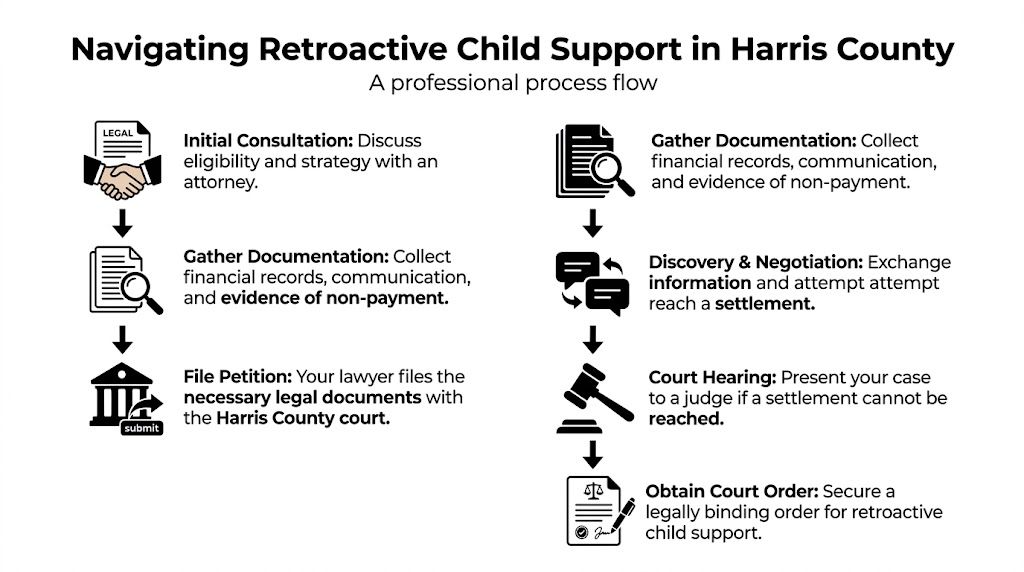
Navigating the Harris County Process Step by Step
A retroactive support case in Harris County moves in stages. Some are predictable. Others depend on how prepared you are before filing.
Start with legal parentage
If paternity is already established, the case can move to support issues more directly.
If not, that usually becomes the first major task. In local practice, this can affect every deadline and every negotiation. A parent may know who the father is. The court still needs legally recognized proof before entering support orders tied to that parent.
That’s why early case review matters. Parents who prepare records, birth documentation, prior communications, and identification details at the start usually avoid expensive detours later.
Build the evidence before you file
Many people assume they should file first and gather proof later. In a clean uncontested matter, that might be manageable. In a disputed retroactive support case, it often creates problems.
A stronger approach is to gather the core file first:
- Income proof such as pay information, tax-related records, business records, or anything showing the other parent’s resources over the earlier time period.
- Child expense records including medical bills, insurance costs, childcare expenses, school-related payments, and recurring household costs tied to the child.
- Communication history like texts, emails, letters, or social media messages showing knowledge of the child or requests for support.
- Timeline documents that help place events in order, especially periods of contact, absence, relocation, or attempted support discussions.
If your file is a stack of screenshots and loose PDFs, careful organization matters. Even outside formal litigation strategy, parents often benefit from understanding what legal document review involves, because a case is only as persuasive as the records you can sort, verify, and present clearly.
Weak facts don’t become strong because they’re filed in court. They become usable when dates, records, and legal theories line up.
File the right petition in the right posture
Once the legal theory is clear and the documents are organized, the petition gets filed through the Harris County court system. This sounds routine, but it’s one of the places where small mistakes create large delays.
The petition needs to match the actual case posture. Is this a paternity matter with support attached? A SAPCR issue involving a child born outside marriage? A divorce-related support question where earlier support was never ordered? The facts determine the pleading.
Service is next. If the other parent is hard to find, evasive, or living elsewhere, that issue needs immediate attention rather than hopeful waiting.
Expect delay and plan around it
One practical reality for families in Atascocita is that local scheduling can be slow. Due to increased caseloads, Harris County family courts are facing significant backlogs, with hearing timelines for retroactive support cases averaging 9-12 months, up from 6 months in 2024, according to this discussion of retroactive child support delays in Harris County.
That delay changes strategy.
A lawyer handling these cases well won’t just “set it and forget it.” They’ll use the waiting period to tighten financial proof, answer discovery thoroughly, prepare for mediation if appropriate, and keep the record current.
What usually helps during the middle phase
This period determines the strength or weakness of many cases.
Three things tend to help:
Consistent financial disclosure
If you’re asking the court to look backward, your own records should be clean and complete.Specific requests
General complaints about unfairness don’t move cases. Specific requests tied to statutory grounds do.Preparation for settlement and hearing
Some cases resolve by agreement. Others need a judge. Good preparation serves both paths.
Local reality in Atascocita and Humble cases
Parents from Atascocita and Humble often assume their case will stay close to home in a simple way. In practice, these family law matters are handled through the broader Harris County court structure, which means the process can feel more complex than expected.
That’s where local familiarity matters. Not because it changes the law, but because it changes how efficiently the case is assembled, filed, and pushed forward.
A practical retroactive child support lawyer Atascocita parents hire should be honest about that. The process is manageable, but it works best when every step is deliberate.
How Texas Calculates Retroactive Child Support Payments
Judges don’t guess at a number. They use the Texas child support framework and then apply it to the earlier period at issue.
For retroactive support, the court looks at the noncustodial parent’s historical net resources during the time support should have been paid. Texas law calculates support based on a percentage of those net resources, and as of September 1, 2025, those guideline calculations apply to net resources up to $11,700 per month, as explained in this overview of Texas child support calculation rules.
The baseline guideline percentages
The standard percentages under §154.125 are straightforward:
| Texas Standard Child Support Guidelines | Percentage of Net Resources |
|---|---|
| One child | 20% |
| Two children | 25% |
| Three children | 30% |
| Four children | 35% |
| Five or more children | 40% |
That table gives the starting point, not always the final result.
What that means in real cases
If the parent’s income changed over time, the court may need to examine different periods rather than treating the whole past as one flat number.
That’s one reason retroactive support cases can become document-heavy. A parent who worked hourly for part of the period, then switched jobs, then had self-employment income, creates a more complicated historical calculation than a parent with one stable salary the entire time.
Key takeaway: The most persuasive support calculation is usually the one tied to actual records from the relevant period, not a rough estimate based on current earnings.
The cap and higher-income issues
The $11,700 cap matters most in higher-income cases. It tells the court where the standard guideline formula stops for ordinary calculation purposes.
That doesn’t mean the child’s actual needs disappear above that point. Courts can deviate when the standard amount would be unjust or inappropriate, and Texas law allows consideration of factors such as medical needs, education, insurance costs, and parenting arrangements when deciding whether deviation is appropriate.
Other costs that shape the final order
Parents often focus only on the monthly support amount. That’s too narrow.
A complete order may also address:
- Medical support
- Dental coverage
- Health insurance responsibility
- Daycare or necessary childcare issues
- Other child-specific proven needs
Those points matter because a strong retroactive support case should fit the child’s real life, not just a spreadsheet.
For parents trying to understand how guideline support works in a broader sense, this page on child support how much gives useful background on the Texas framework.
Enforcement and Overcoming Common Hurdles
A parent in Atascocita finally gets a support order after months of filings, service attempts, and court resets in Harris County. Then the payments still do not come. That is the point where many families feel stuck, but it is also where careful enforcement work starts to matter.

Texas courts have real enforcement tools. A support obligation can be reduced to judgment, wage withholding can be used, and a parent who ignores court orders can face serious consequences. In practice, those remedies work best when the order is precise and the payment history is documented in a way the court can act on quickly.
The order has to be built for enforcement
An order should say exactly what is owed, when it is due, and how it must be paid. That level of detail matters more than many parents realize. In Harris County, where dockets are busy and judges do not have time to sort through vague agreements, unclear wording often turns a valid complaint into a longer and more expensive enforcement fight.
Agreed orders deserve special care. Parents sometimes sign broad language just to end the dispute, then learn later that the missed-payment terms are too fuzzy to enforce cleanly.
If the issue is already unpaid support under an existing order, the case may be less about retroactive support and more about collecting arrears. This overview of a child support arrears attorney in Atascocita TX can help clarify when arrears enforcement becomes the primary focus.
Age, timing, and proof can change the case
Parents often ask what happens if the child is already 18.
That timing can narrow the available options. Texas law places limits on post-18 retroactive support claims, and these cases usually turn on prompt filing, careful pleading, and proof that the other parent knew about the child and avoided responsibility. Delay is costly here, especially if paternity was never formally established or the other parent has moved around the Houston area and is harder to serve.
Local facts matter. A case involving an acknowledged father with payroll records is very different from one involving disputed paternity, cash work, or years of inconsistent contact. Statewide guides often gloss over that difference. Harris County courts do not.
What usually helps in these harder cases:
- Filing as soon as the problem is identified
- Clear proof of paternity, notice, or prior involvement
- Income records from the relevant years, not just current earnings
- A clean timeline of support requests, payments, and missed obligations
- Accurate service on the other parent, especially if he has relocated or is avoiding contact
Here’s a practical overview that helps explain how enforcement issues can unfold in family court:
Common hurdles that slow down enforcement
Some cases are legally strong but get bogged down by avoidable problems.
Informal payments with no paper trail
Cash, gifts, school purchases, or help with rent often lead to disputes over credit. Courts prefer records.Weak service efforts
If the other parent is difficult to find, that issue needs a direct plan. Delays in service can stall the whole case, especially in a crowded county system.Incomplete paternity work
If paternity is still disputed, enforcement may have to wait until that issue is resolved. In local practice, that can add time and require a tighter evidence file than parents expect.Requests that are too broad
Judges respond better to a payment ledger, tax returns, bank records, and message history than to general accusations that someone "never helped."Orders that leave room for argument
Vague due dates, unclear medical support terms, and loose repayment language create enforcement problems later.
One practical truth comes up again and again. Difficult facts can be managed. Missing records are harder to fix.
For families in Atascocita, Humble, and the surrounding Harris County area, the strongest enforcement strategy is usually the one built around proof, local procedure, and patience with the court’s pace. Pressure helps only when it is tied to an order the judge can enforce.
Your Partner in Atascocita for Family Law Matters
Retroactive child support cases sit at the intersection of law, paperwork, timing, and real family pressure. Parents often come into these matters carrying years of unpaid expenses and uncertainty about whether the system can still help.
It can. But the cases that move forward well usually have three things in common. The legal theory is correct. The evidence is organized. The filing strategy accounts for the practicalities of Harris County practice.
That’s especially true in Atascocita, Humble, and surrounding communities where parents may be balancing work, school schedules, and childcare while trying to pursue a case through a busy court system. Having a practical plan matters more than having a loud one.
A good retroactive child support lawyer Atascocita families choose should bring both legal precision and local perspective. That means understanding paternity issues, drafting enforceable requests, preparing for backlog-related delay, and keeping the focus where it belongs, on the child’s support and stability.
If you’re wondering whether you have a claim, don’t assume it’s too late and don’t assume the facts are too messy to sort out. Many cases become clearer once the timeline, communication history, and financial records are reviewed together.
You don’t have to carry the legal burden the same way you’ve been carrying the financial one.
If you need guidance on retroactive child support, paternity, enforcement, or any related family law issue, schedule a free consultation with Law Office of Bryan Fagan – Atascocita TX Lawyers. Our team helps families in Atascocita, Humble, and across northeast Harris County take clear, informed next steps with compassionate local support.


