Skip to content
If you're raising a child in Atascocita or Humble, you already know how fast life changes. A support order that made sense a few years ago can feel badly out of date when school costs rise, healthcare needs change, or the other parent's income has clearly gone up.
A lot of parents hesitate to ask for more support because they don't want more conflict. I think that's the wrong mindset. If your child needs more and the facts support it, asking for an increase isn't picking a fight. It's asking the court to update an old order so it reflects real life.
The hard part usually isn't deciding to act. It's proving the increase should happen, filing the right paperwork in Harris County, and avoiding mistakes that slow the case down. That's where a smart plan matters.
Your Guide to Increasing Child Support in Atascocita
You may be in a familiar spot. Your child is older now. Expenses that used to be manageable have multiplied. Maybe you're paying more for insurance, tutoring, childcare, or recurring medical care. Maybe you've learned the other parent got a better job in the Houston area, started earning commissions, or receives bonuses that never existed when the current order was signed.
That situation frustrates people for good reason. The bills are current. The support order isn't. And if you wait too long, the gap between what your child needs and what the order provides can get wider.
What parents in Atascocita should do first
Start with paperwork, not arguments. Before you confront the other parent, gather what you already have.
- Pull your current order. Read the amount, the signing date, and any medical support terms.
- List what's changed. Income growth, insurance changes, school-related costs, or a different parenting schedule all matter.
- Collect records. Save receipts, account summaries, school invoices, and anything showing the child's current needs.
- Stay formal. Don't rely on side agreements or text-message promises.
- Talk with a lawyer early. A modification case is easier to build when the evidence is organized from the beginning.
A child support increase case is strongest when the facts are documented before the filing starts.
Why this issue deserves immediate attention
Parents often search for an increase child support attorney atascocita because most online guidance talks about reducing support, not raising it. That's backwards. In many households, the bigger problem is that the paying parent's financial picture improved while the child's support stayed frozen.
Texas law gives you a path to fix that. Harris County courts deal with these requests regularly. The question isn't whether an increase is possible in the abstract. The key question is whether your facts fit the legal standard and whether you can prove them cleanly.
Understanding the Grounds for a Child Support Increase in Texas
Texas doesn't let parents rewrite support orders just because one side feels the amount is unfair. You need a legal basis. In plain English, there are two main paths.
Under Texas Family Code §156.401, a child support order may be modified if there's a material and substantial change in circumstances, or if three years have passed and the recipient would be entitled to an increase of more than 20% or $100, based on current net resources. That standard is summarized in this discussion of Texas child support modification rules.
Material and substantial change means something meaningful in the family's financial or parenting reality has changed since the current order was entered.
The first path is a real change in circumstances
This is the ground most parents use when asking for more support.
A few common examples fit this category:
- Higher income for the paying parent. A promotion, better job, larger commissions, or increased self-employment income may support a request for higher support.
- Higher child-related expenses. If your child's healthcare, therapy, tutoring, or day-to-day needs have grown, that matters.
- Insurance changes. If coverage costs changed or new medical expenses started falling on your household, that can matter too.
- Custody and schedule shifts. A parenting arrangement that looks different from the original order may affect how support should be reviewed.
Texas calculates support using a net resources framework. If you want a plain-language starting point for that calculation, review this guide on how much child support may apply under Texas law.
The second path is the three-year rule
This path is simpler, but only if the timing and numbers line up.
If three years have passed since the order was rendered or last modified, and current guideline support would differ by more than 20% or $100, the court may consider a modification.
Parents sometimes miss this because they assume they need a dramatic event. They don't always. Sometimes the passage of time plus updated income figures is enough to justify a review.
What counts as net resources
The statute looks at current net resources, including categories such as wages, commissions, self-employment income, and rentals, as described in the same Bryan Fagan discussion of §154.062 and §156.401. That matters in increase cases because the other parent's paycheck may not tell the full story.
If the paying parent's income has become more complicated, don't make the mistake of looking only at base salary. A support order can become outdated when someone starts earning commissions, side income, or rental income after the original case.
What this means in practice for Atascocita families
Parents in northeast Harris County often know something changed long before they know how to prove it. You may hear the other parent changed employers, moved into a higher-paying role, or started talking about bonuses and travel that weren't part of life before. That's not enough by itself. Courts want records.
Use this standard as your filter:
| Question | Why it matters |
|---|---|
| Has the other parent's income gone up in a meaningful way | That may support a material and substantial change |
| Have your child's needs become more expensive | The court wants proof of current needs |
| Has it been at least three years since the last order | You may qualify under the separate timing rule |
| Can you document the change | Evidence decides these cases |
Don't wait for the situation to become unmanageable
Modification cases don't finish overnight. The same Bryan Fagan source notes that these cases typically take at least six months to finalize. That's one reason delay hurts parents seeking an increase. If you already suspect the order no longer matches reality, start building the case now.
Gathering Essential Evidence for Your Harris County Case
A child support increase case rises or falls on documents. Not assumptions. Not neighborhood gossip. Not what your child told you the other parent bought last weekend.
Texas courts focus on evidence under the net resources framework, and successful modification requests often rely on records such as insurance premiums, childcare receipts, medical records, and tutoring costs to show the child's present needs and best interests, especially when support would deviate by more than 20%. That standard is summarized in this explanation of Atascocita child support modification evidence.
Start with proof of the other parent's income
Your goal is to show the court what the paying parent earns now, not what they earned when the order was signed.
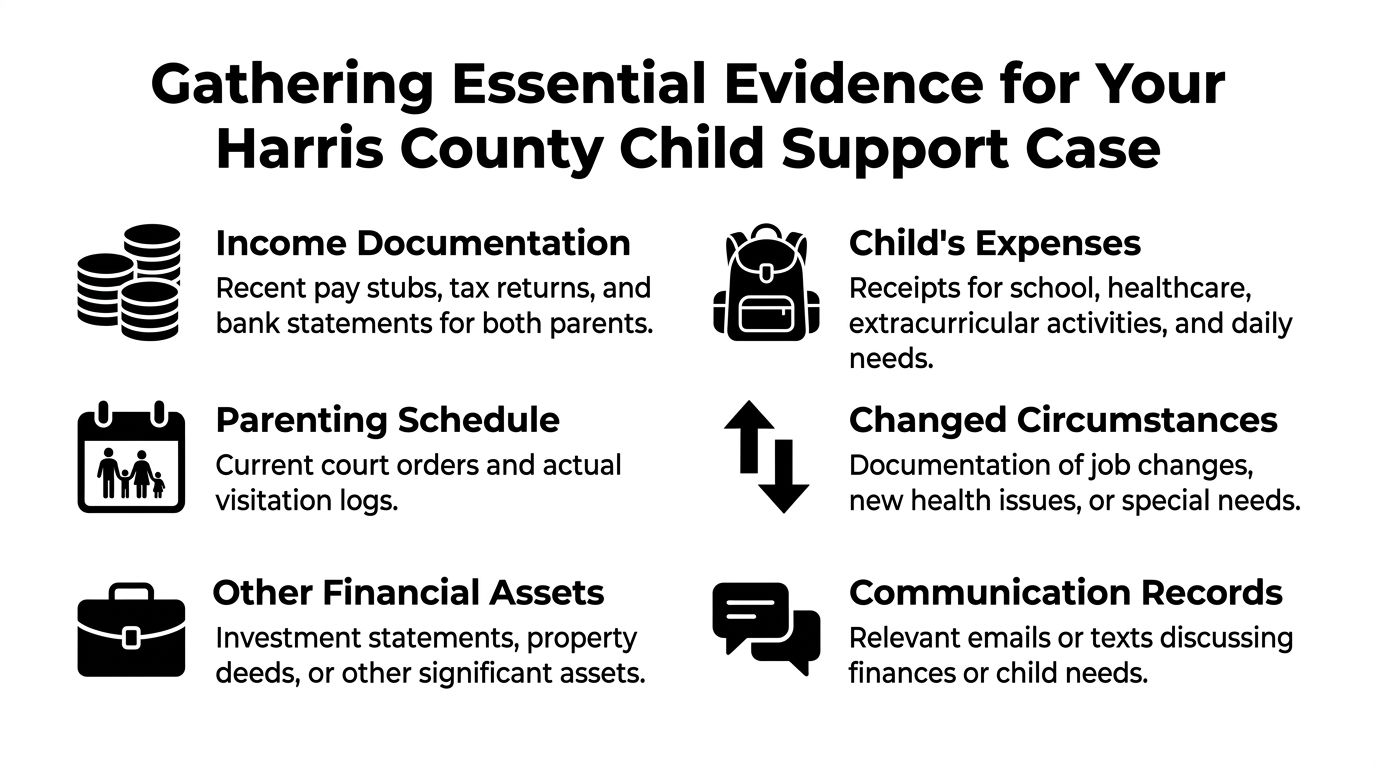
Look for these records first:
- Recent pay stubs: These can show salary changes, overtime, commissions, and recurring deductions.
- Tax returns and W-2s: These help compare current annual earnings to older income levels.
- Bonus records: If compensation now includes bonuses, gather any statements, employer emails, or bank deposits reflecting them.
- Self-employment records: If the other parent owns a business or works contract jobs, account deposits and business records may matter.
- Rental income information: If they receive rental income, that can be relevant to net resources.
If you already have PDF statements and need to sort transactions quickly, a practical tool for processing bank statements can help you organize deposits before you hand records to counsel.
Courts don't reward vague suspicions. They respond to organized proof.
Then build the file on your child's current needs
A lot of parents focus only on the other parent's pay increase. That's half the case. You also need to show what your child needs now.
Useful records often include:
- Insurance premiums: Health, dental, vision, and any changes in what you pay.
- Childcare receipts: Before-school care, after-school care, summer care, or regular sitter expenses tied to work.
- Medical records: Ongoing treatment, therapy, prescriptions, or specialist care.
- Tutoring invoices: Especially where a child needs academic support.
- School-related costs: Required fees, activity expenses, and supplies.
- Receipts for recurring needs: Not every expense matters equally, but a pattern of regular child-related spending matters.
Include parenting and communication records
This category gets ignored too often.
Bring these into your file:
- The current court order
- Any later signed orders
- Visitation logs if the actual schedule differs from the written one
- Emails or texts discussing the child's expenses
- Messages where the other parent mentions a raise, promotion, or bonus
A clean timeline helps. If a promotion happened after the order, note when. If a medical issue started later, note that too. Judges appreciate chronology because it shows the change isn't random or invented.
Organize the evidence the way a court will read it
Don't show up with a grocery bag of papers.
Use a simple folder system:
| Folder | What goes inside |
|---|---|
| Income evidence | Pay stubs, tax records, bonus proof, deposits |
| Child expenses | Medical bills, insurance, tutoring, childcare |
| Orders and filings | Existing support order, custody orders, prior modifications |
| Communications | Relevant emails, texts, written discussions |
| Timeline | A dated summary of major changes |
A practical rule for parents in Humble and Atascocita
Practical rule: If a document helps answer "what changed, when did it change, and how does it affect support," keep it.
You don't need to become your own forensic accountant. You do need to become disciplined. In Harris County, organized evidence makes your attorney's job easier and makes your request easier for the court to trust.
Navigating the Modification Process Timelines and Options
Once your records are in order, the next issue is process. Most parents want the same answer: how long will this take, what will it cost, and do I have to go to court?
In Harris County, a child support modification can take 4-8 months because of docket backlogs, and filing fees are around $300-500. For uncontested increases, the in-office Child Support Review Process can cut that time by up to 40%. Those details appear in this discussion of Texas child support modification timing and costs.
The court route
The traditional path starts with filing a petition in the county where the existing order was entered. For many Atascocita families, that means dealing directly with Harris County procedures.
The court route usually makes sense when:
- The other parent disputes income
- You suspect hidden earnings
- The facts are contested
- You need formal discovery tools
- Settlement efforts have already failed
If you have a pending setting or need to understand the next appearance, this page on a child support court date in Atascocita Texas is a useful companion.
The Child Support Review Process
The Child Support Review Process, often called CSRP, is an administrative option through the Office of the Attorney General. It's often overlooked, especially by parents who assume every increase request requires a full courtroom fight.
CSRP tends to work better when both sides are willing to exchange income information and the requested increase is mostly about updated numbers rather than a factual battle.
Here's a side-by-side view:
| Option | Best fit | Main drawback |
|---|---|---|
| Court petition | Disputed cases, hidden income issues, complex evidence | Slower and more formal |
| CSRP | Uncontested or relatively straightforward increases | Less effective when facts are heavily disputed |
A quick overview may help before you decide which path fits your case:
What usually happens after filing
The process often looks like this:
- Petition filed
- Other parent served
- Financial information exchanged
- Negotiation, review conference, or hearing set
- Agreed order or judge's ruling
- New order signed
That sequence sounds simple. It isn't always simple in practice. Delay usually comes from incomplete records, service problems, or disputes over what the paying parent earns.
My recommendation for Atascocita parents
If your case is straightforward and both parents are transparent, explore CSRP. If the other parent minimizes income, stalls, or has compensation beyond a normal paycheck, use the court process and prepare for a more evidence-heavy case.
The biggest mistake is filing without a plan. A weak filing doesn't pressure the other side. It just gives them time.
How an Atascocita Attorney Strengthens Your Request
A lot of people assume a child support increase case is just math. It isn't. It's math plus proof, procedure, local practice, and pressure.
That's why hiring an increase child support attorney atascocita is often the practical move, not a luxury. One source focused on Atascocita modification strategy notes that self-represented increase cases succeed only 22% of the time, compared with 78% when a lawyer is involved, especially where hidden income from bonuses or side work is an issue. That comparison appears in this discussion of Atascocita post-decree child support increase strategy.
Hidden income is where cases get difficult

Some parents are easy to evaluate. They work a salary job, get paid twice a month, and the pay stubs tell the story.
Others don't.
You may be dealing with someone who gets:
- Bonuses that fluctuate
- Commissions not obvious from one paycheck
- Cash-based side income
- Contract or consulting payments
- Business income mixed with personal spending
An attorney can push the case beyond surface-level records. That may mean formal discovery, subpoenas, or a tighter analysis of bank deposits and tax materials. Without that pressure, many income increases stay hidden behind incomplete disclosures.
When the other parent's financial story doesn't match their lifestyle, your case needs investigation, not guesswork.
Lawyers also solve the procedural problems that sink good claims
Even strong facts can get wasted if the paperwork is sloppy.
A lawyer helps by:
- Drafting the petition correctly
- Identifying the right legal ground for the increase
- Matching the evidence to the statute
- Preparing affidavits and exhibits in a usable format
- Making sure proposed orders solve the problem
Local experience matters here. Harris County family courts expect clarity. Judges don't want a pile of unsorted receipts and a general complaint that "everything costs more now." They want a persuasive record.
Negotiation works better when the case is ready for hearing
Many cases settle before a contested hearing. But settlement happens because one side realizes the other side is prepared.
A prepared attorney changes the dynamic by doing three things well:
| Attorney task | Why it matters |
|---|---|
| Builds a clean financial record | Makes it harder for the other parent to deny the obvious |
| Pushes for disclosure | Forces missing income issues into the open |
| Frames the case around the child | Keeps the focus where the court wants it |
If you're evaluating legal help, one option is the Law Office of Bryan Fagan – Atascocita TX Lawyers, which handles family law matters involving support, custody, and post-decree modifications for local families. The important point isn't branding. It's whether your lawyer knows how to turn changing finances into admissible proof.
My blunt advice
If the other parent's income is simple and fully disclosed, some parents can start the process on their own. If you're trying to prove increased earnings from bonuses, side gigs, business income, or inconsistent payroll records, don't wing it.
You're not just asking for more money. You're asking a court to sign a new enforceable order. That deserves real preparation.
Securing Your Child's Future After the Order Is Signed
Getting the new order signed isn't the end of the job. It's the point where enforcement and follow-through start to matter.
Two issues come up again and again. First, what do you do while the case is still pending if money is already tight? Second, what do you do if the other parent ignores the new amount after the judge signs it?
Temporary relief while the case is pending
A modification case can move slowly. That's why temporary orders matter.
Temporary orders can help create structure while the larger case is still being decided. If the household budget is already strained because the current support amount no longer fits your child's needs, ask your attorney whether temporary relief is appropriate in your case.
Focus on immediate, documented needs:
- Medical costs that can't wait
- Childcare tied to your work schedule
- Education-related expenses
- Insurance obligations currently falling on one parent
Bring current records. Judges respond better to present-tense proof than broad complaints about financial stress.
The strongest request for temporary relief is tied to a concrete child expense, not a general feeling that the old order is unfair.
Enforcement after the increase is granted
A signed order only works if it's followed.
If the paying parent falls behind after the increase, act quickly. Don't let missed payments pile up while you hope the problem fixes itself. An enforcement case can ask the court to require compliance with the order, and in many cases wage withholding is part of keeping payments consistent.
If you need to understand the next legal step, this page on an Atascocita child support enforcement lawyer is a useful place to start.
What parents should do immediately after the new order
Keep this part simple and disciplined.
- Get a file-stamped copy of the signed order
- Review the amount and effective date carefully
- Track every payment from the first due date forward
- Save proof of any missed or partial payments
- Report problems to your attorney early
Don't rely on memory. Use a calendar, payment log, or dedicated folder. Enforcement cases become much easier when the records are clean.
One final point most parents need to hear
Don't accept an outdated support order because you're tired of the legal system. That decision usually shifts the burden to the parent who's already covering the gap.
If your child's needs have grown and the other parent's ability to pay has grown too, pursuing a lawful increase is the right move. It's measured. It's responsible. And for many families in Atascocita, Humble, and northeast Harris County, it's necessary.
If you're considering a child support increase and want direct guidance on your specific facts, contact Law Office of Bryan Fagan – Atascocita TX Lawyers to schedule a free consultation at the Atascocita office. A local attorney can review your current order, identify the strongest basis for modification, and help you move forward with a clear plan.