Skip to content

A lot of parents in Atascocita call a lawyer only after they’ve spent weeks trying to stretch an impossible budget. The paycheck dropped. Overtime disappeared. A layoff hit the plant, the field, the shop, or the office. But the child support order stayed exactly the same.
That mismatch creates panic fast. Rent is due. Insurance premiums don’t wait. Gas, groceries, and school costs keep moving. If you’re in Humble or northeast Harris County and you’re staring at a support amount you cannot keep paying, you’re not alone, and you’re not stuck.
Texas law gives parents a legal path to ask the court for relief when life has changed in a real and meaningful way. That process is called a child support modification. It is not a shortcut, and it is not a way to avoid supporting your child. It is a formal request to bring a court order back into line with current reality.
A good reduce child support lawyer atascocita residents can turn to will focus on two things right away. First, whether you likely qualify. Second, how to prove it in a way a Harris County judge can trust.
Life Changes and Your Child Support Order Can Too
One common story around Atascocita looks like this. A parent has worked steadily for years, often in a field tied to energy, construction, transportation, or another industry where income can swing hard. Then hours are cut, a contract ends, or a position disappears. The parent wants to keep doing right by the child, but the old support amount no longer matches the new paycheck.
That parent usually asks the same question. “What am I supposed to do until I catch up?”
Texas courts won’t change a child support order just because paying it feels harder. But they can modify an order when the facts support it. That matters for families in Atascocita, Humble, and surrounding parts of Harris County, where household finances can change quickly and unexpectedly.

What this process really is
A modification case asks the court to review the existing order and decide whether the support amount should change going forward. The court still centers the child’s best interest. That never goes away.
What does change is the court’s willingness to recognize that parents are human. Jobs change. Health changes. Housing costs change. Parenting schedules sometimes change too.
A support order should reflect real ability to pay, not a version of your life that no longer exists.
What usually works and what usually doesn’t
Some choices help. Others create bigger problems.
- What helps: filing promptly after a serious income change, keeping clean records, and treating the process like a proof case instead of a personal plea.
- What hurts: waiting too long, relying on verbal agreements, or assuming the judge will “understand” without documents.
- What creates risk: making partial payments based on your own math before the court signs a new order.
Parents often feel embarrassed about asking for a reduction. They shouldn’t. If your circumstances changed, the legal system has a process for that. The key is handling it the right way in Harris County.
Do You Qualify to Reduce Child Support in Texas
Qualifying starts with one central question. Has something important changed since the last order?
Under Texas Family Code §156.401, courts typically require the new proposed child support obligation to decrease by at least $100 per month or 20% from the current order. A drop from $1,000 to $800 is one example that can meet that threshold, and one cited source notes that well-documented cases with local counsel familiar with Harris County benches have 50 to 65% success rates, compared with less than 30% for people who file without a lawyer (YouTube discussion of Texas child support modification standards).
The plain English version of the rule
Lawyers and judges often say material and substantial change in circumstances. In everyday terms, that means a change serious enough that the current order no longer fits the facts.
That could include:
- Involuntary job loss: You were laid off or your position was eliminated.
- Permanent pay reduction: Your income dropped and it’s not just a short-term dip.
- Health problems affecting work: A disability or medical condition changed your earning ability.
- A major parenting change: The child is spending substantially different time with a parent, or the child’s primary residence changed.
A temporary inconvenience usually isn’t enough on its own. A brief slowdown in commissions or a short unpaid period between jobs may not persuade the court unless the larger picture shows lasting change.
The three-year review path
Some parents qualify even without one dramatic event. Texas law also allows review when enough time has passed and the guideline amount would come out materially different from the current order.
People often misjudge their position at this stage. They assume they have no case because there was no layoff, no injury, no headline event. Sometimes the numbers alone justify looking closer.
If you’re trying to estimate whether your current order still lines up with the guidelines, this overview of Texas child support calculations is a useful starting point.
Practical rule: The court cares less about the story you tell than the change you can prove.
Situations that deserve a careful review
If any of these sound familiar, it’s worth having your order reviewed:
| Situation | Why it may matter |
|---|---|
| Layoff or reduced hours | It may affect your ability to pay under the current order |
| Shift from salary to inconsistent contract income | The court will want to see whether the reduction is real and ongoing |
| Medical event limiting work | It may support a modification if it changed earning capacity |
| Child now living with you more often | Parenting changes can affect support analysis |
Voluntarily leaving a good-paying job is different. Courts look closely at whether a parent caused the income drop. If the reduction was by choice, the judge may be skeptical.
Gathering the Right Evidence for Harris County Courts
Most child support reduction cases are won or lost on paperwork. Not passion. Not frustration. Not fairness in the abstract.
That’s especially true because one source states that Harris County courts processed over 15,000 family law modifications in 2025, and 40% of petitions failed due to insufficient evidence (discussion of modification evidence requirements). That number tells you exactly how judges see these cases. They are not looking for broad claims. They are looking for proof.
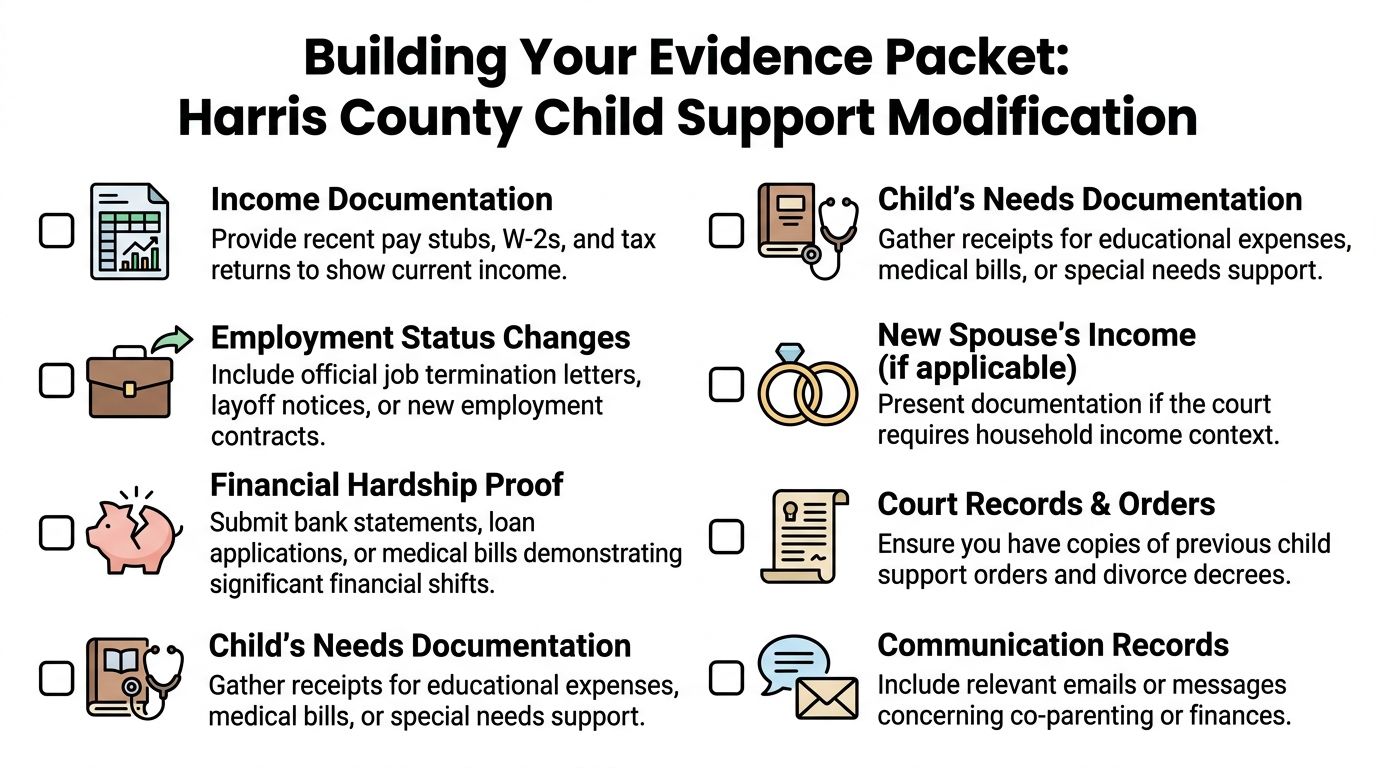
Build a file that answers the judge’s real questions
A Harris County judge is usually trying to answer a short list of practical questions:
- Did your income change?
- Was the change outside your control?
- Is the change likely to last?
- Are you presenting complete, reliable records?
- Is the new amount consistent with Texas law?
Your evidence packet should answer those questions directly.
The documents that carry the most weight
Some records matter more than others.
- Recent pay stubs and prior pay stubs: These show the before-and-after picture. Judges need comparison, not just your current complaint.
- Tax returns and W-2s or 1099s: These help show longer-term earnings patterns.
- Termination letters or layoff notices: These can support that the income drop was involuntary.
- Medical records tied to work limits: If health affected employment, connect the condition to reduced earning ability.
- Bank records and financial statements: These can support cash flow problems, but they usually work best when paired with income proof.
- Job search records: If you lost work, showing active efforts to find comparable employment can matter.
If you’re sorting through your finances and aren’t sure how income is categorized, a plain-language guide to annual gross income can help you organize your records before meeting with counsel.
What parents often miss
The biggest mistake is giving the court fragments. One pay stub. A screenshot. A text to your ex saying work is slow. That won’t usually carry a case.
What helps more is a clean timeline:
- Start date of the income change
- Reason for the change
- Documents supporting that reason
- What your income was before
- What it is now
- Why the change is not temporary
Judges don't reduce support because a parent says things are tight. They reduce support when the records show a substantial, credible, and lasting change.
Organize the packet like a business file
Presentation matters. A disorganized stack of papers makes a real problem look less credible.
Try this approach:
- Section one: prior order and any later child support paperwork
- Section two: income records before the change
- Section three: income records after the change
- Section four: supporting records such as medical documents, job separation notices, or business records
- Section five: a brief written timeline
If you already know your hearing date or expect one soon, this guide to a child support court date in Atascocita can help you prepare for what the court process feels like on the ground.
Navigating the Child Support Modification Process
Once you know you likely qualify and you’ve started gathering evidence, the next question is usually simpler. “What happens now?”
In Harris County, a modification case moves through a sequence. It isn’t mysterious, but it does require precision.
The basic path through the court system
The case usually starts with a petition to modify the parent-child relationship. That filing tells the court what changed and what relief you’re asking for.
Then the other parent must be properly served, unless service is formally waived in a legally acceptable way. If service is mishandled, the case can stall before it really begins.
After that, the case may involve document exchange, negotiation, mediation, temporary-hearing requests, or a final contested hearing. The path depends on whether the other side agrees, disputes the facts, or raises separate issues.
One source notes that the preparation stage alone often takes 4 to 8 weeks, and the full process from filing through final order can take 3 to 6 months in Harris County, depending on court availability and whether the case settles through mediation or remains contested (child support modification timeline in Texas).
Why mediation matters
A lot of parents think court means one dramatic hearing in front of a judge. Many family cases don’t unfold that way.
Mediation often gives both parents a chance to work from actual numbers, review documents, and negotiate a revised amount without the uncertainty of a contested courtroom fight. When both sides are realistic, mediation can reduce conflict and narrow the issues.
This overview may help if you want a visual explanation before taking the next step.
Key decision points where cases swing
Some cases strengthen as they move forward. Others weaken because of avoidable choices.
A few examples:
- Strong start: filing with a complete factual record
- Unforced error: asking for a reduction before doing the guideline math
- Strong position: entering mediation with organized proof and a realistic proposal
- Weak position: treating the hearing like a chance to vent about the co-parent
If you’re looking for local legal help with this kind of case, this page on an Atascocita child support attorney explains the kind of representation families often seek when support, custody, and enforcement issues overlap.
How a Local Atascocita Lawyer Can Help You Succeed
A child support modification looks simple from the outside. File papers. Show reduced income. Ask the judge to lower the payment.
In practice, that approach misses the hard parts. Calculations have to be right. Documents have to line up. The court has to see not just less income, but a legally meaningful change. The other parent may fight the request, question your credibility, or file a counterclaim.
Local knowledge changes how the case is prepared
A lawyer who regularly handles family law matters in Harris County tends to prepare differently than someone relying on statewide generalities.
That includes knowing how to:
- spot missing records before filing
- frame the income story in a way the court can follow
- prepare for mediation instead of assuming settlement will happen on its own
- protect against arguments that the income drop was voluntary
- watch for issues that could cause support to stay the same or even be recalculated differently
That local familiarity matters for parents in Atascocita and Humble because courtroom practice is never just about statutes on paper. Procedure, timing, and presentation all shape the outcome.
DIY filing has real trade-offs
Some parents can file on their own. That doesn’t mean they should.
A do-it-yourself approach may save legal fees at the start, but it can cost more if the case is framed poorly, the evidence packet is incomplete, or the requested amount is unsupported. A weak filing can also give the other side an advantage.
Here’s the trade-off in plain terms:
| Approach | Likely challenge |
|---|---|
| Filing alone | Harder to spot proof gaps and procedural problems |
| Hiring counsel late | Early mistakes may already be in the record |
| Working with local counsel from the start | Better chance to build a coherent, court-ready case |
The strongest modification cases usually look calm on paper. The facts are organized, the numbers are grounded, and the request is modest enough to be credible.
The lawyer’s job is bigger than paperwork
A reduce child support lawyer atascocita parents hire isn’t just filling out forms. The lawyer is also testing your case for weak spots.
That can include questions like these:
- Did you take a lower-paying job voluntarily?
- Is there any evidence your income is likely to rebound quickly?
- Has parenting time changed in a way that affects support?
- Could the other parent respond by asking for something different in return?
The Law Office of Bryan Fagan – Atascocita TX Lawyers handles family law matters including child support cases for families in this area, and their local office information is available at https://www.atascocitaattorneys.com if you want to review location and practice details.
Common risks a lawyer helps manage
Parents usually focus on one goal. Lowering the payment. The court process may raise others.
A lawyer can help you avoid:
- Counter-petitions: the other side may use your filing to raise separate support or custody concerns
- Bad timing: filing before you’ve documented the full picture
- Informal side deals: agreements that feel practical but don’t change the court order
- Overreaching requests: asking for more relief than the records support
That’s why local representation is often less about drama and more about discipline. Good cases are built carefully.
Your Questions About Child Support Reduction Answered
What if I quit my job or took a lower-paying job on purpose
That can create a serious problem. Courts often look closely at whether the income drop was voluntary. If it was, the judge may decide your earning capacity matters more than your current paycheck.
If there was a good-faith reason, the details matter. Health limits, layoffs followed by lower-paying replacement work, or a necessary career shift need documentation.
Can child support go up if I file to reduce it
Yes, that risk can exist. Once a case is opened, the court may review the broader facts. If the other parent files a response or counter-request, your financial situation and parenting facts may be examined from more than one angle.
That doesn’t mean you shouldn’t file. It means you should file carefully.
Can my ex and I agree to a lower amount ourselves
You can agree in principle, but the court order remains in effect until a judge signs a new one. Informal agreements often lead to arrears disputes later because the payment history still gets measured against the written order.
Can I get temporary relief while the case is pending
Sometimes, yes. But this is one of the most technical parts of the process.
One source states that in Harris County, 65% of urgent motions for temporary relief are denied, often because of notice problems or weak proof of immediate hardship. The same source also notes that a recent policy shift allows Atascocita-area parents with documented unemployment claims to seek expedited review, but the process requires careful handling (temporary child support relief in Atascocita).
If you need fast relief, speed alone won't win it. Precision does.
If your income dropped and you’re wondering whether action now could protect you later, that’s the right instinct. It’s much easier to review options early than to undo months of missed payments and procedural mistakes.
Taking Control of Your Financial Future in Atascocita
A child support order doesn’t have to stay frozen when your life has changed in a meaningful way. If your income dropped, your health changed, or your family circumstances no longer match the old order, Texas law gives you a structured way to ask for relief.
The key is preparation. A credible case starts with honest numbers, organized records, and a filing strategy built for Harris County practice. It also helps to move before financial pressure turns into arrears, enforcement, or decisions made out of panic.
If you live in Atascocita, Humble, or nearby northeast Harris County, treat this like a legal and financial project. Gather the records. Review the existing order. Check whether the facts show a real and lasting change. Then decide how to present the case properly.
You don’t have to guess your way through it. The process is manageable when you understand what the court needs to see and what mistakes to avoid.
If you need practical guidance on reducing child support, contact Law Office of Bryan Fagan – Atascocita TX Lawyers to schedule a free, confidential consultation at the Atascocita office. A local attorney can review your order, explain your options under Texas law, and help you take the next step with clarity.