When that envelope shows up, most parents in Atascocita have the same first reaction. Stress. Then confusion. Then a very practical question: where am I supposed to go, and what do I need to bring?
A child support court date Atascocita Texas case usually doesn't happen in a neighborhood courthouse. For families in Atascocita, Humble, and northeast Harris County, the legal process often pulls you into downtown Houston procedures, Harris County scheduling, and paperwork that can affect your finances for years. The court system expects you to keep up, even when the notice feels hard to read and life is already busy.
The good news is that this process becomes more manageable once you break it into pieces. Court date. Location. documents. hearing day. order. next steps. Each part has its own rules, and knowing those rules helps you avoid the mistakes that hurt parents most.
Your Court Notice Arrived What Happens Now
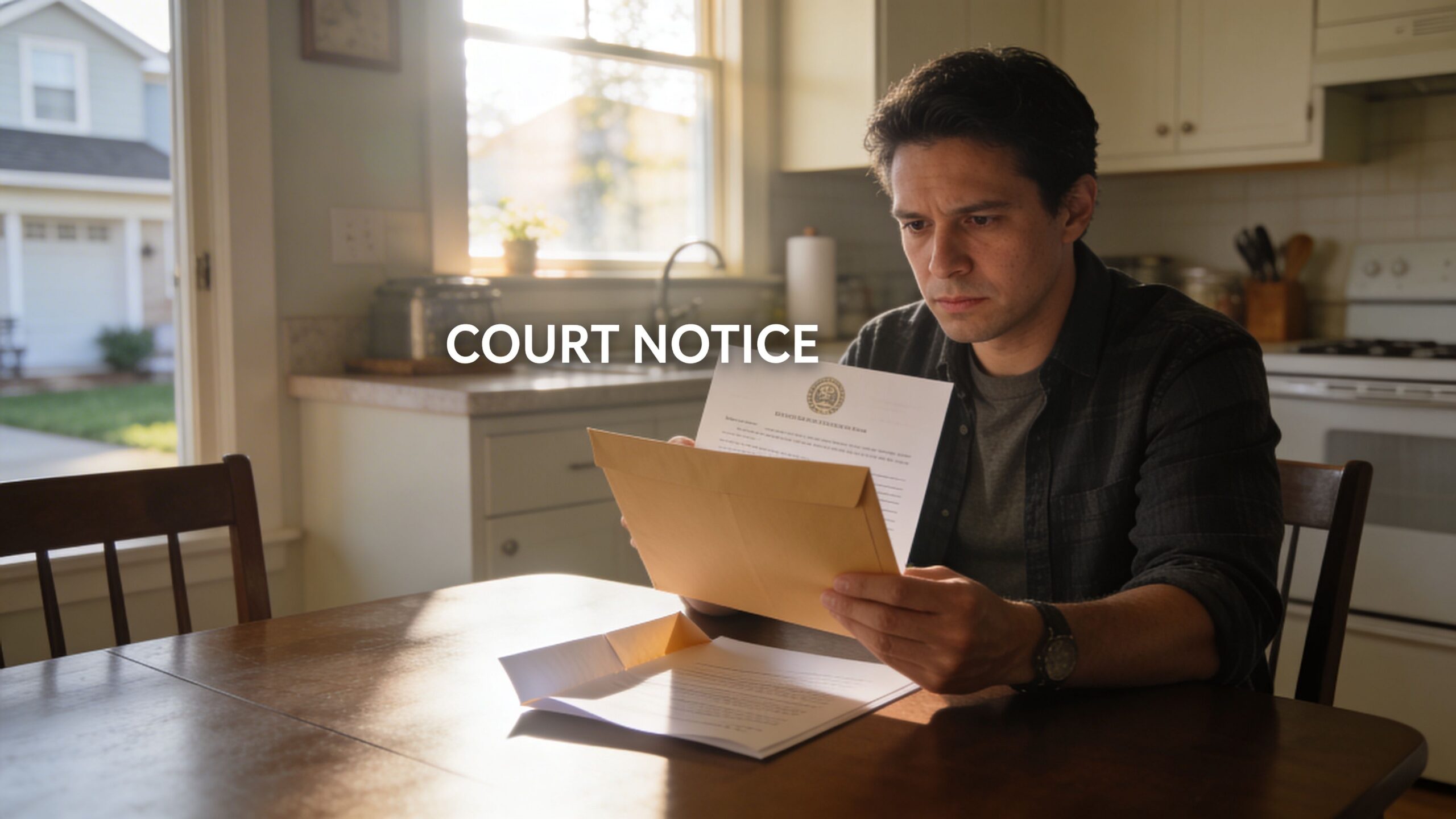
The first step is simple. Read every page of the notice slowly. Look for the case number, the date, the time, whether the setting is in person or remote, and the court name.
If anything looks unclear, don't guess. A missed hearing can create serious problems, and confusion about location is common for local families.
Confirm the court and location
For Atascocita residents, one of the biggest surprises is this: there is no local Atascocita courthouse for child support hearings. These matters are generally handled through Harris County courts in downtown Houston. The Harris County child support system also handles a large volume of cases, and delays are common. The county accounts for about 20% of Texas's 1 million+ annual child support cases, and although virtual hearings have expanded, Harris County's implementation rate was only 40% in early 2025, which means many parents still need to appear in person, according to the Harris County District Clerk child support information page.
That matters if you're coming from Atascocita or Humble. You need to plan for traffic, parking, security screening, and time to locate the right courtroom.
What to do the same day you open the notice
Use a short checklist:
- Verify the setting type: Check whether your hearing is in person, by teleconference, or by video.
- Match the case number: Make sure the notice belongs to your case and not a related matter involving custody or enforcement.
- Calendar it twice: Put it in your phone and on a paper calendar.
- Gather contact details: Keep the court name, case number, and any instructions in one place.
- Start your document folder: Don't wait until the night before.
Practical rule: If your notice doesn't make sense, treat that as a warning sign, not a small issue.
How local parents should plan for downtown court
Parents in Atascocita often underestimate the logistics more than the legal issues. Downtown court can be manageable if you build in extra time.
A workable approach looks like this:
| Task | Why it matters |
|---|---|
| Leave earlier than feels necessary | Houston traffic and parking can derail a good plan |
| Dress neatly and conservatively | The court notices professionalism |
| Bring paper copies | Phones die, portals fail, and clerks may need hard copies |
| Keep child care arranged | Court days rarely run on your exact schedule |
If your notice mentions a virtual appearance, follow the instructions exactly. Don't assume you'll be allowed to switch formats at the last minute. Courts may permit remote attendance in some settings, but many parents still need to show up physically.
When to get legal help
If your notice involves disputed income, paternity, enforcement, or a request for support that doesn't match your financial reality, that's the point to get advice. Early review often prevents avoidable errors, especially when the hearing is only days away.
Gathering Your Essential Financial Evidence
The most persuasive thing you can bring to child support court isn't an emotional speech. It's organized proof.
Courts decide support using financial information. If your numbers are incomplete, scattered, or missing, the judge may rely on what is available instead. That's how parents end up with orders that don't reflect real income, real insurance costs, or real child-related expenses.
The core documents the court expects
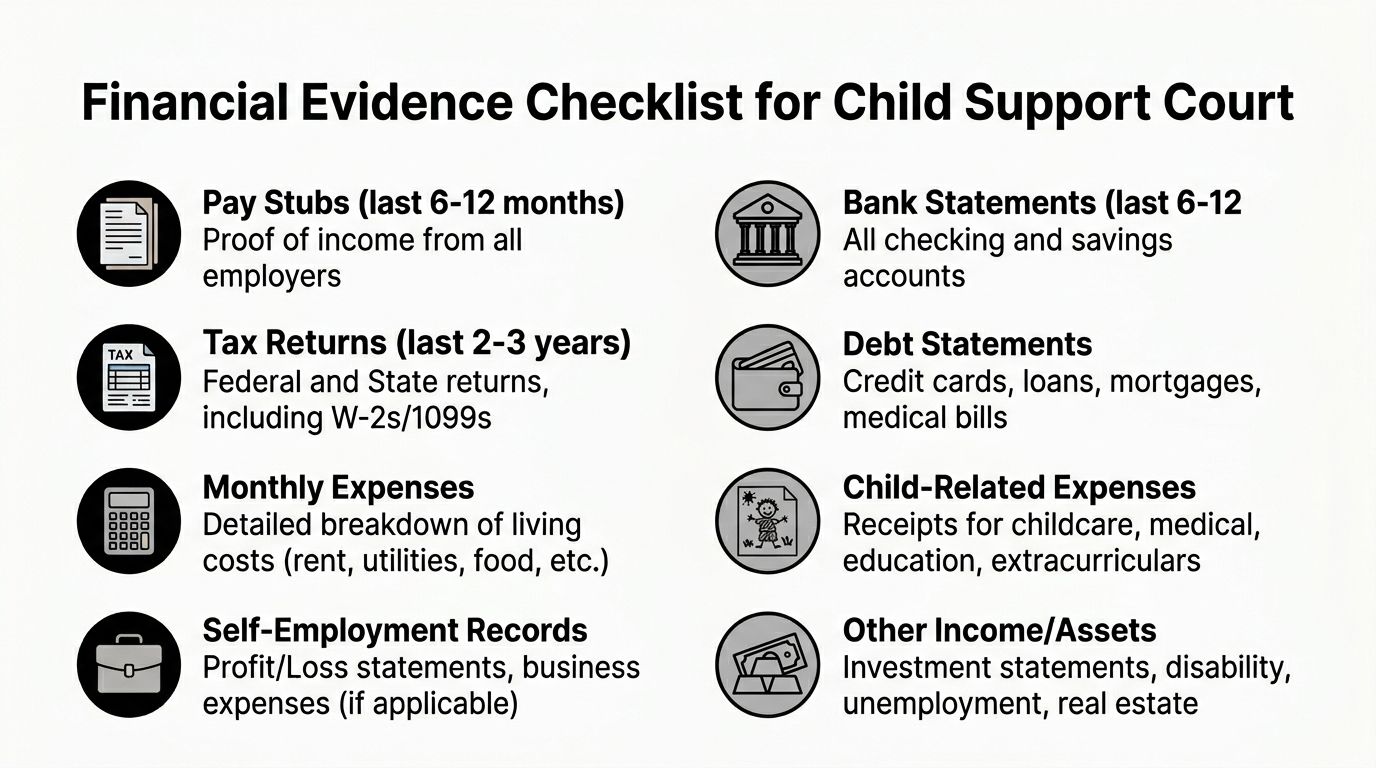
For a Texas child support hearing, you should bring organized evidence including 6-12 weeks' pay stubs, tax returns from the past 2 years, W-2s or 1099s, and health insurance proof. Many cases first go through a 60-90 minute Child Support Review Process, often called the CSRP, and if both sides reach an agreement there, the case can bypass a full hearing, as described in this overview of the Texas child support filing process.
That list sounds basic, but each item serves a different purpose.
Pay stubs
Your pay stubs show what you're earning now. They can also reveal overtime, deductions, and whether your income changes from paycheck to paycheck.
Bring the full range requested. If you only bring one recent stub, you may leave out important patterns.
Tax returns and W-2s or 1099s
These documents help the court compare current income with a longer history. That's especially important if one parent claims income has dropped, if there is self-employment, or if earnings vary during the year.
Health insurance proof
If you're paying for the child's health or dental coverage, that needs documentation. Verbal claims don't carry the same weight as premium statements or employer benefit records.
Childcare and child-related expense records
If you're asking the court to consider work-related childcare or unusual child expenses, bring receipts, invoices, and payment records. The clearer your file, the easier it is to present.
What works and what doesn't
I've seen the same pattern again and again in Harris County matters. Parents who walk in with a labeled folder usually present better than parents who show up with screenshots, loose mail, and memory.
What tends to work:
- A single organized packet: One section for income, one for taxes, one for insurance, one for child expenses
- Clean copies: Easy to read, not crumpled, cropped, or partially cut off
- Chronological order: Recent documents first, with older documents behind them
- Simple summaries: A one-page note listing what each document proves
What usually doesn't work:
- Phone-only evidence: Not every courtroom is patient with scrolling through apps
- Incomplete records: Half a tax return is often treated like no tax return
- Last-minute printing: It raises the odds that you'll miss key pages
- Arguments without backup: Courts need proof, not just frustration
Bring your documents in a form someone else can understand in under a minute.
Make your packet easier to use
If your records are spread across separate downloads, scans, and photos, combine them before the hearing. A simple tool that helps parents combine PDF files can save time and make your evidence far easier to review.
That small step matters more than people expect. A judge or child support officer can follow a clean packet much more easily than a pile of disconnected pages.
Understand why the numbers matter
Texas uses guideline child support based on the non-custodial parent's net monthly resources. If you're trying to estimate what the court may do, this breakdown of how child support is calculated in Texas is a useful starting point.
The practical point is this: your documents shape the income figure the court uses. If the income figure is wrong, everything built on it can be wrong too.
Navigating the Day of Your Hearing in Harris County Court
A hearing day usually feels longest before it starts. You're driving in from Atascocita, checking your folder again at red lights, and wondering whether you'll get lost downtown or say the wrong thing in court.
That anxiety is normal. The key is to make the day as routine as possible.

From your car to the courtroom
Leave early enough that one delay doesn't ruin your morning. Downtown traffic, parking searches, and courthouse security all take time.
Once inside, look for the courtroom listed on your notice. Keep your documents out of your bag and ready to carry.
A common mistake is arriving on time to the building but late to the courtroom. Those aren't the same thing.
What the room usually feels like
Most parents expect a dramatic courtroom scene. Child support dockets usually feel more procedural than dramatic. There may be several cases waiting, lawyers moving in and out, clerks calling names, and a lot of quiet tension.
You may see:
- A judge or associate judge handling the docket
- An attorney for the other parent
- An attorney from the Office of the Attorney General, whose role is not to represent you personally
- Parents waiting with folders, trying to stay calm
If your matter was not resolved earlier, the hearing is where your documents and testimony matter most.
How to conduct yourself
Courtroom credibility often comes from steady behavior, not polished language.
A few rules help:
- Address the judge respectfully: Use “Your Honor.”
- Answer the question asked: Don't wander into unrelated grievances.
- Stay focused on the child and the finances: Personal history matters only when it affects the legal issue.
- Never interrupt: Even if the other side says something you disagree with.
The judge doesn't need a perfect speaker. The judge needs a parent who is prepared, clear, and credible.
The risk of showing up unprepared
Preparation changes outcomes. According to OAG data summarized in this discussion of the Texas child support court process, 40% of self-represented litigants face negative outcomes because financial documents are missing, which can lead to income overestimation. The same source notes that non-appearance often results in a default order based on 100% of guideline calculations without a chance to rebut.
Those two problems are avoidable. Show up, and bring your proof.
A practical sequence for the hearing
A hearing often unfolds in a fairly plain order:
| Stage | What you should do |
|---|---|
| Check-in | Confirm you're present and listen for your case |
| Waiting period | Stay nearby and keep your phone quiet |
| Called forward | Bring your folder, stand where directed |
| Questions from the court | Answer directly and briefly |
| Discussion of documents | Hand over the exact page that supports your point |
| Ruling or next instruction | Write it down before leaving |
Parents from Atascocita who want direct legal help with hearing preparation, evidence review, or representation can learn more about working with an Atascocita child support attorney.
Understanding Potential Outcomes and Court Orders
After the hearing, the most important question is usually this: what exactly did the judge order?
Child support orders are easier to follow when you translate them into ordinary language. The court is deciding who pays, how much, when payments start, and whether the order is temporary or final.

Guideline support in plain English
Texas uses guideline percentages based on the non-custodial parent's net monthly resources. The standard percentages are 20% for 1 child, 25% for 2, 30% for 3, 35% for 4, and 40% for 5 or more, and as of September 1, 2025, the guideline cap on net monthly resources rises to $11,700. Payments typically begin within 4-6 weeks after the judge signs the order, according to this explanation of when child support starts in Texas.
That gives the court a starting point. It is not the end of the conversation in every case.
Temporary orders and final orders
A temporary order is often used while a divorce, custody case, or parentage case is still pending. It puts rules in place during the case so the child has financial support now, not only after everything is finished.
A final order is the longer-term order entered at the conclusion of the case. That is the order people usually live under until a later modification.
When the judge may depart from the guideline amount
Courts don't have to ignore real-life complications. Under Texas Family Code §154.123, judges can depart from the standard formula when the facts justify it.
Examples may include:
- unusual medical needs
- educational expenses
- health insurance costs
- income differences between parents
- parenting arrangements that affect expenses
A fair result isn't always the same as a mechanical result.
If you believe the guideline figure doesn't fit your family, the court needs actual evidence showing why.
Retroactive support and start dates
Parents often assume support only starts after a final trial. That isn't always true. In many cases, support begins after the judge signs an order, and the obligation can tie back to an earlier stage of the case depending on what the court orders.
This is one reason delays can be expensive. Waiting to address the case usually doesn't make it disappear.
What to review before you leave
Before you walk out, make sure you understand:
- Who must pay
- When payments begin
- Whether the order is temporary or final
- How payments will be processed
- Whether any extra obligations were included, such as insurance-related duties
If any part of the ruling sounds unclear, ask your lawyer right away. Confusion after court often turns into compliance problems later.
After the Ruling What Are the Next Steps
Once the judge rules, your attention shifts from arguing the case to managing the order. That part matters just as much.
Most parents want to know two things: How will the money move, and what can be done if life changes later?
How payments are usually handled
Texas commonly routes child support through the State Disbursement Unit, and many orders are enforced through income withholding. That setup creates a payment record and reduces disputes over whether money was paid, when it was paid, and how much was paid.
If you're ordered to pay, follow the order exactly. If you're receiving support, keep your records current and monitor whether payments arrive as directed.
When a review or modification may be possible
Child support doesn't stay frozen forever. Texas law provides that child support orders can be reviewed every 3 years, and a modification can also be requested sooner if a material change would make the monthly support amount differ by at least 20% or $100 from the current order, as explained in this overview of Texas child support review timing.
That rule matters for parents in Atascocita whose work and income may shift over time. Oil and gas work, commission jobs, contract work, and self-employment can all create changes that don't fit neatly into an old order.
If payments aren't made
An order is not a suggestion. If the other parent stops paying, you may need enforcement action. Depending on the facts, enforcement can involve wage withholding, court filings, and other legal remedies.
For local guidance on missed payments and next steps, this page on an Atascocita child support enforcement lawyer explains the enforcement side of the process.
Good habits after court
A few habits save parents trouble later:
- Keep every order: Store signed copies digitally and on paper
- Track every payment: Don't rely on memory
- Update employment information when required: Small delays can create bigger disputes
- Act quickly if circumstances change: Waiting can make arrears or underpayments harder to fix
The best time to deal with a support problem is early. Once missed payments pile up or an outdated order stays in place too long, the process usually gets harder.
Common Questions About Atascocita Child Support Cases
What if the other parent and I were never married
You can still pursue child support. If parentage hasn't been legally established, paternity usually has to be addressed first. Once that issue is resolved, the court can enter child support orders and related provisions.
What if I can't afford a private attorney
Some parents start through the Office of the Attorney General process. Others use limited-scope legal help to review documents or prepare for a hearing. If you're handling much of the case yourself, organization matters even more. Many legal teams now use digital systems to manage records, timelines, and client communication, and this overview of family law software gives a helpful look at how structured case management can reduce mistakes.
The Law Office of Bryan Fagan – Atascocita TX Lawyers handles child support matters involving calculation, modification, and enforcement for families in this area.
What if I missed my court date
Act fast. Don't assume you can wait for the next notice. A missed setting can lead to orders entered without your side being heard. The sooner you respond, the more options you may have.
What if I already have an order, but it no longer fits
That may be a modification issue rather than a new support case. The details matter. A raise, job loss, insurance change, or major shift in the child's needs can all affect what should happen next.
What matters most in these cases
Parents often think the court is looking for the better story. Usually, the court is looking for the better proof, the clearer paperwork, and the parent who followed directions.
If you're dealing with a child support court date Atascocita Texas issue, don't treat it like routine paperwork. It affects your child, your monthly budget, and your legal obligations.
If you have a child support hearing coming up in Atascocita, Humble, or anywhere in Harris County, the Law Office of Bryan Fagan – Atascocita TX Lawyers can help you understand the notice, prepare your financial documents, and evaluate your next steps. Schedule a free consultation with our Atascocita office if you want clear, local guidance before your court date.