 Skip to content
A lot of parents in Atascocita find themselves in the same spot. They plug numbers into an online child support calculator, look at the result, and immediately think, “That cannot be right.”
That reaction is common when one parent earns a high salary, receives large bonuses, owns a business, or has stock-based compensation. The usual calculator gives a starting point, but it does not tell the whole story for families with more complex finances.
For many families in Atascocita, Humble, and northeast Harris County, the primary issue is not just the basic formula. The harder question is this: what does your child need to maintain a fair standard of support? That is where high-income child support cases often turn.
A search for a high income child support lawyer atascocita usually pulls up pages that stop at the cap. That leaves out the part that matters most in everyday life. Courts may look beyond the basic guideline amount when there is strong proof of the child’s needs. If you are paying support, you want that number to be fair and grounded in evidence. If you are receiving support, you want to make sure important expenses are not ignored.
When neighbors ask about this over coffee, I usually tell them the same thing. High-income child support cases feel overwhelming at first because the answer is rarely sitting in one chart. But the rules are understandable once you break them down, and the path forward becomes much clearer when you know what evidence matters.
Navigating Child Support When Income is High in Atascocita
A parent in Atascocita might work in energy, healthcare, or executive management. On paper, the income looks substantial. In daily life, though, the family may also be paying for private school, tutoring, therapy, travel sports, or ongoing medical care.
That is where confusion starts.
One parent may assume child support “maxes out” at the guideline number. The other may assume a higher income automatically means a much higher payment. Neither view is fully accurate. Texas law gives courts a framework, but in higher-income cases, the details matter.
Why standard answers often fall short
Basic child support discussions usually focus on one formula. That works for many cases, but not all of them.
In a high-income case, questions quickly become more specific:
- Is a yearly bonus part of income?
- What about commissions or stock compensation?
- Does private school count?
- Are club sports or specialized tutoring true needs, or just optional extras?
- If the child has always lived a certain lifestyle, how does the court evaluate that?
Those questions do not have one-line answers.
What families usually need most
Most parents are not looking for conflict. They want clarity.
The paying parent wants to avoid an inflated request based on assumptions. The receiving parent wants to avoid an order that looks adequate on paper but does not cover the child’s needs. In both situations, documentation becomes the center of the case.
Key takeaway: In high-income child support cases, the dispute is often less about whether support should be paid and more about how to prove what is fair.
That is why these cases deserve careful attention, especially in Harris County, where judges expect organized financial information and child-focused evidence.
The Texas Child Support Cap Explained for Harris County Parents
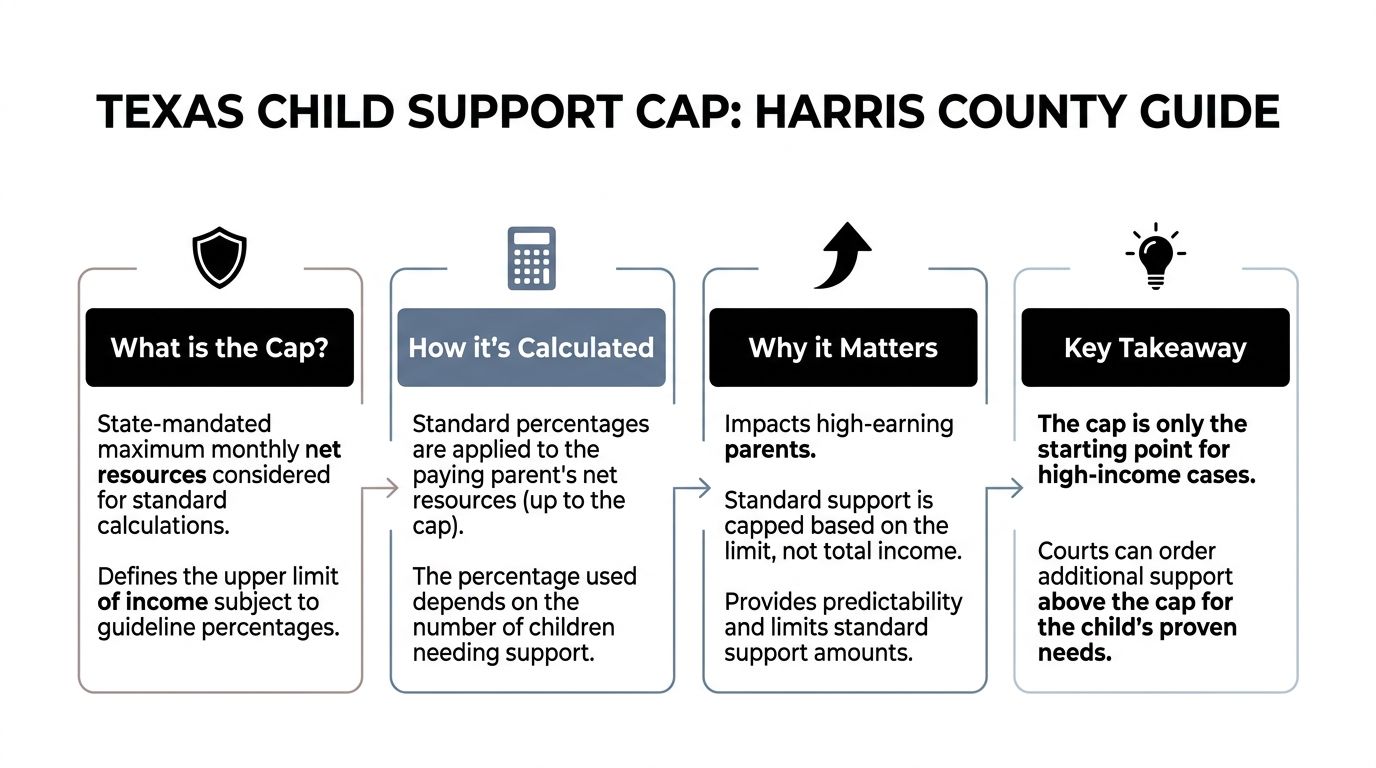
A lot of Atascocita parents hear the word "cap" and picture a hard ceiling. That is not how Texas child support works. In high-income cases, the cap is the court's starting formula for guideline support, not the final answer.
Texas begins with the paying parent's net monthly resources. The court then applies a percentage based on the number of children. As of September 1, 2025, Texas uses a maximum monthly net resources cap of $11,700, up from $9,200, as explained in this discussion of the Texas child support cap for high-income parents.
What the cap means in plain English
The easiest way to understand the cap is to picture a measuring line. The guideline formula applies up to that line first. If a parent earns more than the capped amount, the court does not ignore the extra income. It first calculates the guideline amount at the cap, then decides whether the child has proven needs that support a higher order.
Under Texas Family Code §154.125, the guideline percentages are:
| Number of children | Guideline percentage |
|---|---|
| 1 child | 20% |
| 2 children | 25% |
| 3 children | 30% |
| 4 children | 35% |
| 5 or more children | 40% |
For one child, applying 20% to the current cap produces a guideline amount of $2,340 per month. Under the prior cap, that figure was $1,840.
That math matters, but in many Atascocita high-income cases, it is only the first layer of the analysis.
Why this matters in Atascocita
Families in Atascocita, Humble, and the Lake Houston area often deal with income that is not limited to a base paycheck. A parent may receive bonuses, commissions, deferred compensation, or business distributions. The cap helps define the guideline baseline, but it does not answer the harder question local families usually face. What amount meets this child's needs?
That is the part many articles skip. They stop at the capped number. Harris County courts do not always stop there.
If you are trying to get your bearings first, this overview of how much child support may be ordered in Texas explains the basic calculation before the case turns to high-income issues.
Practical tip: In a higher-income case, calculate the guideline amount first. Then ask a separate question. What expenses can be tied to the child and proved with records, invoices, or testimony?
How Courts Go Beyond the Cap for Your Child's Proven Needs
Once a court reaches the guideline amount, the next issue is often the most important one. Does the child have proven needs that justify additional support?
That phrase, “proven needs,” causes a lot of confusion. It does not mean every expense one parent wants. It also does not mean the child is limited to bare essentials. The court looks for evidence of needs tied to the child.

What proven needs often look like
In Atascocita-area cases, proven needs may include things like:
- Private school tuition when the child has been enrolled or has a clear educational basis for it
- Specialized tutoring for a documented learning need
- Therapy or medical care that insurance does not fully cover
- Structured extracurriculars that are part of the child’s established routine
- Childcare costs tied to work or school obligations
The key is not the label. The key is proof.
Texas family law allows courts to go beyond the capped guideline amount for high-income obligors when the child’s needs justify it. The same Atascocita-focused discussion notes that high earners often face upward deviations for expenses such as private schooling, and that failure to document those needs can lead to a 25-30% shortfall in support in a significant number of contested cases in this explanation of Atascocita child support issues.
The court is not building a luxury budget
Here, parents often talk past each other.
One parent may say, “Our child has always had these opportunities.” The other may answer, “That is your preferred lifestyle, not a legal need.” Both sides may have part of the truth.
Courts do not usually reward vague claims about “the lifestyle the child deserves.” Judges tend to respond better to a concrete, organized picture:
- What does this expense cover?
- How often does it occur?
- Is it ongoing or temporary?
- How does it benefit the child?
- Is there paperwork to support it?
A useful way to think about it
A high-income support case often works like creating a detailed family budget for the child, not a wish list and not a bare-bones emergency plan.
A strong presentation might include school invoices, medical statements, activity fees, therapy records, or payment histories. A weak presentation usually relies on memory, rough estimates, and broad statements about what feels fair.
Key takeaway: Courts usually respond best when a parent connects each requested expense to the child, the child’s routine, and records.
That is the hidden difference in many high-income cases. The cap is math. Proven needs are evidence.
Gathering Key Evidence for a High-Income Support Case
A parent walks into my office in Atascocita with two grocery bags full of papers. Tax returns are mixed with school emails, pharmacy receipts, and screenshots from a banking app. The parent has worked hard, but the court does not reward effort alone. It rewards proof that is easy to follow.
That is the job in a high-income support case. Build a clear record in two parts. One part shows what the paying parent earns. The other shows what the child costs.

Proving the full income picture
High-income cases rarely fit neatly on one pay stub. In this part of Harris County, compensation often comes in layers. Base salary may be only the starting point, with bonuses, commissions, deferred compensation, stock awards, partnership draws, or business distributions filling in the rest.
A judge needs the full movie, not a single snapshot. One unusually low month can hide a strong year. One unusually high quarter can make income look inflated. Good evidence shows the pattern over time.
Useful income documents
- Tax returns: Include the full return with schedules and attachments.
- W-2s and 1099s: These help identify recurring pay and side income.
- Recent pay records: Useful when income rises and falls through the year.
- Bonus and commission records: These show whether extra pay is regular, seasonal, or unusual.
- Equity compensation documents: Stock grants, vesting schedules, and exercise records often need context.
- Business records: Profit and loss statements, general ledgers, and expense records can show whether personal spending is being run through a company.
If the income picture is unusually tangled, expert help can matter. Courts tend to give more weight to records that have been traced carefully and explained in plain English, especially in cases involving business ownership, irregular compensation, or cash flow disputes. That same need for careful documentation often appears in other family law conflicts, including co-parenting challenges when dealing with difficult personalities, where organized records often make the difference between a broad accusation and a provable pattern.
Proving the child’s needs
This second file is where many parents lose ground.
In a high-income case, it is not enough to say, “Our child has always done private lessons,” or “These are normal expenses for our family.” The court usually wants each request tied to the child, the amount, and a document. A simple way to organize it is to treat the file like a household ledger created only for the child.
Helpful categories to build
- Education: Tuition contracts, school invoices, tutoring bills, testing fees
- Healthcare: Explanations of benefits, therapy invoices, prescription receipts, specialist bills
- Activities: Registration fees, uniforms, equipment, and recurring travel costs tied to the child’s program
- Daily support: Childcare statements, after-school care, and other regular child-focused expenses
A spreadsheet helps because it lets you match each expense to a date, amount, and record. If records are scattered across cards and accounts, software such as Quicken can help sort them into categories the court can review without guessing.
Practical tip: If an expense cannot be matched to a bill, invoice, receipt, or account statement, expect the other side to challenge it.
Why organization changes the outcome
Judges see a lot of paper. The parent who presents a clean, labeled, easy-to-check file usually makes the stronger impression.
That does not mean your child’s needs must be extravagant or perfectly predictable. It means your presentation should answer the court’s natural questions before the court has to ask them. What is the expense? How often does it happen? Why is it for the child? Where is the backup?
The same record-keeping habits that help in support cases also help in custody disputes. Parents dealing with communication problems often use similar methods when documenting patterns for cases about how to prove parental alienation. Dates matter. Categories matter. Clean records matter.
In a high-income support case, strong evidence does more than support a number. It shows the court the child’s financial picture in a form the court can trust.
Common Disputes and How to Address Them
High-income child support disputes in Atascocita usually start the same way. One parent believes the numbers on paper do not show the full financial picture. The other believes the requested support goes beyond what the child needs.
That disagreement matters more in high-income cases than many parents expect. Once a case moves past the basic guideline cap discussion, the primary fight often becomes proof. What income is available? What expenses are for the child? What has changed since the last order?
Income that looks smaller than it is
A W-2 is easy to read. High-income compensation often is not.
Parents in Harris County may receive bonuses, commissions, deferred compensation, stock awards, partnership distributions, or irregular business draws. On paper, those payments can make income look lower in one month and much higher in another. Sometimes that is normal. Sometimes it raises fair questions.
If a parent is asking to change an existing order, the court usually wants proof of a material and substantial change. In plain English, that means something meaningful has changed, not just a temporary bump or a rough month. The dispute often turns on whether the court should focus on one snapshot of income or a longer pattern.
That is why these cases often require more than pay stubs. Tax returns, K-1s, bank deposits, compensation plans, year-end statements, and employer records can help show whether income is fluctuating naturally or being presented in a selective way.
Business owners often face a second layer of dispute
With a business owner, the question is not just "What was paid?" It is also "What value is the business providing to the parent?"
A court may need to examine whether personal expenses are being paid through the company, whether income is being delayed, whether earnings are staying in the business for a valid reason, and whether claimed losses reflect business conditions or accounting choices. A business can be a little like a house with several rooms. Payroll is only one room. The full picture may be in the credit card statements, retained earnings, distributions, vehicle expenses, and reimbursements.
Parents often get frustrated here because the records can look technical. The goal is still simple. Show the court what money is available for support.
Disputes about a child's "needs" often hide a deeper disagreement
This is the part many articles skip, and it is often the deciding issue for families with high six- or seven-figure income.
One parent may say, "The guideline amount is enough." The other may say, "Our child's needs are higher, and I can prove it." In Atascocita, that dispute is rarely resolved by broad statements about lifestyle. Courts want specifics. They want to see the child's expenses, the reason for them, and why those expenses are appropriate for that child.
The argument usually becomes more personal here. Tutoring, therapy, travel tied to school or activities, private programs, specialized care, and consistent extracurricular costs can all trigger conflict. One parent may see those items as normal for the child. The other may label them extras.
Clear proof helps lower the temperature. A judge can evaluate invoices and records more easily than frustration.
Communication problems can make a support case harder
Some cases become harder because every request is treated as an attack. Messages turn defensive. Routine questions about expenses become arguments about control, fairness, or old resentments.
That pattern matters because it affects settlement, document sharing, and day-to-day co-parenting. Parents dealing with manipulation or constant conflict may find helpful perspective in this resource on co-parenting challenges when dealing with difficult personalities.
Practical ways to address these disputes
A better response usually starts with structure, not emotion.
- Separate income questions from expense questions so the issues do not get blurred together.
- Use longer-date-range records when compensation rises and falls during the year.
- Identify which claimed expenses are recurring, which are occasional, and which are tied to a specific need of the child.
- Keep business and personal spending distinct, especially if self-employment is involved.
- Present requests in child-focused terms, with records that show amount, frequency, and purpose.
Key takeaway: In high-income support cases, the strongest position usually belongs to the parent who can prove both sides of the equation. The income available and the child's needs above the cap.
A Step-By-Step Guide for Atascocita Parents
When a support issue feels tangled, it helps to reduce it to a few concrete moves.
Start with the right question
Do not begin with, “What do I want the number to be?” Start with, “What facts can I prove?”
That shift changes everything. It keeps the case grounded and makes discussions with counsel much more productive.
A workable path forward
Schedule a legal review early.
High-income cases often involve income streams that need interpretation, not just simple addition.Collect records before anyone asks for them.
Waiting until a hearing is scheduled usually creates stress and gaps in proof.Build a child-focused budget.
List recurring expenses, gather supporting paperwork, and separate child needs from general household spending.Map out income carefully.
If compensation includes bonuses, equity, partnership income, or self-employment revenue, organize those items separately so they can be explained clearly.Prepare for negotiation and court at the same time.
Many cases resolve through negotiation or mediation, but strong preparation matters even when settlement is the goal.
Why local preparation matters
Atascocita cases run through Harris County courts, and local practice matters. Judges want focused evidence, reliable numbers, and clear explanations.
Parents who come prepared usually feel calmer because they know what they are asking the court to do and why. That matters whether you are requesting support, defending against an unsupported request, or seeking a modification of an older order.
The Critical Role of Your High Income Child Support Lawyer
A parent in Atascocita can walk into a child support hearing with a very high income on one side, a stack of expenses on the other, and still lose ground if the proof is scattered. In these cases, the lawyer’s job is to turn a complicated financial picture into a clear story a judge can follow.
A high income child support lawyer atascocita handles far more than paperwork. The work often includes tracing income from bonuses, equity, business interests, or partnership distributions, separating child-related expenses from general household spending, and presenting the child’s proven needs in a way that fits Texas law. That last part matters because high-income cases are often decided in the space beyond the usual cap, where the court looks closely at evidence instead of assumptions.

Why specialized guidance matters
In a standard support case, the math may do much of the work. In a high-earner case, the math is only the starting point.
The harder questions usually sound like this: Which expenses show a child’s needs? How do you present compensation that rises and falls from quarter to quarter? When is a claimed expense for the child, and when is it just part of an expensive adult lifestyle? A lawyer with experience in these disputes helps answer those questions before the other side turns them into weaknesses.
That is especially important in Harris County. Judges do not need a speech about wealth. They need organized proof, clean records, and a sensible explanation for why a requested amount is fair and tied to the child.
What a lawyer is building
A strong lawyer builds the case the way an engineer builds a bridge. Each piece has to support weight. If one key number has no document behind it, or one expense cannot be explained, the whole argument becomes easier to attack.
That work can include:
- identifying income that is easy to overlook or easy to understate
- working with accountants or valuation professionals when compensation is complex
- preparing exhibits that show recurring child-related expenses clearly
- testing whether proposed numbers will hold up under cross-examination
- shaping settlement proposals that reflect both legal risk and practical reality
This is also where experience helps calm the temperature of the case. High-income support disputes often carry a lot of emotion because parents may feel they are arguing about lifestyle, fairness, or control. A good lawyer keeps bringing the discussion back to proof, which usually leads to better negotiation and a cleaner court presentation.
Support issues often connect to larger financial disputes
Child support in a high-income case is sometimes tied to business valuation, executive compensation, restricted stock, trust distributions, or the division of major assets. If your support case sits inside a larger divorce or property dispute, those pieces need to fit together instead of pulling in different directions. Families dealing with that overlap often benefit from advice that also reflects the financial issues common in a high asset divorce case in Atascocita.
Practical tip: The right lawyer helps the court see a reliable number, a reliable reason for it, and reliable proof to support both.
Frequently Asked Questions About High-Income Support in Texas
Can parents agree to an amount above the guideline level
Often, yes. Parents can frequently resolve support issues by agreement, especially when both sides understand the financial picture.
The key is making sure the agreement is properly drafted, enforceable, and realistic over time. A number that looks acceptable in a tense negotiation can become a problem later if it does not match income or needs.
What if the high-earning parent’s income changes from month to month
That is common in cases involving bonuses, commissions, stock-based compensation, or self-employment income.
In those situations, the focus is often on identifying a fair pattern rather than overreacting to one unusually high or low period. Good records become especially important because variable income can be misunderstood if it is presented in fragments.
Can an old child support order be changed
Sometimes, yes.
A parent seeking modification usually needs to show a legally significant change, such as a meaningful income shift or another material change affecting the support picture. If the current order was based on older facts, it may be worth reviewing whether the order still fits the family’s circumstances.
Does private school always count as a proven need
No. It may count in some cases, but it is not automatic.
Courts usually want more than a general statement that private school is better. They tend to look for history, documentation, educational reasons, and proof that the expense is tied to the child rather than a parent’s preference alone.
What if one parent believes income is being hidden
That issue comes up often in high-income cases.
The response usually involves document requests, financial review, and sometimes expert analysis. If the concern involves a business owner, deferred compensation, or irregular payments, careful tracing may matter more than any single bank statement.
Is the child’s standard of living relevant
Yes, but it must be framed correctly.
Courts focus on the child, not on preserving every adult lifestyle choice from the marriage. The stronger argument usually shows how a specific expense supports the child’s education, health, development, or established routine.
Do I need a lawyer if I know the paying parent earns a high income
Usually, yes, if the case is contested.
Knowing that someone earns well is not the same as proving net resources, tracing variable compensation, or presenting child-focused evidence in a way the court can use. High income alone does not decide the outcome.
What should I bring to a first consultation
Bring whatever helps tell the story clearly. That may include recent orders, tax returns, pay information, tuition bills, medical invoices, activity costs, and notes about any major changes since the last order.
If your documents are incomplete, do not let that stop you from getting advice. A consultation can help you identify what to collect next and what gaps matter most.
If you are dealing with a complex support issue in Atascocita, Humble, or northeast Harris County, the Law Office of Bryan Fagan – Atascocita TX Lawyers can help you understand your options and build a practical strategy. Whether you are seeking a fair support amount, defending against an unsupported request, or reviewing whether an older order should be modified, schedule a free consultation with the Atascocita office and get clear guidance suited to your family’s situation.


