Skip to content
The rent is due. School supplies need replacing. Your child has outgrown last season’s shoes. Then you check your account and realize the child support payment still has not arrived.
For many parents in Atascocita, Humble, and nearby northeast Harris County neighborhoods, that moment brings a mix of stress, anger, and confusion. You may wonder whether this is a one-time delay, whether you should contact the other parent, or whether it is finally time to involve a lawyer.
A child support order is not just paperwork from an old case. It is a court order meant to help provide for your child. When payments stop, your household feels it right away.
When Child Support Payments Stop Coming
A parent in Atascocita might start with a simple hope. Maybe the payment is just late. Maybe payroll made a mistake. Maybe the other parent will catch up next week.
Then one missed payment becomes two. Texts go unanswered. Promises keep changing. Meanwhile, groceries, gas, after-school costs, and medical copays do not wait.

If that sounds familiar, you are not overreacting. This is a common problem, and it affects families across the country. Across the U.S., $32.9 billion in child support was owed in a single year, but the average amount received was far less than what was legally owed, according to this child support enforcement overview.
Why missed payments hit so hard
Child support is supposed to help cover everyday needs for a child. When it does not come in, the custodial parent usually has to make up the difference personally.
That often means hard choices like:
- Delaying bills: Paying electricity first and hoping another bill can wait.
- Cutting essentials: Saying no to activities, clothes, or medical extras your child needs.
- Using credit cards: Turning a support problem into long-term debt.
Key takeaway: If support is ordered and not paid, the problem is legal, not just personal.
Many parents also feel guilty for wanting enforcement. They worry they will look aggressive or make co-parenting worse. In reality, asking the court to enforce an order is often the responsible step. It is about protecting your child’s stability.
In some cases, unpaid amounts from the past may matter too. If you are trying to understand older missed obligations, our page on retroactive child support can help you see how Texas courts approach support tied to earlier time periods.
A child support enforcement lawyer atascocita families can turn to should first bring order to the situation. You need to know what is owed, what proof matters, and what legal tools are available in Harris County.
The Legal Power Behind Your Child Support Order
A child support order has the force of a court command. In plain English, it means the payment amount is not something either parent gets to revise on their own because work changed, feelings changed, or communication broke down.
That point matters a lot in Atascocita and Humble cases. Many parents spend months treating missed support like a private dispute, trying to negotiate by text or waiting for promises to turn into payments. The court sees it differently. If a judge signed the order, the obligation stays in place until another judge changes it.
How the order was built
Texas child support orders are usually based on guideline support tied to the paying parent’s income, as explained by this Texas child support lawyer page focused on Atascocita. The exact number in your order came from financial information, legal rules, and the facts available at the time.
A court order works like a set of written instructions. Once signed, those instructions control unless the court enters a new order. A parent who believes the amount is too high must ask for a modification. A parent cannot lower payments by personal decision and call that compliance.
That is a common source of confusion.
Parents often say, "He lost his job," or "She says business is slow." Those facts may matter in a modification case. They do not erase the current order automatically. Until the court changes the amount, the ordered amount is still due.
Why enforcement is more than a warning letter
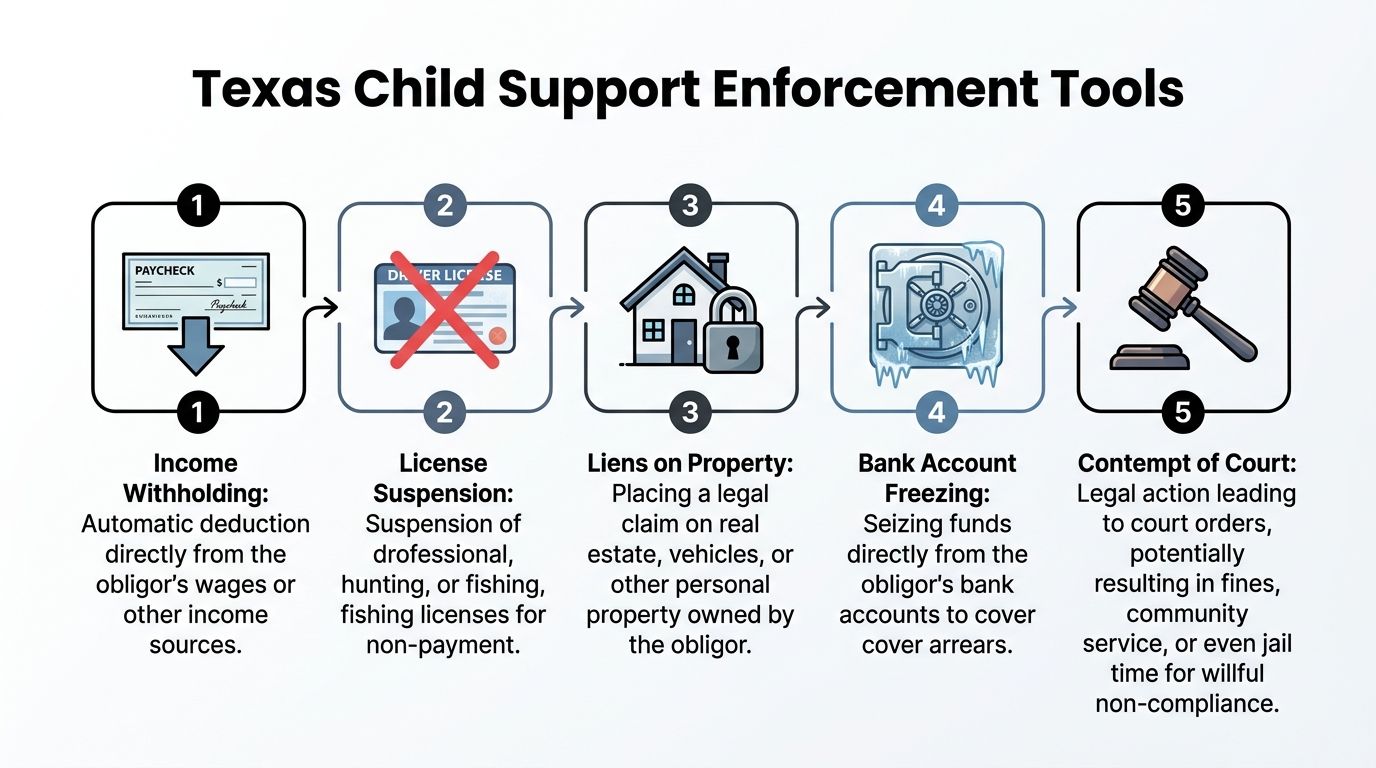
Texas law gives courts and the Office of the Attorney General real ways to enforce support. Depending on the facts, enforcement can involve wage withholding, license consequences, money judgments for arrears, and court action for failing to obey the order.
For many families, that changes the whole conversation. You are no longer asking the other parent to do the right thing. You are asking the legal system to enforce a rule that already exists.
Local experience matters here. In Harris County, the paperwork, payment record, and wording of the existing order often shape how smoothly enforcement goes. If the other parent moved out of Texas, the case can become even more technical because an out-of-state order may need to be recognized and enforced here before the court can act fully. That issue comes up more often than people expect for families who live in the Atascocita and Humble area but have ties to another state.
The order still counts, even when life gets messy
A support order remains enforceable until it is changed by the court. That is true even if parents made side agreements, even if one parent paid some expenses directly, and even if communication became informal over time.
That does not mean every case is simple. It means the starting point is clear.
If there is a signed order and the payments do not match what the order requires, the court has authority to step in. That legal authority is what turns unpaid support from a stressful personal problem into something a judge can address.
Warning Signs You Need an Enforcement Lawyer
Sometimes the warning sign is obvious. Payment stops completely.
More often, the pattern starts small. A late payment here. A partial payment there. A message saying, “I’ll make it up next month.”
Patterns that usually get worse
The following signs often tell parents in Atascocita and Humble that informal efforts are no longer enough:
- Repeated late payments: A payment that is always “a few days late” can become a larger backlog.
- Partial payments without documentation: If the other parent pays less and offers vague explanations, the arrears may keep growing.
- Excuses that change from month to month: One month it is overtime being cut. Next month it is a banking issue. Then it is a new expense.
- Avoiding communication: Ignored calls, unread texts, or blocked messages often signal a deeper enforcement problem.
- Cash payments with no clear record: Informal money transfers create disputes over what was paid and when.
These situations are stressful because they leave you in limbo. You are still budgeting around money that may or may not arrive.
Claims that deserve closer review
Another warning sign is when the paying parent says they cannot pay, but gives no proof. That can happen when someone changes jobs, works for cash, becomes self-employed, or starts receiving income that is harder to track.
A lawyer can help evaluate whether the problem is a genuine inability to pay or an effort to avoid a clear obligation.
This short video gives a helpful overview of enforcement issues parents often face.
When early action helps most
Waiting too long can make the paperwork harder and the arrears larger. Many parents keep hoping cooperation will return. Sometimes it does. Often it does not.
A child support enforcement lawyer atascocita parents hire often becomes most useful when:
- the arrears are growing,
- the other parent’s story no longer adds up,
- or communication has broken down.
Tip: Save every text, email, payment receipt, and missed due date. Small details often become strong evidence later.
You do not need to wait for total nonpayment to ask for legal guidance. Consistent instability is enough reason to get advice.
The Legal Tools Used to Enforce Your Order
Texas gives courts and enforcement agencies several ways to push compliance. Some tools focus on collecting money quickly. Others put pressure on a parent who is ignoring the order.
Income withholding and collection tools
Income withholding is often the most direct remedy. Instead of relying on the other parent to remember or choose to pay, the payment can be taken from income before it ever reaches them.
Other collection methods may also come into play, such as liens against property or steps aimed at accounts and assets. The right tool depends on what the obligor owns, where the income comes from, and how much is owed.
For some families, enforcement is tied to a broader post-divorce problem. If support is only one part of a larger court-order violation, our page on a divorce decree enforcement attorney in Atascocita may be useful.
License suspension and related pressure
Texas can also use license suspension as a tool. Some parents do not respond to reminders, but they do respond when nonpayment affects daily life or professional standing.
Depending on the facts, enforcement can involve suspension of certain licenses. The goal is not punishment for its own sake. The goal is compliance with the court order.
Contempt of court
A motion for contempt is one of the strongest enforcement tools. It asks the court to address willful noncompliance with an existing order.
The consequences can be serious. In Texas, a successful contempt motion can result in jail time of up to 180 days per violation. Courts can also order retroactive child support for up to four years, with 6% annual interest on arrears, according to this Texas child support enforcement discussion.
That does not mean every case ends in jail. It does mean a judge has meaningful power when a parent ignores a clear order.
How lawyers build these cases
Enforcement cases often turn on detail. A lawyer may organize:
- The signed order: The exact terms matter.
- The payment history: Dates, amounts, and missed obligations need to be clear.
- Messages between parents: Texts and emails often show promises, excuses, or admissions.
- Evidence of ability to pay: Work history, lifestyle evidence, and financial records can matter.
Some parents also use private counsel to move faster or to pursue strategies beyond what a state agency may do in a routine case. The Law Office of Bryan Fagan – Atascocita TX Lawyers is one local option for families who want help preparing filings, organizing evidence, and appearing in Harris County court.
Key takeaway: Enforcement works best when the order, the missed payments, and the proof are all lined up clearly before filing.
The Attorney General vs a Private Atascocita Attorney
Parents often ask a fair question. Should I open or continue a case with the Office of the Attorney General, or should I hire private counsel?
The answer depends on the facts, your urgency, and how complicated the case has become.
Comparing Enforcement Options OAG vs Private Attorney
| Feature | Office of the Attorney General (OAG) | Private Atascocita Attorney |
|---|---|---|
| Who is represented | The state’s interest in child support enforcement | Your individual interests as the parent seeking enforcement |
| Cost structure | Public enforcement option | Private legal representation |
| Routine enforcement tools | Can use established enforcement mechanisms | Can pursue an enforcement strategy specific to your facts |
| Communication style | Often process-driven | Usually more direct case-specific guidance |
| Complex financial issues | May be harder to personalize in difficult cases | Often better suited for detailed investigation and court presentation |
| Interstate cases | Handles many of them | Can focus closely on UIFSA registration and local Harris County procedure |
| Case pacing | Can depend on agency workload | Can sometimes move with more individualized attention |
When the OAG may be enough
The Attorney General’s office plays an important role. If the case is straightforward and the parent needs standard enforcement help, the OAG may be a practical path.
That is especially true when the payment source is easy to identify and the case does not involve disputed income, hidden assets, or out-of-state complications.
When private counsel often helps more
Some cases are not simple. The paying parent may be self-employed. They may work inconsistent jobs, move frequently, or hold property in ways that make collection harder. They may also live in another state.
That last issue matters more than many parents realize. Over 20% of Texas child support cases involve interstate enforcement, and those cases can require careful handling of UIFSA registration in Harris County, as noted in this Atascocita child support listing discussing interstate enforcement.
For an Atascocita or Humble parent, that can mean registering an out-of-state order in the proper Harris County court before enforcement can move forward here. If the paperwork is incomplete or the filing is mishandled, delays can follow.
Good fit for private counsel: A local lawyer is often especially useful when the other parent lives outside Texas, hides income, or turns every step into a dispute.
Private representation also helps when you want someone focused on your case, your records, and your hearing instead of a larger agency process.
How to Prepare for Your Enforcement Case
You do not need to solve the whole case before speaking with a lawyer. But gathering the right documents can make your first meeting far more productive.
Start simple. Build a file that tells the story clearly.
What to collect first
Bring together the records that show the order, the missed payments, and your efforts to address the problem.
- Your current child support order: Include any later modifications.
- A payment log: List what was due, what was paid, and what was missed.
- Bank records or payment receipts: These help confirm actual amounts received.
- Texts and emails: Save messages about payment promises, excuses, or refusals.
- Letters or notices from the OAG: If you have opened a state case, keep every notice.
Evidence people often forget
Parents sometimes overlook useful details because they seem minor at the time.
Consider gathering:
- Calendar notes showing due dates and missed payments.
- Screenshots of conversations before messages disappear.
- Employment information if you know where the other parent works now.
- Public posts that may show travel, purchases, or work activity relevant to ability to pay.
Be careful not to edit or rewrite evidence. Save it in its original form when possible.
Make the timeline easy to follow
A judge or lawyer should be able to understand your case quickly. One of the best ways to help is to create a simple timeline.
You might organize it like this:
| Date | What was due | What was paid | Notes |
|---|---|---|---|
| Monthly due date | Amount ordered in your decree | Amount received | Late, partial, or unpaid, plus message summary |
You do not need fancy software. A notebook, spreadsheet, or printed chart works if it is accurate.
Practical tip: The clearer your records are, the easier it is to show a pattern instead of a single disagreement.
If your case involves an out-of-state order, include a complete copy of that order and any payment history you already have from the issuing state.
Your Next Step with a Compassionate Atascocita Lawyer
It is the first week of the month in Atascocita. Rent is due, the after-school program needs payment, and the child support that was supposed to help cover those basics has not arrived again. At that point, many parents are not looking for a fight. They want a clear plan and a steady way to protect their child.
That next step usually starts with a calm review of what already exists. A lawyer looks at the current order, the payment record, and any problem areas that could affect enforcement in Harris County. If your order was issued in another state and the other parent now lives here, that review also helps determine whether the order needs to be registered locally before a Texas court can act.
The process is often simpler once you can see it in order:
- First meeting: You bring the order, your payment records, and the questions keeping you up at night.
- Legal review: The lawyer checks what the order requires, what is unpaid, and what evidence is strong enough for court.
- Case strategy: The next filing depends on the facts. Some cases call for enforcement through contempt. Others involve income withholding, a money judgment, or interstate enforcement steps.
- Court preparation: Your documents, timeline, and communication records are organized so the judge can follow the pattern quickly.
- Hearing and follow-up: The court may issue enforcement orders, and collection efforts may continue after the hearing.
A child support case works a lot like fixing a leak in your roof. If you only see the water on the floor, the problem keeps returning. If you identify where the order is failing, whether that is missed payments, an employer issue, an out-of-state order, or repeated delay tactics, you have a better chance of stopping the problem at its source.
Local experience can make a real difference here. Parents in Humble and Atascocita often ask whether they should keep relying on the Office of the Attorney General or hire private counsel. The Attorney General can be helpful, but that office handles a large volume of cases and may not be able to give your file the same one-on-one attention as a lawyer you hire directly. A private local attorney can often focus more closely on your documents, your hearing, and the practical details that matter in northeast Harris County.
If you want a broader overview of your options, our Atascocita child support attorney page explains how support cases are handled and when enforcement may be appropriate.
You do not need to keep guessing whether next month will be different.
If child support payments have stopped or become unreliable, schedule a free consultation with Law Office of Bryan Fagan – Atascocita TX Lawyers. We help families in Atascocita, Humble, and across northeast Harris County understand their options, prepare enforcement cases, and take practical legal steps toward the support their children are owed.