Skip to content
When one parent doesn't provide financial support, it places an incredible strain on the other parent and, more importantly, on your child. Here in Texas, the law provides a powerful solution called retroactive child support. It’s a legal tool that allows a court to order a parent to pay for a child's support for the time before a formal court order was ever put in place. This ensures a child gets the financial backing they should have had from the very beginning.
At The Law Office of Bryan Fagan, we understand that for families in Atascocita, Humble, and across northeast Harris County, these situations are deeply personal and often stressful. Our goal is to provide warm, knowledgeable guidance in plain English, helping you feel understood and supported as you fight for your child's well-being.
Understanding Retroactive Child Support in Texas

For many families in Atascocita and Humble, life rarely sticks to a clean schedule. It’s common for parents to separate months or even years before any legal papers are filed. During that time, one parent is often left footing the entire bill for the child's needs. This is exactly the situation where retroactive child support becomes essential for fairness.
Here’s a simple way to think about it: a parent’s duty to support their child starts the day that child is born, not just when a judge signs an order. Retroactive child support is the court's way of enforcing that duty. It essentially "looks back" in time to figure out what should have been paid all along and orders it to be paid now.
Why Does This Matter for Atascocita Families?
Raising a child in northeast Harris County isn’t cheap. Between housing in neighborhoods from Eagle Springs to Fall Creek, groceries, and all the other daily costs, the financial pressure is real. When one parent isn't chipping in, the other has to stretch every dollar, which can mean making tough sacrifices that impact the child's well-being. A retroactive order can bring some much-needed financial stability back into the picture.
This legal action helps balance the scales by:
- Recovering Past Expenses: It helps the custodial parent get reimbursed for money they spent alone on things like rent, food, clothes, and doctor visits.
- Establishing Accountability: It makes it clear that a parent can’t just disappear or delay court proceedings to get out of their financial obligations.
- Providing for the Child's Future: The money recovered can go directly toward the child’s current needs, like school supplies for Humble ISD, or be saved for their future.
The bottom line is simple: a child shouldn't have to go without because of a parent's failure to provide support. Texas law gives judges the authority to fix this by ordering payments for that period when no formal order existed.
For a parent in Atascocita who has been juggling everything on their own, filing for retroactive child support is about more than just money. It’s about securing the resources and stability their child deserves. Knowing how this process works is the first step toward getting that support back.
If you believe you are owed past-due support, don’t put it off. The dedicated attorneys at The Law Office of Bryan Fagan are here to guide you. Schedule a free, no-obligation consultation at our Atascocita office to go over your situation and learn how we can fight for your child's rights.
Your Legal Right to Claim Past Due Support
Trying to make sense of the Texas Family Code on your own can feel like an impossible task. But here’s the most important thing to know: you have a legal right to seek financial support for your child, even for the time before a court order was ever in place.
This isn't just a general idea; it’s a specific right baked into Texas law.
The law that gives Harris County judges the power to do this is Texas Family Code §154.131. This is the legal tool that allows the court to look back in time and order a parent to pay for a period when they weren't contributing financially. It's the law’s way of saying that a parent’s financial duty doesn't just start the day they walk into court.
For parents in our Atascocita and Humble communities who've shouldered the entire financial burden of raising a child, sometimes for years, this is a critical piece of the puzzle.
Understanding the "Four-Year Rule"
When you file for retroactive child support, the court starts with something called the four-year presumption. Think of it as a default setting. The law automatically assumes that ordering support for the past four years is in your child's best interest.
To get the ball rolling under this rule, you generally have to prove two main things:
- Legal Paternity is Clear: The court needs to officially recognize the other person as the child's legal parent. We help clients through this all the time, and you can get a better sense of the process by reading our guide on how to establish paternity in Texas.
- The Parent Didn't Pay: You need to show that the other parent wasn't providing consistent or adequate financial support during that four-year window.
This presumption is a game-changer. It shifts the burden of proof, forcing the other parent to argue why they shouldn't have to pay for those four years, rather than you having to prove why they should.
Proving the Parent Had the Money to Pay
A judge can't order back-support from someone who genuinely had no money. A huge part of winning your case is showing the court that the other parent actually had the financial resources to help but simply chose not to.
The judge will examine the other parent's "net resources" for the period in question. This isn't just their paycheck; it includes wages, commissions, self-employment income, overtime, and other assets. This is where evidence becomes your best friend—old pay stubs, tax returns, and bank statements are all vital for painting a clear picture of their ability to pay.
In Texas, where firms like the Law Office of Bryan Fagan in Atascocita serve Harris County families, state law mirrors this by permitting retroactive support under Family Code §154.131, often up to four years back if the paying parent had notice but failed to pay adequately. For instance, if a non-custodial parent's income rose significantly—say from $50,000 to $100,000 annually—without adjusting support, courts can order lump-sum back payments to cover shortfalls, potentially tens of thousands of dollars. You can explore more data on child support trends and financial impacts by reviewing findings from national surveys.
Can a Court Go Back Further Than Four Years?
What if the other parent has been absent for longer than four years? While the four-year rule is the standard, it's not a hard stop.
A judge has the authority to go all the way back to the child's birth, but only under specific circumstances. To do this, you have to prove the other parent engaged in blameworthy conduct.
This isn't just about failing to pay. It means they took active, intentional steps to dodge their parental responsibility. Some classic examples include:
- Intentionally hiding or moving to avoid being served with court papers.
- Lying about their income or quitting a job to avoid a child support order.
- Denying they were the father when they knew, or had good reason to believe, they were.
If you suspect the other parent has been deliberately avoiding their duty for more than four years, it's crucial to talk to an experienced attorney. The team at The Law Office of Bryan Fagan in Atascocita knows how to dig for the evidence needed to build a compelling case and present it effectively to the court.
How Courts Calculate Retroactive Support Amounts
Once a Harris County judge decides that retroactive child support is on the table, the big question becomes: "So, how much are we talking about?" This isn't just a number pulled from thin air. It’s a methodical calculation based on established guidelines and, most importantly, solid evidence. For parents in communities like Atascocita and Humble, understanding how this works can take a lot of the mystery out of the process.
The court’s main job here is to figure out what the non-paying parent should have been paying all along. To get to that number, they have to first establish that parent's "net resources" for every month during that past period. This figure is the bedrock of the entire calculation.
And "net resources" means more than just a paycheck. A judge will look at every source of income and then subtract certain allowed deductions, like Social Security taxes and the federal income tax a single person would pay.
Piecing Together Past Income: A Step-by-Step Guide
Honestly, the biggest hurdle is often proving what the other parent was earning in the past. This gets especially tricky if their income bounced around or if they were paid under the table in cash. This is where rolling up your sleeves and gathering strong evidence really pays off. A Harris County judge needs to see concrete documentation to make a fair and accurate ruling.
Some of the most powerful pieces of evidence include:
- Tax Returns: These are the gold standard, offering an official, year-by-year summary of declared income.
- Pay Stubs (W-2s): If you can get them, these show exactly what was earned during specific pay periods.
- Bank Statements: Patterns of deposits can paint a surprisingly clear picture of income, even for someone who is self-employed.
- Financial Statements or Business Records: For business owners, these are essential for showing the company's profitability and the resources available to the parent.
If the other parent refuses to cooperate, don't worry. An experienced family law attorney has tools for this, like using a subpoena to get those financial records directly from their employer or bank. The goal is to carefully reconstruct a financial history so the final support amount is right on the money.
Applying the Texas Child Support Guidelines
After the court determines the parent's average monthly net resources for that past period, it simply applies the standard Texas child support guidelines. These are straightforward, percentage-based rules that family courts use every day.
For a parent who has no other children outside of the case at hand, the guideline amounts look like this:
- 20% of their net resources for one child.
- 25% of their net resources for two children.
- 30% of their net resources for three children.
Crucially, this formula is applied to their historical income, not what they earn today. This keeps things fair by basing the amount on what they could have and should have paid at the time.
Let’s walk through a quick example for a family in Atascocita.
- The Situation: A mother files a request for retroactive support for her one child, covering the last four years (48 months). Through her attorney, she presents evidence showing the father's average monthly net resources during that period were $4,000.
- The Math: The guideline for one child is 20%. The court will calculate 20% of $4,000, which comes out to $800 per month.
- The Total: Finally, the judge multiplies that monthly figure by the number of months in question: $800/month x 48 months = $38,400.
In this scenario, the father would be ordered to pay $38,400 in back-due child support.
To give you a clearer idea of how these numbers can add up, the table below shows some hypothetical examples of total retroactive support that could be owed over a four-year period.
Estimated Retroactive Child Support Owed Over Four Years
This table provides hypothetical examples of total retroactive child support that could be owed over a four-year period based on the non-custodial parent's average monthly net resources and the number of children, according to Texas guidelines.
| Parent's Average Monthly Net Resources | One Child (20%) Total Owed | Two Children (25%) Total Owed |
|---|---|---|
| $3,000 | $28,800 | $36,000 |
| $5,000 | $48,000 | $60,000 |
| $7,000 | $67,200 | $84,000 |
| $9,000+ (Statutory Cap) | $86,400 | $108,000 |
Please remember, these are just examples. A judge will always consider the specific facts of a case before making a final decision.
The entire process is designed to be fair and based on facts. It’s not about punishing anyone; it’s about providing the financial support that your child was legally entitled to from the very beginning.
At The Law Office of Bryan Fagan, we specialize in digging deep to find the necessary financial evidence and presenting it to the court in a clear, compelling way. If you need help figuring out what your child may be owed, contact our Atascocita office for a free consultation today.
Filing Your Claim in the Harris County Court System: A Step-by-Step Guide
Taking that first step to pursue legal action can feel intimidating, but knowing what to expect brings a sense of control. For families here in Atascocita and Humble, filing for retroactive child support in Harris County follows a clear path. Think of this as your roadmap for turning a rightful claim into a legal reality for your child.
Your journey starts with a crucial legal document: the "Original Petition in Suit Affecting the Parent-Child Relationship," which we often call a SAPCR petition. This is the official starting gun for your case. It tells the court who is involved, formally establishes or confirms who the parents are, and makes the specific request for a judge to order retroactive child support. Filing this petition is what gets the legal ball rolling.
Step 1: Gathering Your Evidence for Court
From the moment you decide to file, evidence becomes your best friend. The more documentation you have, the clearer the picture you can paint for the Harris County judge. You don't need a perfectly organized binder on day one, but starting to collect these items now will build a rock-solid foundation for your case.
Here are the key pieces of evidence to start pulling together:
- Proof of Parentage: This is usually the child's birth certificate (if the other parent is listed) or the official results from a DNA test.
- Proof of Residence: You need to show the child lived with you during the period you're claiming support for. School enrollment records, doctor's bills, or anything official addressed to your home with the child's name works well.
- Evidence of the Other Parent’s Income: This one is vital. Dig up any old pay stubs, W-2s, tax returns, or bank statements you can find. Sometimes, even social media posts showing a lavish lifestyle can help illustrate their financial situation.
- Records of Your Expenses: Pull together receipts, bank statements, or even a simple spreadsheet showing what you've spent on the child for essentials like housing, food, clothing, and medical care.
This chart gives you a quick visual of how Texas guidelines use a parent's net resources to calculate support amounts for one or two children.
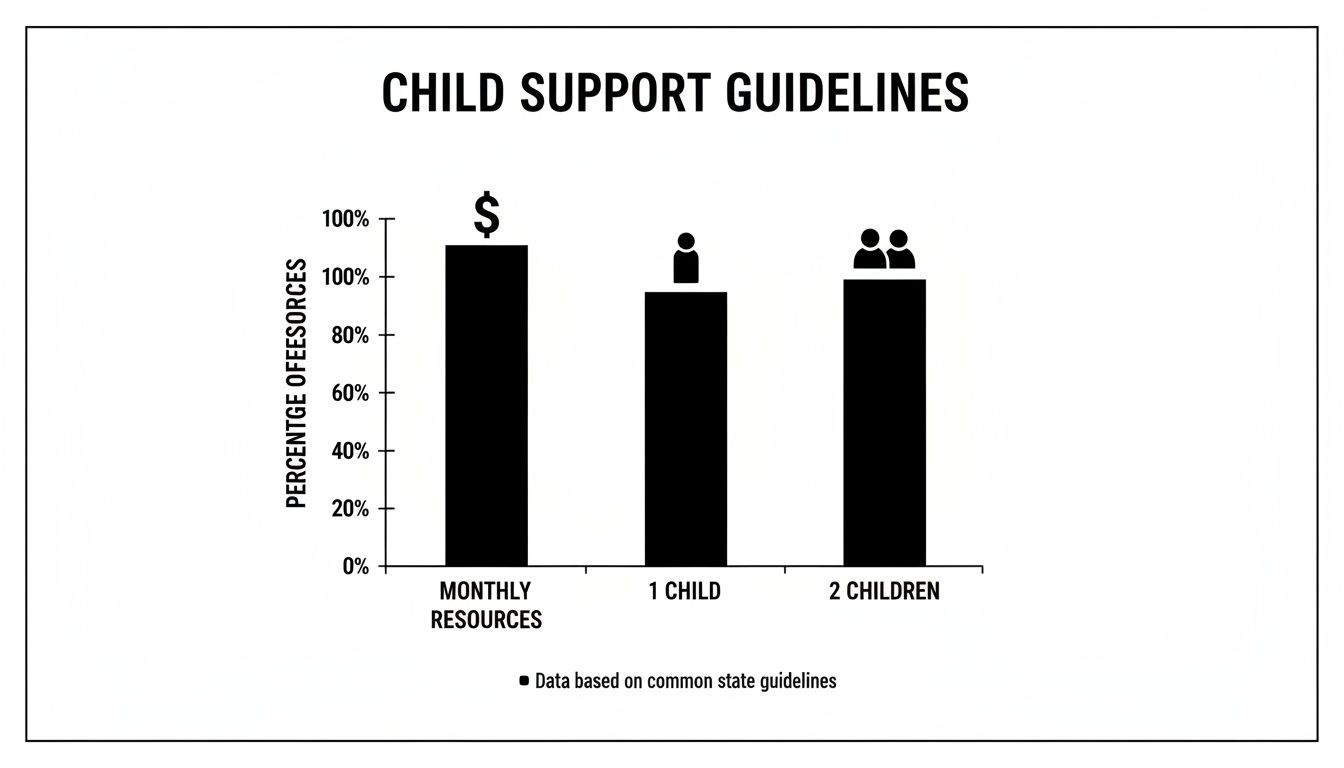
As you can see, the support obligation grows as the parent's income increases, which is why proving their past income accurately is so critical to your case.
Step 2: Navigating the Legal Process
Once your petition is filed with the Harris County District Clerk, the next move is to formally notify the other parent. This is called "service of process," and it has to be done by the book for the case to proceed. This step ensures the other parent is legally aware of the lawsuit and has a chance to respond.
From there, your case moves into a phase of evidence gathering and potential negotiation. It's fairly common for these cases to be resolved through mediation, but you always have to be prepared to present your case in court. Getting ready means organizing your documents and planning what you'll say. For some great advice on this, check out our guide on how to prepare for a custody hearing—many of the same principles apply here.
For Texas families in Atascocita or Humble, Harris County courts apply similar retroactive rules, often triggered by income changes or evasion. Imagine a parent hiding a $20,000 annual raise for years—courts can order back support calculated via guidelines (e.g., 20% of net income for one child), plus interest at 6% under Texas law, ballooning debts quickly. The 44% full-payment rate underscores urgency; with poverty hitting 29.2% of custodial-mother families, retroactive awards compensate hardships like unmet medical or education costs. You can explore more global statistics on child support to understand the broader context.
Knowing your way around the local court rules in Harris County requires experience. An Atascocita attorney who is in these courtrooms regularly can manage the filings, deadlines, and legal arguments for you, letting you focus on your family.
If you're ready to seek the financial support your child deserves, you don't have to figure it all out alone. The team at The Law Office of Bryan Fagan is here to guide you. Schedule a free consultation at our Atascocita office, and let's talk about building a powerful case for your child.
Common Defenses Against a Retroactive Support Claim
When you file for retroactive child support, you’re fighting for what your child is rightfully owed. But it’s not a one-sided conversation. You have to be ready for what the other parent might argue in court. Understanding the common defenses used right here in Harris County will help you and your attorney build a much stronger case from day one, allowing you to anticipate their moves and gather the evidence to counter them.
One of the most common arguments a parent will make is called an affirmative defense. This isn't just a simple denial. Instead, the other parent is essentially saying, "Yes, I didn't write official 'child support' checks, but I was still taking care of my financial responsibilities in other ways."
The Affirmative Defense Explained
With an affirmative defense, the other parent tries to convince the judge that a retroactive order isn't necessary because they were already providing significant support all along. For this to work in a Harris County courtroom, they can't just say it—they have to prove they were actively involved and contributing money during the time in question.
Here’s what they might bring to the table as proof:
- Proof of Shared Residence: They could show they lived with the child and helped pay major household bills, like the mortgage, rent, or utilities.
- Direct Financial Contributions: They might produce bank statements or receipts showing they paid directly for the child's needs—things like groceries, clothes, school tuition, or medical care.
- Evidence of Regular Support: This could be proof of consistent cash payments or other direct support given to you for the child's care.
A judge is going to look at the whole story. If the other parent can show a clear pattern of providing a home and financial care for the child during that period, the court might decide that ordering back-pay on top of that would be unfair or redundant.
This is exactly why keeping your own detailed records is so important. If you can clearly document the expenses you shouldered on your own, it becomes much harder for the other parent to claim they were pulling their weight.
The "Laches" or Unreasonable Delay Defense
Another defense strategy you might encounter is based on the legal idea of laches. In plain English, this means you waited an unreasonable amount of time to ask for support. While Texas law has a very strong four-year lookback period for retroactive child support, a judge does have some wiggle room. If you waited many, many years to file without a good reason, the other parent could argue that the long delay is unfair to them.
For example, they might claim they can no longer access financial records from a decade ago to build their defense, or that people who could back up their story are no longer around. This argument is definitely less common and harder to prove, but it's a possibility a good attorney prepares for, especially if your claim goes back further than four years. Sometimes, a court's ruling on these kinds of defenses can be challenged, and knowing how to appeal a family court decision gives you a better understanding of what happens next.
At the end of the day, being aware of these potential defenses gives you a real strategic advantage. It lets us build a case for your Atascocita family that not only proves what you’re owed but also anticipates and neutralizes the arguments from the other side.
If you are ready to pursue the support your child deserves, contact The Law Office of Bryan Fagan today. Schedule your free, confidential consultation at our Atascocita office to go over the specifics of your case and see how we can help you prepare for every possibility.
Enforcing the Court Order and Collecting Payment
Getting a Harris County judge to sign off on a retroactive child support order is a huge win, but it’s not the finish line. The next challenge—and honestly, the most critical one—is actually getting that money into your hands for your child. For families in Atascocita and Humble, it’s a relief to know that Texas law provides some very powerful tools to turn that piece of paper into real financial support.
The good news is you aren't left to chase down these payments on your own. The legal system has some serious muscle built in to ensure the other parent complies.
Powerful Enforcement Tools in Texas
Once you have that judgment, we can take action. There are several ways to enforce the order and collect the past-due support, many of which don't require the other parent's cooperation at all.
These are the most common and effective tools we use:
- Wage Withholding Order: This is the workhorse of child support enforcement, and for good reason. We send a legal order directly to the non-paying parent's employer. The employer is then legally required to deduct the payments from each paycheck and send the money to the state. It’s automatic, consistent, and incredibly reliable.
- Property Liens: We can place a legal claim, or a lien, on the other parent’s property—think a house, land, or even a car. This means they can't sell or refinance that asset until the child support debt is paid in full. It's a powerful motivator.
- Bank Account Levies: In certain situations, we can obtain a court order that allows us to freeze the other parent’s bank accounts and take the funds needed to cover what's owed.
Don't forget about interest. Under Texas law, any unpaid child support judgment racks up interest at a rate of 6% per year. Over time, this adds significant financial pressure, making it much more expensive for the other parent to keep delaying payment.
This is about more than just collecting a debt; it's about securing the financial resources your child should have had all along. It’s about making sure the judge's decision makes a real, tangible difference in your family's life.
At The Law Office of Bryan Fagan, we are committed to seeing your case through from start to finish. If you have a retroactive support order and are struggling with enforcement, contact our Atascocita office for a free consultation to figure out the best way forward.
Your Top Questions About Retroactive Support Answered
When you're trying to navigate retroactive child support, it's natural to have a lot of questions. In Atascocita and Humble, we hear from parents facing similar situations every day. These issues can feel overwhelming, but getting straight answers is the first step toward finding a solution.
Let's walk through some of the most common questions we hear from families in our community to help you understand your options.
What If the Father Isn’t on the Birth Certificate?
Yes, you can still pursue support, but we have to handle first things first. Before a judge can even consider retroactive child support, paternity needs to be legally established. This means filing a court action to legally prove he is the father.
As part of that process, the court will almost certainly order a DNA test to confirm it. Once those results come back and he's legally recognized as the father, the court can move forward and order him to pay retroactive child support.
What Happens If the Other Parent is Self-Employed or Gets Paid in Cash?
This is a very common hurdle, but it's definitely not a dead end. Figuring out the true income for a self-employed parent or someone working for cash just requires a different strategy than looking at W-2s. Having a skilled attorney in your corner is non-negotiable here.
We use a legal process called "discovery" to dig for the real financial picture. This isn't just one thing; it's a combination of tactics, like:
- Subpoenaing bank records to see what's actually being deposited and spent.
- Performing a lifestyle analysis to show that their reported income doesn't square with their car, apartment, and vacation habits.
- Calling on witnesses who know about their work and how much they really earn.
By piecing this evidence together, we can paint a realistic financial picture for the judge, making sure the retroactive support calculation is based on reality, not just what the other parent claims.
Is There a Deadline to File for Retroactive Child Support in Texas?
Texas law has a powerful "four-year presumption," which means courts will generally go back four years when ordering support. While there isn't a hard-and-fast deadline on the books, you absolutely should not wait.
There's a legal concept called "laches," where a court can deny your request if you wait an unreasonably long time to file without a good excuse. The other parent could argue that your delay makes it impossible for them to find old financial records to build their case. The takeaway is simple: act quickly. The sooner you move forward, the stronger your case will be and the better you protect your child's right to support.
Does a Retroactive Order Include Health Insurance and Medical Bills?
It sure does. Retroactive support isn't just about the monthly payment. A judge can also order the other parent to pay you back for their share of past medical, dental, and vision costs that insurance didn't cover.
This is all about making sure the financial weight of raising your child is shared fairly, especially for the years you might have been covering all those costs alone. This is why keeping detailed receipts and records of every doctor's visit and prescription is so important—you'll need them to prove your expenses in court.
Tackling a retroactive child support case requires a solid grasp of Texas law and the Harris County court system. At The Law Office of Bryan Fagan – Atascocita TX Lawyers, our team is ready to fight for the financial stability your child is entitled to. We know the unique challenges families in Atascocita and Humble are up against, and we're here to provide the determined, compassionate legal help you need.
Don't put your child's future on hold. To talk about the specifics of your situation, schedule a free consultation at our Atascocita office by visiting us online at https://www.atascocitaattorneys.com.