 Skip to content
When you're facing a custody battle, the uncertainty can be the hardest part. Temporary custody orders in Texas are designed to cut through that chaos, offering a clear, court-ordered plan for your family while the bigger legal issues get sorted out. For families here in Atascocita and Humble, it's an immediate roadmap for parenting responsibilities, schedules, and financial support that brings stability when you need it most.
Your Guide to Temporary Custody Orders in Atascocita
For families in Atascocita, Humble, or anywhere in northeast Harris County, a changing family structure brings a lot of questions. Where will the kids sleep after school? Who makes decisions about their doctor? How will the bills get paid? A temporary custody order is the court's answer to these urgent questions, providing clear, practical solutions.
This isn't the final word on your custody arrangement. Instead, it’s a set of ground rules meant to protect your child's well-being and create a predictable routine while the legal process plays out. Every decision a Harris County judge makes is guided by one core principle: what is in the best interest of the child.
What Do These Orders Typically Cover?
A well-drafted temporary order leaves little room for arguments by providing clear instructions on the most critical parts of your child's life. A judge will lay out specific terms for:
- Conservatorship: This is the legal term for who gets to make the big decisions for your child—things like where they go to school in Humble ISD, what doctor they see, and their religious upbringing.
- Possession and Access: This is the nitty-gritty of the parenting schedule. It's a calendar that details exactly when the child will be with each parent, covering everything from weekdays and weekends to holidays and summer vacation.
- Child Support: The order will set a temporary child support amount, making sure that the child’s financial needs are covered by both parents from the get-go.
- Geographic Restrictions: It's common for an order to require the child to live within a specific area, like Harris County and its surrounding counties. This prevents one parent from suddenly moving far away with the child while the case is active.
To give you a clearer picture, here’s a step-by-step breakdown of what you can expect to see in a typical order.
Key Components of a Texas Temporary Custody Order
| Component | What It Covers | Why It's Important for Atascocita Families |
|---|---|---|
| Conservatorship (Decision-Making) | Rights and duties related to education, medical care, and general welfare. | Determines which parent enrolls the child in Humble ISD or makes key healthcare choices. |
| Possession Schedule | The calendar specifying when the child is with each parent. | Creates a predictable routine for school nights, weekends, and holidays, reducing daily conflict. |
| Child Support & Medical Support | Monthly payments and health insurance obligations. | Ensures the child's financial stability isn't disrupted by the parents' separation. |
| Geographic Restriction | Limits on where the child's primary residence can be. | Provides stability by keeping the child close to their school, friends, and both parents in the Atascocita area. |
This structure helps everyone know what to expect, minimizing friction and allowing your family to focus on adjusting to the new normal.
Why Temporary Orders Are So Important
For any parent in Atascocita going through a separation, these orders are more than just legal documents; they're a lifeline. While a full Suit Affecting the Parent-Child Relationship (SAPCR) is pending, a temporary order acts as a crucial bridge, establishing clear rules before a final decision is reached. This legal clarity is vital for protecting both parents and, most importantly, the children during a deeply emotional time. To learn more about the different parental roles, you can explore our guide on the difference between legal and physical custody.
These orders are not suggestions—they carry the full weight of the law. They are enforceable court directives designed to bring order to what can feel like a chaotic situation. By defining who picks up the kids from their Humble ISD school or how weekends will be handled, they build a much-needed sense of normalcy.
At The Law Office of Bryan Fagan, we believe a temporary order provides immediate structure and predictability for your children. It ensures their daily lives are disrupted as little as possible while you work toward a final resolution. This stability is the foundation upon which a healthier future can be built.
Ultimately, getting a strong, well-defined temporary custody order is one of the most critical first moves in any family law case. It sets the tone for the entire process and, more importantly, shields your child from the stress of conflict and uncertainty.
When Should You Ask a Judge for a Temporary Order?
Going to court for a temporary order can feel like a massive step, but it’s often the only way to protect your child’s routine and your own rights as a parent. For many families right here in Atascocita and Humble, the breaking point comes when co-parenting conversations stop working and a child’s life is thrown into chaos.
If you're a parent involved in a divorce, a paternity suit, or are trying to modify an existing custody arrangement, you can ask a Harris County judge to step in and set some ground rules with a temporary order. The best time to do this is almost always right at the start of your case—when you first file your lawsuit. If you wait, you risk letting a new, undesirable situation become the "status quo," which can be much harder to undo down the road.
Why You Might Need a Temporary Order Now
Life doesn't hit pause just because a court case has started. Urgent problems pop up all the time, and they often demand a judge's immediate input. Here are a few real-world scenarios we see from residents of Atascocita, Humble, and surrounding communities that lead parents to seek temporary custody orders in Texas:
- One Parent is Blocking Visitation: Your ex is suddenly refusing to let you see your child, cutting off that vital connection and damaging your relationship.
- A Parent Threatens to Move: There are serious threats of one parent moving away with the child, maybe out of the Humble ISD school district or even out of Harris County altogether, which would upend the child's entire world.
- Financial Support Has Stopped: The other parent has cut off financial support for the child, leaving you to carry the entire financial load on your own.
- Gridlock on Big Decisions: You and the other parent are at a standstill over something important, like where the child should go to school or what kind of medical treatment they need.
The purpose of a temporary order is to hit the reset button. It’s designed to replace chaos and arguments with a stable, predictable, and court-enforced plan that both parents must follow while the case is ongoing.
The "Best Interest of the Child": What It Really Means
When you stand in front of a Harris County judge and ask for a temporary order, they are going to make their decision based on one single, powerful idea: the best interest of the child. This isn't just a legal phrase; it's a practical test that forces the judge to look at everything that impacts a child's physical and emotional health.
The judge will examine things like each parent’s ability to offer a safe and stable home, the specific needs of the child, and how important it is to keep their daily life as consistent as possible. They’re also looking to see which parent is more likely to encourage and support the child's relationship with the other parent.
Looking at recent Texas custody statistics can also give local families a dose of reality. While Texas actually has a lower divorce rate than the national average, the outcomes in custody disputes are what really matter. On average, fathers in Texas are awarded around 33% of the parenting time, a number that's right in line with the national average. Knowing these kinds of trends can help you set realistic goals for your own case. You can dive deeper into the numbers with these Texas divorce and custody statistics.
At the end of the day, your job is to convince the court that the plan you’re proposing will give your child the stability and support they need to get through this difficult period. It's not about scoring points against the other parent—it's about finding a solution that helps your child thrive.
The Step-by-Step Process for Obtaining Temporary Orders
Navigating the legal maze to get temporary custody orders in Texas can feel overwhelming, but breaking it down into a series of clear, manageable steps makes all the difference. For families in Atascocita and Humble, understanding this roadmap can bring a sense of clarity during a deeply uncertain time. Here is our step-by-step guidance on the journey, from the very first document you file to the day you stand before a judge.
The process usually kicks off when a parent realizes that court intervention is the only way to safeguard their child's well-being and stability. The decision often looks something like this: a dispute arises, you have to determine if there's immediate harm or instability, and then you decide whether court action is necessary.
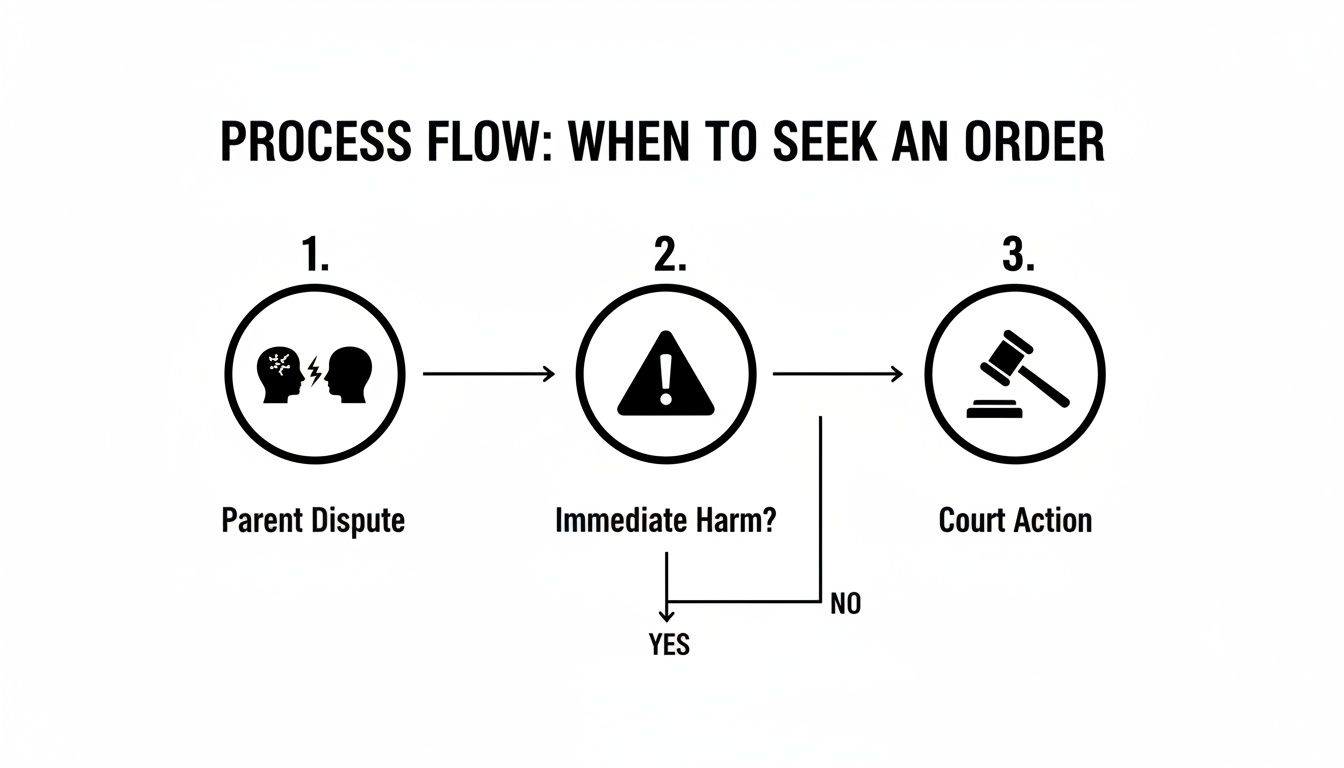
This simple flow shows how an unresolvable conflict often becomes the catalyst for seeking a formal, enforceable solution from the court.
Step 1: Filing the Initial Lawsuit
Before a judge can even consider your request for temporary orders, a lawsuit has to be on file. This all starts with filing an Original Petition at the Harris County District Clerk's office, which is the document that officially opens your case.
Depending on your situation, this initial filing could be a Suit Affecting the Parent-Child Relationship (SAPCR), a Petition for Divorce, or a Petition to Modify an existing court order. Along with the petition, you'll file a crucial document called a Motion for Temporary Orders. This is your specific request asking the judge to set temporary rules for custody, support, and other pressing issues.
Step 2: Serving the Other Parent
Once the paperwork is filed, the other parent must be formally notified about the lawsuit. This isn't optional; it's a legal requirement known as service of process. You can't just text them or hand them the documents yourself—it has to be done by a neutral third party to be valid.
In Harris County, service is typically handled by a sheriff's deputy or a certified private process server. Proper service is non-negotiable. It guarantees the other parent knows about the case and has a fair chance to respond and show up in court. Without it, your case stalls.
Step 3: Gathering Your Evidence
While you're waiting for your court date, it's time to switch into preparation mode. The temporary orders hearing is your first real opportunity to make your case to the judge, so you need to back up your requests with solid, relevant evidence.
Your evidence should be organized and laser-focused on proving what is in the "best interest of the child." Start gathering things like:
- Financial Documents: Pay stubs, bank statements, and recent tax returns are vital for calculating child support.
- Communication Records: Save text messages, emails, and even relevant social media posts. They can reveal patterns of behavior—good or bad.
- School and Medical Records: A child’s report cards, attendance sheets, and doctor’s notes provide a tangible snapshot of their current well-being.
- Witness Information: Make a list of people who can vouch for your parenting. Think teachers, neighbors, or family members in the Atascocita area who have firsthand knowledge.
Think of the temporary orders hearing as a condensed trial. The judge needs clear, concise information to make a fast but informed decision about what’s best for your child right now.
Step 4: The Temporary Orders Hearing
This is the moment it all comes together. You, the other parent, and your attorneys will appear before a Harris County judge for the hearing. Both sides will get a chance to present their evidence and testify.
The judge will hear both arguments, review the evidence, and typically make a ruling that same day. That ruling becomes a legally binding temporary order, spelling out the rules for conservatorship, possession schedules, and financial support until the case is finalized. Staying calm, being prepared, and keeping the focus on your child's needs are the keys to a successful hearing.
How to Prepare for Your Temporary Orders Hearing
The temporary orders hearing is one of the most critical moments early on in your custody case. This hearing sets the tone and the rules of the road for your family for the next several months, and the outcome often casts a long shadow, heavily influencing the final custody orders. Showing up prepared isn’t just a good idea—it’s absolutely vital.
Walking into a Harris County courtroom can be nerve-wracking, but with the right guidance, you can feel confident and supported. Expect to see the judge, yourself, the other parent, and your lawyers. The judge’s only mission is to figure out what is in the best interest of the child and make a ruling.
This is your chance to demonstrate to the court that your plan for the children provides the best stability and support. The key is to stay laser-focused on that goal. It's easy to get sidetracked by old arguments with the other parent, but that won't help your case.
Gathering Persuasive Evidence
In family court, what you can prove is what matters. You need to back up your words with solid, credible evidence. A well-organized file makes it easy for the judge to understand the situation and, hopefully, agree with your requests. Your evidence should paint a clear picture of your child’s life and why you are equipped to meet their needs.
Start by pulling together documents that provide a snapshot of your family's daily reality. This means gathering financial records, printing out communications, and collecting your child’s school and medical records. To make sure you don't miss anything, it's smart to review a comprehensive guide on how to prepare for your custody hearing for a deeper dive.
Putting together your evidence can feel overwhelming. This checklist provides step-by-step guidance on the most important documents you'll need.
Evidence Checklist for Your Temporary Orders Hearing
| Evidence Category | Specific Examples | Purpose |
|---|---|---|
| Financial Information | Recent pay stubs, the last two years of tax returns, and current bank statements. | Gives the judge the necessary data to accurately calculate temporary child support and assess financial stability. |
| Communication Records | Text messages, emails, or conversations from a co-parenting app (like OurFamilyWizard). | Shows the judge the tone and substance of your communication, highlighting cooperation or conflict. |
| Child's Records | School report cards, attendance sheets, immunization records, and doctor's notes. | Provides objective proof of the child’s current well-being and can flag any areas of concern. |
| Witness Testimony | Written declarations or live testimony from teachers, daycare staff, or neutral family friends from the Humble area. | Offers a third-party perspective on your parenting and the child's needs, which can be very powerful. |
Having your documents in order is a huge step. But remember, the goal is to present a compelling narrative that supports your position as the more stable and child-focused parent.
Presenting Your Case Effectively in Court
The way you carry yourself in the courtroom matters just as much as the paperwork you bring. Harris County judges appreciate parents who are composed and focused on their kids. Basic courtroom etiquette—dressing appropriately, standing when you speak, and addressing the judge as "Your Honor"—shows you respect the process.
When it’s your turn to testify, be clear, concise, and truthful. Just stick to the facts. Avoid emotional tangents or slinging mud. Your testimony should revolve around your child: their schedule, their activities, and why your proposed orders serve their best interests.
For example, instead of saying, "He's always late!" try a fact-based approach: "Our son has been marked tardy at his school in Humble ISD on five occasions this month, and all of those days were when he was with his father." That's far more persuasive to a judge.
The most compelling argument you can make is one that consistently prioritizes your child's stability and happiness over your own disputes with the other parent. A judge will always be more receptive to a parent who demonstrates a mature, child-centered mindset.
By preparing your evidence and presenting yourself as a reasonable, responsible parent, you dramatically improve your chances of getting a temporary order that protects your child and sets a positive foundation for the rest of your case.
Life After Your Temporary Order Is Signed
That moment the judge’s pen hits the paper can feel like a huge weight has been lifted. You finally have a signed, legally binding document that brings some much-needed order to the chaos. This temporary order isn't a friendly suggestion—it’s an enforceable command from a Harris County court, laying out the ground rules for custody, visitation, and support.
This order is the law of your case until it's finalized, whether that happens through a mutual agreement or a final trial down the road. That process can take months, sometimes even a year or more. It’s critical to understand that these "temporary" rules often shape the new normal for your children and can heavily influence the final outcome.
The Power and Duration of Your Order
A signed temporary order carries the full weight of the law behind it. It gives both you and the other parent a clear, unambiguous set of expectations and gives you legal standing if someone doesn't follow the rules. Think of it as the official playbook for co-parenting while your case is moving forward.
The whole point of this order is to create consistency for your kids. For example, it’ll spell out exactly who has the right to pick up your child from their Humble ISD school on a certain day or how you’ll split up the holidays. The goal is to build a stable, predictable routine that shields your child from as much emotional turmoil as possible during a really difficult time.
What Happens When an Order Is Violated?
Unfortunately, just because an order is in place doesn't mean everyone will follow it. Let's imagine a scenario right here in Atascocita: the order says you get your child every first, third, and fifth weekend of the month. But when you show up, the other parent consistently has an excuse and refuses to let your child go. That isn't just frustrating; it's a direct violation of a court order, and you have practical solutions available.
You can file what’s called a Motion for Enforcement. This is a formal request asking the judge to step in and force the other parent to comply. The consequences for ignoring a court order can be pretty serious, including:
- Make-up visitation time to give you back the time you lost.
- Fines or financial penalties for disrespecting the court's authority.
- Attorney's fees awarded to you, so the non-compliant parent has to cover your legal costs.
- In extreme cases, a judge can even order jail time for contempt of court.
It's absolutely crucial to document every single violation. Save the texts and emails. Keep a detailed log with dates, times, and what happened. This evidence is your best ammunition if you need to take legal action.
While a temporary order provides a clear path forward, it only works if both parties follow it. If you face non-compliance, taking swift legal action is essential to protect your rights and ensure your child’s stability is not compromised.
Can Temporary Orders Be Changed?
Life happens. Sometimes, a major event completely changes the landscape after a temporary order is signed. Maybe one parent gets a new job and has to relocate out of Atascocita, or a child is diagnosed with a serious medical condition. In situations like these, it is possible to ask the court to modify the temporary order, but you should know it isn't a common or easy process.
To succeed, you have to prove there’s been a "material and substantial change in circumstances" since the judge signed the original order. The bar for this is intentionally high because courts prioritize consistency and stability for the child above all else. If you feel your current order is genuinely unworkable or unfair and are exploring your options, it's a good idea to understand how to appeal a family court decision.
Ultimately, the way things go during the temporary order period often sets a powerful precedent for your final custody arrangement. Sticking to the rules and addressing violations head-on is one of the best ways to build a strong case for your family’s future.
Partner with a Local Atascocita Custody Lawyer
Getting a well-crafted temporary custody order isn't just a legal hoop to jump through. It is the foundation for your entire case—it sets the tone for everything that follows. It's the legal shield that protects your child's routine and your rights as a parent when everything else feels up in the air.
While this guide gives you the map, navigating the Harris County court system on your own is a tough road. This is where having a dedicated Atascocita family law attorney in your corner can change everything. It's often the difference between feeling lost and feeling supported and in control.
Why Local Experience is a Game-Changer
A good lawyer does so much more than fill out forms. We become your storyteller, translating your family's unique situation into a powerful legal case that shows the judge what’s truly best for your child. We've been down this road before, so we can anticipate the other side's moves and get you ready for the temporary orders hearing, giving you the clarity and confidence you need.
Choosing an attorney who lives and works in the Atascocita and Humble area gives you a home-field advantage. We know the community—we know the Humble ISD school schedules, the local resources, and the tendencies of the specific Harris County family court judges you'll be seeing. This local insight lets us build a case that's not just legally strong, but also deeply connected to the realities of life for residents of northeast Harris County.
The decisions made at your temporary orders hearing will directly impact your family's day-to-day life for the next several months. You don't have to carry this weight by yourself. Our team is here to support you every step of the way.
If you live in Atascocita, Humble, or a nearby community, we invite you to connect with us at The Law Office of Bryan Fagan – Atascocita TX Lawyers. We understand how stressful this is, and our job is to help lift that burden. We offer a free, no-obligation consultation to simply listen, understand your story, and talk through how we can help protect your family.
Taking that first step is the hardest part. Let us help you make it the right one. Contact our Atascocita office today to schedule your consultation and see how we can fight for you and your children.
Common Questions About Texas Temporary Custody Orders
Working through the specifics of a temporary custody order in Texas can feel overwhelming, and it’s natural to have a lot of questions. We often help families right here in Atascocita and Humble navigate this process, so we've gathered answers to the questions we hear most often to provide clear explanations.
How Long Do Temporary Custody Orders Actually Last?
The word "temporary" can be a bit misleading. While these orders aren't permanent, they don't just expire after a few weeks. A temporary order stays in full legal effect until the day a judge signs a final order in your case.
This period can stretch from a few months to, in more complex situations, over a year. The whole point is to establish a stable and predictable environment for your child while the rest of the case moves forward. Think of it as the official rulebook everyone follows, which helps minimize conflict and uncertainty during a tough time.
Can My Child Tell the Judge Who They Want to Live With?
This is a big question for parents, especially when teenagers are involved. In Texas, the law says a judge must interview a child who is 12 years of age or older to hear their preference. But it's critical to understand that the child's wish doesn't automatically become the judge's decision.
The judge’s final call will always come down to the best interest of the child. Their preference is just one factor among many. The court will also weigh things like each parent's ability to provide a safe and nurturing home, the child's emotional and physical needs, and what situation offers the most stability.
A child’s preference is an important piece of the puzzle, but it is not the only piece. The court’s duty is to look at the entire picture and make a decision that best supports the child’s long-term well-being.
What if We Can Agree on Temporary Orders Ourselves?
If you and the other parent can come to an agreement, that’s almost always the best-case scenario. When you can find common ground, you skip the stress and expense of a contested court hearing, saving a tremendous amount of time and emotional energy.
When you're in agreement, your lawyers can draft what's called an Agreed Temporary Order. This document simply puts all the terms you've decided on—from the living schedule to child support—into a formal legal document. Once drafted, it's presented to the judge, who will typically sign off on it.
Even if things are completely amicable, it's still essential to have an experienced family law attorney review the agreement. A good lawyer will make sure the language is precise, legally enforceable, and that your rights and your child’s best interests are truly protected before it becomes an official, binding order.
Figuring out temporary orders is one of the most important first steps you'll take to protect your family's future. At The Law Office of Bryan Fagan – Atascocita TX Lawyers, we're dedicated to helping our neighbors in Atascocita, Humble, and nearby communities with the practical, compassionate legal guidance they need. To talk about your situation, schedule your free, no-obligation consultation with us today.


