You fought hard to get through your divorce, and when that judge signed the final decree, you probably felt a huge sense of relief. You finally had a clear, court-ordered plan for your new life—a plan for your property, your finances, and your kids.
But what happens when that plan is ignored?
When an ex-spouse decides the judge's orders don't apply to them, it can feel like you’re right back in the thick of the conflict. It's frustrating, stressful, and can throw your entire life into chaos. If this is happening to you, know that you aren't powerless. An experienced divorce decree enforcement attorney in Atascocita can show you how to use Texas law to hold your ex-spouse accountable.
When Your Ex-Spouse Refuses to Cooperate
A final divorce decree isn't a list of suggestions. It's a direct, legally-binding order from a Harris County judge. When your ex-spouse intentionally violates that order, they are breaking the law.
For families here in Atascocita, Humble, and across our part of Harris County, this isn't some abstract legal problem. It's real life. It’s the missed child support payment that means you can't cover a bill. It's being denied your scheduled weekend with your kids, leaving you heartbroken and them confused. These violations create enormous emotional and financial burdens.
Common Divorce Decree Violations in Atascocita
Over the years at our Atascocita office, we’ve seen a few recurring themes when it comes to ex-spouses ignoring their obligations. These aren't minor disagreements; they represent a fundamental failure to follow a court's mandate.
The table below outlines some of the most frequent violations we help our neighbors in the Atascocita and Humble communities overcome.
| Type of Violation | Example Scenario | Primary Legal Remedy |
|---|---|---|
| Child Support Non-Payment | Your ex is consistently late with payments, pays only partial amounts, or has stopped paying altogether. | File a Motion for Enforcement, which can lead to wage garnishment, license suspension, and even jail time. |
| Denial of Visitation | Your ex repeatedly makes excuses for why you can't see the kids during your court-ordered possession time. | File a Motion for Enforcement seeking to have your time made up and potentially asking the judge for penalties against your ex. |
| Failure to Hand Over Property | The decree awarded you the family car, but your ex refuses to sign over the title. Or they won't vacate the house you were awarded. | A Motion for Enforcement can compel them to sign documents or a Clarification Order might be needed to specify the steps they must take. |
| Unpaid Spousal Maintenance | You were counting on court-ordered alimony payments to get back on your feet, but the checks have stopped coming. | A Motion for Enforcement can seek a judgment for the back-due amount plus interest, and hold your ex in contempt of court. |
| Ignoring Debt Obligations | Your ex was ordered to pay off a joint credit card but has defaulted, and now collectors are calling you. | File a Motion for Enforcement to force them to pay. You may also need to show the creditor the decree to protect your own credit. |
These scenarios are more than just frustrating—they can have serious consequences for your financial stability and your relationship with your children. Fortunately, Texas law provides a clear path forward for Atascocita residents.
Your divorce decree is not just a piece of paper. It is a powerful court order, and Texas law gives you specific tools to compel your ex-spouse to follow it. You don’t have to accept the violations or fight this battle on your own.
Taking Action: The Motion for Enforcement
When polite reminders and firm requests have failed, it’s time to get the court involved again. Your primary tool for this is filing a Motion for Enforcement. This is the first step our Atascocita attorneys take to protect your rights.
This is a formal legal document filed with the same Harris County court that granted your divorce. It essentially tells the judge, "My ex-spouse is not following your orders, and I need your help to make them comply." Filing this motion starts a legal process focused specifically on fixing the non-compliance.
It’s the official way to put the problem back in front of the judge and demand accountability. The sooner you act, the better. Delay can sometimes make it harder to gather the evidence you need or to recover what you're owed, especially when it comes to certain property divisions.
At The Law Office of Bryan Fagan, we know how defeating it feels when the peace you expected after your divorce never materializes. We're here to make sure you understand your legal options and to help you take action. An experienced divorce decree enforcement attorney in Atascocita can guide you through the enforcement process and fight to get you the justice you and your family were promised. We invite you to schedule a free consultation with our local Atascocita team to discuss your case.
Navigating The Enforcement Process in Harris County
So, your divorce is finalized, the ink is dry on the decree, but your ex-spouse isn't holding up their end of the bargain. What now? It’s a frustrating and surprisingly common situation for our neighbors in Atascocita, Humble, and surrounding communities. For anyone living here, getting a court to enforce your decree means working through the Harris County court system. Knowing how that process works, from start to finish, is the first step toward taking back control.
Many people find themselves in a cycle of frustration when court orders are ignored. You make a phone call, send a text, and get nowhere. Eventually, you realize that informal requests aren't going to work.
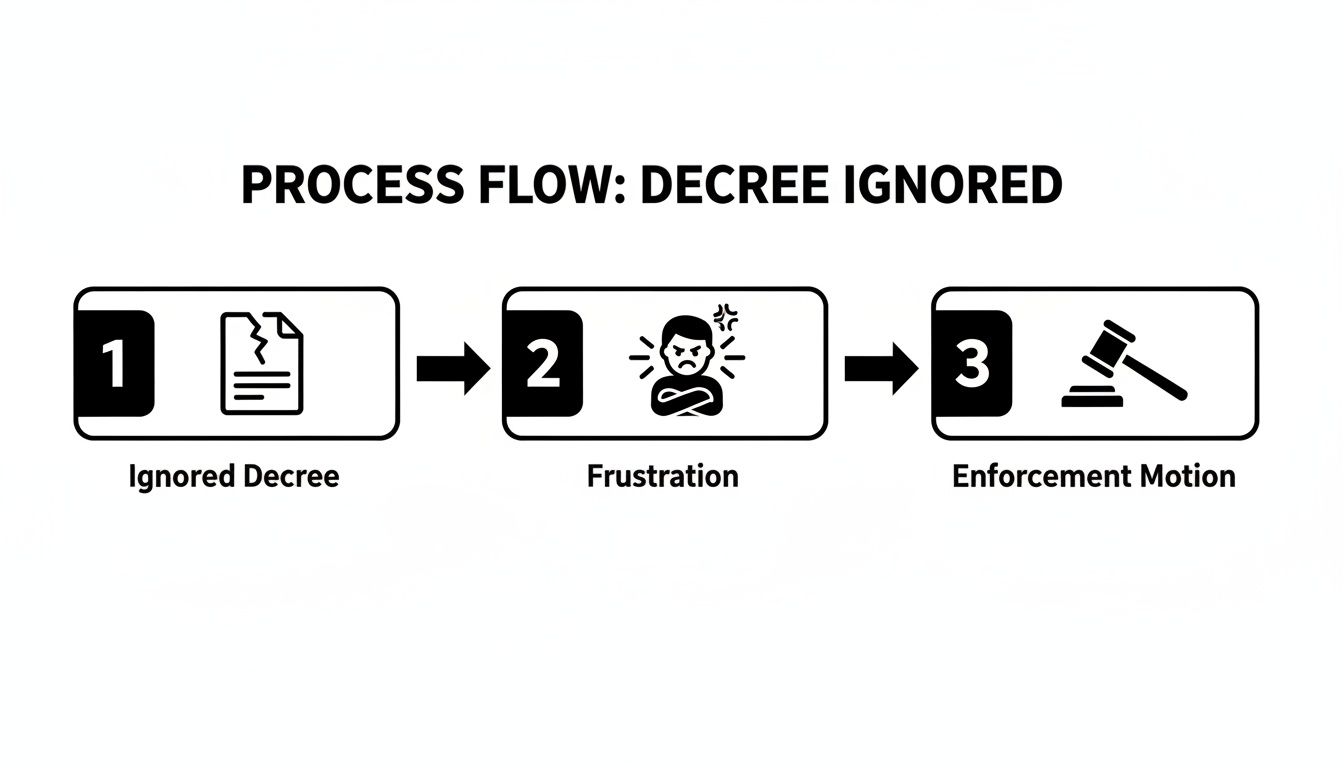
If that process looks familiar, you're not alone. This is exactly the point where legal action becomes necessary. A formal motion to enforce is how you break the cycle and get the court's attention. Here's a step-by-step look at how we help our Atascocita clients do just that.
Step 1: Your Free Consultation and Case Review
Everything starts with a conversation. When you come to our Atascocita office for a free consultation, we're not just going to glance at your paperwork; we're going to listen to your story. Our goal is to understand exactly what’s happening so we can build a solid foundation for your case.
To make the most of this meeting, it helps to bring:
- Your signed final divorce decree.
- Any proof you have of the violations, such as bank statements showing missed child support, texts where your ex denies visitation, or photos of property they haven't turned over.
This meeting allows a local divorce decree enforcement attorney in Atascocita to evaluate your position and walk you through the real-world options available under Texas law. We’ll provide clear, step-by-step guidance on what to do next.
Step 2: Drafting and Filing the Motion for Enforcement
Once you're ready to proceed, we get to work on the legal paperwork. The key document is a Motion for Enforcement, which we draft and file with the Harris County District Clerk.
This isn't just a simple form; it has to be incredibly precise. The motion must point to the specific parts of your decree that were violated and tell the judge exactly what you want done. For example, if $3,000 in child support is past due, the motion will demand an order for payment. If you've been denied five weekends with your children, it will ask the court to grant you make-up possession.
A well-crafted Motion for Enforcement is more than just a complaint. It's a strategic legal document that lays out the violations for the judge and requests specific, enforceable remedies allowed by the Texas Family Code.
Step 3: Making it Official: Serving Your Ex-Spouse
After the motion is filed, your ex-spouse must be formally notified. In legal terms, this is called "service." You can't just drop the papers off yourself or send them in an email. It has to be done by a neutral third party, like a private process server or a Harris County constable.
Proper service is non-negotiable—it's a fundamental requirement to ensure the case can move forward. It guarantees your ex has official notice of the court date and a fair chance to respond. Our team at The Law Office of Bryan Fagan handles all the logistics to make sure every rule is followed to the letter, so our Atascocita clients don't have to worry about these technical details.
Step 4: Building Your Case for Court
With a hearing on the calendar, our focus shifts to preparing you for your day in court. We'll work with you to organize all the evidence needed to prove the violations to the judge. While your testimony is crucial, it’s the documentation that often seals the deal. A case built on clear, verifiable proof is always more compelling.
From tracking down financial records to establishing a pattern of denied visitation, we help our Atascocita clients build the strongest argument possible. We'll also prepare you for what to expect inside the courtroom, how to handle questions, and what the most likely outcomes are. Preparation is key to walking into that hearing with confidence, knowing you have a strong advocate fighting for you. If you're ready to get started, contact us for a free consultation at our Atascocita office.
The Power of a Contempt of Court Ruling
It’s one of the most frustrating things we see as family law attorneys: you went through the entire divorce process, and you have a signed decree, but your ex-spouse is simply ignoring it. That court order, which is supposed to be the final word, feels like just a piece of paper.
This is where the court’s real power comes into play. When someone willfully ignores a judge's order, it's not just a problem between you and your ex anymore. It's a direct challenge to the court's authority, and judges in Harris County do not take that lightly. The single most powerful tool we have to get their attention is a contempt of court action.

Civil vs. Criminal Contempt: Two Sides of the Same Coin
When we file an enforcement action, we can ask the judge to find your ex in contempt. It's crucial for our clients in Atascocita to understand that there are two different types of contempt, each with a distinct purpose.
- Civil Contempt is all about getting the other person to comply. Think of it as coercive. The classic example involves jail time where the person in violation "holds the keys to their own cell." They can get out as soon as they do what the order says—like handing over the $5,000 in back child support they’ve been withholding.
- Criminal Contempt is about punishment for past bad acts. This is the court holding your ex accountable for their defiance. The penalties are fixed, like a specific fine (up to $500 per violation) or a set jail sentence (up to 180 days per violation).
In many of our cases, we ask for both. A judge can sentence someone to 10 days in jail for past failures to pay (criminal) and also order them to stay there until they've paid up (civil). It's an incredibly effective combination.
A Real-World Atascocita Scenario
Let's walk through a situation we see all the time. An Atascocita dad is supposed to receive child support, but his ex-wife, who has a steady job, has simply refused to pay for months. She's now $5,000 in arrears.
After our attorneys file a motion and prove she had the ability to pay but chose not to, the judge has several potent options:
- Grant a judgment for the $5,000 she owes, plus interest.
- Find her in criminal contempt for the months of non-payment and sentence her to 30 days in the Harris County jail. The judge might suspend this sentence, but only if she strictly follows a new payment plan.
- Use civil contempt by ordering her to be held in jail until the full $5,000 is paid.
Suddenly, the ignored court order has very real, immediate consequences. This is how we turn the tables and force compliance for our clients.
A contempt of court finding is a clear message from the judge: "My orders matter, and you will follow them." It leverages the court's full authority to protect your rights and bring finality to the conflict.
The messy reality of post-divorce life is why local expertise is so critical. While national data shows 41% of first marriages end in divorce, the fight often truly begins after the ink is dry. In fact, an alarming 61.9% of uncontested divorces are finalized without either person having a lawyer, which dramatically increases the risk of confusion and non-compliance down the road. You can see more on these trends in these divorce statistics and facts. This is exactly why having a sharp enforcement attorney is non-negotiable for protecting your rights in Harris County's busy court system.
The Role of Your Enforcement Attorney
Getting a judge to issue a contempt finding isn't about just complaining that your ex isn't cooperating. It’s a very specific legal process. We have to prove three things, clearly and methodically:
- There was a clear, unambiguous court order.
- Your ex-spouse knew about the order.
- Your ex-spouse had the ability to comply but willfully chose not to.
A seasoned Atascocita attorney knows exactly what a Harris County judge needs to see. We’ll gather the proof—bank records, incriminating text messages, pay stubs, witness testimony—and weave it into a compelling legal argument. We handle the precise drafting of the motion and stand up for you in the courtroom, so you can feel understood and supported.
If you're tired of your decree being ignored, it’s time to make the court's order mean something. Schedule a free consultation at our Atascocita office, and let's talk about how we can enforce your rights.
What Else Can a Judge Do? More Tools for Enforcing Your Decree
While holding someone in contempt of court is a serious step, it’s not the only move a Harris County judge can make to get your ex-spouse to follow the rules of your divorce decree. Think of it as a toolbox—and contempt is just one of the tools. An experienced attorney knows exactly which tool to grab for which problem to get the best results for their client.
The real goal isn't about punishment; it’s about getting the compliance you were promised. It’s about ensuring the property settlement is honored or that child support is paid on time. Let's walk through some of the other powerful options a judge can use to make things right for families in Atascocita.

Hitting Them in the Wallet: Wage Orders and Property Liens
When it comes to unpaid child support, one of the most effective strategies is a wage withholding order, which most people know as garnishment. It’s a pretty straightforward court order that goes directly to your ex's employer. Their payroll department is then legally required to deduct the child support payments before your ex even sees their paycheck and send the funds to the Texas Child Support Disbursement Unit. It takes the "forgetting" out of the equation.
For other major financial obligations, like an unpaid property settlement, we can turn to a property lien. Imagine your ex owes you a large sum of money from the divorce settlement. We can ask the judge to place a lien on their assets. This could be:
- The house they live in over in Humble or Atascocita
- A car, boat, or other vehicle
- Any other real estate they might own
A lien is essentially a legal flag on the property. It prevents them from selling or refinancing it without settling the debt they owe you first. It’s an incredibly effective way to secure what's rightfully yours, even if you don't get the cash immediately.
Applying Pressure by Suspending Licenses
So, what happens if your ex is self-employed or gets paid in cash, making a wage order useless? You’re not out of luck. Texas law gives judges a very creative and persuasive way to get someone's attention: license suspension.
A judge has the authority to order the suspension of all sorts of licenses until your ex complies with the decree. This isn't just a minor inconvenience; it can bring their life to a grinding halt. A judge can suspend their:
- Driver's license, making it illegal for them to drive.
- Professional licenses for doctors, lawyers, electricians, or real estate agents.
- Recreational licenses, like those needed for hunting and fishing.
Suddenly, the inability to legally drive or work in their chosen field becomes a very strong incentive to follow the court's orders. If you're dealing with this specific headache, our guide on how a lawyer for unpaid child support in Atascocita can be incredibly helpful.
You shouldn't have to pay to force your ex to follow the rules. Texas law recognizes this, allowing a judge to order the non-compliant party to cover your reasonable attorney’s fees for having to drag them back to court.
Fighting to enforce a decree is a major reason why divorce can become so expensive. While 40-50% of first marriages end in divorce, the financial battle doesn't always stop when the ink is dry. An uncontested divorce might run $15,000-$20,000, but when you have to repeatedly go back to court for enforcement, those costs can easily balloon, sometimes past $100,000. The Harris County family courts are filled with these disputes every single day, which is why having an experienced guide is so critical. You can see more family law statistics on clio.com.
There is no one-size-fits-all strategy here. Every situation is unique. Here at The Law Office of Bryan Fagan, our first step is always to listen to your story and analyze the specifics of your case. From there, we build a practical strategy to get you the resolution you deserve. If you're ready to see what your options are, schedule a free consultation with our team in Atascocita today.
Why a Local Atascocita Attorney Matters
You're probably asking yourself, "Do I really need a lawyer to file this? Can't I just do it myself?" The technical answer is yes, you can represent yourself. But in my years of experience helping families in our community, I’ve seen this decision backfire time and again. Trying to navigate the Harris County court system alone when you’re already stressed is a recipe for frustration and, often, failure.
When your ex-spouse is ignoring a court order, the last thing you need is another complex and draining battle. This is where having a local divorce decree enforcement attorney in Atascocita on your side isn’t just helpful—it's a critical part of your strategy.
The Home-Field Advantage in Harris County Courts
Having an attorney who practices in the Harris County family courts every day is an advantage you can't overstate. The procedures, filing rules, and even the unwritten expectations are different from one courthouse to the next. A lawyer who lives and breathes this system knows how to make it work for you.
Here’s what that local knowledge really means for our Atascocita and Humble clients:
- We Know the Judges: Every judge has their own way of managing their courtroom and specific views on enforcement cases. An experienced local attorney knows which arguments resonate with which judges and what kind of evidence they demand to see. It’s not about knowing them personally; it's about knowing their professional tendencies.
- We Master the Local Procedures: Something as small as an improperly formatted document or a missed deadline with the Harris County District Clerk's office can get your case thrown out or delayed for months. We handle these details every day, ensuring nothing falls through the cracks.
- We Build Cases That Win: We know what works in a Harris County courtroom. We understand how to frame your side of the story, present your evidence so that it's admissible, and craft a compelling argument that connects with the local judiciary.
This isn't about some secret "insider" knowledge. It’s about professional experience that we put to work to make the process smoother and more effective for you.
From Legal Headaches to Peace of Mind
Enforcing a divorce decree is far more than just filling out a few forms. It demands a sophisticated understanding of the Texas Family Code, the strict rules of evidence, and proper courtroom procedure. An experienced Atascocita attorney manages all of this for you.
We draft the precise legal motions, make sure your ex is properly served with the lawsuit, gather all the necessary evidence, and argue your case powerfully in court. This frees you up to step back from the fight and get back to your life—your job, your kids, and your own well-being.
Your job is to focus on your family's future. Our job is to handle the legal fight to protect it. By entrusting your case to a skilled local attorney, you gain not just a legal advocate, but a dedicated partner committed to securing the outcome you deserve.
For families here in Atascocita, Humble, and the surrounding areas, that local connection is everything. We don't see you as just another case file; we see you as our neighbor. We get the unique challenges families face in our community and are dedicated to providing strong, compassionate legal support. You can read more about how we approach these cases in our guide to choosing a divorce lawyer in Atascocita, Texas.
You Don't Have to Do This Alone
Facing a defiant ex-spouse is exhausting, emotionally and financially. You went through a divorce to put the conflict behind you; you shouldn't have to keep fighting on your own. The right attorney gives you more than just a powerful voice in court—they give you the support and clear guidance you need to navigate this difficult chapter.
If you live in Atascocita, Humble, or anywhere in northeast Harris County and you’re fed up with your divorce decree being treated like a suggestion, we're here to help. You have rights, and that court order is enforceable. Let us show you the path forward.
Take the first step. Schedule a free, no-obligation consultation at our Atascocita office. We’ll listen to what’s happening, explain your options in plain English, and map out a strategy to get the justice and peace of mind you were promised.
Answering Your Top Questions About Enforcing a Divorce Decree
When your ex-spouse decides your divorce decree is just a suggestion, it's easy to feel frustrated and powerless. You're not alone. We talk to people from Atascocita, Humble, and all over northeast Harris County who are in the exact same boat, and they all ask the same urgent questions: How long does this take? What if they still don't comply? And can I even afford to fight this?
Let's cut through the confusion. Drawing from years of experience in Harris County family courts, here are the straightforward answers you need.
How Long Does an Enforcement Action Take?
This is always the first question, and the honest answer is: it depends. Most of the time, you can expect an enforcement case to take anywhere from two to six months from start to finish.
What causes the timeline to stretch? A few things we see all the time in Harris County:
- The Court’s Jammed Schedule: The family courts that serve Atascocita are notoriously busy. Just getting a date on the judge's calendar for a hearing can take time.
- A Hard-to-Find Ex-Spouse: We have to formally "serve" your ex with the lawsuit papers. If they’re actively dodging service or have moved without a forwarding address, it adds a layer of delay while we track them down.
- The Case's Complexity: A straightforward case for unpaid child support, where we have clear financial records, often moves faster. On the other hand, a dispute over a complicated property division or a pattern of denied visitation that's harder to document will naturally take more time to build and argue.
We push every case forward as quickly as the system allows, but it’s crucial to understand that the legal process has built-in steps that simply can't be skipped.
What if My Ex Still Refuses to Comply After We Go to Court?
This is a very real fear, and we understand. What’s the point of going through all this if your ex just ignores the judge, too? This is where an enforcement action truly shows its teeth.
When a judge finds your ex-spouse in contempt, they often give them a chance to make things right—what’s known as a "suspended sentence." Think of it as probation. They avoid jail time if they start following the rules immediately.
If they violate the order again, we don't have to start from scratch. We can immediately go back to the judge and ask to revoke their probation and enforce the original punishment, which often includes jail time. At this point, the judge has a documented history of defiance and is much less likely to be lenient. The penalties become much more severe, including jail, steep fines, and a court order forcing them to pay every dime of your attorney's fees.
The first enforcement hearing is the warning shot. Any defiance after that isn't just a violation of your old decree—it's a direct slap in the face to the judge and their new order. Judges do not take that lightly.
Can I Afford to Hire an Attorney for This?
This is a huge, practical concern for most people in our community. The great thing about Texas law is that it anticipates this very issue. The Texas Family Code specifically empowers judges to order the person who violated the decree to pay for your reasonable attorney's fees and all court costs.
You will almost always need to pay a retainer fee upfront to get the case filed and moving. However, in every enforcement case we handle, a primary goal is to have the judge order your ex-spouse to reimburse you for those legal expenses. You shouldn't have to pay out of pocket because someone else refuses to follow a court order.
Sometimes, life throws a curveball, and the terms of the original decree just don't work anymore for you or your children. In those situations, you may need a post-divorce modification, which our Atascocita lawyers can explain. An enforcement is for forcing compliance with the current order; a modification is for changing the order itself.
An enforcement action is about protecting the rights you've already been granted. If you're ready to make your ex-spouse answer for their non-compliance, we're ready to help you take that first step. Call The Law Office of Bryan Fagan today to schedule your free consultation at our Atascocita office.