Skip to content

When your divorce was finalized, the court order probably felt like the last chapter in a long, difficult book. But life in Atascocita doesn't stand still. If you're facing major life changes, what worked for your family back then might be completely unworkable now. A post divorce modification lawyer in Atascocita can help you bring your legal agreements into line with your current reality, making sure your custody and support orders are still fair and practical for your family.
Adapting to Life After Divorce in Atascocita

That final divorce decree was meant to be a solid plan for the future. The truth is, life in communities like Atascocita and Humble is anything but static. Jobs change, kids grow up, and their needs evolve in ways no one could have possibly predicted when the ink on that order was still drying.
Seeking a post-divorce modification isn't about admitting failure or trying to re-fight old battles. It’s a smart, responsible step to ensure your legal arrangements actually work for your family's current best interests. As your neighbors, we understand that life just happens, and we're here to help you navigate these changes with compassion and practical advice.
Why Modifications Become Necessary
A great new job opportunity over by Lake Houston, a promotion that completely changes your work hours, or a child who suddenly needs a different school in Humble ISD—any of these can make an old custody schedule or support amount obsolete.
Thankfully, Texas law understands this. It provides a formal legal path to update your orders when things change significantly.
This process is called a post-divorce modification, and it lets you officially change key parts of your original decree. Here at The Law Office of Bryan Fagan in Atascocita, we guide families through this process every day for many valid, common-sense reasons.
We see a lot of life events that can trigger the need for a modification. To give you a clearer picture, here are some of the most frequent scenarios we handle for our northeast Harris County clients:
Common Reasons for Post-Divorce Modifications in Atascocita
This table outlines the most frequent life events that may legally justify a modification of your divorce decree in Texas.
| Type of Modification | Common Triggers | Example Scenario in Harris County |
|---|---|---|
| Child Custody | Parent relocation, child's preference (if 12+), change in a parent's work schedule, substance abuse issues, or a parent not following the current order. | A parent living in Atascocita gets a major promotion that requires a move to downtown Houston, making the original 50/50 possession schedule impossible to maintain. |
| Child Support | Significant increase or decrease (at least 20%) in either parent's income, change in the child's health insurance costs, or a change in custody arrangements. | The paying parent loses their job in the oil and gas sector and is unemployed for over six months, making the original child support amount unaffordable. |
| Spousal Maintenance | The receiving spouse remarries or cohabitates with a new partner, or other specific conditions outlined in the original decree are met. | The ex-wife who was receiving spousal maintenance gets remarried, which automatically terminates the legal obligation for her ex-husband to continue paying. |
These are just a few examples. The core requirement under Texas law is proving that a "material and substantial change" has occurred since your last order was signed.
The need for these adjustments is a normal part of post-divorce life. Even as divorce rates have seen a slight dip, the reality of co-parenting and managing separate households means many families will need to revisit their court orders at some point.
It's an interesting trend—while 41% of first marriages may end in divorce, that number climbs to 60% for second marriages and a staggering 73% for third marriages. For families right here in Harris County, this data underscores a simple fact: life after divorce is complex and often requires ongoing legal adjustments. Skilled, compassionate legal guidance is not a luxury; it's essential for navigating these changes.
Our goal is to help you see that asking for a change isn't about starting a war. It's about adapting responsibly to life's new circumstances. Whether you need to modify child custody, visitation schedules, or support payments, a local post divorce modification lawyer in Atascocita can be your guide.
We'll help you file the correct paperwork and build a compelling case to protect your family's future. To get the conversation started, schedule a free, no-obligation consultation with our team at our Atascocita office today.
Understanding the Material and Substantial Change Standard
Life changes after a divorce. That’s a given. But when those changes are big enough to make your original divorce decree unworkable, Texas law provides a way forward. To get a judge to alter your order, you first have to prove there's been a "material and substantial change in circumstances" since it was signed.
This isn't just a legal phrase; it's the specific hurdle you must clear. So, what does that actually mean for your family here in the Atascocita area? In short, the change has to be a genuine, significant shift in the life of a parent or child—not something temporary or minor. A Harris County judge won't rewrite your order just because you and your ex have a new disagreement. They need to see that the current order is now impractical or no longer serves the child’s best interest.
What Orders Can Be Changed?
It’s critical to know right from the start that some parts of your divorce decree are set in stone, while others can be revisited. Understanding this can save you a tremendous amount of time, money, and frustration.
Generally, the parts of your order that can be changed are those related to your children and ongoing financial support. These are considered "living" parts of the agreement because life is unpredictable. They include:
- Child Custody (Conservatorship): This covers who has the right to decide where the child lives.
- Visitation (Possession and Access): We can ask the court to adjust the parenting schedule for weekends, holidays, or summer break.
- Child Support: Payments can be increased or decreased to reflect new financial realities.
- Medical and Dental Support: This involves who provides health insurance and how out-of-pocket costs are handled.
On the other hand, one major part of your decree is almost always final:
- Property Division: The way your community property—the house, cars, retirement accounts, debts—was divided is final. Once the judge signs that decree, you can't go back and ask for a do-over on who got what.
What Qualifies as a Material and Substantial Change?
So, what kind of life event is "material and substantial" enough to convince a judge? There’s no magic formula, because every family's situation is unique. But over the years, we've seen clear patterns of what consistently meets this standard in Texas courts.
Think about the realities of life around here. Maybe a parent working in the Houston Ship Channel gets a huge promotion, effectively doubling their income. Or perhaps a child attending school in the Humble ISD is diagnosed with a condition that requires specialized care or a completely different school environment.
The core idea is that these modifications become necessary when major life shifts happen. Whether it’s a big change in income, a job loss, a parent remarrying, or a child's needs evolving, a Harris County judge will only modify custody or support if you can prove this significant change has occurred.
We often see this standard met when there's a 20-30% change in income or a parent plans a relocation more than 100 miles away. You can't just tell the judge this happened; you have to show them. This means gathering documentation like pay stubs, tax returns, school records, or doctor's reports to build your case.
Local Examples of Qualifying Changes
Let's ground this in some real-world examples that could easily happen to a family in Atascocita, Kingwood, or Humble:
- Job Loss or Promotion: A parent working at the Deerbrook Mall gets laid off, and their income plummets. The current child support payment is now simply impossible to make. On the flip side, a parent could land a high-paying new job in the energy corridor, which would likely justify an increase in support.
- Relocation for Work: A parent gets a fantastic job offer but it's in Austin. A move like that makes the standard possession schedule totally unworkable and requires a new, long-distance plan.
- Child’s Evolving Needs: A teenager attending Atascocita High School expresses a strong, mature desire to live with their other parent to be closer to their sports team and friends, and the court may find this to be in their best interest.
- A Parent's New Family: A parent remarries and has another child. This new reality can impact their financial situation or their availability for the current visitation schedule, sometimes justifying a modification.
If any of these scenarios sound familiar, you may have solid grounds to file a modification. The details matter, especially when it comes to financial adjustments. To learn more about this specific area, you can review our guide on how to approach a child support modification.
The next step is figuring out how to effectively present these changes to the court. An experienced post-divorce modification lawyer in Atascocita can help you gather the right evidence to build a compelling case.
Navigating the Modification Process in Harris County
Thinking about changing a court order can feel like stepping into a whole new legal world. It's a formal process, and for most folks in Atascocita and Humble, it's an unfamiliar path. But you don’t have to walk it alone. We’ve handled countless modifications in the Harris County court system, and our goal is to make the journey as clear and stress-free as possible.
This isn't just about filing paperwork. It's about building a solid case that accurately shows the judge how your life has changed. We're here to guide you through it all, helping your family move toward a fair, updated arrangement that actually works.
Your First Step: The Free Consultation
Everything begins with a conversation. When you come into our Atascocita office for a free consultation, the first thing we do is listen. What’s different now? What parts of your current divorce decree or custody order just aren't sustainable anymore?
We’ll talk specifics. Are you looking to adjust child support after a major promotion or, conversely, a layoff? Has a new job or a necessary move made the old visitation schedule impossible? We'll give you an honest, straightforward assessment of whether your situation meets the “material and substantial change” standard required by Texas law.
This initial meeting is a no-pressure chance for you to get real answers and feel understood. You’ll walk away with a much clearer picture of your legal options and what the road ahead might look like.
Step Two: Gathering Your Evidence
Once you decide to move forward, we shift our focus to preparation. A successful modification hinges on solid proof. You can't just tell a judge that your income dropped; you have to show them. As your post divorce modification lawyer in Atascocita, we guide you in gathering the exact documents needed for your specific situation.
Depending on your case, this evidence might include things like:
- Financial Records: Pay stubs, W-2s, tax returns, or bank statements that clearly document a significant change in income for you or your ex-spouse.
- School and Medical Records: Report cards showing a decline in grades, attendance logs, or notes from a therapist to demonstrate a child’s changing needs or struggles under the current arrangement.
- Communication Logs: A history of text messages, emails, or conversations in a co-parenting app that reveals a pattern of conflict or one parent's refusal to follow the current order.
- Relocation Details: A formal job offer letter in another city, a new lease agreement, or other proof that a move is necessary.
We help you organize this mountain of information into a compelling narrative that leaves no doubt for the court why a change is justified.
The graphic below simplifies this legal journey, showing how a significant life event acts as the catalyst to transform your old court order into a new one.
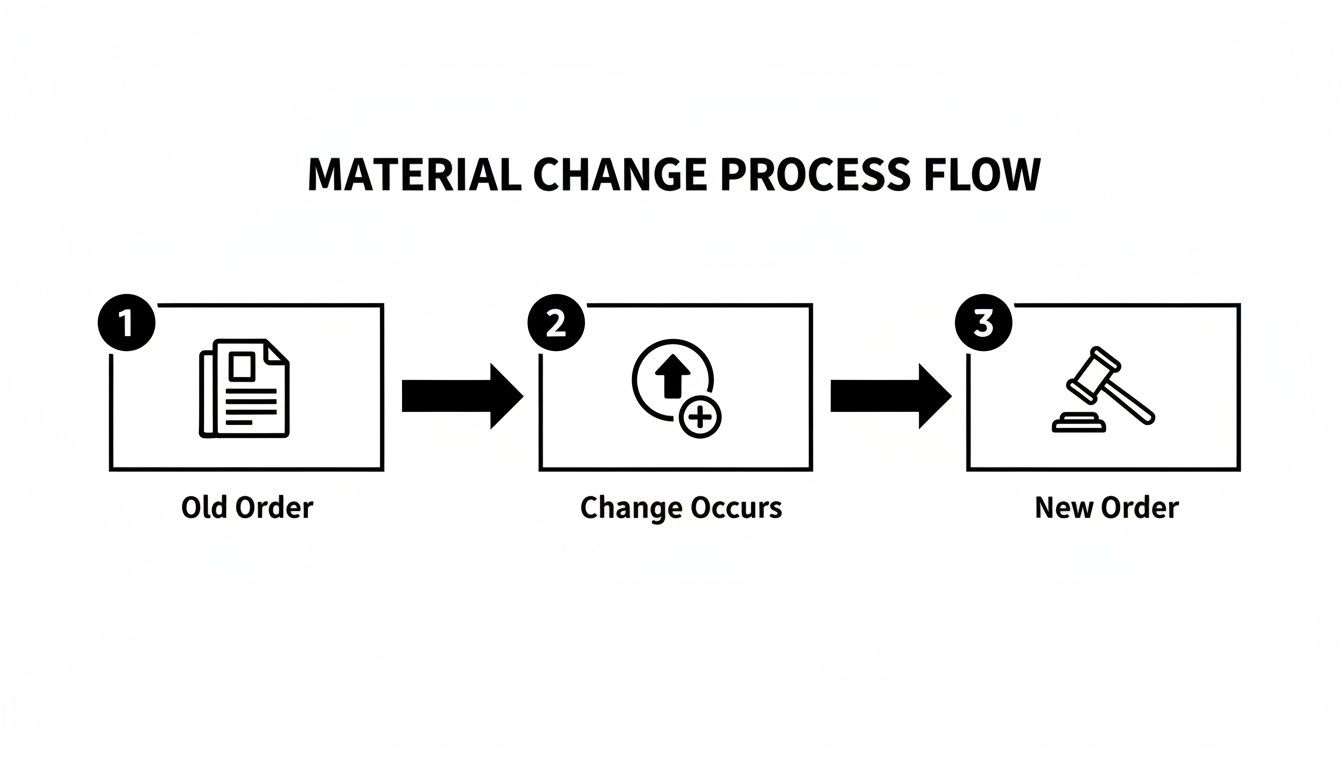
This process flow shows the path from your old order, through the life change, to a new, enforceable order that reflects your family's current reality.
Step Three: Filing the Petition and Navigating the Courts
With your evidence compiled, we then draft and file the official document that kicks things off: the Petition to Modify the Parent-Child Relationship. This document is filed downtown at the Harris County Civil Courthouse, and it formally tells the court and your ex-spouse what changes you’re requesting and why.
Getting this first filing right is critical. Simple mistakes can cause frustrating delays or even get your case dismissed. Our deep familiarity with the Harris County District Clerk’s office and local court rules ensures everything is filed correctly from the get-go. We handle the procedural headaches so you can focus on your family. For more background on local court procedures, our guide to filing for divorce in Harris County offers helpful context.
After the petition is filed, your ex-spouse must be formally "served" with the lawsuit. From there, they have a set amount of time to file a response. The next steps really depend on whether they agree with the changes you've proposed.
Key Stages: Temporary Orders and Mediation
If your ex-spouse contests the modification, the path forward often involves asking the court for temporary orders. These are short-term rulings that put a plan in place while the case is pending. For instance, a judge might issue a temporary possession schedule or adjust child support until a final agreement or trial can happen. This usually requires a temporary orders hearing—a sort of mini-trial where we present the most urgent evidence to the judge.
In Harris County, it's almost a given that judges will require parents to attend mediation before they will set a case for a final trial. Mediation is a confidential meeting where you, your ex, and a neutral third-party mediator work to negotiate a resolution outside of court.
Frankly, mediation is where the vast majority of modification cases get resolved. It gives you more control over the outcome and is almost always cheaper and less adversarial than going to trial. We'll be right there with you during the mediation, advocating for your position and helping you negotiate a settlement that protects your interests. If you reach an agreement, we draft it into a final order for the judge to sign. If not, we are always prepared to fight for you in the courtroom.
Modifying Custody for Today’s Families
Of all the things a divorce decree sets in stone, nothing feels more permanent—or more emotional—than the child custody order. In Texas, we call this a “possession order,” and it’s really just a snapshot of your family’s life at a specific moment. But life doesn’t stand still, does it?
As your children grow and your own circumstances shift, that old schedule can start to feel less like a solution and more like a source of constant friction.
Maybe your work schedule has changed, making those weekday pickups impossible. Perhaps your child made the competitive soccer team at their Humble ISD school, and the practice schedule completely conflicts with the current order. For older kids, especially, their own social lives and preferences start to take center stage. When these real-life situations pop up, modifying your order isn’t just a good idea—it’s often a necessity for keeping the peace.
It All Comes Down to the “Best Interest of the Child”
When a Harris County judge looks at any case involving children, they have one guiding principle: making a decision that is in the “best interest of the child.” This isn’t just a catchphrase; it’s the legal standard that underpins every single ruling.
To figure out what’s “best,” the court considers a set of guidelines known as the “Holley factors.” When you’re asking to change a custody order, your job is to show the judge two key things: first, that a material and substantial change has happened since the last order was signed, and second, that the modification you’re proposing is now in your child’s best interest.
Some of the things a judge will look at include:
- The child's immediate physical and emotional needs.
- Any potential danger to the child, either now or in the future.
- Each parent's ability to provide a stable, loving home.
- The stability of each home environment.
- The child's own wishes, especially if they are 12 years of age or older.
For instance, if your teenager at Atascocita High School has a mature, well-reasoned desire to live primarily with the other parent to be closer to their friends and after-school job, a judge is going to give that serious weight.
The heart of any custody modification is telling a clear story about how the changes you want will directly benefit your child. This isn't about one parent winning and the other losing. It's about crafting a stable, supportive environment where your child can flourish.
Our role is to help you frame your situation and your evidence through this lens. We'll work to show the court exactly why your proposed plan is the best path forward for your child's well-being.
How Parenting Has Evolved and Why It Matters
Parenting roles and family dynamics have changed dramatically over the last few decades, and family law has had to adapt. One of the biggest shifts we’ve seen is the move away from the "standard" possession order toward more balanced, shared parenting plans.
Think about it: an order from 10 years ago might have designated one parent as the primary caregiver while giving the other parent visitation every first, third, and fifth weekend. That was common then, but it doesn’t always fit today’s co-parenting realities.
This isn’t just an observation; the data backs it up. A major study showed the rate of shared physical custody arrangements more than doubled nationwide, jumping from just 13% before 1985 to 34% by 2014. Here in Harris County, judges are very aware of this trend.
This cultural shift can actually work in your favor. If you’re trying to update an older, more traditional order to a 50/50 or expanded schedule, judges are often receptive, provided you can show it’s what your child needs now. As an experienced post divorce modification lawyer in Atascocita, our team knows how to use these evolving norms to build a stronger argument for your case.
Starting the Conversation with Your Ex-Spouse
Even if you have a rock-solid case, the best place to start is often with a direct, calm conversation with your co-parent. If you can talk through the issues and come to an agreement, you’ll save everyone a tremendous amount of time, stress, and money.
When you have this talk, frame everything around the child’s needs, not your own frustrations.
- Instead of: “Your new job is messing up the whole schedule.”
- Try: “I’m worried about getting Sarah to her tutoring on time. Would it help if we swapped Tuesdays for Wednesdays?”
If you manage to work things out, that’s fantastic! But be warned: a simple handshake or verbal agreement is not legally enforceable in Texas. To make it official, you have to put it in writing and get a judge to sign a new order. Our firm can help you draft an agreed modification order to ensure it’s done right and protects everyone.
Of course, these talks don't always go smoothly. If your ex refuses to cooperate or things get heated, that’s your cue to bring in a legal professional. From there, we can step in to negotiate or, if it comes to it, advocate for you in court. You can learn more about what that process looks like in our guide on custody modification in Atascocita.
Whether we reach a resolution through mediation or in front of a judge, our goal remains the same: to secure a new custody arrangement that fits your family's life today and protects your child’s stability.
Why a Local Atascocita Lawyer Makes a Difference

When you need to modify a court order, you might think any licensed attorney can do the job. Technically, that’s true. But the reality on the ground is that having a local Atascocita lawyer from The Law Office of Bryan Fagan gives you a home-field advantage you can't get anywhere else.
This isn’t just about having an office down the street. It’s about hiring a legal team that lives and breathes the Harris County family court system. We're not just practicing law in your community; we're part of it. We are deeply invested in helping our neighbors in Atascocita and Humble find stable, fair, and lasting solutions for their families.
Unmatched Knowledge of the Harris County Courts
Every courthouse has its own unwritten rules, and the Harris County family courts are no different. Each judge has a unique way of looking at cases, specific procedures they prefer, and arguments they find more compelling than others. An out-of-town lawyer simply won’t have this firsthand intelligence.
Our attorneys are in front of Harris County judges almost daily. We know their temperaments, their expectations, and what it takes to build a persuasive case in their courtroom. We’ve also built professional relationships with court staff and the local attorneys on the other side of the aisle, which helps us cut through red tape and resolve issues without unnecessary friction or delays.
This local insight is a huge strategic benefit. It helps us:
- Dodge common filing errors that can get your case stuck in administrative limbo.
- Frame your evidence in a way that resonates with your specific judge.
- Anticipate the other side's next move because we’ve likely faced that law firm before.
A Reputation for Effective Mediation and Negotiation
While we are always ready for a courtroom battle, the reality is that most modification cases get resolved in mediation. Our firm has earned a solid reputation in the Atascocita legal community for being tough but fair negotiators who get things done.
When we enter a mediation, opposing counsel and mediators know we are prepared and serious about finding a practical solution. That reputation alone often brings the other party to the table in good faith, saving you the immense stress and financial drain of a prolonged court fight.
We are your local partners, invested in your family’s future. Choosing a local firm means you're getting an advocate who understands the community, the courts, and what it takes to protect what matters most to you.
Just recently, we worked with a mother in Atascocita who needed to relocate for her child's specialized medical treatments. Her ex-husband was initially dead-set against modifying their custody order. Knowing the local courts prioritize a child's health above almost all else, we guided her to collect powerful medical documentation and presented a clear, organized proposal in mediation. An agreement was reached, and she avoided a trial altogether.
We Are Your Neighbors in Atascocita
Beyond the legal tactics, there’s a real, practical benefit to working with someone who just gets it. When we discuss school districts, we know the difference between Humble ISD and Sheldon ISD. When you mention a new job near Lake Houston, we know exactly what that commute looks like. This shared context isn't trivial—it helps us build a stronger case for you.
This community connection is at the core of our practice. We aren't some faceless, corporate firm with a satellite office. We’re your neighbors, dedicated to giving clear advice and compassionate support to the families of Atascocita because we believe strong families build a strong community. Choosing a local post divorce modification lawyer in Atascocita is choosing a partner who is genuinely invested in your success.
When you're ready to discuss your options, you don't have to fight Houston traffic. Our Atascocita office is right here, ready to help. Schedule a free, no-obligation consultation with us today, and let's talk about how we can help you and your family move forward.
Common Questions About Post-Divorce Modifications
When you're thinking about changing your divorce decree, a lot of questions and "what-ifs" can pop up. It's completely normal. Having worked with countless families in Atascocita and Humble, we've heard just about every question there is. Here are some of the most frequent ones we answer for our clients.
How Much Is This Going to Cost?
This is usually the first question people ask, and the honest answer is: it depends. If you and your ex-spouse are on the same page and can sign off on the changes, it’s an uncontested modification. This is by far the most direct and cost-effective path.
However, if you can’t agree, the case becomes contested. This might involve formal discovery, multiple court hearings, and potentially a trial, which naturally increases the legal costs. We're always upfront about pricing. In your free consultation, we'll give you a clear estimate based on your specific situation and talk through payment options that can work for you.
Can We Just Make a New Agreement Ourselves Without Going to Court?
It’s fantastic when you can work things out with your co-parent, but a handshake deal or even a written note between the two of you is not legally enforceable in Texas. This is a critical point many people miss.
If your ex suddenly decides to stop following your informal agreement, there’s nothing you can do legally to enforce it. The old court order is the only thing that matters. To truly protect yourself, the new agreement must be drafted into a formal order and signed by a judge. A post-divorce modification lawyer in Atascocita can handle this for you, making your new arrangement official and binding.
How Long Does a Modification Take in Harris County?
The timeline really hinges on how much cooperation there is. An uncontested case where everyone signs the documents promptly can be wrapped up in a couple of months.
Contested cases, on the other hand, take longer. An experienced local attorney who knows the ins and outs of the Harris County family courts can make a huge difference. We know how to navigate the system, avoid common roadblocks, and keep your case from getting stuck in limbo.
What Happens if My Ex-Spouse Refuses to Agree?
This is a common scenario, and it’s not a dead end. It just means we need to get to work. If your ex won’t budge on a change that is clearly needed, that's when having a strong advocate becomes essential.
We'll start with negotiation and mediation, which often resolves things. But if your ex remains unreasonable, we are fully prepared to fight for you and your child in the courtroom. Our job is to build a compelling case showing the judge why the change is necessary and in your child's best interest.
If you're facing a significant life change and need to update your court orders, you don't have to figure it out alone. The team at The Law Office of Bryan Fagan – Atascocita TX Lawyers is ready to help. Schedule a free, no-pressure consultation at our Atascocita office by visiting us at https://www.atascocitaattorneys.com.