Skip to content

When the thought of divorce takes root, it's often followed by a wave of overwhelming questions. If you live in Atascocita, Humble, or anywhere in northeast Harris County, you’re likely searching for a "divorce lawyer atascocita texas" and feeling a mix of anxiety and confusion.
At The Law Office of Bryan Fagan, we wrote this guide to cut through the noise. It’s a straightforward, local roadmap designed to give our Atascocita neighbors clarity and real answers, not more legal jargon. Our hope is that by the end, you’ll feel less uncertain and more confident about what comes next.
Navigating Divorce in Atascocita With a Local Advocate
Thinking about divorce brings up a whirlwind of concerns. Where do I even start? Who can I trust? How will this impact my kids, my house, my savings? It’s a deeply personal process, and facing the legal system alone can make you feel like just another case file.

At The Law Office of Bryan Fagan, we’re not just lawyers who practice in the area—we’re your neighbors. We understand that a divorce here isn't just a legal transaction. It’s about carefully and respectfully restructuring your family’s future, right here in our community.
A Straightforward Guide for Our Atascocita Neighbors
We built this guide to break down the Texas divorce process into understandable pieces, always keeping the perspective of local residents in mind. We'll walk you through everything, focusing on what truly matters to families in Atascocita, Humble, and northeast Harris County.
Here’s a look at what we’ll cover:
- The Harris County Legal System: We’ll explain the specific court procedures and timelines you can expect locally, so you’re never caught off guard.
- Step-by-Step Divorce Process: From the first filing to the final decree, we’ll map out each stage of the process in plain English.
- Protecting Your Children and Assets: We’ll translate Texas’s rules on child custody (what the law calls conservatorship) and community property into practical advice, using examples relevant to our communities.
- Choosing the Right Attorney: You'll learn exactly what to look for when you’re ready to hire someone to represent you in the Harris County courts.
We believe that when you understand the process, you're in a much better position to make smart, clear-headed decisions for your family. Knowledge is power, especially now.
This is ultimately about moving forward to a new, stable chapter in your life. To do that, you need a partner who provides tough, effective representation in the Harris County courts while also offering the compassionate, human guidance you deserve.
Think of this guide as your starting point. When you’re ready to talk about your unique situation, our team is here to listen. Schedule a free, no-obligation consultation at our Atascocita office to speak with a lawyer who genuinely wants to help you protect your future.
Understanding the Harris County Divorce Landscape
If you're facing a divorce in Atascocita, you might assume the process is the same all across Texas. But that’s not quite right. The reality is, filing for divorce here in Harris County is a unique experience, and understanding why can make all the difference in how your case unfolds.
Think about it like this: driving down a quiet country road is a completely different ballgame than navigating the Sam Houston Tollway during rush hour. Both are roads, sure, but the Houston freeway demands a specific set of skills, local knowledge, and an ability to anticipate what’s coming next. The Harris County legal system is a lot like that freeway—fast, crowded, and unforgiving if you don't know the rules of the road.
The Fast-Paced Harris County Court System
The Harris County Civil Courthouse, which handles all divorce cases for Atascocita, Humble, and the surrounding communities, is one of the busiest legal hubs in the entire country. This isn't just a trivial fact; it creates a high-speed environment with its own set of procedures and unwritten rules. For someone walking in for the first time, it can feel overwhelming and incredibly impersonal.
This is where having a true divorce lawyer in Atascocita, Texas becomes so critical. An attorney who is in these specific courtrooms every day develops a practical wisdom you just can't get from a textbook. They understand the judges' personalities, know the clerks' expectations, and understand the best way to navigate this high-volume system to protect their clients.
Divorce Rates: A Look at Harris County vs Texas
Just how busy are our local courts? The numbers speak for themselves. The sheer volume of divorce filings in our area has a direct impact on everything from timelines to judicial attention. This table puts the local demand for divorce services into perspective.
| Statistic | Harris County (Includes Atascocita) | Texas Statewide Average |
|---|---|---|
| Annual Divorce Filings | Approximately 28,500 | N/A |
| Divorce Rate (per 1,000 residents) | 3.4 | 2.6 |
Source: Data compiled from Texas state health services and county clerk records.
As you can see, the divorce rate here is significantly higher than the statewide average. This intense volume means the court dockets are packed, deadlines are strictly enforced, and judges simply don't have the time to linger on any single case. Without a guide who knows this rhythm, it’s easy to make a procedural misstep that could stall your case or even harm the outcome. For a deeper dive into these numbers, you can review more detailed Texas divorce statistics.
An attorney familiar with Harris County's pace can anticipate roadblocks, prepare filings that meet the court’s exact standards, and ensure your case keeps moving forward without getting lost in the shuffle.
Navigating Local Court Procedures and Expectations
Every courthouse develops its own unique culture, and Harris County is no exception. There are specific preferences for how documents must be filed, unspoken rules for scheduling hearings, and even established norms for how lawyers are expected to communicate with the court and each other.
Here’s what that local know-how means for your divorce case:
- Efficiency: A lawyer who knows the system gets documents filed correctly the first time, avoiding frustrating rejections and delays.
- Strategy: Being familiar with the individual judges allows an attorney to frame arguments in a way that is most likely to connect and persuade.
- Relationships: Solid professional relationships with court staff and other local attorneys can smooth over minor issues quickly and quietly, saving you significant time, money, and stress.
Choosing a lawyer who is deeply embedded in the Harris County legal community isn’t a minor detail—it’s a foundational part of your strategy. It means your case is in the hands of someone who not only knows the law but knows how to make our local system work for you. At The Law Office of Bryan Fagan, our daily work in these courthouses is what gives our clients that essential local advantage.
Your Step-By-Step Guide to the Texas Divorce Process
Going through a divorce in Texas can feel like you've been handed a map to a foreign country, with confusing roads and unfamiliar landmarks. But it doesn't have to be that way. While every family's situation is unique, the legal path follows a predictable sequence. Let's walk through it step-by-step so you know exactly what to expect.
The whole process starts when one spouse, who the court will call the Petitioner, files a document called an Original Petition for Divorce. This paperwork is filed with the Harris County District Clerk and officially gets the ball rolling. Think of it as the starting pistol—it formally tells the court and your spouse that you are seeking to end the marriage.
Of course, your spouse has to be officially told that a case has been filed. This isn't done with a simple phone call or text. It requires a formal process called "service," where a neutral person—like a sheriff's deputy or a private process server—delivers a copy of the lawsuit papers. This crucial step ensures everyone is on the same page from day one.
The Initial Filing and Waiting Period
Once that petition is filed, a timer starts. Texas has a mandatory 60-day waiting period. This means a judge cannot legally grant your divorce until at least 61 days have passed from the filing date. There are very rare exceptions, like cases involving family violence, but for most people, this waiting period is a given.
This isn't just dead time, though. The law intends for this to be a "cooling-off" period, giving you both a moment to breathe and even reconsider. More practically, this is your window to get organized, hire your attorney, and start planning for what comes next.
This flowchart shows how divorce filings from our local Atascocita community flow into the larger Harris County court system.
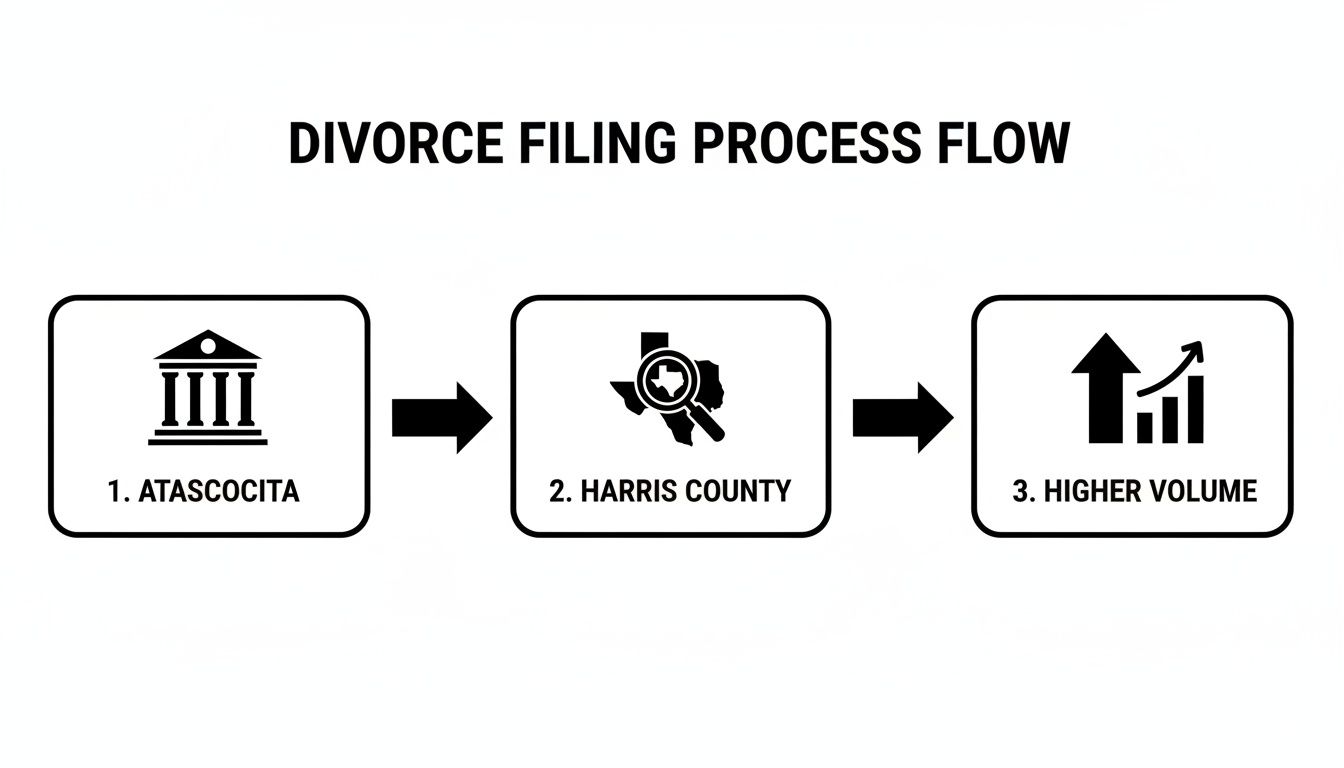
As you can see, your individual case is part of a high volume of matters handled by the Harris County judges every single day.
Temporary Orders and the Discovery Phase
While that 60-day clock is ticking, life goes on. The kids still have school, the mortgage is still due, and you and your spouse are likely living apart. This is where Temporary Orders come in. These are absolutely critical. They are court-enforceable rules that set the ground game for how things will work while the divorce is ongoing.
Getting strong, clear Temporary Orders is one of the most important things your attorney will do for you. These orders will establish:
- Who gets to stay in the family home.
- A temporary schedule for when each parent has the children.
- Who is responsible for paying the mortgage, car notes, and other bills.
- Whether temporary child support or spousal support is needed.
After Temporary Orders are in place, the case moves into what's known as Discovery. This is the formal information-gathering phase. It's like both sides have to lay their cards on the table, especially when it comes to finances. Through tools like written questions (Interrogatories) and formal interviews under oath (Depositions), your attorney builds a complete financial picture to ensure a fair division of property.
Mediation, Negotiation, and Finalization
Once all the information is out in the open, it's time to negotiate a final settlement. In Harris County, the vast majority of cases are required to go to Mediation before a judge will even consider hearing your case at a trial.
Mediation is a structured negotiation session. You, your spouse, your attorneys, and a neutral third-party mediator all sit down to work through the unresolved issues. The mediator doesn't make decisions but helps you find common ground and craft your own agreement.
This is where most cases are settled. In fact, well over 90% of divorces are finalized through agreements reached in mediation, not in a dramatic courtroom showdown. It saves an incredible amount of money, time, and emotional turmoil.
The agreement you create becomes the blueprint for your Final Decree of Divorce. This is the comprehensive legal document that officially ends your marriage and spells out every detail—from who gets the house to your final parenting plan. For a deeper dive, you can read our complete guide on how to file for divorce in Texas.
If you reach a full agreement, the last step is a short, informal court appearance called a "prove-up." Here, you'll answer a few simple questions for the judge, who will then sign your Final Decree. At that moment, your divorce is official, and you are free to start your next chapter.
Protecting Your Family and Finances in a Divorce
When you're facing a divorce, your mind is usually racing with two overwhelming questions: "What will happen to my kids?" and "How will we divide everything we've built?" These aren't just legal issues; they're deeply personal, and they represent your future. Getting them right is everything.

When you're looking for a divorce lawyer in Atascocita, Texas, you need an advocate who gets it. You need someone who understands that these aren't just files and motions—they're your life. Our job is to protect your rights as a parent and secure your financial footing with skill and genuine care.
Child Custody in Texas: Understanding Conservatorship
While most of us talk about "custody," you'll find that Texas law actually uses a different term: conservatorship. This is simply the legal framework that outlines each parent's rights and responsibilities for their children. Above all else, a Harris County judge’s decisions will be guided by one single principle: the "best interest of the child."
In the vast majority of cases, Texas courts favor what’s known as Joint Managing Conservatorship. This is the standard arrangement for a reason—it presumes that having both parents actively involved in a child’s life is best. It means you and your co-parent will share the responsibility for making major life decisions.
These shared decisions typically cover:
- Education: Choosing schools and staying involved in their academic life.
- Medical Care: Agreeing on doctors, major treatments, and mental health support.
- Religious Upbringing: Deciding on the spiritual or moral guidance for your children.
Even with a joint setup, one parent is usually designated as the "primary" conservator. This parent has the right to decide where the children live (often within a certain geographic area, like Harris County and its neighbors) and receives child support. The other parent, the "possessory" conservator, has a visitation schedule, which is laid out in a possession order.
The whole point is to ensure both parents remain a consistent, stable presence. A possession order isn't about one parent "winning" time and the other "losing." It's about creating a reliable routine for the kids. We often help Atascocita families build custom schedules that align with the Humble ISD calendar, making holidays and summer breaks predictable for everyone.
Dividing Your Assets: Community Property Explained
The other half of the equation is dividing your marital estate. Texas is a community property state. The easiest way to think about it is to imagine a shared basket. Throughout your marriage, nearly everything you and your spouse earned or acquired—income, property, investments—went into that basket. Now, the court's job is to divide the contents of that basket fairly.
Here’s how the law sorts everything:
- Separate Property: This is anything you owned before the wedding, plus any gifts or inheritances you received personally during the marriage. This property belongs to you alone and isn't part of the marital estate to be divided.
- Community Property: This is the basket. It includes all assets and debts either of you acquired while married. It makes no difference whose paycheck bought the asset or whose name is on the account. If it was acquired during the marriage, the law presumes it's community property.
This basket includes the family home in a community like Eagle Springs, the balance in a 401(k) retirement account, cars, and furniture. It also includes debts, like credit card balances and mortgages.
A Texas court must divide the community estate in a "just and right" manner. Notice the wording—it doesn't say "equal." A 50/50 split is often the starting point, but a judge can adjust the division based on factors like fault in the divorce, differences in earning potential, or who will be caring for the kids. A skilled attorney’s role is to build a clear financial picture and argue for a division that protects your long-term security.
Who Files for Divorce and What It Means for Your Case
When you're facing a divorce, it can feel like you’re the only person in the world going through it. But behind the legal filings and financial worksheets, there’s always a human story. Understanding the common dynamics of who files for divorce—and why—can give you some much-needed perspective, whether you're considering it yourself or have just been served papers.
This isn't about pointing fingers. It's about seeing the bigger picture. As divorce lawyers in Atascocita, we know that the emotional reality of your separation is just as critical as the legal facts on paper.
The Dynamics of Who Initiates Divorce
It might come as a surprise, but there's a very clear trend when it comes to who actually files the first paperwork. The data consistently shows that women are far more likely to initiate a divorce. In Texas, and across the country, women file roughly 69-70% of all divorce petitions.
That number tells a story. It’s not just a statistic; it points to a deeper reality in many marriages. Studies often highlight things like an unequal division of household chores and "emotional labor"—the unseen work of managing a family's emotional well-being and social calendar. When one spouse feels they’re shouldering most of that burden, dissatisfaction can build until ending the marriage feels like the only path forward. You can see more of the data behind these trends in these Texas divorce and custody statistics.
We get it. Understanding this context is central to how we approach every case at The Law Office of Bryan Fagan. We know that by the time you walk into our office, there are years of history that led you here. Whether you’re feeling unheard or completely blindsided, our first job is simply to listen.
Knowing this helps us build a better strategy. If you're the one filing, it helps validate your experience. If you're the one responding, it can shed light on your spouse's perspective, which is often the first step toward finding a more constructive path forward.
How Different Life Stages Impact Divorce
Divorce looks completely different depending on where you are in life. A young couple in their 20s with a toddler is facing a different set of problems than a couple in their 50s who've been married for 30 years.
One of the most significant trends we're seeing is the rise of "gray divorce"—couples divorcing after the age of 50. For many of our neighbors here in Atascocita and Humble, this is their reality, and it comes with a unique set of financial and legal challenges.
After a long marriage, a gray divorce almost always involves:
- Complex Retirement Accounts: Untangling decades of 401(k)s, pensions, and investments is no simple task. It requires specific legal tools like a Qualified Domestic Relations Order (QDRO) to divide these assets correctly without triggering massive tax penalties.
- Spousal Maintenance: If one spouse was the primary breadwinner while the other managed the home, the need for post-divorce spousal support often becomes a key point of negotiation.
- The Family Home: The house is more than just an asset; it's a place full of memories. Deciding whether to sell it or have one person buy out the other can be one of the most emotional—and financially complex—parts of the process.
We never forget these human elements. We aren't just filing paperwork; we're helping you navigate a major life transition while protecting your financial future and well-being. When you're ready to talk about your situation, we invite you to schedule a free consultation at our Atascocita office.
How to Choose the Right Atascocita Divorce Lawyer
Picking the right lawyer for your divorce is probably the single most important decision you'll make in this whole process. It’s a choice that can either bring you a sense of calm and control or lead to a mountain of frustration. When you’re looking for a divorce lawyer in Atascocita, Texas, you need to see past the flashy ads and figure out what really counts for your case, right here in Harris County.

This isn't about finding the lawyer with the biggest billboard on Highway 59. It’s about finding a real partner who knows the local courts inside and out and who will treat you like a human being, not just a case number. Your attorney should be your guide, your strategist, and your strongest defender.
Your Practical Checklist for Choosing a Lawyer
To help you cut through the noise, we've put together a straightforward checklist. These are the things that genuinely matter for families going through divorce in Atascocita, Humble, and Kingwood. Keep these points in mind when you sit down to talk with potential attorneys.
- Real Harris County Experience: Don't just ask if they handle divorces. Ask them how often they're actually at the Harris County Civil Courthouse. An attorney who is in those courtrooms every week has a feel for the judges and the unwritten rules that an outsider just won't have.
- They Actually Listen: In your first meeting, who does most of the talking? You should feel like the lawyer is truly hearing your story, not just waiting for their turn to speak or rushing you through their sales pitch.
- Clear and Honest Communication: Your lawyer needs to explain their plan, the possible outcomes, and their billing structure in plain English. If you’re confused about fees from the start, that's a huge red flag.
- A Solid Local Reputation: Find out what people in the community are saying. A lawyer who is well-respected in the Atascocita area usually has a long track record of helping people just like you.
A firm's public reputation and even their online presence can offer clues. Well-regarded firms often have Winning Law Firm Marketing Strategies that reflect their professionalism, which can be another piece of the puzzle in your evaluation.
Red Flags to Watch Out For
Knowing what to look for is only half the battle; you also need to know what to avoid. Your peace of mind is on the line, and the last thing you need is an attorney who doesn't have your back.
Be extremely cautious of any lawyer who promises you a certain outcome. No ethical attorney can guarantee how a case will end—that power belongs to the judge. Big promises are usually a sales tactic, not a legal strategy.
Keep an eye out for these warning signs:
- Guaranteed Wins: As we said, this is the biggest red flag. It’s a sign of dishonesty.
- Radio Silence: If they're slow to respond before you've even hired them, it will only get worse once you've paid them.
- Aggression for Aggression's Sake: A "bulldog" attorney might sound appealing, but that approach often just racks up legal bills and creates more conflict. You want a smart strategist, not just a fighter.
Your journey with the Law Office of Bryan Fagan starts with a genuine conversation, not a high-pressure sales pitch. We invite you to schedule a free consultation at our Atascocita office to see for yourself how our knowledgeable and compassionate team puts clients first.
Common Questions We Hear About Divorce in Atascocita
When you’re first thinking about divorce, your mind is probably racing with urgent questions. People in Atascocita, Humble, and across our part of Harris County ask us the same things every day. They want straightforward answers, not a bunch of legal jargon. Let's get right into some of the most common ones.
How Much Is This Going to Cost?
This is almost always the first question, and for good reason. The honest answer? It really depends on how much you and your spouse can agree on.
If you’ve already worked out the big issues, you're looking at an uncontested divorce. These are faster, less stressful, and naturally, much more affordable. But if you’re at odds over things like who the kids will live with, how to split up a business, or if someone needs spousal support, it’s a contested divorce. Those disagreements require more time for negotiation, gathering evidence, and potentially court involvement, which increases the cost. At The Law Office of Bryan Fagan, we’re up-front about costs and will map out the financial side of things in your free consultation.
Will I Have to Go to Court?
Probably not, at least not for a full-blown trial. The truth is, the vast majority of Texas divorces settle without ever seeing the inside of a courtroom. Most are resolved through negotiations between lawyers or, very commonly, through mediation. A trial is always the last resort. In fact, Harris County judges push for—and often require—couples to try mediation first.
Mediation is a private meeting where a neutral guide—the mediator—helps you and your spouse find common ground and build an agreement yourselves. It’s a far cry from a courtroom battle: it's less formal, completely confidential, and much easier on your wallet.
Even if you settle everything, one of you will still need to make a quick, informal appearance in front of a judge. It’s called a “prove-up,” and it’s just to get the judge’s signature on your Final Decree of Divorce. We always aim for the most direct route to resolution, and you can get a head start by reading our guide on how to prepare for divorce mediation.
How Does Child Support Work Around Here?
Texas has a pretty clear formula for child support. It’s calculated as a percentage of the non-primary parent's net monthly resources—which is a legal term for most of your take-home income. The percentage just depends on how many kids are involved.
As a starting point, the guidelines are:
- 20% of net resources for one child
- 25% for two children
- 30% for three children
While Harris County judges use these state guidelines as a baseline, the final number isn't set in stone. Things like a child's special medical needs, who pays for health insurance, or a non-standard visitation schedule can all lead to adjustments.
Divorce is more than just a legal process; it's a major life event. Taking care of your own well-being is critical, and many people benefit from finding support during divorce to help manage the emotional transition.
The path ahead might seem complicated, but you don’t have to figure it out by yourself. The Law Office of Bryan Fagan – Atascocita TX Lawyers is here to give you the clear advice and strong advocacy you deserve. To talk about your situation and get real answers to your questions, schedule a free, no-obligation consultation with our team by visiting us at https://www.atascocitaattorneys.com.