Skip to content
Under Texas Family Code Section 154.062, mandatory union dues are a statutory deduction from gross income when calculating net resources for child support, and that means they lower the base used to determine the support obligation. In Atascocita and across Harris County, that can change the number on a paycheck order, but only if the deduction is documented the right way.
A parent who works union jobs often notices the same thing first. The dues come out of the check, the child support order follows, and suddenly the math feels confusing. Texas law gives that payroll line item a real place in the calculation, but it also puts the burden on the parent to prove the deduction is legitimate, ongoing, and authorized.
How Union Dues Affect Your Child Support in Atascocita
An Atascocita parent might open a paycheck, see union dues withheld, and assume the child support number should automatically go down too. In Texas, that instinct is directionally right. Union dues are a statutory deduction when courts calculate net resources, so they can reduce the income base used for child support under Texas Family Code Section 154.062.
That matters because child support in Texas is not based on gross pay alone. It starts with income, then subtracts specific deductions before the guideline percentage is applied. If a parent is paying dues every pay period, those amounts can affect the support calculation in a real, measurable way, as long as the court can verify them.
For families in Humble and northeast Harris County, this usually comes up in one of two ways. Sometimes the paying parent wants to make sure the order reflects the actual paycheck. Other times the receiving parent wants proof that the deduction is required and not just a personal spending choice. Harris County courts focus on the documents, not just the explanation.
A local lawyer will usually start by asking for pay stubs, payroll records, and any union authorization forms. That paper trail shows whether the deduction is ongoing and whether it belongs in the support math. If you need help organizing that material, a Child Support Attorney in Atascocita handles establishing, modifying, and enforcing child support in Harris County.
Practical rule: if the dues are not documented, they're much harder to use in court, even if they've been coming out of your check for months.
The main point is simple. Union dues don't get ignored in Texas child support cases, but they also don't reduce support by assumption. In Atascocita, the court wants the payroll record to match the legal claim.
Understanding Net Resources Under Texas Family Law
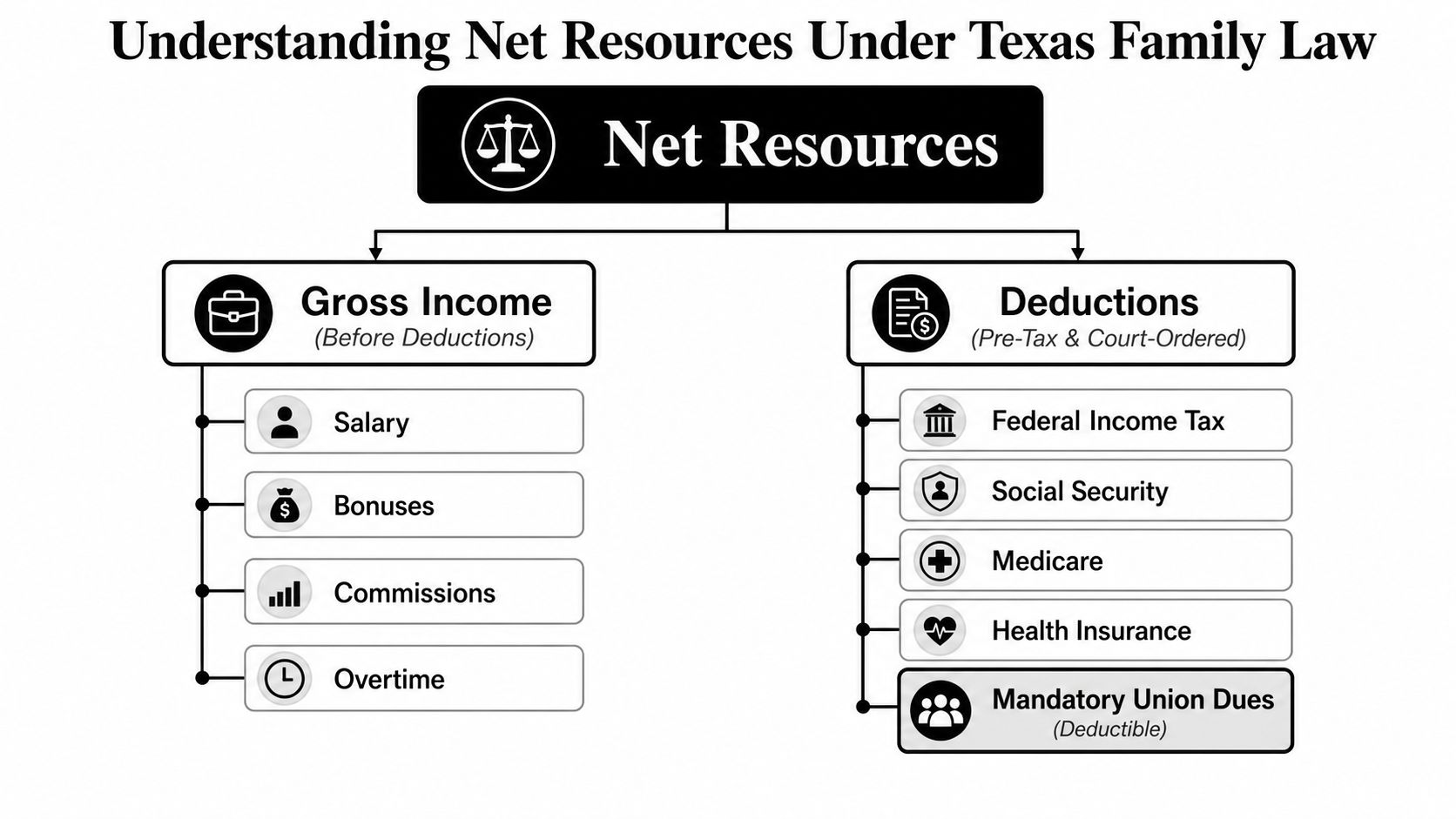
Texas child support starts with monthly net resources, not the number printed at the top of a pay stub. That's where many parents get tripped up, because gross pay, take-home pay, and net resources are not the same thing. The legal formula begins by identifying income, then subtracting only the deductions the statute allows.
What gets counted and what gets subtracted
Texas guidance treats wages, commissions, self-employment income, and other recurring earnings as part of the resource picture. From there, the law subtracts items like Social Security taxes, federal income tax calculated for a single filer, union dues, and child health or dental insurance costs before support is computed. Texas law help materials also explain that child support is calculated from net resources, not gross pay, so every allowable deduction affects the base amount used in the formula.
That's why a pay stub matters so much. A parent may think, “I make X, so support should be based on X,” but Texas does not work that way. The support figure is built after the statutory deductions come off the top.
Bottom line: the smaller the net-resource base, the smaller the guideline support figure, because the court applies the percentage to what remains after allowable deductions.
Why this matters in a real paycheck dispute
Suppose a parent in northeast Harris County has recurring deductions for union dues and child insurance. Those deductions are not treated the same as rent, gas, or car payments. They sit inside the statutory formula, which means the court may rely on them when it works out support. That distinction often surprises people who are trying to budget around a new order.
The calculation can feel mechanical, but the documentation behind it is personal. Judges and attorneys need the payroll trail because it shows whether the deduction is part of the employment arrangement. That's why clients dealing with union dues and net resources child support Atascocita TX questions are often asked for their recent pay stubs first, not their opinion of what seems fair.
The Written Consent Rule for Union Dues in Texas
Texas adds an extra layer that many parents don't expect. A contract allowing an employer to withhold pay for union dues or assessments is void unless the employee gives written consent. Texas Historical Association material also notes that employer checkoff of union dues is allowed only upon written authorization by the member, so payroll deductions for dues are not automatic here. They depend on a signed authorization.
That written-consent rule matters in child support because it creates proof. If a parent says union dues should reduce net resources, the court can ask whether the employer has a signed form showing the deduction was authorized. Without that, the claim gets weaker fast. Harris County judges are not looking for a guess or a verbal explanation, they're looking for a document.
The federal rule does something different
Federal labor law works on a separate track. The NLRB explains that union-security agreements can require employees in a bargaining unit to start paying dues or dues equivalents within 30 days of hire, but employees still may choose not to become union members and may pay only the portion used directly for representation, such as bargaining and contract administration. That means the labor rules and the family-law rules are related, but they're not the same thing.
For public-sector workers, Texas legislative materials also note that government entities may automatically deduct union dues after the worker completes an authorization form. In real life, that creates a payroll record that can help or hurt a child support argument depending on whether the deduction is current, valid, and documented.
Why judges care about the paper trail
A parent may be paying dues every month and still lose the argument if the records are thin. That's because the written-consent requirement gives the court a clear evidentiary standard. The employer needs to show a signed authorization, not just an assumption of membership.
A payroll deduction can be real and still be disputed if the authorization form is missing.
For Atascocita families, confusion often starts here. One parent sees the dues on the paycheck and assumes the case is over. The other parent asks for proof and is told the union “has it on file.” In court, “has it on file” is not the same as “can prove it now.”
Step by Step Child Support Calculation with Union Dues
A useful way to understand the math is to walk through the calculation in the same order the court does. Start with gross monthly income, then subtract only the deductions Texas allows, then apply the guideline percentage to the result. That's the part most parents never see when they look at a payroll stub.
A simple example
Let's say an Atascocita union worker has monthly gross pay, then sees deductions for Social Security taxes, federal income tax, union dues, and health insurance for the child. Each one of those deductions lowers the amount used for support. If the same worker had no union dues, the support base would be higher.
Here's the practical sequence:
- Start with gross monthly income from wages and recurring earnings.
- Subtract Social Security taxes and federal income tax for a single filer.
- Subtract union dues if they're properly authorized and documented.
- Subtract qualifying health or dental insurance for the child.
- Apply the Texas guideline percentage to the remaining net resources.
| Line Item | Monthly Amount | Notes |
|---|---|---|
| Gross monthly income | Starting point before deductions | |
| Social Security taxes | Statutory deduction | |
| Federal income tax | Calculated for a single filer | |
| Union dues | Deductible if properly authorized | |
| Child health insurance | Statutory deduction | |
| Net resources | Amount used for support calculation | |
| Guideline child support | Applied to net resources |
If the support amount seems higher than expected, the first place to look is the deduction list. Texas law only allows certain items to come out before support is calculated, so a paycheck can be more complicated than it first appears. The formula is also tied to a cap, and the Office of the Attorney General's calculator shows the standard table is designed for monthly net resources up to $11,700.
That cap matters because income above that amount is not automatically converted into proportionally higher guideline support. In other words, once net resources move past the cap, the basic formula stops scaling in a simple straight line. For parents with union wages plus overtime or commission income, that can change how much a dues deduction matters in the final number.
If you want to explore the support formula in more detail, the local resource at child support how much can help frame the issue before you go to court.
Important: a deduction only helps if it belongs in the net-resources calculation. Personal spending does not get the same treatment.
Common Disputes Over Union Dues and Net Resources
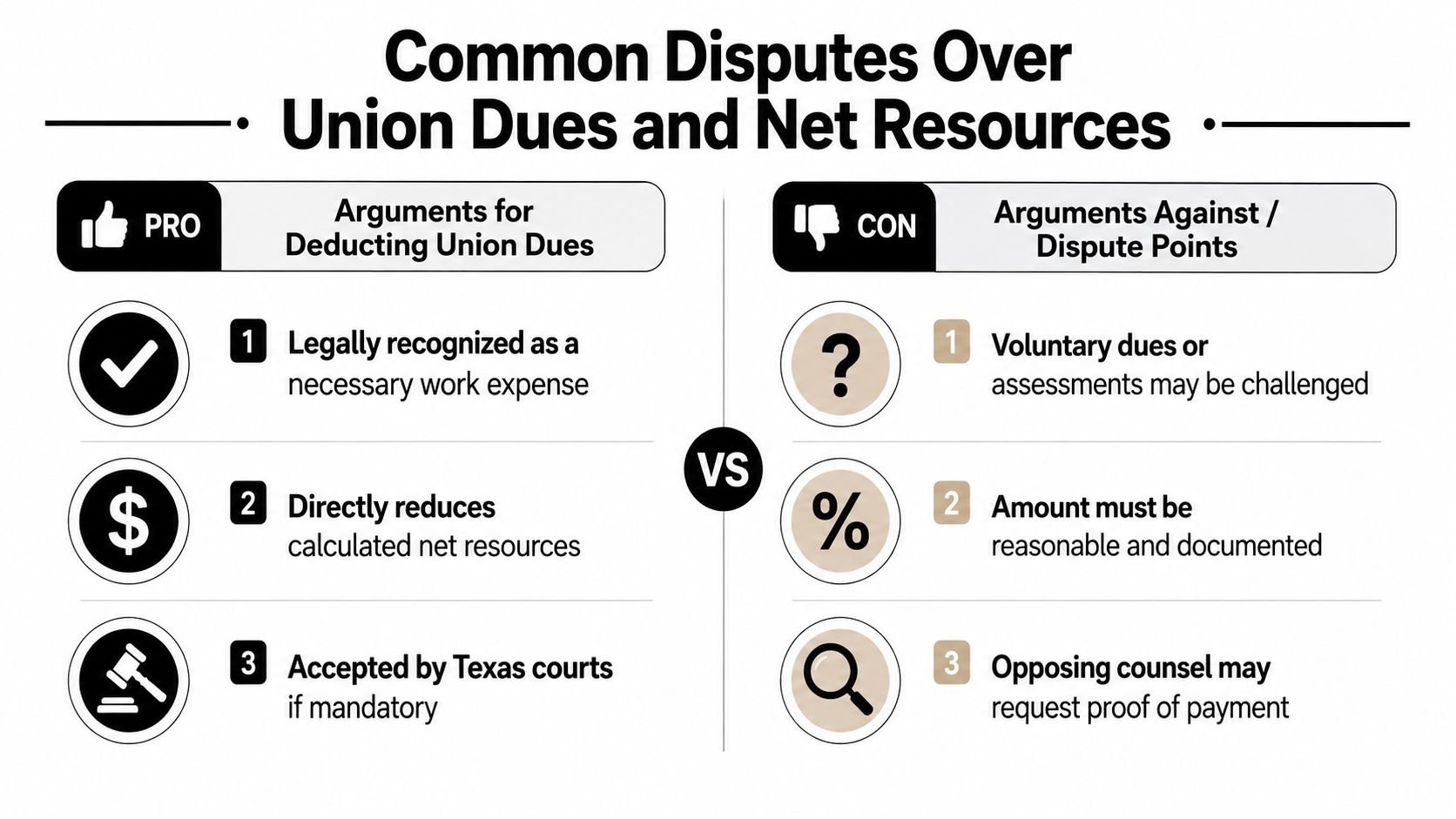
Union dues often become a fight because the same paycheck document can support two different stories. One parent says the deduction is mandatory and should lower net resources. The other says the deduction is voluntary, outdated, or unsupported by the paperwork. Both sides know the number matters, which is why these disputes show up often in Harris County family courts.
Arguments that tend to matter
A valid challenge usually focuses on proof. If the paying parent cannot show a signed authorization, the deduction is easier to question. If the union membership has lapsed but dues are still being withheld, that's another issue the court may want explained.
The strongest arguments are the ones tied to records:
- No signed authorization: the deduction may not satisfy Texas written-consent rules.
- Old or stale payroll records: the court may want current pay stubs and employer verification.
- Mismatch between membership and withholding: the payroll line item may need clarification.
Arguments that usually go nowhere
A parent sometimes argues that dues are just a personal choice, so they should never count. That argument ignores the Texas rule that makes authorized union dues a statutory deduction. Another common mistake is assuming the court can use the gross salary because it looks cleaner. Texas child support does not work that way.
The mechanics of income withholding also matter. Texas Attorney General guidance says child support payments are commonly collected through income withholding, not by waiting for voluntary payment. That means the employer payroll system may already be handling both the union dues and the support deduction, which gives the court a built-in comparison point when records are available.
If the order is too high because the deduction list is wrong, the issue may overlap with enforcement or modification concerns. In those cases, what to do if child support is too high in Texas Atascocita can help you understand the next step before a hearing. For some families, Enforcement of Court Orders in Atascocita becomes part of the conversation when a decree or custody order needs to be followed exactly.
The key is credibility. When the same payroll system is tracking wages, dues, and support withholding, Harris County judges usually want the records to line up.
Evidence to Present and When to Consult an Atascocita Attorney
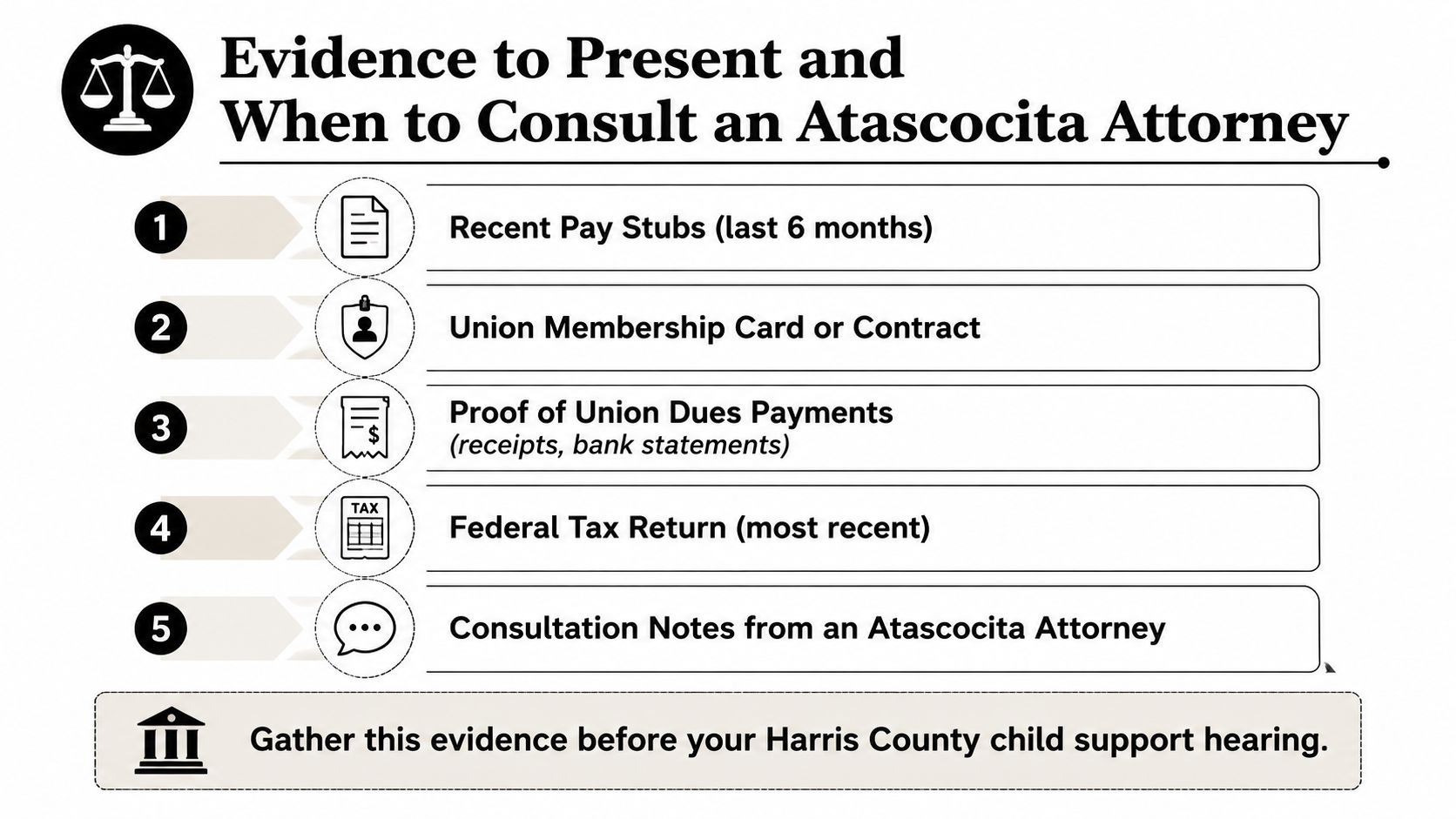
The fastest way to make a union-dues argument stronger is to organize the evidence before the hearing. Courts are much more comfortable with a deduction when the paperwork shows it came from the employer, it was authorized by the employee, and it's still active. That is especially true in support cases where the other parent is questioning the numbers.
The documents that carry the most weight
Bring the records that show the deduction from more than one angle:
- Recent pay stubs: these show the actual line-item deduction.
- Union membership card or contract: this helps connect the worker to the dues obligation.
- Proof of dues payments: receipts or bank statements can confirm the money left the account.
- Federal tax return: this helps the court see the broader income picture.
- Consultation notes from an Atascocita attorney: these help organize the legal argument before a hearing.
Texas child-support fees can also affect how payments move through the system. The Office of the Attorney General says there is a $35 annual service fee in full-service cases for custodial parents who receive at least $550 in collections during the year, and a $3 monthly State Disbursement Unit fee for registry-only payment processing. The $35 fee is not charged if TANF has ever been received, and it does not increase the noncustodial parent's child-support obligation.
Those details matter because the withheld amount and the recorded amount are not always identical. The payment path can affect what ends up in the file, which is why payroll accuracy matters so much in Atascocita and Humble cases.
When to get legal help
Some cases are straightforward, but others need a closer look. You should talk with counsel if the parent's income is above the cap, if the dues deduction is disputed, if self-employment income and union wages are both involved, or if you need to modify an existing order. A local lawyer can review the withholding records and decide whether the problem is calculation, documentation, or enforcement.
The firm's child support modification lawyer in Atascocita can also help when the current order no longer fits the family's real financial picture. In support cases, details matter more than assumptions.
Protecting Your Family's Financial Future in Northeast Harris County
Union dues are not just a paycheck detail. In Texas child support cases, they can be a legitimate statutory deduction that lowers net resources, but only when the paperwork proves the deduction is authorized and current. For parents in Atascocita, Humble, and the rest of northeast Harris County, that means the right records can make the difference between a support order that fits the law and one that misses the mark.
The written-consent rule protects workers from unauthorized withholding, but it also creates a responsibility to keep records. If you throw away the authorization form or never ask payroll for updated stubs, the deduction may be harder to prove when it matters most. That problem shows up quickly in divorce, custody, and modification cases.
Generic online calculators can't see the payroll history behind your order. A local review can. If your case involves union dues, deductions, withholding, or a dispute over net resources, it makes sense to have the numbers checked against the actual Texas rules before the court hearing.
The Law Office of Bryan Fagan – Atascocita TX Lawyers helps parents review child support calculations, payroll deductions, and modification issues with the documentation Texas courts expect. If you're dealing with union dues and net resources child support Atascocita TX questions, visit Law Office of Bryan Fagan – Atascocita TX Lawyers to schedule a free consultation and get help sorting out your next step.