A deployment letter can turn an ordinary evening in Atascocita into a hard conversation about where the kids will sleep, which school routine stays stable, and whether the other parent will try to change custody while you are gone. If you're a service member or the spouse of one, the first worry usually isn't the legal jargon, it's the day-to-day fallout, who picks up from school, who keeps the house moving, and what happens if orders change again before the dust settles.
That's why a military custody lawyer near Atascocita TX has to do more than talk about family law in the abstract. In northeast Harris County, the questions are practical: how Texas courts treat deployment, what happens if one parent needs to move, where the case gets filed, and how to protect parenting time when the family is split across a military schedule.
What Life Looks Like for an Atascocita Military Family Facing Custody
A Humble parent gets short-notice deployment orders on a weekday afternoon. By dinner, the other parent is asking whether the children will stay in Atascocita, whether summer possession changes, and whether the existing order still controls once the service member leaves.
That kind of call is common because military custody problems are rarely just about one issue. They usually touch parenting time, the family home, school stability, and the emotional strain on children who already know something big is changing.
The four problems that usually come up first
The legal questions tend to cluster around four points. Deployment changes availability. Relocation raises pickup, exchange, and school questions. Jurisdiction can become messy if one parent is in another state. Enforcement matters when someone ignores the order already in place.
Texas treats military families as a distinct situation because the parenting schedule may need to shift without ending a parent-child relationship. That is one reason a local family lawyer needs to know both the civilian court process and the military realities behind it.
If you live in Atascocita or Humble, the concern is usually immediate, not theoretical. Parents want to know who has the children next week, what document changes that answer, and whether they need temporary relief before the deployment starts.
The first legal task is usually not “winning” custody, it's keeping the children's routine as steady as possible while the court looks at the new facts.
The rest of this guide follows that exact path, from Texas custody basics to the local Harris County process, so you can see how the pieces fit together before you sit down with counsel.
Texas Custody Basics Every Service Member Should Understand
Texas uses a few core custody terms that sound technical but are easier to understand in plain English. Conservatorship is the decision-making side of custody, and possession and access is the time-sharing side. Think of conservatorship as the steering wheel and possession as the family calendar.
What the judge is actually deciding
When a court signs an order, it is deciding who can make choices about the child's life, and when each parent gets time with the child. Many Harris County cases also rely on a standard possession order, which gives a default schedule unless the facts justify something different.
A geographic restriction often matters too, because it keeps the child tied to a certain area unless the court allows otherwise. For military families, that restriction can become a real pressure point if orders send one parent away or bring one parent back after a long absence.
If you're reading paperwork for the first time, look for three things. Who has the decision-making authority. What the possession schedule says. Whether the order limits where the child can live.
How military life fits into the basics
Military orders do not erase the custody framework. They sit on top of it. That means a service member may still share conservatorship, but the possession schedule may need temporary adjustment when deployment or training makes the regular calendar impossible.
If you're also trying to update wills or beneficiary choices while custody issues are pending, an Estate Planning Attorney in Atascocita handles wills, trusts, and estate plans for Atascocita families, which can matter when a parent's status, guardianship planning, or long-term support questions are changing at the same time.
The key point is simple. A Texas judge is not just asking who “deserves” more time. The judge is reading a schedule, a set of rights, and the child's practical needs.
Practical rule: if you can point to the exact clause in your order, you can usually explain the issue more clearly to your lawyer and to the court.
A quick reading guide for your order
- Conservatorship language: tells you who makes major decisions.
- Possession terms: show the actual handoff schedule.
- Geographic limits: show where the child is expected to live.
- Temporary order language: shows whether the schedule can change while a military issue is pending.
How Military Service Changes Custody in Texas
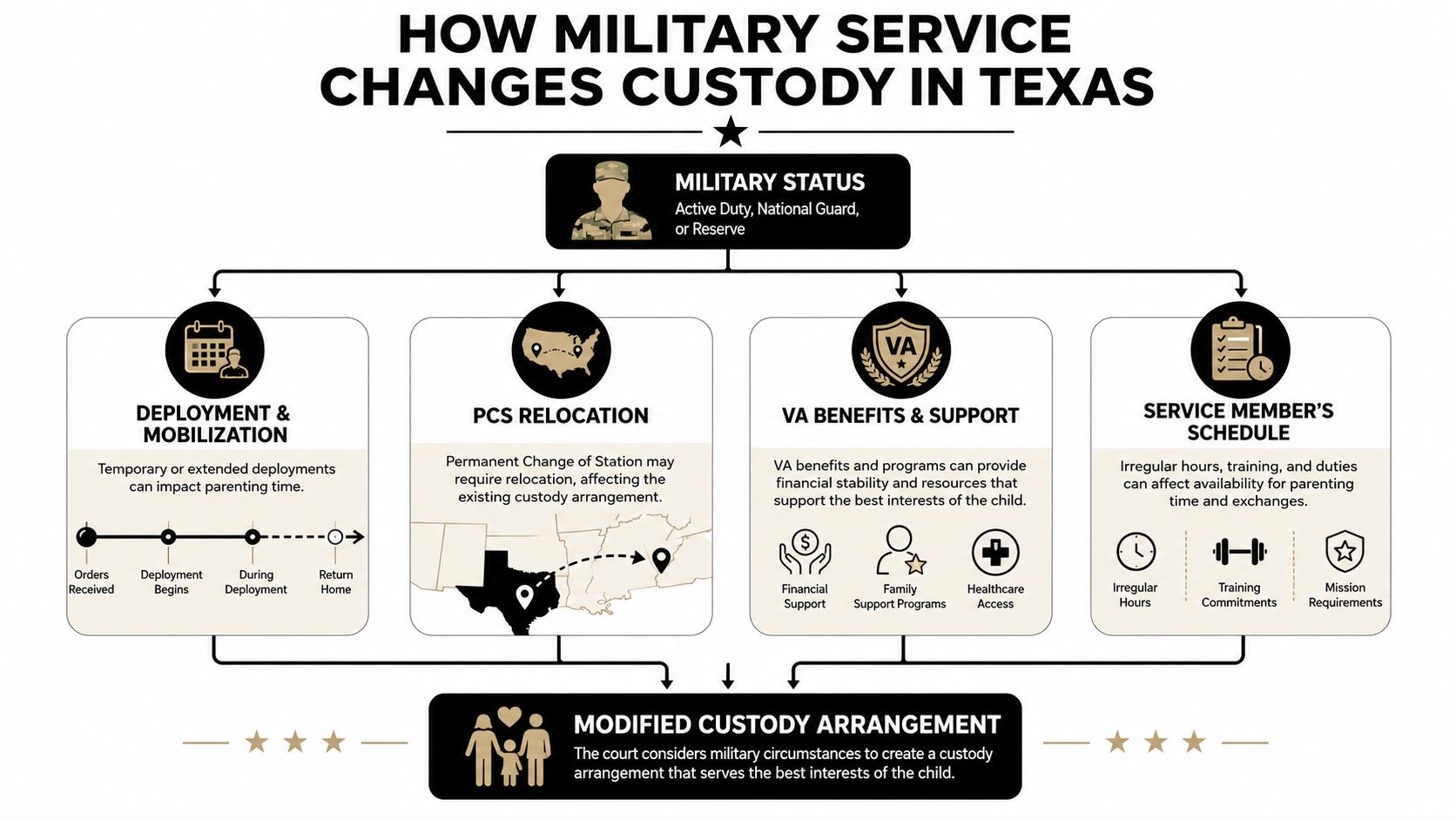
A deployment notice can turn a stable custody routine into a set of moving parts. One parent may be packing for duty while the other is trying to keep school drop-offs, exchanges, and phone calls on schedule. Texas law gives the court a way to adjust the order without pretending the family's day-to-day life has stayed the same.
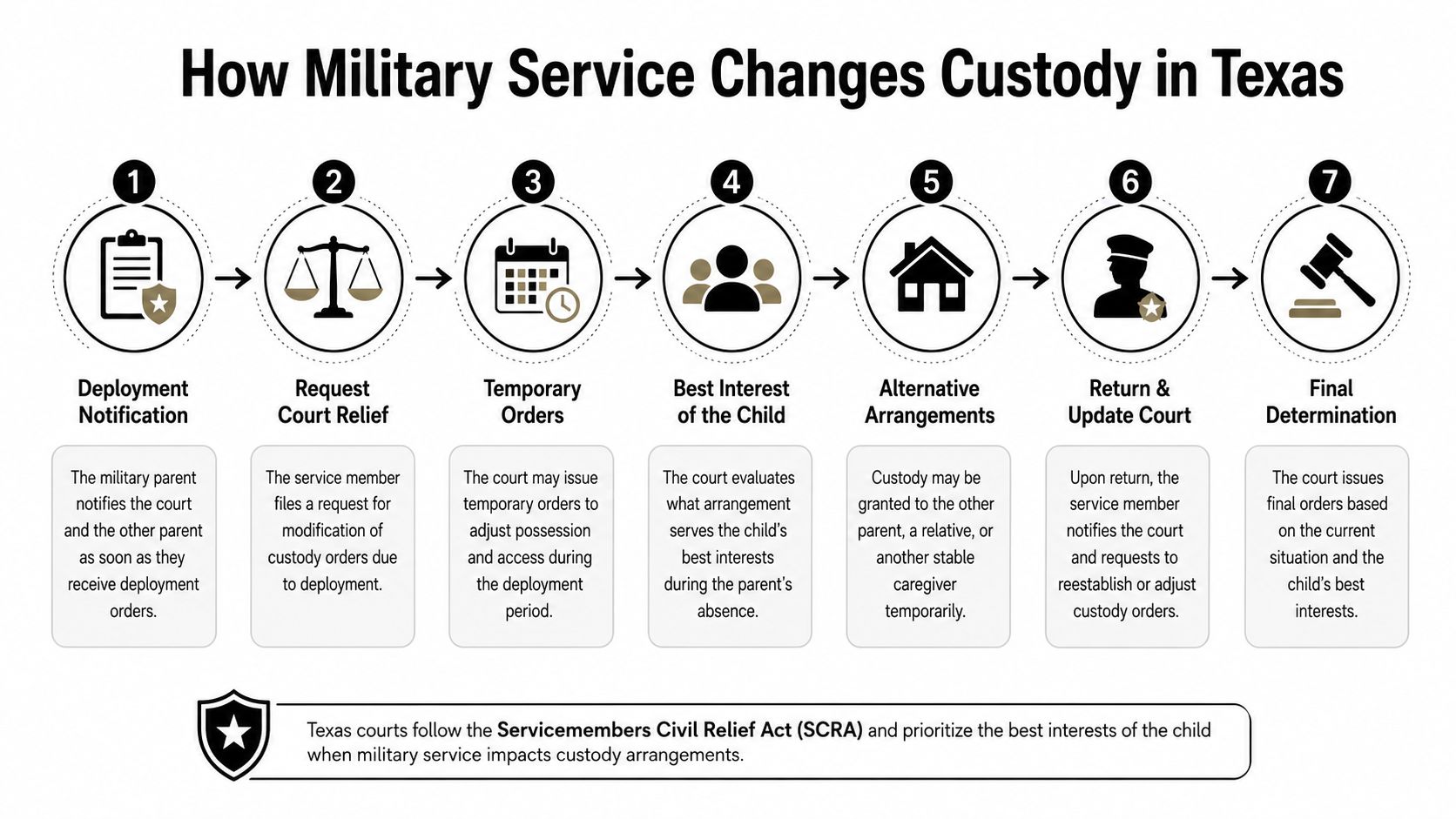
Texas Family Code § 153.702 is the local rule that matters most when deployment, mobilization, or temporary duty affects a parent's ability to exercise parental rights and duties. It allows temporary orders in that situation. In plain terms, military service can change how custody works in practice, but it does not automatically erase a parent's rights.
Deployment and mobilization
A deployment usually calls for a temporary change, not a permanent rewrite. The court can shift possession so the child still has a predictable routine, and the order can spell out who handles exchanges, calls, and other contact while the service member is gone. Texas family law handles that problem by adjusting the schedule, not by treating service as a reason to punish the parent.
Harris County judges look for an order that can be followed on a school night, not just one that sounds fair in the abstract. If a parent will be unavailable for a stretch of time, the court can change exchange dates, build in alternate ways to stay in contact, or set another practical arrangement while the parent is away. For a fuller look at the legal issues that often come with service-related family cases, see our guide to a military divorce lawyer in Atascocita.
PCS relocation across state lines
A PCS move creates a different problem. It can affect school enrollment, commuting distance, and the logistics of handoffs, especially when the current order assumes both parents live close by. It can also lead to a dispute over whether one parent can move with the child or whether the current geographic restriction still controls.
Texas courts usually focus on the child's stability, the rights already set out in the order, and whether a temporary change is needed while the move is being handled. A military move does not automatically cut off access, but it does force the court to deal with a schedule that fits real life instead of a calendar on paper. For families needing a local court option that handles decree terms or custody violations, Enforcement of Court Orders in Atascocita addresses enforcing divorce decree and custody order provisions in Harris County.
Jurisdiction and out-of-state enforcement
Military families often have ties to more than one state. One parent may live in Texas, another may be stationed elsewhere, and the children may spend time in both places. That can raise a jurisdiction question, which means the court has to decide which state has authority over the custody dispute.
If an order already exists and someone refuses to follow it in another state, enforcement becomes the issue. A local case can turn into a multi-state problem quickly when exchanges, travel, and communication break down.
Military service changes the timeline, not the basic structure. Texas law gives the court a tool for temporary adjustment, and that tool keeps parenting time from falling apart when duty calls.
A good custody request in a military case usually starts with the order you already have, then shows the court exactly what deployment, relocation, or distance has changed.
What a Military Custody Lawyer Actually Does for You
The first meeting is usually less dramatic than people expect. You bring the current order, the deployment papers, and whatever messages show the other parent's position. The lawyer listens for the underlying problem, then starts sorting the issue into something the court can decide.
From intake to evidence
A military custody case usually starts with a document review. That can include orders, leave dates, school records, parenting logs, and any communication about exchanges or schedule changes. If benefits or support questions are part of the same dispute, those records matter too because financial issues often sit right beside possession issues.
The next step is temporary relief if the schedule needs immediate protection. That is where the lawyer frames the request around the child's routine and the service member's availability, rather than around broad complaints that are hard to prove.
Negotiation and court in Harris County
Once the facts are organized, counsel usually tries to resolve the issue through negotiation. Sometimes that means a temporary schedule agreed to by both sides. Sometimes the other parent only agrees once the paperwork is filed and a hearing is set.
The Texas courts that hear family cases in this area expect clear, organized proof. If the dispute does not settle, your lawyer presents the order, the military timeline, and the requested changes to the judge or associate judge. The process is procedural, but it is still grounded in one basic question, what arrangement protects the child while respecting the parent's military obligations.
The Law Office of Bryan Fagan – Atascocita TX Lawyers handles family law matters, including custody and divorce, for residents who need local guidance through those steps.
Limits matter too
Texas has a limited-practice rule for military attorneys. The rule allows them to handle defined civil matters, including family-law matters under the Family Code except Title 3, plus a few other listed categories, and anything outside that scope needs advance written permission from the court or tribunal. Texas also requires military attorney registration through ATLAS, a $25 filing fee, a current Certificate of Good Standing issued within 30 days, and 15 hours of continuing legal education for renewal.
That doesn't make the process harder for families, but it does mean you should know what any lawyer is authorized to do before you rely on them. The right attorney will explain the scope of the representation in plain English.
How to Find and Hire the Right Attorney Near Atascocita

A parent gets a call about deployment orders, the custody schedule starts to feel uncertain, and the first question is usually simple: who near Atascocita can handle this without wasting time. Start local, then verify. The State Bar of Texas operates a referral line at 1-800-252-9690, and Justia's Atascocita directory shows multiple family lawyers serving the area, which tells you there is a real local pool instead of a one-lawyer market. That matters when a deployment issue needs prompt attention and you do not want to begin your search from scratch.
What to check before you book the consultation
A military custody case can move quickly, so the first screening call should answer a few basic questions. Does the lawyer handle deployment-related custody issues. Have they worked with temporary orders. Can they explain how the case would move through Harris County.
Ask how the lawyer approaches military service in a Texas family case, not just whether they have heard of it. The answer should sound practical, because the judge will want a filing that fits the local procedure and the service member's timeline. If the lawyer cannot describe the next steps in plain English, keep looking.
If you are talking to a military attorney, verify the registration status too. Texas requires the ATLAS account, the application, the filing fee, the good-standing certificate, and the renewal CLE. Those are concrete markers that the attorney is operating inside the state's military-practice framework.
For a detailed guide on comparing local attorneys, see how to choose a family lawyer in Atascocita Texas.
A simple comparison table
| Attribute to Check | Why It Matters for Military Custody | Where to Verify |
|---|---|---|
| Deployment experience | Shows whether the lawyer understands temporary orders and schedule changes | Initial consultation and prior case descriptions |
| Harris County familiarity | Helps the lawyer anticipate local court procedure | Consultation and local office information |
| Registration status | Confirms the lawyer is properly registered for military-related practice | Texas Board of Law Examiners military application |
| Communication style | Matters when orders change fast and you need clear updates | Phone screen or first meeting |
| Referral source | Helps you compare more than one option | State Bar of Texas referral line and Justia directory |
Questions to ask before you sign
- How do you handle deployment-related temporary orders?
- What documents should I gather before filing?
- How will you keep me updated if I am out of state?
- Who will appear in court with me, and where?
- How close is your office to the Harris County family-court process I will be dealing with?
One practical way to compare lawyers is to speak with two or three local options and listen for clarity. The right attorney should explain the next step without making the process sound mysterious.
A Realistic Harris County Scenario and What a Temporary Order Looks Like
A Humble father gets deployment orders and immediately wonders whether his summer time with the children will disappear. His lawyer files for a temporary modification under Texas Family Code § 153.702, attaches the deployment paperwork, and asks the court to adjust the schedule until the parent returns.
The court is usually looking for a temporary arrangement that can be followed, not a permanent rewrite of the family's order. That means the judge may focus on possession windows, exchange logistics, and how the children stay connected to the deployed parent while service duties are in place.
What the filing often includes
The filing usually begins with the current order, the new military orders, and a clear request for temporary relief. If the dispute involves school timing, travel, or communication, those facts need to be set out plainly so the court can build a schedule that works in real life.
In Harris County, that request may be heard by an associate judge before a final ruling. The hearing can be short, but the facts still need to be organized. The judge is trying to make the arrangement practical while protecting both parents' rights as much as the deployment allows.
For a fuller explanation of how temporary relief works in local custody cases, review our guide to temporary custody orders in Texas. If you want a broader look at how local custody cases move through the county system, Harris County Family Courts: A Atascocita Resident's Guide explains how family law cases proceed in the courts serving Atascocita.
What the family can expect
Military service does not erase custody rights. Texas law gives the court room to adjust possession temporarily, which usually means a schedule built around duty instead of a punishment for serving.
The process often feels like putting a house on temporary supports while repairs are underway. The structure stays in place, but a few parts shift so the family can keep living in it.
The best temporary order is the one a family can actually follow while everyone is under stress.
The practical outcome is often a pause, not a verdict. The court sets a temporary possession structure, the family follows it during deployment, and then the case can be revisited if circumstances change again.
Your First Steps and How to Schedule a Free Consultation

Before you call a lawyer, gather the papers that tell the story fast. Bring the deployment orders, the current custody order, any recent messages about parenting time, and a short list of the changes you want to ask the court for.
What to bring
- Deployment or duty paperwork: shows why the schedule has changed.
- Current order or decree: shows what the court already said.
- Parenting notes or messages: helps the lawyer see what has been happening.
- Your questions: keeps the consultation focused on what matters to your family.
The main things to remember are simple. Temporary orders are available under Texas law, military status does not erase custody rights, and registration details matter when you're choosing counsel. Those points can change the entire direction of a case.
If you live in Atascocita, Humble, or northeast Harris County, you do not need to guess your way through it. A local consultation can help you see whether your case needs emergency filing, negotiation, or a more measured approach.
The Law Office of Bryan Fagan – Atascocita TX Lawyers helps Atascocita and Humble families work through custody, divorce, and related family-law issues with local guidance and clear next steps. If you're dealing with deployment, a possible relocation, or a custody order that no longer fits your family's reality, visit Law Office of Bryan Fagan – Atascocita TX Lawyers and schedule a free consultation with the Atascocita office today.