Skip to content

Expect roughly $7,500 to $27,000 or more for a commingled-account tracing engagement, depending on complexity, with hourly rates commonly ranging from $300 to $600. A limited review may cost less, while extensive reconstruction, depositions, and trial testimony can increase the total.
You may be sitting at your dining room table in Atascocita or Humble with a stack of bank statements, an inheritance document, and a divorce petition nearby. You remember that certain money came from before the marriage or from a family inheritance. But the account also received paychecks, paid household bills, funded investments, and transferred money to other accounts. The question is no longer just, “Whose name is on the account?” It is whether the records can show what happened to each important dollar.
That is where a commingled account tracing expert may help. The cost usually isn't the hourly rate by itself. The larger pricing variable is evidentiary complexity, including the number of accounts, years covered, missing documents, transfers, investments, business interests, and disputed assets.
Understanding Commingled Accounts in Your Divorce
You are at your dining room table in Atascocita, sorting through statements while your divorce paperwork sits nearby. Before the marriage, you had savings. Later, the same account received paychecks, paid the mortgage, funded investments, and received an inheritance. Each transaction may have made the original funds harder to identify.
An account becomes commingled when separate and community funds share the same account or move through connected accounts. The account title and first deposit do not decide ownership by themselves. Property possessed by either spouse at dissolution is presumed to be community property, so the spouse claiming separate ownership must trace and identify those funds through direct or circumstantial evidence. Tarver v. Tarver explains why overcoming that presumption matters.

Why the account history matters
Suppose an inheritance entered an account that already held marital earnings. The inheritance may still qualify as separate property, but the records must connect the money to its source, show how it moved, and establish what remains. A tracing expert follows those connections much like a map follows roads between locations. The more transfers, accounts, and years involved, the more difficult the reconstruction can become.
At this stage, you do not need to gather every possible record into one pile. Start with the account statements and inheritance or premarital records that identify the funds' origin. The specific documentation used to test deposits, withdrawals, transfers, and investments is addressed in the documentation section below.
For a resident of Atascocita, Humble, or northeast Harris County, the practical risk is straightforward: repeated transactions can blur the line between separate and community funds. If the separate portion can no longer be resegregated and identified, the community-property presumption may control. That evidentiary problem, rather than an hourly rate alone, often drives the cost of professional tracing.
How Texas Law Handles Separate Property Tracing
Texas law requires the spouse claiming separate property to prove that claim with clear and convincing evidence under Texas Family Code §§ 3.001 and 3.003. The practical question is not just where the money began. It is whether the records still identify the claimed separate funds after deposits, withdrawals, transfers, and investments.
Tracing follows each material event in sequence. An expert may review the balance when separate funds entered the account, significant deposits and withdrawals, transfers to other accounts, investment conversions, and periods when the balance fell below the claimed separate amount. Texas appellate authority treats these transaction details as important to reconstructing the account's history.
The bucket analogy
An account can work like a bucket holding community water and separate water. Deposits add funds, and withdrawals remove them. Under the community-out-first method, withdrawals are assigned to community funds until that portion is used. Later withdrawals may then be assigned to separate funds, while later community deposits can restore the community portion.
For example, an inheritance enters an account that already contains marital earnings. A withdrawal does not automatically represent inheritance money just because the inheritance was deposited most recently. The result depends on the account's balances, transaction order, and the tracing method applied.
If the balance drops below the claimed separate amount, the analysis becomes more difficult. The expert must examine later deposits and determine whether the records support identifying any remaining separate funds.
Why early legal review helps
A Property Division Lawyer in Atascocita can help define the disputed asset, identify the applicable legal theory, and assess whether the available records justify hiring an expert. That early review may show that the claim is strong, limited, or unlikely to support the cost of a full engagement.
For a practical discussion of commingled bank account tracing in an Atascocita divorce, the focus is reliable identification, not proving that every dollar remained separate. The hidden pricing variable appears here: the more accounts, transfers, and gaps an expert must reconstruct, the more work the engagement requires. A focused legal review can help decide whether that evidentiary complexity justifies the expense.
Typical Fee Structures and Cost Ranges
A forensic accountant may quote an hourly rate, but the invoice usually grows from the number of transactions that must be reconstructed. A simple account with clear statements may require focused review. Several accounts, repeated transfers, missing periods, and disputed deposits can turn the work into a financial timeline that resembles assembling a puzzle from scattered pieces.
A 2024 SEAK survey of more than 1,600 expert witnesses reported median rates of $450 per hour for file review and preparation, $475 per hour for deposition testimony, and $500 per hour for trial testimony. It also reported a median upfront retainer of $3,000. The published SEAK fee benchmarks offer market context, not a guaranteed Atascocita quote.
At 20 hours of document review and analysis, the first benchmark equals approximately $9,000. At 40 hours, it equals approximately $18,000, before deposition, trial, travel, or additional records. A published divorce example involving income analysis, business expenses, and lifestyle analysis estimated 25 to 60 hours, or approximately $11,250 to $27,000 at $450 per hour. These figures are planning benchmarks rather than promises about a particular case.
What the range means in practice
Asset-tracing engagements commonly begin around $7,500 and may exceed $20,000. The published SEAK fee benchmarks also report experienced forensic-accounting work around $300 to $450 per hour, with senior principals around $450 to $600 or more. A Texas family-law source reports a broader working range of $5,000 to $50,000 or more when deposition preparation, testimony, and trial appearances are included. Its discussion of forensic financial experts explains why scope matters more than a single advertised price.
Ask for a written scope, hourly schedule, retainer requirement, assumptions, and separate estimates for analysis and testimony. Those details show whether you are paying for a focused review or several stages of evidence reconstruction. They also make it easier to compare the likely cost with the separate-property claim at issue.
The Role of Documentation in Tracing Costs
A tracing bill often reflects the quality of the records more than the expert's hourly rate. Complete statements let the expert follow money from its original source through each transfer. Missing pages turn a focused review into financial archaeology, requiring substitute records, comparisons with other accounts, and explanations for gaps the opposing side may challenge.
Consider an inheritance deposited into a joint account. The current balance does not show whether the money remained identifiable, paid community expenses, or mixed with earnings. Statements, transfer records, and related documents create the timeline needed to answer those questions. They also help determine whether the engagement should remain limited or expand into a broader reconstruction.
The evidence should connect the claimed separate source to the property existing at divorce. Preserve that connection as early as possible.
Build a record trail before the review begins
Collect documents that show both where money came from and where it went:
- Monthly account statements: Request the complete period, including opening and closing balances.
- Canceled checks: These may identify the recipient, purpose, and account used.
- Wire records: Transfers often require records for both the sending and receiving accounts.
- Brokerage statements: Track conversions from cash to securities and back again.
- Closing documents: Real estate purchases and sales can show funds entering or leaving an asset.
- Inheritance or gift records: These support the claimed separate source.
- Tax returns: They may help reconcile income, transfers, investments, and business transactions.
- Loan and reimbursement records: These can clarify whether payments came from separate or community funds.
Keep original electronic files intact, and do not alter downloaded statements. Organize records by institution and account, then mark missing periods or unexplained transfers. A lawyer can help decide whether a gap requires formal discovery or has little effect on the disputed issue.
For related planning guidance, review how to protect assets during divorce. Organized records cannot guarantee a separate-property ruling, but they can reduce avoidable review time and give the expert a clearer foundation for a defensible report.
Stages of a Tracing Engagement
A tracing engagement can be narrow or extensive. Paying for the right stage matters because a one-account question shouldn't automatically become a reconstruction of every financial activity during the marriage.
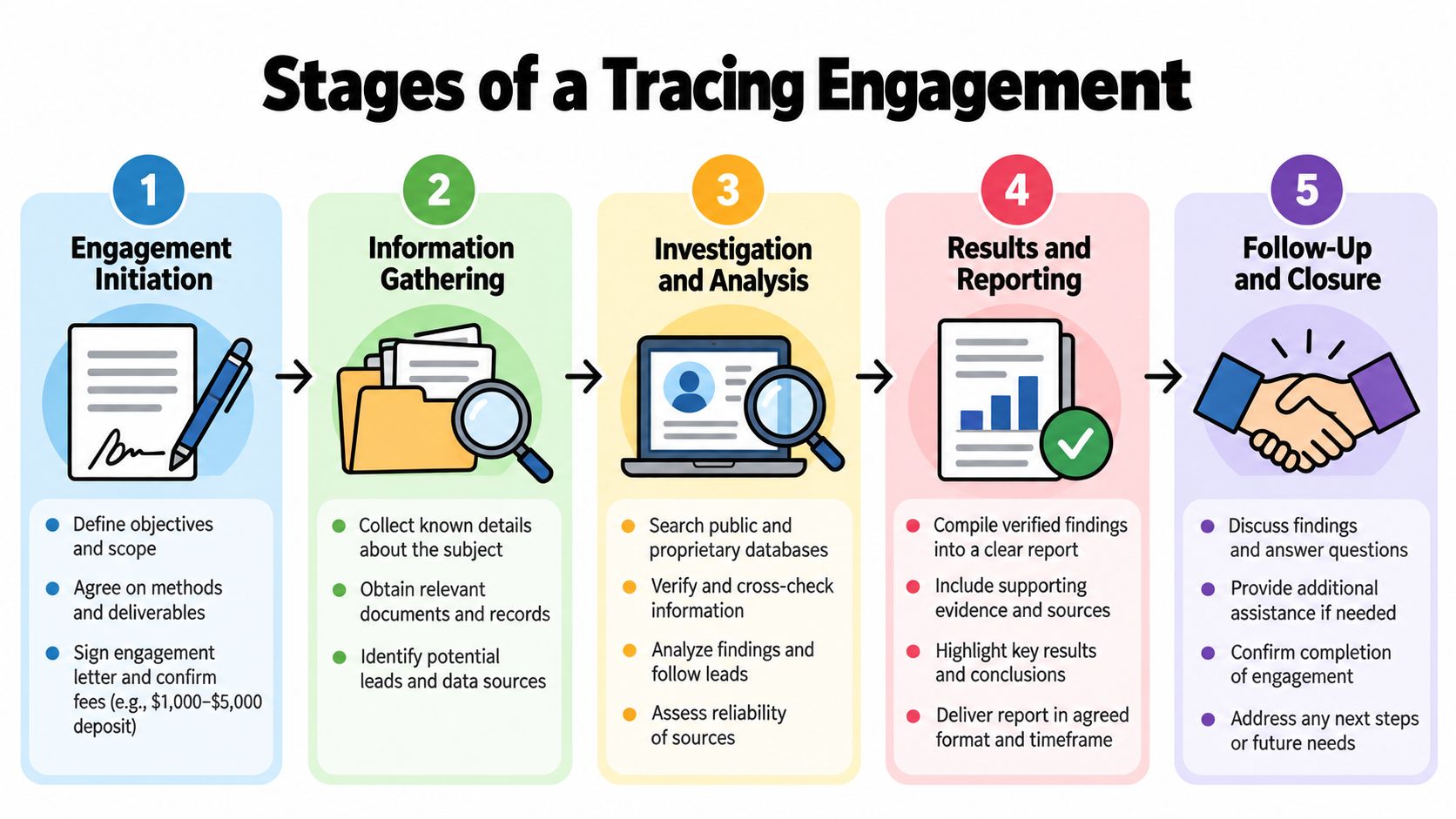
Four useful engagement levels
-
Initial document screening: The expert reviews available statements and key documents to identify the issue, missing records, and likely scope. This can help determine whether further work is justified.
-
Focused tracing: The expert follows one account, inheritance, premarital balance, or investment conversion. This may suit a divorce where the disputed funds moved through a limited number of accounts.
-
Full forensic reconstruction: The expert analyzes multiple accounts, institutions, investment transactions, business entities, loans, reimbursements, and property sales. The report may include alternative allocation scenarios and a transaction-level schedule.
-
Testimony and rebuttal: A testifying expert may prepare for deposition, participate in deposition, review and correct the transcript, prepare for trial, and respond to opposing expert opinions.
These stages can overlap, but they shouldn't be confused. A screening review answers, “Is there enough evidence to investigate?” A focused tracing asks, “Can this particular asset be followed?” A full reconstruction asks, “How should the entire financial history be allocated?” Testimony asks, “Can the expert explain and defend the methodology under examination?”
An attorney reviewing marital property planning may also address Prenuptial & Postnuptial Agreements in Atascocita, which concerns drafting and review of marital property agreements for Atascocita clients.
The process may also include a final closure stage, such as delivering the completed report, preserving the supporting schedules, and explaining unresolved assumptions. That final organization can matter if the case settles or returns to the issue later.
Is Hiring an Expert Economically Justified?
Suppose a tracing review could affect an inherited account, a reimbursement claim, or the value assigned to a family business. The fee matters, but evidentiary complexity often matters more. A few clear statements may support a focused review. Multiple accounts, missing records, transfers, and competing explanations can turn the same question into a larger engagement.
One Texas family-law source, discussed in guidance about hidden assets and financial investigation in an Atascocita divorce, offers a practical rule of thumb: an expert may be economically justified when the disputed asset or issue is worth at least ten times the expected expert fee. If the projected fee is $10,000, that approach places the disputed assets at approximately $100,000. This is a planning comparison, not a legal requirement or a promise that the work will produce a financial gain.
Use the comparison as a starting point, then examine four cost stages:
- Screening: The expert reviews the available records and identifies whether a meaningful tracing question exists.
- Focused analysis: The work follows a particular account, transfer, asset, or reimbursement claim.
- Full reconstruction: The expert organizes a longer financial history when several accounts, institutions, entities, or investments interact.
- Court support: Report preparation, deposition work, or testimony adds time when the analysis must withstand opposing scrutiny.
A small account with complete records and little disagreement may need only legal review. A disputed inherited account connected to real estate, a business, brokerage accounts, and repeated transfers presents a different cost decision. The more the evidence resembles a tangled set of wires, the more time may be needed to identify each connection.
Before authorizing extensive work, ask what question the expert must answer, which records are missing, and whether a narrower review could resolve the issue. A lawyer at a Contested Divorce Attorney in Atascocita practice can help assess how expert evidence fits the settlement or litigation strategy. The value of the engagement may also include clarifying a weak opposing claim or protecting a reasonable settlement position.
Questions to Ask a Forensic Accounting Expert
A useful consultation should clarify the work and its boundaries before any retainer is paid. Ask the expert to explain the question being tested, the records needed, and the result you will receive. A written scope should identify the accounts, dates, assets, assumptions, and limits of the assignment. It works like a map for the engagement, showing where additional fees could arise.
Organize your questions around four stages:
-
Screening: Will the expert review the available statements and determine whether a meaningful tracing issue exists? What gaps or contradictions would require further work?
-
Focused analysis: Will the review follow one account, transfer, asset, or reimbursement claim? Which Texas family-law method will guide it, such as direct tracing, clearinghouse tracing, or community-out-first analysis?
-
Full reconstruction: If several accounts, institutions, entities, or investments are connected, how will the expert organize the history? Ask how missing statements, checks, wire records, tax returns, inheritance documents, and brokerage records will be addressed. Will the expert identify assumptions and test alternative scenarios?
-
Court support: Ask whether the estimate includes report preparation, exhibits, deposition preparation, transcript review and corrections, or trial testimony. Clarify whether the accountant will serve as a consulting or testifying expert, since that choice can affect disclosure, discovery, and preparation needs.
Ask for the retainer amount, replenishment terms, billing frequency, and treatment of unused funds. Confirm the deliverable, such as a transaction schedule, report, exhibits, and a discussion of unresolved issues. Also ask how scope changes will be approved before added fees are incurred.
Texas Family Code § 301.107 creates a specific deposition-cost obligation for the party who retained a testifying expert. When the opposing party takes the expert's oral deposition, the retaining party must pay the expert's reasonable fees for preparing for, giving, reviewing, and correcting the deposition. Read the statutory text of Texas Family Code § 301.107.
The initial document-review quote therefore may not cover the full engagement. Discuss deposition preparation, participation, transcript review, corrections, and trial preparation as separate cost items.
Moving Forward with Confidence in Your Divorce
A commingled account doesn't automatically answer the property question in your divorce. It creates an evidence problem. Texas begins with a community-property presumption, and the spouse claiming separate property must build a reliable financial path from the original source to the asset or funds still being claimed.
The cost of that work depends less on a single advertised hourly number than on the evidence involved. Clean records, one account, and a focused issue may support a limited review. Multiple institutions, missing statements, business interests, investments, and transfers may require a broader reconstruction and testimony.
For Atascocita, Humble, and northeast Harris County residents, early legal guidance can help identify the actual tracing question before you hire an expert. A lawyer can help preserve records, evaluate the disputed asset, compare the likely benefit with the expense, and coordinate with a forensic accountant when specialized analysis is appropriate.
Do not wait until a deposition or trial date to discover that an important account history is incomplete. Gather the records you have, avoid moving or spending disputed funds without advice, and ask for a written scope before authorizing extensive work.
The Law Office of Bryan Fagan – Atascocita TX Lawyers helps local clients address divorce, property division, and complex financial issues with practical legal guidance. Schedule a free consultation through Law Office of Bryan Fagan – Atascocita TX Lawyers to discuss your commingled accounts, tracing records, and options for protecting your position.