 Skip to content
Divorce already puts your home life, your schedule, and your finances under strain. When you also suspect your spouse isn’t being honest about money, the stress changes shape. It becomes the feeling that every account statement, every missing document, and every vague answer matters more than it should.
That feeling is often what brings people in Atascocita, Humble, and northeast Harris County to a hidden assets divorce lawyer atascocita search in the first place. They don’t need dramatic courtroom language. They need straight answers about what counts as hiding property, what a court can do about it, and how to protect themselves before money disappears.
Feeling Something is Off? An Introduction to Hidden Assets
Think of a marriage in Texas like a shared financial build. During the marriage, both spouses usually contribute to the structure, whether through income, childcare, managing the household, or supporting a business. In a divorce, the court’s job is to divide that shared estate in a way that is just and right.
That only works if both sides put the full financial picture on the table. In Texas, spouses in a community property divorce must fully disclose marital assets under penalty of law. When someone conceals an account, transfers money to another person, understates business income, or leaves property off the inventory, that interferes with fair division.
A hidden asset is not just a secret offshore account in the movie version of divorce. It can be a bonus delayed until after the divorce, a side account opened without your knowledge, or a business expense claim that doesn’t hold up when records are reviewed.
Practical rule: If the numbers stop making sense, don't dismiss it as stress. Financial confusion during divorce often deserves a legal review.
In Atascocita and Humble, these cases often begin with subtle signs. One spouse notices less access to banking apps. Tax returns don't match the lifestyle. A retirement statement stops arriving at the house. The concern is real, and Texas law gives courts tools to respond when dishonesty affects property division.
What Legally Counts as Hidden Assets in a Texas Divorce
Texas divorce law starts with classification and disclosure. Before a court can divide property fairly, each spouse has to identify what exists, who controls it, and whether it is community or separate property. If you need a clear primer on that framework, review this explanation of community property in Texas.

In practice, a hidden asset case usually turns on conduct. The question is whether a spouse failed to disclose property, shifted control of it, or reported its value in a misleading way. An asset does not need to be exotic to qualify. A plain checking account, a side business, a gun collection, or unpaid commissions can matter if they should be part of the marital estate and one spouse keeps them out of view.
Courts in Harris County look closely at ordinary financial records. Bank statements, tax returns, payroll records, retirement statements, QuickBooks files, and title documents often show whether the numbers match the story being told.
Property that often becomes part of a hidden asset dispute
Hidden assets often include:
- Undisclosed bank or brokerage accounts opened in one spouse’s name only
- Business income that is skimmed, deferred, or underreported
- Transfers to relatives, friends, or new partners that are labeled as loans, gifts, or repayments without solid documentation
- Cryptocurrency and online financial accounts that do not appear in the initial disclosures
- High-value personal property such as jewelry, firearms, collectibles, equipment, or tools
- Bonuses, commissions, stock awards, and deferred compensation that are delayed or minimized during the divorce
Around Atascocita and Humble, I often see disputes involving practical assets rather than dramatic offshore stories. Family businesses, contractor income, sales commissions, rental deposits, overtime, and retirement accounts are common pressure points. In those cases, concealment may show up as missing deposits, unusual reimbursements, or a sudden drop in reported income that does not fit the household spending pattern.
Separate property issues are different from concealment issues
A spouse is allowed to argue that certain property is separate. That claim may be valid, but it still has to be supported with records. Separate property usually requires tracing. A spouse may need to show that an inheritance stayed segregated, or that a premarital account kept its separate character over time.
Concealment is a different problem. It involves withholding information, obscuring ownership, or interfering with the court’s ability to see the full estate.
That distinction matters. A legitimate dispute about characterization can be resolved with documents and tracing analysis. A concealment dispute raises credibility issues and can change how the court approaches the division of property.
What counts legally
In a Texas divorce, hidden assets generally include property or income that should have been disclosed but was omitted, transferred, misstated, or undervalued. The legal problem can involve the asset itself, the timing of the transfer, or the way the spouse reported it.
Examples include leaving an account off the inventory, moving cash to a sibling shortly before filing, delaying a receivable until after temporary orders, or claiming a business asset has little value while continuing to use it for income.
The court focuses on whether the marital estate presented on paper is accurate.
For local families, that can affect far more than the final spreadsheet. If a house payment, retirement balance, business interest, or savings account is hidden or distorted, the entire division can become unfair.
Common Ways Spouses Hide Assets in Atascocita and Humble
Uncovering hidden property doesn't typically occur because of a sudden confession. Individuals often notice behavior that doesn't fit. A spouse who used to talk freely about money becomes guarded. An account disappears from shared access. A business owner starts saying cash flow is tight while still spending freely.
In Atascocita and Humble, the hiding methods are often practical, local, and tied to everyday assets rather than exotic financial structures.
What concealment looks like in real life
One common pattern involves a spouse moving money to a trusted third party. That might be a sibling in Kingwood, a parent in another county, or a friend who agrees to hold funds temporarily. On paper, it may look like a repayment, a gift, or a vague debt.
Another pattern shows up in employment compensation. A spouse who expects a commission, performance payment, or ownership distribution may try to push it past the divorce date. The hope is simple. If the money arrives later, maybe it won’t be counted.
Retirement assets also get overlooked or concealed more often than people expect. If your case involves pensions, 401(k)s, IRAs, or rollover accounts, this page on division of retirement accounts in an Atascocita divorce can help frame what should be identified and valued.
Common Asset Hiding Tactics and Their Red Flags
| Hiding Method | What It Looks Like | Potential Red Flag |
|---|---|---|
| Transfer to a relative or friend | Money leaves a shared or known account and is described as a loan or repayment | No prior record of the debt, vague explanation, no written terms |
| Underreporting business income | A spouse says the business suddenly earns less | Lifestyle stays the same, invoices seem delayed, cash-heavy operations become harder to track |
| Creating a secret online account | New banking or investment activity happens outside shared devices or regular mail | Password changes, paperless statements, unfamiliar apps or notifications |
| Buying hard-to-trace assets | Funds are converted into items easier to move or store | Missing cash paired with purchases of collectibles, precious items, or digital assets |
| Delaying compensation | Income is pushed to a later date | Employer history suggests bonuses or commissions, but current records look unusually quiet |
| False debt creation | A spouse claims to owe money to someone else | Debt appears late in the case and lacks normal supporting documents |
Tactics that often work for the hiding spouse at first
The reason these methods cause trouble is that they can look ordinary in isolation. A single transfer might not stand out. A few missing statements could be blamed on paperless billing. A business downturn might sound believable unless someone compares tax returns, bank deposits, and personal spending.
That’s why suspicion alone isn't enough. The issue has to be documented. If you think something is being concealed, save account access records, copies of tax filings, payroll information, business communications, and any financial statements you can lawfully access.
Small inconsistencies matter. A hidden asset case is often built from documents that don't match each other.
Warning Signs Your Spouse May Be Concealing Property
Some hidden asset cases begin with records. Others begin with behavior. A spouse doesn’t have to announce a secret account for the warning signs to show up.

If you're in Atascocita or Humble and your spouse has become unusually protective of financial information, that deserves attention. The strongest cases often combine what you observed at home with what formal discovery later confirms.
Behavioral signs that often come first
Watch for changes that don't fit the way your household normally handled money:
- New secrecy around devices and passwords that used to be shared or openly accessible.
- Mail redirection or paperless conversion that keeps statements from coming to the house.
- Abrupt hostility when finances come up even on routine issues like taxes or mortgage payments.
- Pressure to settle quickly before documents are exchanged.
- Claims that there’s less money available while spending patterns don’t seem to change.
A spouse may also become strangely vague about a business they used to discuss freely. If you hear that revenue is down, clients are slow to pay, or the company is barely getting by, compare that story against travel, purchases, entertainment spending, or visible upgrades.
Financial red flags that courts take seriously
Texas law treats fraud on the community as a serious claim. According to this Texas hidden asset overview, common red flags include anomalous transfers over $10,000 and lifestyle inconsistencies, and subpoena-driven analysis detects those issues in 85% of high-net-worth cases. The same source notes that pre-divorce temporary restraining orders can prevent 90% of fraudulent transfers by quickly notifying financial institutions.
That legal label matters because it tells the court this is not just sloppy paperwork. It may be intentional interference with a fair division of community property.
What to do when the signs start adding up
Start with preservation, not confrontation. Pull together statements, tax returns, screenshots of balances, loan records, deeds, payroll stubs, and business documents you already have lawful access to. Keep a timeline of unusual withdrawals, changed passwords, or explanations that shifted over time.
For online behavior, some spouses find it useful to review public-facing digital clues before formal discovery begins. If you want to spot digital red flags, that type of review can sometimes help you identify accounts, profiles, or spending patterns that should later be examined through proper legal channels.
A practical explanation of the issue can also help before you take the next step:
Why speed matters in Harris County cases
Waiting can make a hidden asset problem worse. Once a spouse realizes you're paying attention, accounts can be emptied, records can be altered, and third parties can get involved. In the right case, a Harris County lawyer may seek immediate restrictions to stop transfers while discovery moves forward.
When concealment is suspected, early court intervention often protects more than late-stage argument ever can.
Our Legal Process for Uncovering Hidden Assets in Harris County
A spouse says the money is gone, but the household income did not suddenly disappear. In Harris County, that kind of gap has to be proved with records the court can trust, a clear timeline, and pressure applied in the right order.
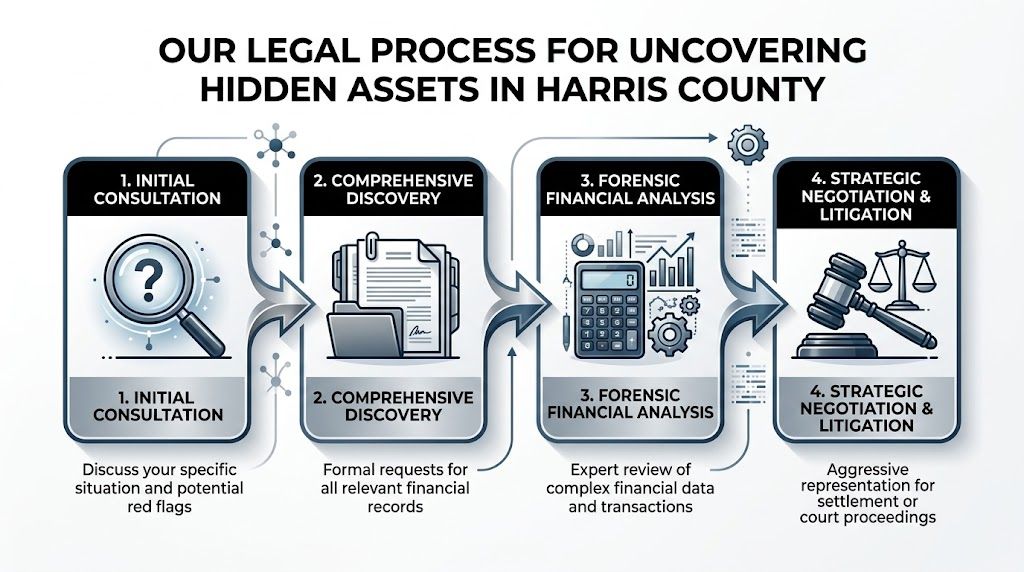
Step one is building a financial timeline the court can follow
Hidden asset cases are won or lost on sequence. I start by asking when the numbers stopped matching the family’s normal financial life. That may be the month direct deposits changed, the point credit card balances rose while reported income fell, or the date online access suddenly disappeared.
The first round of review usually includes tax returns, bank and credit card statements, retirement summaries, pay records, business books, deeds, vehicle records, and prior loan applications. Loan applications are especially useful because people often disclose income, accounts, and property more fully when they are asking a lender for credit.
A strong file is specific. Dates matter. Amounts matter. Contradictions matter.
Step two uses formal discovery to pin down answers
Once a divorce is on file, we can require sworn responses and document production instead of relying on explanations that keep changing. In Harris County practice, that often starts with targeted interrogatories, requests for production, requests for disclosure, and depositions when the paper trail raises more questions than it answers.
The goal is precision, not volume. If payroll records show compensation that never reached a joint account, I want to know where it went. If a spouse claims a business is struggling while personal spending says otherwise, I want the underlying ledgers, merchant statements, and account transfers. If the estate may be larger than first reported, a lawyer with experience in high-asset divorce representation in Atascocita can help frame discovery around valuation, tracing, and control of funds.
This stage also brings trade-offs. Broad discovery can uncover useful information, but it can also increase cost and invite delay objections. A good strategy asks for the records most likely to prove concealment first, then expands only where the documents point.
Step three brings in forensic accounting when suspicion turns into patterns
Some cases can be handled with careful lawyering and solid records. Others need forensic accounting.
A forensic accountant tests whether the documents fit the story being told. That can include tracing transfers between accounts, separating community and separate property claims, reviewing owner-paid personal expenses through a business, checking cash flow against tax filings, and identifying money routed through relatives or closely held companies. In self-employment cases and business-owner divorces, that work often makes the difference between a hunch and admissible proof.
Texas courts can address fraud on the community if one spouse concealed or diverted marital assets. The remedy depends on what can be shown, how clearly it can be traced, and whether the evidence supports reconstitution of the estate or a disproportionate division. That is why expert work is sometimes worth the added cost. Spending money to trace a large missing account is different from spending the same amount to chase a weak theory with little documentary support.
Step four reaches third parties and public records
Important evidence often sits outside the home and outside your spouse’s control. Banks, employers, title companies, payroll processors, business partners, cryptocurrency exchanges, and benefits administrators may have the cleanest records in the case.
Subpoenas can be used to get those materials when voluntary disclosure is incomplete or misleading. In local cases, we also check public records that may reveal omitted property interests, entity filings, assumed names, transfers, and liens tied to Harris County or nearby communities such as Atascocita and Humble.
Digital behavior can also supply leads. If a spouse is using alternate usernames or separate online identities tied to sales activity, side income, or account creation, lawful public research may help find someone's hidden profiles before we pursue the formal records behind them.
Step five is resolution from a position of proof
Once the records are organized, many cases shift. Some settle because the missing pieces are now visible and hard to explain away. Others go to temporary hearings, mediation, or trial because concealment is still being denied.
The Law Office of Bryan Fagan – Atascocita TX Lawyers handles these matters by combining discovery, subpoenas, financial analysis, and courtroom preparation in family law cases involving suspected concealment. The process has to stay disciplined. Every request for records, every subpoena, and every deposition topic should tie back to a specific theory about where the asset went, who controlled it, and how it affected the community estate.
Good hidden asset litigation is organized. Every subpoena, every account statement, and every deposition question should support a provable claim.
Choosing Your Atascocita Divorce Lawyer and Next Steps
Not every divorce lawyer is the right fit when hidden assets are in play. A routine uncontested case and a concealment case require different instincts. You need someone who knows how to push for records, work with financial experts, and deal with the realities of Harris County practice.
What to look for before you hire anyone
Start with experience in property division, not just divorce filings generally. If a lawyer rarely handles business records, retirement tracing, third-party subpoenas, or fraud-based claims, that gap can hurt your case.
Then ask practical questions:
- How do you handle suspicious financial disclosures
- When do you bring in a forensic accountant
- How do you approach subpoenas to banks or employers
- What do you do if the other spouse keeps delaying document production
The answers should be concrete. You want a lawyer who can explain process, not someone who only repeats that the court wants fairness.
Local knowledge matters more than many people realize
An attorney familiar with Atascocita, Humble, and northeast Harris County will understand how local filing practices, scheduling, and courthouse procedure affect timing. That matters when records need to be obtained quickly or when temporary relief may be needed to stop transfers.
If your marital estate includes business interests, investment holdings, executive compensation, or significant property, this resource on a high asset divorce lawyer in Atascocita may help you evaluate the kind of representation your case requires.
What works and what doesn't
What works is early action, organized records, and a lawyer willing to test claims against documents. What doesn't work is relying on verbal assurances, hoping suspicious issues will resolve themselves, or waiting until the final stages of divorce to investigate.
If you're uneasy because something in the financial picture doesn't add up, trust that instinct enough to get informed. You don't need proof before you speak with counsel. You need a clear explanation of what to preserve, what to request, and what to do next.
Frequently Asked Questions About Hidden Assets
Can a divorce be reopened if I discover hidden assets later
Yes, sometimes. Texas law gives a former spouse a possible path to challenge a property division after divorce if the other side committed fraud or failed to disclose property, but these cases are very procedure-driven and time-sensitive. The remedy depends on the wording of the decree, when the asset was discovered, and whether the court treats the issue as fraud on the community.
Texas courts can award a disproportionate share of property and attorney’s fees in the right case. The Texas Supreme Court has recognized that fraud on the community can justify a reconstituted estate and an unequal division, as explained in Schlueter v. Schlueter, 975 S.W.2d 584 (Tex. 1998). In Harris County, the practical question is not just whether relief exists. It is whether the claim is presented correctly and backed by records the court can trust.
What penalties can a Texas court impose for hiding assets
A judge can do more than add an account back into the marital balance sheet. If concealment is proven, the court may divide the community estate in a way that favors the innocent spouse, assess attorney’s fees, and make credibility findings that affect the rest of the case.
That last point matters. A spouse who lies about money often has a harder time persuading the court on valuation disputes, reimbursement claims, or support issues.
Can hidden assets affect child support
Yes. Hidden income and hidden assets often overlap, especially if one spouse is paid through a business, receives irregular commissions, or delays compensation. If reported income is artificially low, child support calculations may also be wrong.
In practice, I look for whether the property issue is also an income issue. A spouse may hide money in an account, but the larger problem is sometimes the income stream that fed it.
What should I bring to my first meeting with a lawyer
Bring documents you already have lawful access to and a short summary of what feels inconsistent. Good starting materials include recent tax returns, bank and credit card statements, retirement account summaries, pay stubs, business profit and loss statements, loan applications, property records, and screenshots showing balances or transfers.
A one-page timeline is often more useful than a stack of loose papers. If you can identify when spending changed, when an account disappeared, or when a business suddenly looked less profitable, that gives your lawyer a cleaner starting point.
Should I confront my spouse before talking to a lawyer
Usually no. Direct confrontation can lead to wiped devices, changed passwords, unusual withdrawals, or pressure to sign a quick agreement before the finances are fully examined.
Quiet preparation is often the better approach. Preserve what you can lawfully access, write down dates and concerns, and get legal advice before signaling what you know.
What if I only suspect concealment and can't prove it yet
That is a common position. Hidden asset cases rarely begin with a clear confession or a neat paper trail. They usually start with missing statements, inconsistent explanations, cash flow that does not match reported income, or a spouse who becomes unusually secretive about routine finances.
That level of concern is enough to speak with counsel. A good lawyer should be able to tell you whether your facts justify formal discovery, a tracing review, business valuation work, or a faster request for court intervention in Harris County.
If you suspect your spouse isn't being honest about money, you don't have to sort it out alone. Schedule a free consultation with Law Office of Bryan Fagan – Atascocita TX Lawyers to discuss your situation, protect the records that matter, and get a practical plan for pursuing a fair result in your divorce.


