Skip to content
If you're reading this from your office in Atascocita, your truck between appointments in Humble, or your kitchen table after the kids are asleep, you're probably carrying two worries at once. One is the divorce itself. The other is the business you built, bought, or helped grow, and whether it will survive what comes next.
For many local owners, the business isn't just another asset on a spreadsheet. It's the storefront on a neighborhood road, the practice you've spent years building, the contractor business with employees who count on your leadership, or the family company that supports your household. When divorce starts, one question shows up fast: What is my business worth, and who gets what?
That question sounds simple. It rarely is.
A proper business valuation divorce atascocita case involves law, accounting, timing, and strategy. It also involves emotion. Owners often feel insulted by low numbers, trapped by high numbers, or confused about why a business they started before marriage is still part of the conversation. Those reactions are normal.
This guide is written in plain English for business owners in Atascocita, Humble, and northeast Harris County who want clarity, not jargon.
An Atascocita Business Owner's Guide to Divorce
A lot of people walk into a divorce consultation with the same look. They're not only worried about the marriage ending. They're worried that the divorce process will tear through the business they've spent years protecting.

Take a common local example. A business owner in Atascocita may run a landscaping company, a small medical practice, a construction operation, or a retail shop near Humble. The owner knows payroll, vendor issues, and customer relationships. Divorce law is different. Suddenly, they're hearing terms like valuation date, community property, goodwill, forensic accounting, and reimbursement claims. It can feel like someone changed the rules overnight.
The first thing to know is this: panic leads to bad decisions. Rushing to accept your spouse's number, guessing what the business is worth, or assuming the company is fully protected because your name is on the formation documents can create lasting damage.
Your divorce case and your business future are tied together, but they aren't the same problem. They need separate attention and a coordinated plan.
For business owners, the path forward usually starts with good information, clean records, and local legal guidance. If your situation involves ownership questions, valuation disputes, or fears about losing control of the company, this guide on divorce for business owners in Atascocita is a helpful place to begin.
What most owners need right away
You don't need to master every accounting rule in a week. You do need to understand a few basics early:
- What part of the business is separate property
- What part may be community property
- How the value will be measured
- Whether the valuation number reflects taxes, debt, and reality
- How to keep the business operating while the divorce moves forward
Once those pieces are clear, the rest of the process becomes much more manageable.
Why a Formal Business Valuation is Crucial in Your Divorce
A divorce court can't divide property fairly if nobody knows what a major asset is worth. That's why a formal valuation matters. It gives everyone a common starting point, even when they disagree about almost everything else.
Think about selling a house without an appraisal. One person says it's worth far more because of the updates. The other says it needs work and should be priced lower. Until someone applies a recognized method and supports it with evidence, the number is only an opinion. A business works the same way, except it's usually more complicated than a house.
Guessing creates expensive problems
When owners skip a formal valuation, they often rely on one of these shortcuts:
- last year's tax return
- a rough number from a bookkeeper
- what a friend says the business might sell for
- the amount listed in internal financial software
- a spouse's unsupported claim about what the business "must be worth"
None of those is enough by itself in a contested divorce.
A business valuation affects more than the business. It can change how the rest of the property division is handled, including retirement accounts, real estate, cash reserves, and buyout proposals. If the business is overstated, you may end up giving up too much elsewhere. If it's understated, the other side may challenge the settlement or push the case into litigation.
A valuation is evidence, not just math
A proper valuation report usually does several jobs at once:
- It identifies what records were reviewed.
- It explains the method used.
- It addresses assets, liabilities, and earnings.
- It gives the court or negotiating parties a defensible number.
That last point matters. In divorce, a number isn't useful just because it's detailed. It's useful because it can hold up under scrutiny.
Practical rule: If the business is one of the largest assets in the marriage, a casual estimate is rarely enough.
Why owners in Atascocita should care early
Local small business owners often keep things moving with a mix of formal records and practical judgment. That may work well in day-to-day operations. It doesn't work as well in divorce litigation. Courts and experts want backup. They want financial statements, tax returns, ownership documents, debt records, and explanations for unusual transactions.
A formal valuation also helps reduce confusion during settlement talks. Instead of arguing in circles over a number pulled from emotion or fear, the discussion can focus on evidence, assumptions, and whether the method fits the business.
What a valuation can help you avoid
- An inflated payout demand based on gross revenue rather than actual value
- A rushed buyout that hurts cash flow
- A misleading settlement that ignores debt or owner perks
- A trial surprise when the other side brings in an expert and you don't have one
For many owners, the valuation report is the document that turns a chaotic dispute into a problem that can be solved.
How Texas Law Views Your Business in a Divorce
Texas doesn't start with the question, "Whose name is on the company?" It starts with a property classification question. Is the business, or part of it, separate property or community property?

That distinction shapes almost everything that follows in a business valuation divorce atascocita case. If you don't understand it early, the rest of the process can seem random.
For a broader foundation, it's worth reviewing how community property works in Texas, because business issues sit inside that larger framework.
Separate property doesn't always end the conversation
Under Texas law, a business started before marriage may begin as separate property. But that doesn't automatically mean the business is untouched in divorce. One of the most common surprises for owners is that the increase in value during the marriage caused by spousal effort can become a divisible community asset, as discussed in this Texas business valuation discussion.
That means a company can be partly protected and partly exposed at the same time.
A simple example helps. Suppose you launched a small service company before marriage. Years later, during the marriage, the business grew because of your labor, management, client development, and reinvestment. The original ownership interest may still matter as separate property, but the marital growth may still become part of the divorce dispute.
Timing can change the number
The date used to value a business matters. Texas courts may look to valuation points such as the date of marriage, date of separation, date of service, or date of trial, and the chosen date can sharply affect the result, especially when business conditions have changed. The same source explains that a business valued at $500,000 at separation could be $600,000 or $450,000 six months later, depending on market movement and company performance.
For a small or mid-size company, that difference isn't abstract. It can change buyout negotiations, property offsets, and whether a settlement even feels possible.
Why financial cleanup matters
Valuation experts don't just copy the profit line from a tax return. In many cases, they work to normalize the financials. That can mean adding back personal expenses run through the business, separating one-time events from ordinary performance, and looking closely at earnings in a way that reflects the company's actual economics.
If that isn't done, the reported value may be artificially low or artificially high.
Here is where owners often get confused:
- Revenue is not value. A busy company can still carry debt, weak margins, or unstable contracts.
- Ownership is not the same as divisible value. You can own the company and still face a claim involving marital growth.
- Book value is not always fair market value. The balance sheet may not capture customer relationships, brand value, or operational risk.
A short video can help if you learn better by hearing the concepts explained aloud.
Why this issue affects many business owners
Divorce risk isn't rare. The same Texas source notes that 41% of first marriages end in divorce. For owners with a closely held company, the stakes can be especially high because the business may be the family's largest asset, its income source, or both.
Courts aim for a division that is "just and right." That doesn't always mean a simple split down the middle, and it doesn't happen accurately without reliable valuation work.
If there's evidence of hidden assets or misuse of community resources, the dispute can become even more serious. That's one reason business owners in Harris County often need both legal and financial guidance early, before assumptions harden into positions that are hard to unwind.
The Three Main Business Valuation Methods Explained
Most valuation reports rely on three broad approaches. If those labels sound technical, it helps to translate them into something more familiar.
Let's use one example throughout. Picture a popular local restaurant near Atascocita or Humble. It has kitchen equipment, inventory, a lease, staff, regular customers, and an owner who knows how to keep the place profitable. There are different ways to decide what that business is worth, and each method asks a different question.
The asset approach
The asset-based approach asks, "What do we have, and what do we owe?"
For the restaurant, that could include equipment, furniture, inventory, cash, receivables, and any other tangible or intangible business assets, minus liabilities. This method often makes sense when a company is asset-heavy or when the value lies more in what it owns than in future earnings.
This approach can be easier for clients to understand because it feels concrete. You can point to ovens, tables, vehicles, tools, or inventory. But it can miss part of the picture if the business has real value in customer loyalty, systems, reputation, or earning power.
The market approach
The market approach asks, "What have similar businesses sold for?"
With the restaurant example, an expert would look for sales of comparable businesses and use those comparisons to estimate value. In plain language, it's similar to how people think about home prices. If several similar homes sold nearby, those sales help frame what your home might be worth.
The challenge is that no two small businesses are exactly alike. A company in Humble with stable repeat customers, a stronger manager, or cleaner books may deserve a different valuation than another business that looks similar from the outside.
The income approach
The income approach asks, "What is this business likely to earn?"
This method often carries a lot of weight for active small businesses because buyers usually care about future cash flow. Experts may review earnings, normalize the numbers, and consider expected future performance. If you want a basic finance refresher on how projected gains are evaluated, this short piece on understanding incremental cash flow can help make the logic easier to follow.
For owner-operated companies, this approach can be powerful, but it also creates room for dispute. If one side assumes stronger future performance and the other side assumes decline, the numbers can spread apart quickly.
Comparison of Business Valuation Methods
| Valuation Method | How It Works | Best For | Pros | Cons |
|---|---|---|---|---|
| Asset-Based | Adds business assets and subtracts liabilities | Asset-heavy companies, holding entities, businesses with significant equipment or inventory | Clear starting point, easier to document, useful when earnings are unstable | May understate value if goodwill or future income matters |
| Market-Based | Compares the business to similar companies that have sold | Businesses with good comparable sales data | Familiar logic, grounded in real transactions, helpful as a reality check | Comparable sales may be limited or not truly comparable |
| Income-Based | Estimates value based on expected earnings or cash flow | Operating businesses where future profitability drives value | Captures earning power, often useful for established local businesses | Sensitive to assumptions, can become a battle of projections |
Why experts sometimes use more than one method
A good valuation doesn't always rely on only one approach. An expert may consider several methods, then explain which deserves the most weight. That's especially true when the business has both hard assets and meaningful income.
For example, a machine shop in northeast Harris County may need an asset review because of equipment, but an income review also matters if contracts and recurring work drive its core value. A professional practice may have fewer physical assets, yet strong earnings may make the income method more informative.
If a valuation method doesn't fit how your business actually makes money, the final number may be hard to trust.
The practical takeaway for owners
You don't need to become a valuation analyst. You do need to ask smart questions:
- Why was this method chosen?
- What documents support it?
- Were the financials normalized?
- Did the expert consider debt and unusual expenses?
- Does this method reflect how my company really operates?
When clients ask those questions early, they usually understand the report better and spot problems faster.
Your Step-by-Step Valuation Process in Harris County
The valuation process feels less overwhelming when you know the order of events. Most cases follow a pattern, even though the details vary from one business to another.
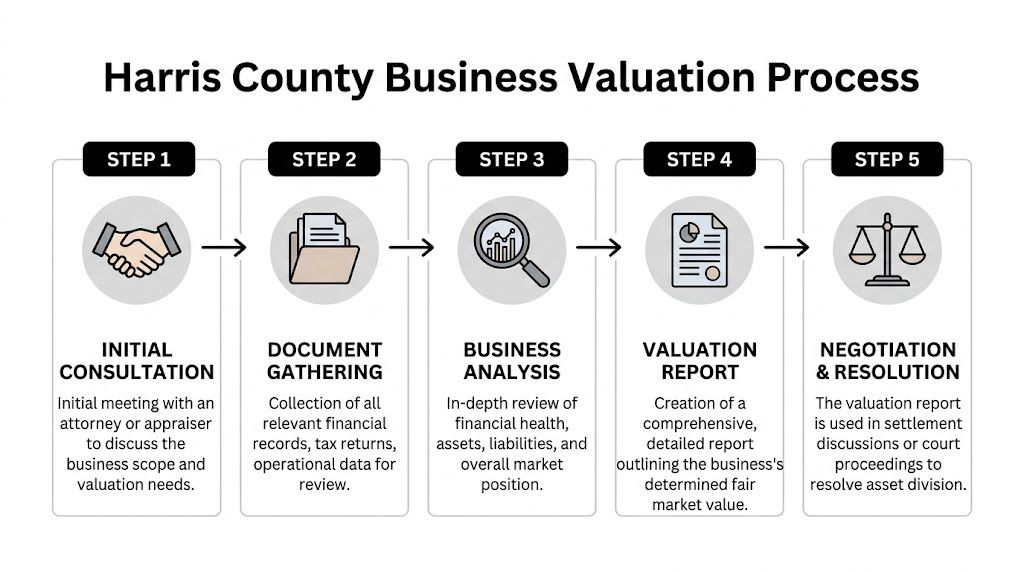
Step one starts with scope
Early in the case, the first question is usually who will perform the valuation. Sometimes the spouses agree on a joint expert. Other times, each side hires its own professional. The right choice depends on conflict level, trust, and the complexity of the company.
At this stage, the attorney and valuation professional usually define the scope of work. They need to know what entity is being valued, what period matters, what records exist, and whether special concerns are already visible.
Step two is document gathering
This stage often causes the most stress because it interrupts normal business routines. The expert may request tax returns, profit and loss statements, balance sheets, bank records, payroll records, debt documents, formation records, ownership agreements, and details about any unusual transactions.
If the books are clean, this step moves faster. If personal and business expenses have been mixed, there may be follow-up questions.
A practical approach is to gather records in categories:
- Core financials such as tax returns, internal statements, and year-end reports
- Ownership records including formation papers, partnership agreements, or operating agreements
- Debt and liability documents for loans, leases, and credit obligations
- Operational records that explain how the business earns money
Step three is business analysis
Once the records are in, the expert begins the deeper review. This part is more than data entry. The analyst studies how the company operates, where its income comes from, whether earnings are stable, and whether any reported expenses should be adjusted.
That may include interviews with the owner or management. It may also include review of industry conditions, customer concentration, compensation, and whether nonrecurring events distorted the books.
A valuation expert isn't just asking, "What did this company earn?" The expert is asking, "What do these numbers really mean?"
Step four is the report
After analysis, the expert prepares a written valuation report. The report typically explains the records reviewed, the assumptions made, the valuation date used, and the methods chosen.
This is the stage where legal review matters. A report can look polished and still contain assumptions that deserve challenge. If a number seems off, the issue may be buried in a discount rate, a compensation adjustment, or a growth assumption rather than in the final page total.
Step five is negotiation or court use
Once the report is done, it becomes a tool. In some cases, it helps the spouses settle because they finally have a serious number on the table. In others, it becomes evidence used in mediation, negotiation, deposition, or trial.
The report doesn't decide the case by itself. People do. But it gives the court and the parties a structured way to discuss a very personal asset without reducing the process to guesswork.
How to make the process easier on yourself
A few habits help owners move through this stage with less disruption:
- Keep communication clear. Answer document requests on time and explain missing records directly.
- Don't alter records. Cleaning up books is one thing. Rewriting history is another.
- Separate emotion from documentation. Feeling frustrated won't hurt your case. Sloppy responses can.
- Protect daily operations. Keep serving customers, paying staff, and maintaining ordinary business routines.
For many owners in Harris County, the process feels manageable once they stop seeing it as one giant event and start treating it as a sequence of smaller tasks.
Protecting Your Business and Contesting a Valuation
Some valuations are fair. Some aren't. A business owner needs to be ready for both possibilities.
A valuation can hurt you in two opposite ways. It can come in too high, making it look like you have more divisible wealth than you really do. Or it can come in too low, which may push the other side to attack your credibility, accuse you of hiding value, or demand a second review.

Start by protecting the records
The best defense against a bad valuation is good documentation. Owners help themselves when they maintain clean bookkeeping, avoid informal cash practices, and keep business and personal expenses as separate as possible.
That doesn't mean your records must be perfect. It means they should be explainable.
If you're thinking ahead about broader financial safeguards, this resource on protecting assets during divorce is a useful companion to the valuation process.
Watch for tax blind spots
One of the most overlooked issues in a business valuation divorce atascocita matter is taxes. A valuation may look generous on paper while ignoring the tax cost tied to the value being assigned. According to this discussion of Texas divorce valuation disputes, embedded taxes can reduce net business value by 15% to 40% for pass-through entities, and courts are increasingly receptive to hypothetical sale scenarios that include capital gains taxes. That same discussion also notes that IRS rules on divorce-related business sales make tax-adjusted valuations especially important for owners of closely held companies in this area.
A high number doesn't always equal a fair number if the path to realizing that value would trigger meaningful tax consequences.
Common reasons to challenge a valuation
You may have grounds to contest a valuation if:
- The expert used weak assumptions about future earnings or growth
- Personal expenses weren't handled correctly, which can distort normalized earnings
- Debt or liabilities were understated
- The selected method didn't fit the business
- Tax effects were ignored, especially for pass-through entities
- The valuation date didn't reflect the reality of the case
Sometimes the problem is obvious. Other times it takes a second expert to identify where the first report went wrong.
A valuation report can be detailed and still be wrong in the places that matter most.
What contesting usually looks like
Challenging a valuation doesn't mean merely saying, "I disagree." It usually means identifying the specific assumptions, records, or methods that need to be tested.
That process may include:
- asking follow-up questions through counsel
- providing additional records or explanations
- hiring a rebuttal expert
- using mediation to narrow the disagreement
- presenting competing testimony if the dispute reaches court
A practical point matters here. Judges tend to respond better to organized criticism than emotional criticism. If you're contesting the report, your position should show exactly what changed, why it changed, and how that affects the final number.
Keep control where you can
Even during a valuation dispute, you can still protect the business operationally. Keep your customer relationships stable. Avoid unusual transfers. Don't shut down normal spending out of fear unless your lawyer advises it. And don't make side deals with your spouse about the business without getting them reviewed first.
Many business owners feel more secure once they realize they don't have to accept the first number placed in front of them.
Choosing Your Legal and Financial Team in Atascocita
A business valuation dispute usually isn't solved by one professional working alone. You need the right combination of legal strategy and financial analysis.
The attorney handles the legal framework, deadlines, discovery, negotiations, and court presentation. The forensic accountant or valuation expert handles the financial investigation, methods, and technical opinion. Those roles overlap, but they aren't interchangeable.
What to look for in a family lawyer
In a business-related divorce, local experience matters. An attorney familiar with Harris County practice will understand how to organize evidence, frame disputes clearly, and work with valuation professionals in a way that's useful in settlement or trial.
Ask direct questions in the consultation:
- Have you handled divorce cases involving closely held businesses?
- How do you work with valuation experts?
- How do you approach disputes about separate versus community interests?
- What records should I start gathering now?
You don't need a flashy answer. You need a clear one.
What to look for in a valuation professional
A strong expert should be able to explain the numbers in plain language. If an accountant can't tell you, in understandable terms, why a method fits your company, that can become a problem later.
Useful questions include:
- What valuation methods do you think fit this kind of business?
- What assumptions are likely to drive the result?
- What records do you need first?
- How do you address owner compensation, debt, and unusual expenses?
If you like reviewing documents yourself, tools can help you organize before meetings. For example, an AI legal contract analyzer can help you scan agreements such as operating agreements, leases, or buy-sell documents for key provisions to discuss with your attorney. It isn't a replacement for legal advice, but it can help you prepare smarter questions.
Build a hometown team
Owners in Atascocita and Humble often benefit from professionals who understand local businesses, local court expectations, and the practical reality of running a company while going through litigation.
Look for a team that does three things well:
- Translates jargon into plain English
- Moves quickly when documents, hearings, or rebuttal work are needed
- Stays grounded in solutions that protect both the case and the company
The best team doesn't just produce documents. It helps you make calm decisions when the pressure is high.
You should leave early meetings feeling clearer, not more confused.
Take the First Step to Protect Your Business Today
If your divorce involves a company you've spent years building, the valuation process isn't a side issue. It's one of the main issues. The number attached to your business can shape property division, buyout options, tax consequences, and your ability to keep operating without long-term damage.
The good news is that this process becomes more manageable once you break it into parts. First, understand how Texas law classifies the business interest. Next, identify the right valuation method. Then gather records, review the assumptions carefully, and challenge any number that doesn't reflect reality. That's how business owners protect what they've built.
If you're in Atascocita, Humble, or another part of northeast Harris County, don't wait until the other side defines your business for you. Early guidance can help you avoid preventable mistakes and put you in a stronger position for negotiation or court.
If you need guidance specific to your business and your divorce, schedule a free consultation with Law Office of Bryan Fagan – Atascocita TX Lawyers. Their Atascocita office serves local families and business owners throughout Atascocita, Humble, and Harris County with compassionate, practical legal support.