Skip to content
A lot of families in Atascocita and Humble find themselves in the same spot after a loss. One day you're making funeral arrangements, answering calls, and trying to keep everyone together. A few days later, someone asks, “What do we do about the house, the bank account, or Dad’s will?” That’s usually when probate enters the conversation.
If you’re searching for probate court near atascocita texas, you probably don’t need legal theory. You need clear answers. You need to know where the case goes, what the court does, how long it may take, and what happens if your loved one didn’t leave a will at all.
That uncertainty is normal. Probate sounds intimidating because it involves a courthouse, formal paperwork, deadlines, and family property at a time when emotions are already high. But in most cases, the process is more manageable once you understand the path in front of you.
Navigating Loss A Guide for Atascocita and Humble Families
A common local scenario looks like this. A parent in Atascocita passes away. The family home is still in the parent’s name. One adult child has the original will, another is trying to help with bills, and everyone assumes the paperwork can wait until things settle down.
Then practical questions start piling up. Can someone access accounts to pay expenses? Who has authority to deal with creditors? Can the house be sold, refinanced, or transferred to the people named in the will?

Why families feel stuck
Few individuals have direct experience with probate. They may have signed as witnesses for a relative’s will years ago, but they’ve never had to file an application, appear in court, or gather estate records. Even organized families can feel overwhelmed.
A few things usually create the most stress:
- Unclear authority: No one knows who is legally allowed to act for the estate yet.
- Property questions: The home, vehicles, and financial accounts may still be titled in the deceased person’s name.
- Family assumptions: One relative may think a will avoids court entirely, while another thinks every estate turns into a long legal battle.
- No-will situations: If there’s no will, or the will is outdated, people often don’t know where to begin.
Probate is often less about conflict and more about getting legal authority in place so someone can handle the estate correctly.
For families in northeast Harris County, the good news is that there is a structured court system for this work. The probate courts that serve Atascocita residents handle these matters every day. Once you know which court has jurisdiction and what the first few steps look like, the process becomes less mysterious.
A neighborly way to think about it
Probate is the formal legal process that helps close out a person’s affairs. It gives the court a chance to confirm who should act, protect creditors and heirs, and make sure property ends up where the law says it should go.
That may sound technical, but the purpose is practical. Probate creates order at a time when families need stability.
What is Probate and Why is it Necessary in Texas
Probate is the court-supervised process for handling someone’s estate after death. In plain English, it’s the legal system’s way of saying, “Let’s confirm who has authority, identify what exists, pay what must be paid, and transfer what remains to the right people.”
A simple analogy helps. Think of probate as the official closing process for a person’s legal and financial life. Even when a family agrees on everything, someone still has to be legally recognized to act on behalf of the estate.

What probate usually accomplishes
Texas probate generally serves three core purposes:
- Validate the will if one exists.
- Deal with debts and claims against the estate.
- Transfer remaining property to beneficiaries or heirs.
If there’s a will, the court often needs to admit it to probate before the named executor can fully act. If there isn’t a will, the court still has work to do. It must identify the legal heirs and apply Texas succession rules.
The confusion around no-will estates
Many online articles frequently fall short. They focus on families with a current will and skip over a very common reality. Many online resources focus heavily on will-based probate, but they often fail to adequately discuss intestate probate, meaning no will, or cases involving outdated wills. That gap matters because an estimated 60% of Americans die without an updated will, according to this discussion of Atascocita probate issues from Murphy Law Firm.
When someone dies intestate, Texas law decides who inherits. That can create real surprises in blended families, second marriages, and situations involving separate property versus community property. A child may assume a surviving spouse inherits everything. A spouse may assume an old will still reflects the current family structure. Those assumptions can be wrong.
Practical rule: A will doesn’t move title by itself. Until the right probate procedure happens, many assets remain legally stuck.
Why court involvement still matters when there is a will
People often ask, “If Mom had a will, why do we need probate at all?” Because a will is a written expression of intent, not automatic authority. The court usually has to recognize it and authorize the executor to act.
That’s why families often benefit from reading a plain-language probate guide alongside legal advice. It helps translate the sequence of events into everyday terms before you start gathering documents and making decisions.
In Texas, probate isn’t designed to punish families. It exists to create a lawful handoff from one generation to the next.
Finding Your Harris County Probate Court
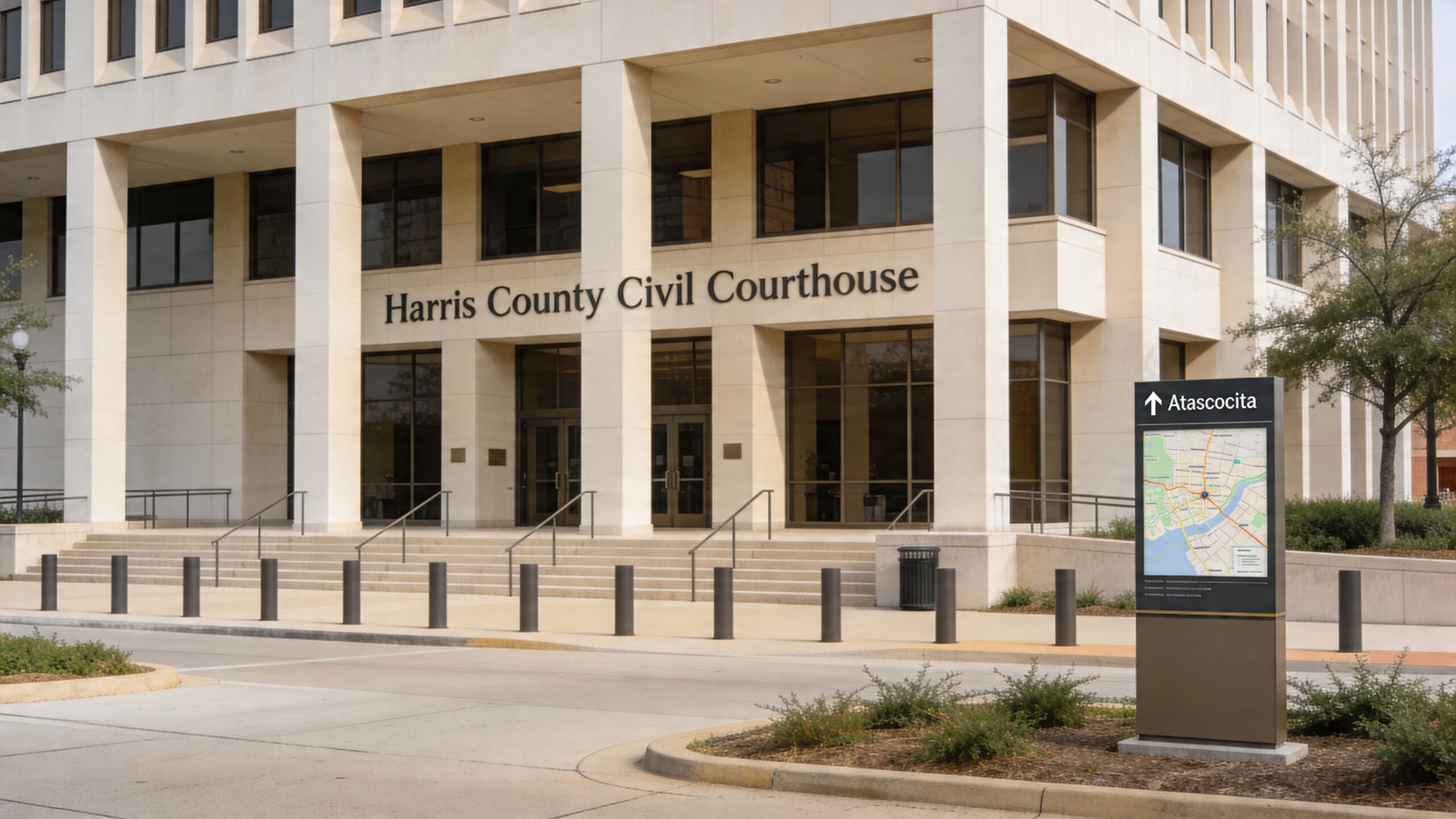
A family in Atascocita often starts with a simple question after a death: “Which courthouse do we even go to?” For estates tied to Atascocita, Humble, and other northeast Harris County communities, the answer is usually the Harris County Statutory Probate Courts in downtown Houston. Those courts are set up for probate, guardianship, and related estate matters, so families are not guessing their way through a general civil docket.
That court assignment matters more than people expect. Harris County uses dedicated probate courts rather than sending these cases through a regular county court, which means the judges and clerks deal with estate filings every day.
Why these courts serve Atascocita families
For local residents, the practical point is simple. If a loved one lived in Harris County, the probate case is generally filed in Harris County’s probate court system, even if the family lives closer to Atascocita than downtown Houston.
These courts routinely handle questions about whether a will is valid, who has authority to act for the estate, and who inherits when there is no will at all. That last issue, intestate probate, creates a lot of confusion because families often assume the closest relative can just step in. Texas law does not work that way. The court still has to determine the proper heirs and appoint someone to manage the estate.
If you want a practical overview of the filing side, this page on probating a will in Texas gives a useful local starting point.
What the court’s workload means for your timeline
Busy does not always mean stalled. In probate, a better question is whether the court is regularly processing cases and signing orders.
According to this Harris County Probate Court No. 1 caseload review, Probate Court No. 1 recorded a 128.8% clearance rate from March 1, 2024 through February 28, 2025, resolving 3,092 cases compared to 2,401 new or reopened cases. During that same period, the court handled 9,866 motions, signed 12,244 orders, and conducted 3,134 hearings.
For an Atascocita family, those numbers help set expectations. A straightforward uncontested estate may move on a normal court schedule because these courts process probate matters in high volume. A disputed will contest or an intestate estate with unclear heirs usually takes longer, not because the courthouse is unfamiliar with the issue, but because the legal questions take more work to sort out.
What to bring before filing
Start with the basics. Gather the original will, if one exists, a certified death certificate if you have it, names and addresses for close family members, and a rough list of assets and debts.
That packet works like the first folder you bring to a doctor appointment. It does not need to contain every answer, but it gives the court and your attorney enough to identify the right probate path.
One more point catches families off guard. If the estate includes a house, probate may affect when and how it can be sold. Even though this article is about Texas courts, the process questions in how to sell a house in probate can help you understand why court authority matters before a sale happens.
If your search was for probate court near atascocita texas, the direct answer is straightforward. Your case is usually handled in the Harris County probate courts in downtown Houston, not at a separate courthouse in Atascocita.
Key Steps in the Texas Probate Administration Process
A common Atascocita scenario goes like this. A parent dies, the family finds a will in a desk drawer, and the person named as executor assumes they can start closing accounts or dealing with the house right away. In Harris County, probate usually starts one step earlier. The court has to accept the will and appoint the person who will act for the estate.
That first point matters even more in intestate estates, which means there is no will. In those cases, the court is not just approving paperwork. It is also sorting out who the legal heirs are under Texas law, and that can add time, extra filings, and more room for disagreement.
The probate sequence in plain language
For most estates served by the Harris County probate courts, the process follows a practical order:
File the probate application. The case begins with a filing that asks the court to open the estate and, if there is a will, admit it to probate. Texas law usually gives families up to four years from the date of death to probate a will, but waiting often creates avoidable problems with property access, account transfers, and record collection.
Attend the initial hearing. This is the point where the judge reviews the filing, confirms the will if one exists, and decides who should be appointed. If there is no will, the court may need additional proof about family relationships before naming an administrator.
Receive authority to act. After appointment, the executor or administrator receives court authority to handle estate business. In practice, that authority is what banks, title companies, and other institutions usually want to see before they will talk seriously about transfers.
Give required notices. The personal representative must notify certain parties, including creditors, and follow the notice rules that apply to the estate. This step sounds routine, but missed notice deadlines can create headaches later.
Identify and value the estate. The job here is to gather a full picture of what the person owned and owed. That can include a house in Atascocita, vehicles, bank accounts, retirement funds payable to the estate, business interests, and personal property.
Handle debts, expenses, and claims. Valid debts and estate expenses are addressed before beneficiaries receive property. Families often underestimate this part because it occurs through letters, statements, and filings rather than one dramatic court appearance.
Distribute the remaining property and close the estate. Once the estate is ready, property passes under the will or, if there is no will, under Texas intestacy rules. That distinction is one reason intestate estates often feel more stressful. The court is applying a legal family tree, not informal family understandings.
Where executors and administrators get stuck
The hardest part is often the middle. Probate works like a long paper trail that has to stay in order from start to finish.
Executors commonly run into trouble when they cannot find account information, do not know whether an asset belongs to the estate, or assume family agreement is enough to skip a formal step. Intestate estates create another layer of difficulty because relatives may agree in principle about what feels fair, but the court still has to follow the inheritance rules Texas provides.
An executor’s job is part record-keeper, part traffic director, and part fiduciary. That means handling other people’s property carefully and keeping a clear paper trail.
Real estate needs extra care
For many local families, the house is the asset that raises the most questions. Can it be sold now? Does everyone have to sign? Does the court need to approve anything first?
Those questions depend on the type of probate, the wording of the will, and whether the property passed outside the estate. A useful general explainer on how to sell a house in probate can help families understand the moving parts, even though the actual Texas procedure should be reviewed based on the Harris County case.
Some estates also benefit from legal help with e-filing, hearing preparation, heirship issues, and county-specific forms. One local option is the Law Office of Bryan Fagan’s Atascocita probate practice, which assists with Harris County probate filings and executor support.
A practical way to approach the job
Treat probate like a checklist with deadlines, not a single event. Keep copies of everything. Do not distribute money or property early. If the estate has no will, expect the heirship piece to require extra patience.
Families who want a fuller local picture of timing can review this guide on how long probate takes in Texas for Harris County area estates. That context helps because the same basic steps can move quickly in a simple uncontested case or stretch out when heirship, title issues, or family conflict are involved.
Probate Timelines and Costs What to Expect
Families usually ask two questions early. How long is this going to take, and what is this going to cost me?
The honest answer is that probate in Harris County isn’t one-size-fits-all. Publicly available county information shows a filing fee of around $360 for various probate types, and the total timeline can range from 6 to 18 months depending on which of the five specialized probate courts handles the case and whether the matter is contested, according to the Harris County probate information summarized from the county probate court resource.
A realistic way to think about timing
A simpler estate usually moves faster when these pieces line up:
- There’s a valid will
- The executor is ready to act
- The heirs agree
- The asset list is clear
- No one contests the filing
A more difficult estate tends to slow down when there are title issues, missing documents, unpaid debts, family conflict, or questions about who should inherit.
If you want a more detailed local discussion of duration, this page on how long probate takes in Texas gives additional context for families trying to set expectations.
Where the money usually goes
Probate costs often include several layers rather than one single bill. Common categories include:
- Court filing fees: the filing itself
- Attorney’s fees: depending on the work required and fee structure
- Appraisal or valuation costs: especially when real estate or hard-to-value assets are involved
- Administrative expenses: copies, notices, publication, and related tasks
A low filing fee doesn’t mean a low total cost. The complexity of the estate usually drives the overall expense more than the first court payment does.
Why transparency matters
A lot of family stress comes from uncertainty, not just from the amount itself. When relatives don’t know whether a case may resolve in months or stretch much longer, they hesitate to make decisions about property, debt, and family agreements.
That’s why it helps to ask direct questions early. Is this likely to be uncontested? Is independent administration available? Are there any signs of an heirship dispute? Those answers shape both timeline and budget.
Can You Avoid Probate Court in Atascocita
Not every estate needs full formal probate. Texas offers alternatives, and for some families those alternatives save time, court appearances, and administrative burden.
The most common path in Texas is still independent administration. According to this Texas probate court guide, over 90% of Texas probate cases use independent administration, which cuts court hearing needs by 70% and reduces timelines from 18 to 24 months down to 6 to 12 months. The same source notes that a Muniment of Title can transfer real property in 3 to 6 months for certain simple estates.
Probate alternatives in Texas compared
| Method | Best For | Typical Timeline | Key Requirement |
|---|---|---|---|
| Independent Administration | Estates where an executor can act with less ongoing court supervision | 6 to 12 months | A probate path that allows the executor to manage the estate with reduced court involvement |
| Muniment of Title | Simple estates with a valid will, especially when the main goal is transferring real estate | 3 to 6 months | A valid will and circumstances that support bypassing full administration |
| Small Estate Affidavit | Smaller no-will estates that may qualify under Texas law | Varies by case | Estate must meet the legal requirements for this simplified procedure |
How to choose the right option
Families in Atascocita often focus first on whether a will exists. That matters, but it isn’t the only question. You also need to look at debt, asset type, and whether the estate mainly consists of a homestead.
A quick decision framework helps:
- If there’s a straightforward will and little need for ongoing administration, Muniment of Title may be worth discussing.
- If there’s no will and the estate is modest, a Small Estate Affidavit may be possible.
- If the estate is larger or needs an executor to handle multiple tasks, independent administration is often the practical route.
For a closer look at the planning side, this local resource on how to avoid probate in Texas can help families understand which tools may fit their situation.
Some estates don’t need less legal care. They need the right legal procedure.
One important caution
People sometimes hear that probate can be avoided and conclude they should skip court entirely. That can create bigger title and transfer problems later. The better approach is to identify the proper Texas procedure for the estate you have, not the one you wish you had.
Why You Need an Atascocita Probate Lawyer on Your Side
A family in Atascocita can feel fairly sure they know what to do after a death. There is a house, a few bank accounts, and relatives who believe they are all on the same page. Then the first court filing raises a harder question. Was there a valid will, or are they dealing with an intestate estate under Texas law?
That question changes almost everything.
Some probate matters are routine. Others become complicated once the family learns that Harris County Probate Courts need more than informal agreements and good intentions. An intestate estate often requires heirship proof, closer attention to family history, and more care in how property is transferred. That is one reason legal help can save time, stress, and avoidable mistakes.
You should strongly consider hiring a probate lawyer if the estate involves:
- No will, more than one possible will, or a will that looks outdated
- Children from different relationships, stepchildren, or uncertainty about legal heirs
- Disagreement over who should serve as administrator or executor
- Questions about debts, creditor claims, or who is responsible for bills
- A home, mineral interest, or other asset that cannot be transferred cleanly
- A personal representative who feels stuck in forms, notices, or deadlines
- Any sign that someone may challenge the will or dispute heirship
Local court knowledge matters
A lawyer familiar with Harris County probate procedure can match the estate to the correct process, prepare the filings the way these courts expect to see them, and reduce the risk of rejection or delay. For Atascocita families, that local experience matters because your case is usually handled through the Harris County probate courts, not a courthouse in Atascocita itself. Searching for a probate court near atascocita texas is a useful first step, but the more important question is which Harris County procedure fits your facts.
Probate works a bit like taking the right lane before a highway split. If you miss the proper lane early, fixing it later takes more time and causes more frustration. That is especially true in no-will cases, where families often assume the closest relative automatically has authority. Texas law does not work that way. The court still has to determine who has legal priority and, in some estates, who the heirs are.
A local attorney also helps with the human side of the case. Probate is paperwork, deadlines, and court procedure. It is also grief, old family tension, and different ideas about what a parent or spouse would have wanted. Clear advice can lower the temperature and keep one disagreement from turning into a case that drags on for months.
Waiting creates its own problems
The biggest mistake many families make is waiting too long to start. They delay because they are grieving, unsure whether a will exists, or hoping the estate can be handled privately. During that delay, mortgage payments still come due, insurance issues can arise, and relatives may start making conflicting assumptions about the house, vehicles, or personal property.
In Harris County, timing matters in practical ways. Some estates can move steadily when the filings are prepared correctly and the family is aligned. Intestate estates, contested matters, and cases with title problems usually take longer. A probate lawyer cannot remove every obstacle, but a lawyer can spot the obstacle early and help the family choose the right response before a manageable issue becomes a larger one.
If your family is facing probate, heirship questions, or concerns about a loved one’s will in Atascocita, Humble, or northeast Harris County, Law Office of Bryan Fagan – Atascocita TX Lawyers can help you understand your options and the next steps. Schedule a free consultation with the Atascocita office to talk through your situation in plain English and get practical guidance appropriate for your circumstances.