Skip to content

When you own a business in Atascocita or Humble, going through a divorce feels like a different kind of battle. It’s not just the personal heartache; it’s the terrifying thought of losing the business you poured your life into. At The Law Office of Bryan Fagan, we have worked with countless entrepreneurs throughout our community, and we understand that fear. This guide is built from that experience, offering a straightforward, supportive look at divorce for business owners in Atascocita, Texas, and how to protect what you've built.
The Unique Stakes of Divorcing as an Atascocita Business Owner
For a business owner in northeast Harris County, a divorce isn’t just a private matter—it’s a direct threat to your company’s survival, your employees’ jobs, and your own financial future. The daily grind of running a business is already a pressure cooker of managing cash flow, serving customers from Atascocita to Kingwood, and putting out fires. Piling the emotional and financial weight of a divorce on top of that can feel completely unsustainable.
You’ve invested years of sweat, long nights away from home, and your own money to get this far. The idea that all that effort could be undone in a legal proceeding is a heavy burden to carry. We see it every day, and we're here to help you carry it.

Why Local Business Owners Face Higher Risks
It’s a tough reality, but the very things that make a person a successful entrepreneur—the drive, the long hours, the financial risks—can put incredible strain on a marriage. The lines between work life and home life get blurred, which often leads to more conflict and less connection. This isn't just a feeling; we've seen this dynamic play out for many hard-working people in our community.
In fact, business-owning couples in areas like Atascocita face significantly higher divorce risks due to the intense pressures of entrepreneurship. Studies show that around 50% of small business owners experience at least one divorce, a rate that can be higher than the national average.
This statistic really highlights how the unique demands of running a business can affect a marriage. You can discover more insights about the divorce rate for business owners and the underlying reasons.
Your Biggest Concerns Addressed
As lawyers who live and work right here in the Humble and Atascocita area, we’ve sat across the table from countless business owners just like you. The same questions and fears come up every time. We hear you, and we want to provide some clarity.
- Will I lose my business? This is almost always the number one fear—being forced to sell the company or hand over control.
- How will my business be valued? The uncertainty around the valuation process causes a lot of anxiety. You worry if the number will be fair or wildly inaccurate.
- Can my spouse disrupt my operations? It’s a valid concern. An angry or hurt spouse could try to interfere with employees, contact clients, or disrupt the company’s finances.
This guide is designed to tackle these worries head-on. We'll walk you through the specifics of Texas community property law, explain how a Harris County court will approach valuing your business, and lay out practical strategies to protect your company. Our goal is to give you the knowledge you need to move from a place of fear to one of control and strategic action.
Understanding How Texas Law Views Your Business
If you're a business owner in Atascocita facing a divorce, there's one phrase you'll hear over and over: community property. This isn't just legal jargon; it's the rulebook that determines how every asset you and your spouse have, including your business, will be treated. Grasping what this means is the first step toward protecting the company you've poured your life into.
Think of your marriage as a financial partnership. From the day you said "I do" in Texas, everything you or your spouse earned or acquired became part of a shared pot—the community estate. That pot includes salaries, real estate, investments, and crucially, the growth of a business during the marriage.
Step-by-Step: Separate Property vs. Community Property
The Texas Family Code requires us to sort every asset into one of two buckets: separate property or community property. Getting this right is everything when a business is on the line.
- Step 1: Identify Separate Property: This is anything you owned before the marriage. It also includes gifts or inheritances given specifically to you during the marriage.
- Step 2: Define Community Property: This is the default category for everything else. Any asset acquired during the marriage is presumed to be community property unless you can prove otherwise with “clear and convincing evidence.”
For a business owner in Humble or Atascocita, this distinction is where the legal work often begins. If you started your company before getting married, its original value is your separate property. The challenge? Any increase in the business's value during the marriage is often considered community property.
For example, let's say you owned a small landscaping company in Atascocita worth $100,000 on your wedding day. That initial $100,000 is your separate property. But if you've grown that business over a decade and it's now worth $750,000, that $650,000 of growth is likely considered part of the community estate that needs to be divided.
You Will Not Automatically Lose Half Your Business
One of the biggest fears we hear from clients is that "community property" means they have to hand over 50% of their company to their spouse. That’s a myth we want to dispel. Texas law requires a "just and right" division of the community estate, which is rarely a simple 50/50 chop.
A "just and right" division means a judge will look at the whole picture—things like each spouse's earning power, who was at fault for the divorce (if applicable), and the nature of the assets. The goal is fairness, not a rigid math equation.
When it comes to a business, a Harris County judge knows that forcing you and your ex-spouse to become business partners is a recipe for disaster. They almost never do it.
Instead, the court looks for ways to award the business entirely to you while ensuring your spouse receives other assets of equal value to compensate for their share. This could mean you keep the company, and your spouse gets the house, a larger share of retirement accounts, or other property. You can learn more about protecting your assets during a divorce on our website.
Knowing you won't be forced to liquidate or co-own your business should help you move from a place of fear to one of smart, strategic planning. That strategy starts with getting a rock-solid, professional business valuation—the most critical step in any divorce for business owners in Atascocita, Texas.
How Your Atascocita Business Gets Valued in a Divorce
For a business owner, this is often the single most contentious part of a divorce. What is my company really worth? The number a Harris County court lands on will have a massive ripple effect on how every other piece of your marital estate is divided.
It's a high-stakes process, and frankly, it can get complicated fast. Let's walk through how valuation actually works in plain English so you can understand what’s coming, what to look for, and how to protect the business you've worked so hard to build.
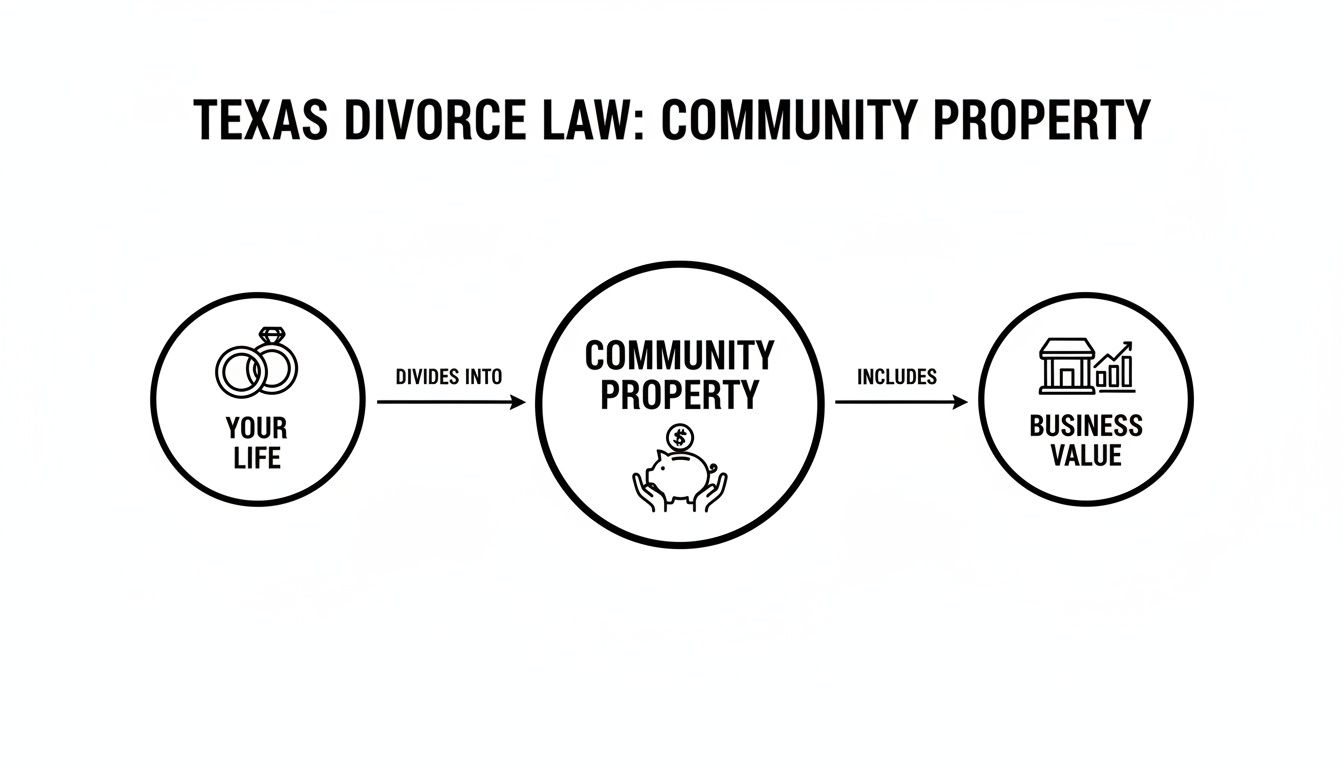
As you can see, the value of your business isn't some separate, protected asset. Under Texas law, it’s a core piece of the community property pie that has to be divided in a "just and right" manner.
The Three Main Ways to Put a Price Tag on Your Business
There isn't a single magic formula for business valuation. Instead, financial experts and courts in Harris County typically lean on one of three accepted methods. The approach used is critical, as it can lead to dramatically different results.
To figure out which method fits, we have to look at the nature of the business itself. Is it a company with lots of heavy equipment, a popular local brand like a well-known Atascocita eatery, or a professional service that relies on future income? Each scenario calls for a different lens.
Here's a look at the three main approaches and when they're most often used.
Common Business Valuation Methods in Texas Divorce
| Valuation Method | How It Works | Best For Businesses That… |
|---|---|---|
| Asset Approach | Adds up the value of all tangible assets (equipment, inventory, property) and subtracts all liabilities (debts). It's a "liquidation value." | Are heavy on physical assets, like a local construction company, trucking firm, or manufacturing plant in the northeast Harris County area. It doesn't capture intangible value. |
| Market Approach | Compares your business to recent, real-world sales of similar companies in the Atascocita/Humble area. It's like finding "comps" for a house. | Are in common industries with plenty of sales data, such as restaurants, retail stores, or auto repair shops. It’s tough for niche businesses. |
| Income Approach | Forecasts future income and cash flow to determine what the business is worth today. It's focused on earning potential, not just physical stuff. | Are service-based or have strong intellectual property and goodwill. Think medical practices, consulting firms, or software companies. |
Ultimately, a seasoned expert might even use a combination of these methods to arrive at the most accurate and defensible number—one that will hold up under a judge's scrutiny.
Why You Can't—and Shouldn't—Value the Business Yourself
We see the temptation all the time: trying to save some money by coming up with a value on your own. It feels like you know your business better than anyone. But in the context of a divorce, this can be a devastating mistake.
A court doesn't care about your gut feeling or a "rule of thumb" you heard from a friend. They need an objective, defensible valuation based on established financial principles.
Attempting to value your own business in a divorce is like trying to perform your own surgery. You are too close to the subject, you lack the specific tools and training, and the potential for a catastrophic error is extremely high.
This is where a qualified forensic accountant becomes an indispensable part of your team. This expert isn't on "your side" or "their side"—they work for the truth of the numbers. Their job is to dig into the financials, apply the correct valuation method, and produce a report that can withstand challenges from the opposing side.
Think of it as an investment in a fair outcome. A credible, third-party valuation gives you a solid foundation for negotiations and protects you from a wildly inflated or unfairly lowball number proposed by your spouse. An experienced family law attorney who handles cases for business owners in Atascocita, Texas, will know exactly who to call and how to manage this critical process.
Taking Action: A Step-by-Step Plan to Protect Your Business During Divorce
Let's be direct: the divorce process is a real threat to the business you’ve poured your life into. While we build the legal strategy, there are immediate, practical things you can do right now to shield your company from the fallout. It’s all about building a firewall between the personal chaos of a divorce and the professional stability your business needs to survive.
Step 1: Secure Your Operations with Temporary Orders
One of the most powerful tools in our initial toolkit is a Temporary Restraining Order (TRO) or other similar temporary orders from the court. These aren't meant to be punitive; their purpose is to maintain the status quo and prevent either party from making rash decisions that could harm the business.
Think of it as hitting the "pause" button on the entire marital estate. Once we file for a TRO in a Harris County court, it can immediately forbid both you and your spouse from taking specific actions. A properly drafted TRO can stop a spouse from:
- Making unusual or massive withdrawals from business accounts.
- Showing up at your Atascocita office to cause a scene with employees or customers.
- Contacting your clients, vendors, or key staff about the divorce.
- Hiding, altering, or destroying critical financial records.
- Selling off major assets or changing the company’s legal structure without approval.
These orders establish clear ground rules from day one, protecting not just you, but the business itself.
Step 2: Maintain Professionalism and Set Firm Boundaries
While legal orders are crucial, how you handle yourself day-to-day is just as critical. The stress of a divorce for business owners in Atascocita, Texas, is immense, but professionalism is non-negotiable.
You have to start treating your business as a separate, protected entity, completely walled off from the emotional drama of your divorce. That means no venting to a trusted employee or using company time to deal with personal matters.
Here’s your immediate to-do list:
- Communicate with Your Team: Talk to your key managers or partners. Calmly and professionally let them know you're going through a personal matter but have a plan in place to ensure it’s business as usual.
- Secure Your Digital Fort: Change passwords immediately—for your accounting software, online banking, client databases, and social media accounts. Limit access to only those who absolutely need it.
- Keep Doing Your Job: Now is the time to be more focused than ever. Show up, keep your appointments, hit your deadlines, and deliver the same quality your customers in Humble and Atascocita have come to expect.
Following court orders is mandatory. Compliance not only keeps you out of legal trouble but also shows the judge that you're the responsible party focused on preserving a valuable marital asset. As you consider your overall strategy, you might find more helpful information in our guide on how to protect assets during a divorce.
Creative Solutions for Dividing Your Business Assets
After your business has been valued, you’re left facing the big question: How do we actually split this thing without destroying it? Many business owners we work with in Atascocita are terrified they'll be forced to sell the company they’ve poured their life into. Let us put that fear to rest—a forced sale is the absolute last resort, and it’s almost never the best option for anyone.
The goal here isn't to win a fight; it's to solve a complex financial puzzle. There are plenty of creative ways to structure a settlement that protects your company while still being fair to your spouse. We want to find a path that allows the business to keep running and growing, giving you long-term stability and providing your ex-spouse with their rightful share of the marital estate.

Structuring a Buyout
By far, the cleanest and most common solution is a buyout. One spouse—usually the one running the company—buys out the other’s financial interest. You keep control of your business, and your spouse walks away with cash or other assets equal to their share.
Of course, most entrepreneurs don't have that kind of cash just lying around. That’s perfectly normal, and it’s why buyouts are often structured over time.
- Structured Payout: We can negotiate a deal where you pay your ex-spouse their share in installments over several years. This is typically secured with a promissory note, which turns a potentially crippling upfront payment into a manageable, long-term expense.
- Asset Swap: This is another extremely practical approach. Instead of cash, you trade other marital property. For instance, you might keep 100% of the company, while your spouse receives the family home on a quiet street in Atascocita, a larger share of the retirement accounts, or other real estate.
This strategy allows both people to walk away with assets that make sense for their future. You keep your livelihood, and your ex-spouse gets tangible assets without being tied to the future risks and rewards of a business they're no longer a part of.
Getting Creative with Profit-Sharing
Sometimes, a full buyout just isn't on the table, especially if the business is young or has tight cash flow. When that happens, we have to think outside the box to find a solution that doesn't choke the company.
One option is to create a profit-sharing agreement. Your ex-spouse could receive a percentage of the business’s profits for a set number of years. This gives them a stake in the company's future success without giving them any ownership or say in how you run it. It’s a way to deliver a fair settlement that’s directly tied to how the business actually performs post-divorce.
A Powerful Tool for LLCs: The Charging Order
If your Atascocita business is an LLC or a partnership, Texas law provides an incredibly powerful tool called a charging order. This is a concept every local business owner needs to understand. A charging order is something a court grants to a creditor—in a divorce, that would be your ex-spouse. But here’s the critical part: it does not give them ownership rights. They can't tell you how to run the business, and they can't force you to sell it.
Here’s a step-by-step look at how it works:
- It Protects the Business: The charging order attaches to your ownership interest, not the business assets themselves. Your ex-spouse has no power to interfere with management decisions, fire staff, or sell off equipment.
- It Redirects Distributions: The order says that if and when the business makes a profit distribution to you, that money goes to your ex-spouse instead, until their share of the property division is paid off.
- You Retain Control: You stay in the driver's seat. Most importantly, you still control if and when the company makes distributions.
This is an invaluable strategy in a divorce for business owners in Atascocita, Texas, because it shields the company from being torn apart while still ensuring your spouse receives what the court deems a just and right division. Understanding these kinds of nuanced legal tools is often the key to navigating the end of a business relationship, which has its own complex framework. You can learn more about the legal mechanics behind the dissolution of a partnership to see how these principles apply.
Partnering with a Local Atascocita Divorce Attorney
All the concepts we’ve covered—from Texas community property rules to the fine art of business valuation—aren't just textbook theories. They are real-world tools that must be used skillfully, especially within the Harris County court system. Knowing the law is one thing; knowing how to make it work for a business owner in Atascocita is something else entirely.
You've poured your life into building your business. Now, its very survival, your income, and your financial future are all on the table. Trusting this to an attorney who doesn’t specialize in the challenges local entrepreneurs face is a gamble you simply can't afford.
Why a Local Attorney Makes All the Difference
Choosing a law firm that’s truly woven into the fabric of the Atascocita and Humble communities gives you a powerful home-field advantage. We don't just drive into Harris County to appear in court; we live and work here. That gives us a firsthand understanding of the local business climate and the specific judges and processes in our local courtrooms.
At The Law Office of Bryan Fagan, our job is to connect legal strategy with the practical reality of protecting your company. We walk you through every critical stage:
- Getting the Value Right: We work with a network of trusted local forensic accountants to make sure your business valuation is fair and defensible. This is a non-negotiable first step in any high-asset divorce in the Atascocita area.
- Protecting Your Operations: From day one, we use legal instruments like Temporary Restraining Orders to erect a legal shield around your business, keeping divorce-related conflict from disrupting your day-to-day.
- Finding a Smart Exit Strategy: We explore every possible solution to separate your business from the divorce. This could mean a structured buyout over time, trading other assets to keep the company whole, or other creative settlement options that let you move forward.
When your life's work is on the line, you need a legal team that gets both the law and the local landscape. We are committed to protecting what you've built with the same passion you used to build it.
Your Next Step Is a Simple Conversation
This guide gives you a solid overview, but no two businesses or families are the same. The single most important thing you can do right now is get advice that’s actually about your specific situation. You don’t have to figure this out alone.
We invite you to schedule a confidential, no-obligation consultation at our Atascocita office. Let our team sit down with you, listen to your story, and show you exactly how we can help secure your assets, protect your business, and start building a stable future. Your peace of mind is our only goal.
Answers to Your Pressing Questions as a Business Owner in Atascocita
When you've poured your life into building a business, the thought of divorce brings a tidal wave of questions. As lawyers who work with entrepreneurs right here in the Atascocita area, we've guided countless clients through this. We know what's on your mind. Here are some straightforward answers to the most common concerns we hear about divorce for business owners in Atascocita, Texas.
What Happens if My Spouse Worked in the Business with Me?
This is incredibly common, especially with family-owned businesses in our community, and it definitely complicates things. While it doesn't change the basic community property laws in Texas, your spouse's hands-on involvement becomes a huge talking point during negotiations.
We're not just dividing an asset on paper anymore. We have to figure out their future, if any, with the company. This often means negotiating things like a severance package, a non-compete agreement so they don't become your direct competitor, or a clear plan for their exit from daily operations. Our job is to create a clean, professional break so the business can keep running smoothly without constant friction.
Can a Prenuptial Agreement Really Protect My Business in Texas?
Absolutely. A solid, well-written prenuptial (or postnuptial) agreement is the single best tool you can have. When done right, it can clearly state that the business is your separate property, set the rules for how it would be valued, or even spell out specific buyout terms in case of a divorce.
The key word there is "well-written." These agreements have to be ironclad to hold up in a Harris County court. If it was signed under pressure, without a full and honest financial disclosure, or if the terms are just wildly unfair, your spouse can challenge it. If you have an agreement, the first thing we'll do is review it to spot any weaknesses. If you don't have one, don't panic—we have plenty of other legal strategies to protect what you've built.
How Do I Stop My Divorce from Harming My Business's Reputation?
Protecting your company's goodwill in the community is paramount. The strategy is simple in theory but hard in practice: discretion and professionalism. You have to fight the urge to vent about the divorce to employees, complain to vendors, or post anything about it on social media.
Your professional reputation is a valuable business asset, especially in a tight-knit community like Atascocita or Humble. Protecting it requires a legal strategy that prioritizes privacy and constructive solutions over public, contentious court battles.
On the legal side, we can ask the court for temporary orders that include specific rules preventing either of you from badmouthing the business. By setting clear boundaries for conduct and keeping the conflict out of the public eye, we can help you preserve the customer trust and community standing you've worked so hard to build.
At The Law Office of Bryan Fagan – Atascocita TX Lawyers, we get it. Your business isn't just an asset on a spreadsheet—it's your livelihood, your passion, and your legacy. If you're an entrepreneur facing these tough questions, you don't have to figure it all out on your own. We invite you to contact our Atascocita office for a free, confidential consultation to talk about your situation and see how we can help protect your future. Visit us at https://www.atascocitaattorneys.com to get started.