You're in Atascocita, sitting beside your phone, waiting for the video call your child was supposed to make. The scheduled time passes. You send a message, receive no answer, and then see the other parent online. This happens again the following week. By the third missed call, you're angry, worried, and unsure whether a judge will view the problem as serious.
Electronic communication order enforcement in Atascocita, TX starts with the signed custody order, not an argument over text. The practical question is whether the other parent violated a specific court requirement, whether you can prove it, and whether your requested remedy belongs in an enforcement motion or a modification case. Gather first, then ask the court for relief.
When a Court-Ordered Call Does Not Happen
A parent in Atascocita has a Tuesday evening video call scheduled with their child. The other parent cancels once, ignores the next call, and then allows the third call to begin late before ending it almost immediately. The frustrated parent sends angry messages and threatens to “take this back to court.”
That response may feel justified, but it can create evidence against you. A Harris County judge will focus on the operative order, the exact communication schedule, what happened during each scheduled period, and whether the denial was intentional or caused by a genuine equipment or availability problem.

Read the order before reacting
Find the paragraph that addresses calls, texts, video contact, messaging applications, or access to the child's electronic account. Identify:
- The scheduled period: Note the day, start time, expected duration, and time zone.
- The communication method: Confirm whether the order names FaceTime, a telephone call, a parenting application, email, or another platform.
- The equipment obligation: Determine who must provide the phone, tablet, computer, internet access, or account.
- The interruption rule: Look for language addressing privacy, supervision, reasonable limits, or emergencies.
Enforcement asks the court to require compliance with an existing order. Modification asks the court to change the arrangement because circumstances or the child's needs have changed. Don't ask for a modification when the actual problem is that the other parent refuses to follow the current schedule.
Gather the order, preserve the record, and stop escalating the conflict. Your first goal is a provable timeline, not the last word in a text exchange.
Follow the order yourself. Don't withhold physical possession, interfere with the child's relationship with the other parent, or coach your child to report on the missed call. In Atascocita and Humble custody disputes, credibility matters. A calm record showing that you were ready, available, and compliant is more useful than a long series of emotional messages.
What Texas Law Actually Says About Electronic Communication
Texas Family Code §153.015 sets the framework for electronic communication between a conservator and a child. It covers telephone calls, email, instant messaging, videoconferencing, webcams, and similar communication through wired or wireless technology, the Internet, or other electronic media. Review the Texas Family Code provision governing electronic communication before treating a missed call as an enforceable violation.
A court may award reasonable electronic-communication periods when they supplement a conservator's possession of the child. Video calls and messages can preserve the parent-child relationship between physical visits. They do not replace possession or expand the parenting time already granted by the order. For a practical explanation of how courts structure an electronic communication with child order in Atascocita TX, review the order's specific schedule, technology requirements, and limits.
The court must consider the child's best interest and whether the required equipment is reasonably available to everyone involved. That requirement often decides whether an enforcement claim is workable. The record should identify who owned the device, controlled the account, provided internet access, and carried responsibility under the order for making the connection possible. In Harris County family courts, vague complaints about a missing device are weaker than evidence tied to each written obligation.
The detail parents often miss
Each conservator covered by the order must provide the other conservator with the child's email address and other electronic-access information. A change must be reported no later than 24 hours after the change takes effect. Changing a child's email address, phone number, messaging account, or access credentials without timely notice can create a separate compliance problem.
If the equipment is reasonably available, the parties must permit communication at a reasonable time and for a reasonable duration, subject to the order's limits. Read every qualifier carefully, including “reasonable,” “private,” “supervised,” “parenting application,” and “at the child's convenience.” Those terms can determine whether a failed connection supports enforcement or reflects an allowed limitation.
Electronic communication is not used to calculate child support under this statute. Keep the disputes separate. A support disagreement does not justify blocking court-ordered contact, and a denied call does not justify withholding support. In Atascocita cases filed through the Harris County family courts, the strongest position follows the statute and the signed order rather than relying on frustration alone.
Building a Court-Ready Evidence Record
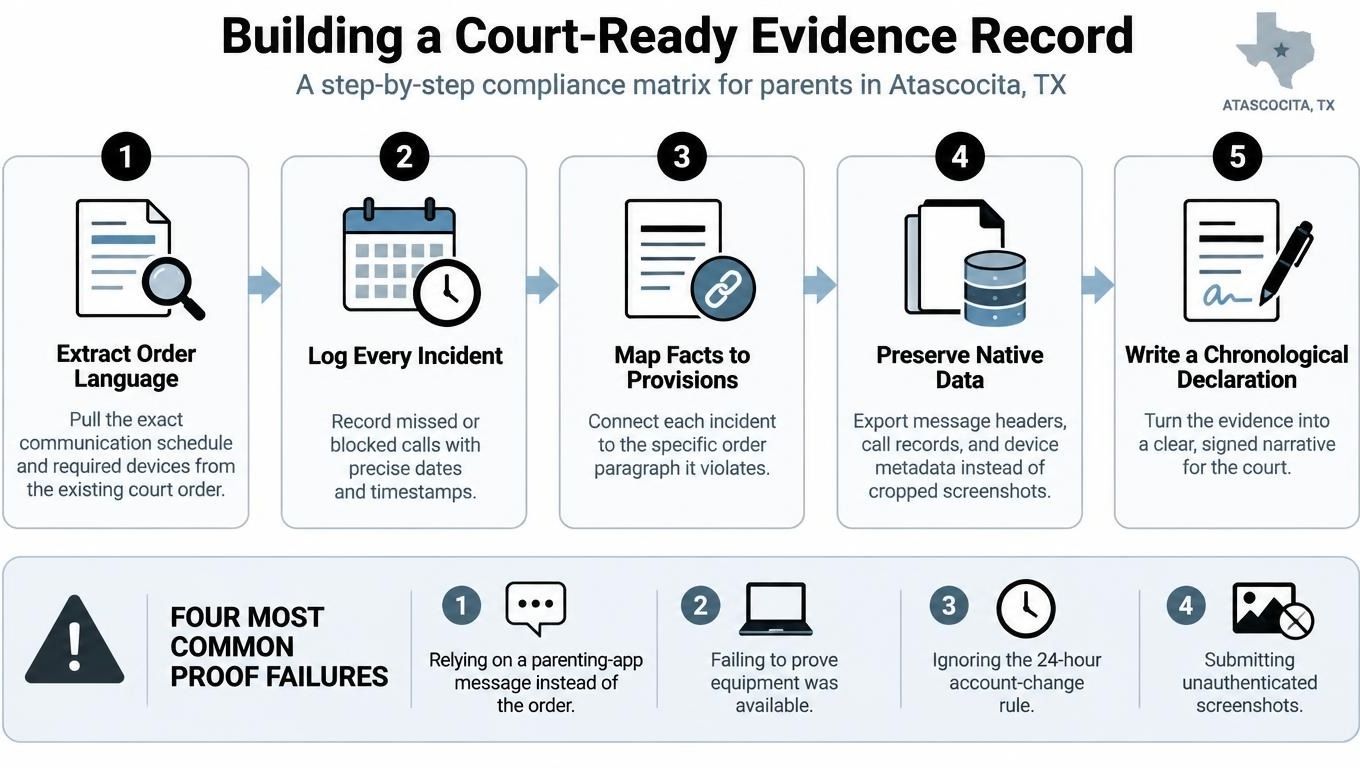
Most parents arrive with a phone full of screenshots. That's a starting point, not a finished case. A Harris County family court needs to see the connection between the signed order, the scheduled event, the actual conduct, and the evidence proving each part.
Build the compliance matrix
Create a simple document with one row for each alleged incident. Use the order's language rather than your own labels.
| Record each incident | What to identify |
|---|---|
| Order requirement | The paragraph requiring the call, message, account, or access |
| Scheduled event | Date, start time, expected duration, and time zone |
| Required technology | Device, application, account, telephone number, or email |
| Actual conduct | Missed, blocked, shortened, interrupted, or unauthorized contact |
| Supporting proof | Native export, call history, message header, screenshot, or witness |
| Explanation | What you did to comply and how the other parent responded |
Start with the signed order and every modification. An informal parenting-app agreement can show what the parents discussed, but it doesn't replace the operative court order unless the court adopted it.
Preserve the complete conversation, not only the sentence that helps you. Export messages in their native format where possible. Retain message headers, sender and recipient identifiers, account names, call-history records, attachment relationships, device metadata, and the surrounding messages. Screenshots should show the full screen, visible dates and times, and identifying information. Don't crop away context or add annotations to the original file.
Protect authenticity and timing
A chronological declaration should explain what happened without argument. State when you attempted the call, what device and account you used, what appeared on the screen, whether you contacted the other parent, and what happened afterward. Use a consistent time zone, especially if a parent lives outside Harris County or the application displays UTC.
Four proof failures appear repeatedly:
- Wrong governing document: A text conversation is offered instead of the signed order.
- Unproven equipment: The record doesn't show that the required device, account, or internet connection was available.
- Ignored account change: A changed email or access credential isn't tied to the statutory reporting obligation.
- Unauthenticated communications: Screenshots lack account identifiers, metadata, complete threads, or a reliable explanation of who created them.
Save the original files before forwarding or editing them. A clean folder structure, exhibit index, and incident log will help your attorney determine whether the facts support enforcement, contempt, modification, or no filing at all.
Immediate Steps After a Violation
The first response should be controlled and practical. If the conduct presents an immediate safety threat, call 911. If the issue is a missed child communication period without an immediate danger, preserve the evidence and avoid turning a civil custody dispute into a confrontation.
Use the first hours wisely
Send one brief, nonthreatening message identifying the missed period and asking whether there was an equipment or emergency problem. Don't send a stream of accusations. Then preserve the order, call logs, complete message thread, application records, and any notice that the child's account or device changed.
Issue a written preservation notice to the other parent. Ask that relevant messages, call records, account information, device data, and cloud material not be deleted or allowed to auto-delete. Suspend auto-delete settings on your own applications, export native chat data before replacing a phone, and maintain a chain-of-custody log identifying the file, source device, date collected, and person who collected it.
Know what law enforcement can do
Contact the Humble Police Department or the appropriate Harris County Constable when there is a safety concern, a protective-order issue, suspected criminal conduct, or a situation requiring an incident report. Officers may document the complaint, investigate conduct within their authority, or respond to an immediate threat. A police report won't itself modify a custody order, award make-up communication, or decide whether a civil violation occurred.
A report can still preserve a contemporaneous account and may matter if the electronic conduct also involves harassment or a protective order. It should supplement, not replace, the family-court evidence record. For broader custody issues, guidance on what to do if an ex violates a custody order in Atascocita can help you identify the next procedural questions.
Don't retaliate, confront the other parent at the child's school or home, involve the child in the dispute, or unilaterally rewrite the possession schedule. If the matter also affects extended-family access, Grandparents' Rights in Atascocita addresses custody and visitation rights for grandparents in Harris County.
Filing a Motion for Enforcement or Contempt in Harris County
Atascocita parents generally file in the Harris County family court that issued the existing order, unless the case has been transferred or another court has jurisdiction under the governing rules. Filing in the wrong court, using the wrong cause information, or attaching an incomplete order can delay the case before the judge reaches the communication dispute.
A motion should identify each alleged violation with enough detail for the other parent and the court to understand what must be defended. Attach the signed order and organized exhibits. Verification, service of process, a certificate of conference when required, and a proposed order are not clerical afterthoughts. They affect whether the matter can move toward a hearing.
Choose the relief carefully
An enforcement motion asks the court to enforce an existing obligation. You might request compliance, clarification of the communication process, make-up electronic contact, or other relief authorized by the order and applicable law.
A contempt request is more serious. It asks the court to find that the other parent knowingly violated a clear command and to impose consequences. The court may consider attorney's fees, fines, community service, or jail-related relief where the legal requirements for contempt are met.
Harris County dockets generally move over weeks to a few months rather than immediately. An urgent safety issue may require separate emergency relief, but a missed video call usually requires a properly prepared family-court filing, service, and a hearing.
Use current Office of Court Administration and Harris County filing resources, but don't rely on a form alone. The filing must match the actual order and evidence. Include a concise exhibit index, label each record, and connect every incident to a specific paragraph. The following video provides general procedural context:
Possible Outcomes, Penalties, and Court-Ordered Remedies
The remedy should match the problem. If the evidence shows that a scheduled call was denied, the most useful relief may be a clear communication protocol and make-up contact. If the evidence shows repeated, deliberate violations of a precise command, contempt becomes a more serious possibility.
Enforcement and contempt are different tools
| Enforcement | Contempt |
|---|---|
| Focuses on compliance with the existing order | Focuses on punishment for a proven, knowing violation |
| May seek make-up communication or clearer procedures | May seek fines, community service, attorney's fees, or other sanctions |
| Can be appropriate when the main goal is restoring contact | Requires careful proof of a clear command and willful noncompliance |
| Doesn't automatically change custody | Can increase conflict and affect later custody litigation |
A judge may order make-up electronic-communication time, clarify the schedule, require a particular communication platform, or address access information. Attorney's fees and costs may be available when supported by the facts and applicable law. Serious or repeated conduct can lead to sanctions, but asking for every available punishment without strong proof can damage your credibility.
Don't confuse criminal contempt with criminal harassment. Texas Penal Code §42.07 addresses repeated electronic communications sent with the required intent and in a manner reasonably likely to harass, annoy, alarm, abuse, torment, embarrass, or offend. The statute also addresses certain repeated communications published through websites or social-media platforms. Preserve complete threads, timestamps, account names, and witness information if the conduct may support a criminal complaint. A single rude message doesn't automatically establish the offense.
Under Texas Penal Code §42.07, harassment by repeated electronic communications is generally a Class B misdemeanor and becomes a Class A misdemeanor if the actor has previously been convicted under the same section. The statutory materials on harassment classifications should be reviewed for the applicable version and facts.
When to Hire a Local Attorney and What to Bring to a Consultation
Self-help may be enough for an isolated misunderstanding that the parents resolve promptly. It becomes a poor strategy when missed calls form a pattern, the other parent changes accounts without notice, the conduct escalates, relocation is threatened, or the messages may also implicate harassment or a protective order.
A local attorney can separate the issues instead of placing everything into one emotional filing. The family-law question may concern enforcement of the custody order. A criminal-law question may concern repeated electronic communications or impersonation. A protective-order question may require a different response. Those matters can overlap, but they don't have identical elements or remedies.
Bring an organized file
Before a consultation, gather:
- The complete order: Include the original decree, later modifications, and any written communication protocol.
- The incident timeline: List every missed, blocked, shortened, or interrupted contact period in chronological order.
- The original evidence: Preserve native exports, call histories, complete message threads, account identifiers, and device information.
- Your preservation record: Note when you exported files, where they came from, and whether any messages disappeared.
- Your objective: State whether you want make-up contact, clearer rules, contempt relief, a protective order, or a modification.
Don't delete unfavorable messages. A lawyer needs the whole record to assess authentication, context, defenses, and risks. The Atascocita custody enforcement lawyer resource can help you identify what to assemble before discussing your case.
For parents in Atascocita, Humble, and northeast Harris County, the right decision usually depends on three questions: Is the order clear, is the violation provable, and is the requested remedy proportionate? If the answer is yes, stop arguing through the phone and prepare a focused filing. Protecting communication with your child isn't about winning a digital fight. It's about restoring a predictable, court-approved relationship.
The Law Office of Bryan Fagan – Atascocita TX Lawyers can review your electronic-communication order, organize the evidence, and explain whether enforcement, contempt, modification, or another legal response fits your facts. Visit Law Office of Bryan Fagan – Atascocita TX Lawyers to request a free consultation for your Atascocita, Humble, or northeast Harris County matter.