Skip to content
A joint checking account can look simple for years, then turn into the hardest part of a divorce. One spouse remembers an inheritance, a premarital home sale, or a gift that went into the account long ago. The other spouse remembers that both paychecks landed there, the mortgage came out of it, and family life was built from the same pile of money.
That is the exact problem in commingled bank account tracing divorce atascocita tx cases. Texas law does give a path for proving separate property inside a mixed account, but it asks for records, not memory. In an Atascocita or Humble divorce, the central question is often not whether separate money ever existed, but whether the paper trail is strong enough to follow it through years of deposits, withdrawals, and rebuilding.
When a Joint Account Hides Two Stories
An Atascocita couple often comes in with the same story, just from opposite sides. One spouse says, “That money was my inheritance.” The other says, “It hit the joint account years ago, and we used it for the house, the kids, and life.” Both can be talking about the same bank account and still be describing different legal realities.
Texas starts from a strong presumption that property possessed by either spouse during marriage is community property under Texas Family Code § 3.003(a), so the spouse claiming separate money has the burden to prove it by clear and convincing evidence. That's why a divorce lawyer won't stop at the current balance. The lawyer has to look backward, often all the way to the deposit that introduced the separate funds and then forward through every transaction that followed.
A common Atascocita pattern is simple on the surface. An inheritance is deposited into a shared checking account, the account pays household bills for years, and then the spouse trying to trace the money can't remember what came from where. Under Texas tracing doctrine, that memory gap matters less than the records. If the documents can reconstruct the path with dates, amounts, and balances, the claim can still survive.
Practical rule: if you can't show where the money came from and where it went, a judge may treat the mixed account as community property.
That's why this issue creates so much stress in northeast Harris County divorces. The law gives you a chance to protect separate property, but it doesn't reward guesswork. If the records are there, tracing can work. If the records are thin, the argument gets expensive fast and the result may not justify the effort.
How Texas Law Separates Your Money From Marital Money
Texas family law draws the line between community property and separate property, but the line only holds if the documents support it. Property possessed during marriage is presumed community, and the spouse claiming a separate share must overcome that presumption with clear and convincing evidence. In practice, that means the lawyer has to prove a documented path from the separate source to the account balance being claimed today.
The most useful doctrine for mixed accounts is the community-out-first rule, recognized in Texas tracing practice. When the account history supports it, withdrawals are generally treated as coming from community funds before separate funds are reached. That matters because it can preserve separate money that still remains in the account after ordinary household spending.

The related concept people miss is the lowest-balance approach. If the account's balance drops below the amount of traced separate funds, the recoverable separate portion can be limited to that lower figure under the lowest-balance analysis. So if a spouse deposited separate funds, then the account was repeatedly spent down and rebuilt, the maximum recoverable share may be much less than the original deposit.
A simple fictional example makes it easier to see. A spouse deposits a $40,000 inheritance into a joint account, then the balance later falls to $5,000 during a kitchen remodel. If the records support tracing, the traceable separate claim may be capped at that lower balance point rather than the original deposit amount. That is why the final decree doesn't turn on what the spouse feels was “really mine,” it turns on what the bank records can prove.
For a local overview of asset protection while divorce is pending, How to Protect Assets During Divorce is a useful starting point. And when the issue becomes a broader property dispute, Property Division Lawyer in Atascocita describes representation for division of community property and complex assets for Atascocita divorces.
Building the Paper Trail Before Divorce Is Filed
A tracing claim usually rises or falls on the file cabinet, not the courtroom speech. The first thing I want is the full run of bank statements, not just the latest month. I also want brokerage statements, tax returns, closing disclosures, gift letters, inheritance paperwork, wire confirmations, and any document showing where the money came from before it touched the joint account.
That is especially true when the account was active for years. A single statement only shows a snapshot, while tracing needs the period immediately before the separate deposit through the present so the movement of funds can be reconstructed over time. If the account history includes premarital sales, inherited money, stock vesting, or transfers between institutions, those records matter just as much as the final balance.
A practical collection list for Atascocita residents usually looks like this:
- Bank and brokerage statements: Get the longest run you can, including the period before marriage if possible.
- Deposit and wire records: These show the source and date of each traced transfer.
- Inheritance and gift documents: Probate papers, gift letters, and estate records can prove the separate source.
- Property sale records: Closing statements help when a premarital house or land sale funded the deposit.
- Tax returns: They can help show how money moved and whether an asset produced income during marriage.
If the records are scattered, a simple organization system helps. Family Folder organization advice gives a straightforward way to sort important papers so they can be pulled quickly when a divorce starts heating up. That kind of order can save real time when your lawyer needs to decide whether tracing is worth pursuing.
When people in Humble or Atascocita tell me they “have the documents somewhere,” that's usually the first problem to solve.
For account hunting, how to find hidden bank accounts in divorce Texas Atascocita is a useful related topic. The main point is simple, though. If the claim is separate property, the documents have to tell the story, not the spouse's recollection.
Working With a Forensic Accountant on the Tracing

Once the statements are in hand, many contested cases need a forensic accountant or CPA to make sense of the numbers. Their job is usually to build a transaction ledger, track running balances, apply the community-out-first analysis, and match deposits and withdrawals to source documents. In a tough Harris County case, that work turns a messy stack of statements into exhibits a judge can follow.
That's also where the weaknesses show up. Unexplained cash withdrawals, missing statements, or a balance dip below the separate deposit can break the tracing chain even when a professional is involved. A good expert doesn't create proof out of thin air, they organize what the records already show and flag where the chain stops.
A Divorce Lawyer in Atascocita, TX handles divorce representation for clients in Atascocita and Harris County, and in a tracing case that usually means deciding early whether the records justify hiring the expert at all. If the balance history is clean and the source documents are solid, the accountant can strengthen the claim. If the account has been drained and rebuilt repeatedly, the report may show that the separate share is too small to chase aggressively.
The work product usually has a very practical shape:
- Transaction chronology: Every relevant deposit and withdrawal in order.
- Balance analysis: What the account held after each important event.
- Source matching: Which document supports each separate deposit.
- Legal assumptions: Whether the analysis uses community-out-first or lowest-balance reasoning.
The video below gives a helpful visual sense of how financial records get broken down and organized in contested matters.
A strong tracing report doesn't just say the money was separate. It shows how the separate money survived every transaction that came after it.
That matters in front of a Harris County judge because opposing counsel will usually attack the gaps first. If the chart depends on assumptions instead of documents, the trace is vulnerable.
Motions, Subpoenas, and Discovery Tools in Harris County
When one spouse controlled the money, voluntary disclosure is often incomplete. That's when a lawyer turns to discovery tools to force the missing records into the case. Requests for production, interrogatories, requests for admission, and subpoenas to banks, brokerages, and employers are the standard path when a spouse says records are “gone” but the account still exists.
The first priority is preservation. A temporary restraining order or a preservation letter can help freeze account history before statements are purged or accounts get moved again. In a Harris County divorce, that matters because the paper trail is often the case. Once it is lost, even a strong theory becomes much harder to prove.
If the other side is dragging its feet, the next step is usually a motion to compel. At that point, the family court can order production of statements, account applications, tax documents, and related financial records. what privilege works in law is a useful concept to understand here, because not every refusal is really about privilege, and not every document is protected just because a spouse wants it kept private.
For a hidden-asset fight, what happens if my spouse hides assets in divorce Texas Atascocita connects directly with these tools. The practical sequence usually looks like this:
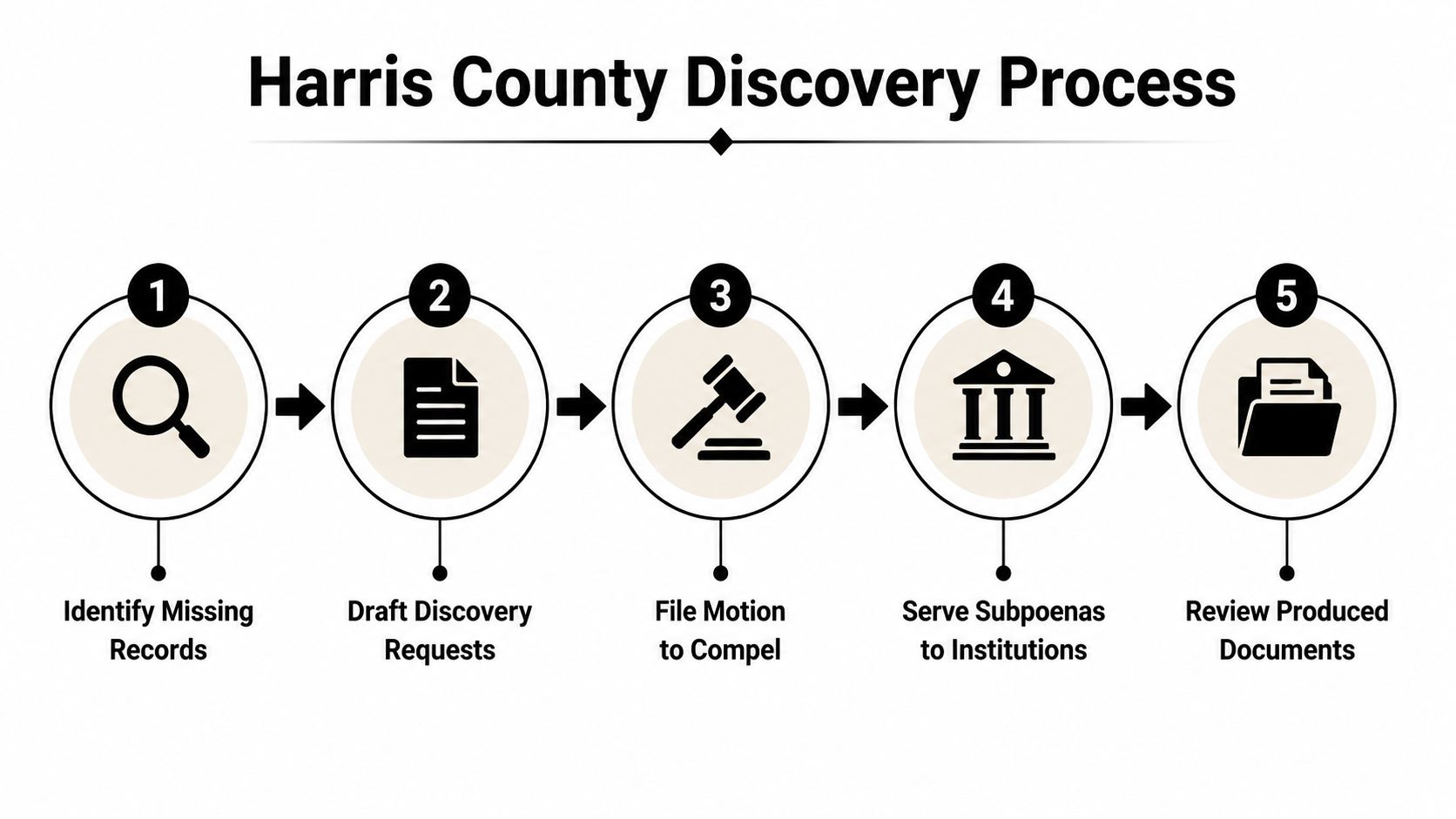
- Identify missing records. Look for the unexplained gap, not just the obvious account.
- Draft discovery requests. Ask for the exact statements, transfers, and source documents needed.
- File a motion to compel. Use the court when the other side stalls.
- Serve subpoenas to institutions. Banks and employers often hold cleaner records than the spouse does.
- Review produced documents. The new records either strengthen the trace or expose its weak point.
Discovery in family court is not about being aggressive for its own sake. It is about deciding whether the account can be reconstructed. If the records are there, a subpoena can uncover them. If they are not, that tells you something important about the cost of going further.
Common Defenses and the Cost-Benefit Question
A spouse fighting tracing usually has three main defenses. First, the documents are incomplete. Second, the funds were commingled so thoroughly that the whole account should be treated as community property. Third, the separate money was gifted to the marriage by conduct, use, or repeated mixing. Each defense attacks the same weak point, the chain of proof.
| Scenario | Best Evidence | Likely Outcome |
|---|---|---|
| Clean inheritance deposit, full bank records | Statements, inheritance paperwork, transfer records | Strong tracing claim |
| Mixed account with occasional gaps | Partial statements, some source documents | Limited recovery, likely narrowed by missing proof |
| Account repeatedly spent below traced amount | Full ledger and balance history | Recovery may be capped by lowest balance |
| Cash withdrawals and no source documents | Testimony only, no documentary chain | Community-property presumption likely controls |
The harder question is the one most articles skip. Is tracing worth it if the account was spent down and rebuilt many times? That's not a theoretical issue in Atascocita or Humble, where couples often use one joint account for everything. If the likely separate share is small, forensic accounting, subpoenas, and expert testimony can eat into the value fast.
I've seen families spend more energy proving a modest separate claim than they would have spent negotiating a fair credit in settlement. That doesn't mean tracing is never worth it. It means the value of the claim has to justify the cost, the time, and the strain of dragging bank history into a contested divorce.
Cost-benefit rule: trace when the records can likely support a meaningful recovery, settle when the paper trail is weak and the disputed amount is too small to justify a fight.
Hybrid banking and instant-payment habits make this harder because money moves faster and leaves a thinner trail. The more frequently an account is used for both separate and community purposes, the more likely it is that the tracing fight becomes a battle over missing records instead of the money itself.
Working With a Local Atascocita Divorce Attorney
A tracing case starts with a practical review, not a courtroom speech. The first consultation usually focuses on the statements you already have, the source documents you can still get, and whether a forensic accountant is likely to help more than hurt. That decision matters because some cases need a full tracing model, while others are better handled through settlement negotiations or a negotiated credit.
The Law Office of Bryan Fagan – Atascocita TX Lawyers works with clients in Atascocita, Humble, and northeast Harris County on divorce and property division issues, including mixed accounts that need careful review. Local knowledge matters because Harris County courts expect organized financial proof, and it helps to work with a team that knows how these cases are handled in the area. Meeting at the Atascocita office also keeps the process closer to home, which matters when you're already managing work, kids, and a marriage that's coming apart.
A sensible plan usually starts with three questions:
- What can be proven now? That tells you whether tracing is realistic.
- What will it cost to prove more? That keeps the case grounded in economics.
- What is the likely settlement alternative? That keeps the focus on a real outcome, not a perfect one.
Not every case needs a courtroom fight. Sometimes a partial claim, a credit in the property division, or a better settlement number is the smarter win. A good local divorce lawyer should tell you that plainly instead of pushing a fight that costs more than it returns.
If you're dealing with a mixed account and you don't know whether the numbers justify tracing, talk with Law Office of Bryan Fagan – Atascocita TX Lawyers. Our team helps clients sort through bank statements, separate-property claims, and property division strategy with a focus on practical results. Call for a free consultation at the Atascocita office and get a clear answer before the paper trail gets any harder to follow.