Skip to content
If you're asking what happens if my spouse hides assets in divorce in Texas Atascocita, you're probably already seeing signs that something isn't right. A bank statement disappears. A bonus never shows up in the conversation. A business suddenly looks less profitable on paper than it did during the marriage. That kind of financial secrecy creates real fear, especially when you're trying to protect your home, your retirement, and your ability to move forward after divorce.
I want to be direct with you. If your spouse is hiding assets, this isn't just rude or unfair. In a Texas divorce, it's a legal problem, and judges in Harris County can punish it. You are not expected to shrug and hope the truth comes out on its own. Texas law gives you tools to force disclosure, trace money, and ask the court for meaningful remedies when a spouse lies.
For families in Atascocita, Humble, and northeast Harris County, the right response is not guessing. It's building a record, using discovery correctly, and moving quickly before documents disappear or stories change.
The Worry and Suspicion When You Think Assets Are Hidden
Individuals rarely anticipate becoming financial investigators when starting a divorce. Then the case begins, and suddenly the numbers stop making sense. A spouse who used to discuss money openly becomes defensive. Account balances seem lower than expected. Mail gets redirected. Online access changes. You know the family lifestyle hasn't matched the income being reported, but you can't yet prove why.
That suspicion is exhausting. It also matters.
When a spouse hides assets, the damage isn't limited to one account or one transaction. Hidden property can affect the entire division of the marital estate. It can also drive up legal costs because someone has to do the work of finding what should have been disclosed in the first place.
You don't need perfect proof before talking to a lawyer. You need facts, documents you legally have access to, and a strategy.
What you should do first
Start with restraint. Don't hack passwords, break into devices, or take records from accounts you have no legal right to access. That kind of self-help can create a new problem in your case.
Do this instead:
- Save what you already receive: Keep copies of tax returns, loan applications, pay stubs, account statements, and notices that come to the house or to shared email.
- Write down behavior changes: Note when you saw unusual withdrawals, a sudden cash habit, or unexplained transfers.
- Stop accepting vague answers: If your spouse says money is "gone" or an account is "business-related," that claim needs documentation.
Why this isn't hopeless
Texas courts don't treat financial disclosure as optional. When concealment shows up in a divorce, the issue moves from suspicion to procedure. That matters because procedure creates deadlines, sworn responses, and a paper trail. Once that starts, a dishonest spouse has a harder time keeping the story straight.
If you're in Atascocita or nearby, this is the moment to get organized and get local legal help involved before the case drifts.
Understanding Texas Community Property Law
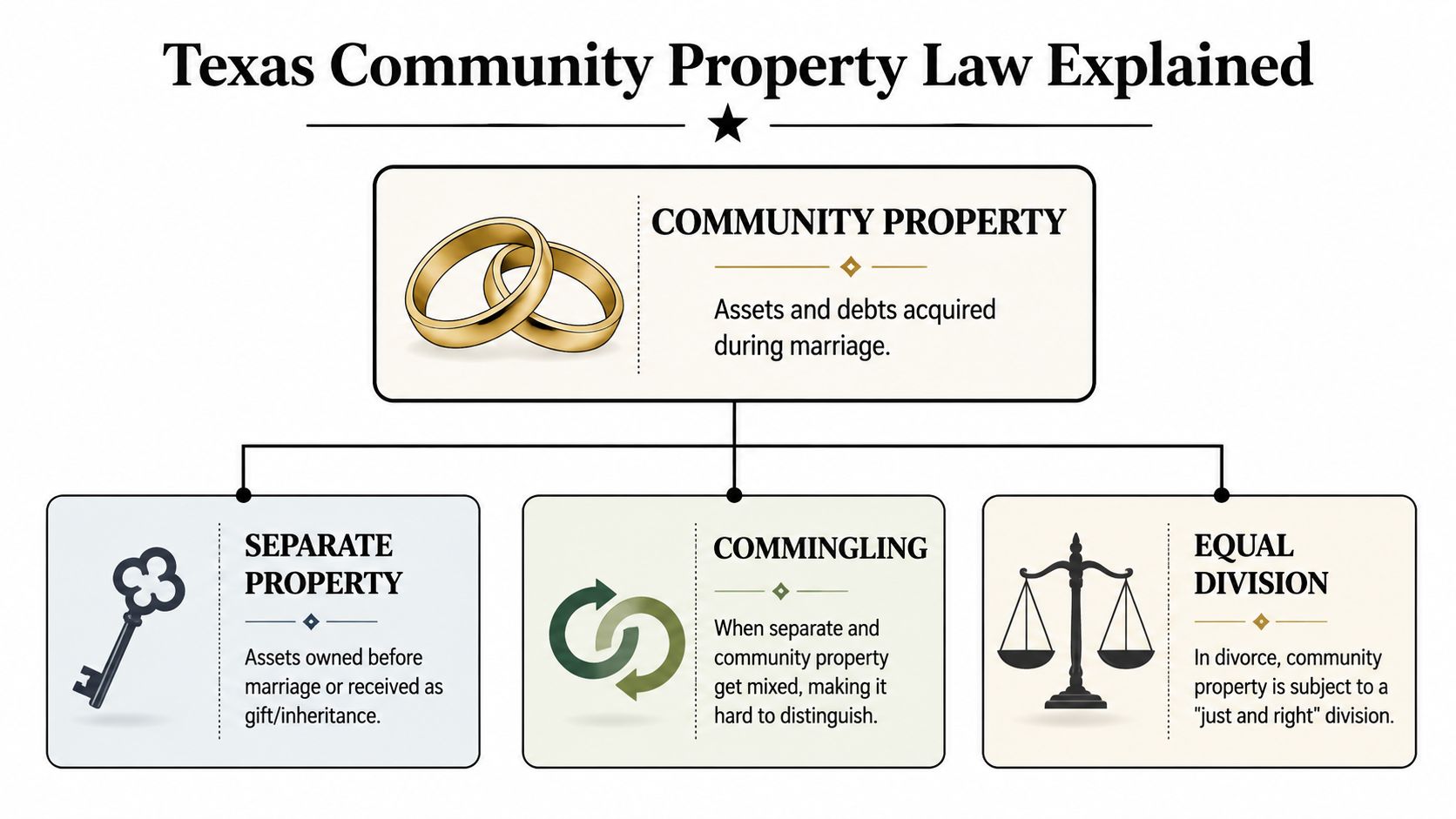
Texas treats marriage as an economic partnership. The simplest way to think about it is this. During the marriage, you and your spouse are filling the same family savings jar. Property acquired during the marriage is generally part of that shared jar, even if only one spouse earned the paycheck or only one name appears on an account.
What counts as community property
Texas is a community-property state, so property acquired during the marriage is generally subject to division at divorce, and concealment can distort that division. If an asset wasn't awarded because it was hidden, Texas sources note it may later be treated as an undivided asset, which can allow the harmed spouse to pursue recovery even after the decree is entered, as discussed in this Texas overview of hidden assets and undivided property.
That usually includes things like:
- Income earned during marriage
- Retirement contributions made during marriage
- Savings built during marriage
- Vehicles, real estate, and investments acquired during marriage
What separate property means
Separate property is different. In plain English, it's usually property a spouse owned before marriage, or property received individually as a gift or inheritance. The problem comes when separate and community funds get mixed together. Lawyers call that commingling. Once the lines blur, the burden of sorting them out gets harder.
Here's the practical point. A spouse can't turn community property into separate property just by moving it, retitling it, or refusing to talk about it.
Practical rule: If the asset was acquired during the marriage, don't assume your spouse gets to keep it just because it's in one name.
Why hidden assets matter so much
Concealment attacks the basic math of a divorce. The judge can only divide what the court sees. If one spouse understates accounts, income, business value, or cash holdings, the entire property division gets skewed.
For Atascocita families, that often shows up in familiar ways. A spouse may claim a side business has no real value. A commission gets delayed. A brokerage account seems to have vanished. The legal issue isn't just dishonesty. It's interference with the court's ability to make a fair division.
The Consequences of Concealment Penalties for Hiding Assets
If your spouse hid assets and the evidence proves it, the court isn't limited to a lecture. Texas judges have several ways to respond, and some of them hit hard.
Early in this section, it's worth seeing the range of consequences in one place.

The property division can change dramatically
Texas family-law practice recognizes fraud on the community. If a spouse's concealment is proven, courts can impose fraud-on-the-community remedies. A judge may award a larger share of the community estate to the innocent spouse, order reimbursement, and require the offending spouse to pay attorney's fees and court costs. The court can recalculate the estate to compensate the wronged spouse for the discovery burden, as explained in this Texas discussion of fraud-on-the-community remedies.
Fraud on the community means one spouse wrongfully depleted, diverted, or concealed community assets in a way that harmed the other spouse's share.
That term matters because it gives the court a legal framework for correcting the damage. Judges don't have to pretend the lie never happened. They can adjust the result because of it.
Sanctions can go beyond the final property split
A spouse who hides assets may face:
- A disproportionate award to you: The judge can give you a larger share of the community estate.
- Fee shifting: The spouse who caused the extra work may be ordered to pay attorney's fees and costs.
- Reimbursement or restitution: If money was diverted or concealed, the court can account for that in the division.
- Contempt exposure: In serious cases involving disobedience of court orders, the court can use contempt powers.
Later in the case, if sworn statements were false or documents were forged, the consequences can become more serious still.
To understand how these cases are often handled in practice, this short video gives useful background:
Lying under oath makes the case worse
A lot of people think hidden-asset cases are just about money. They're not. Once a spouse files sworn inventories, answers discovery, or testifies under oath, false statements can expose that spouse to more than a bad property ruling. The court can treat the conduct as contemptuous, and Texas family-law sources also note possible perjury or fraud exposure in severe situations.
In Harris County, judges tend to focus on credibility fast. Once a spouse loses credibility on finances, everything else in the case gets harder for that spouse.
Uncovering the Truth Legal Tools for Discovery in Texas
Case victories are secured. Not by outrage. Not by assumptions. By using discovery properly and forcing the other side to commit to a financial story they can document.
Disclosure isn't optional in a Texas divorce
Under Texas Family Code §6.502, financial disclosure is mandatory. Both spouses must provide complete financial information. Courts can respond to nondisclosure with contempt, sanctions, or a larger property share for the wronged spouse. Written discovery requests must typically be answered within 30 days, creating a paper trail for the court, as summarized in this discussion of Texas discovery obligations and sanctions.
That 30-day deadline matters because it turns suspicion into a timeline. Once requests go out, the other side has to answer, object, or risk court intervention.
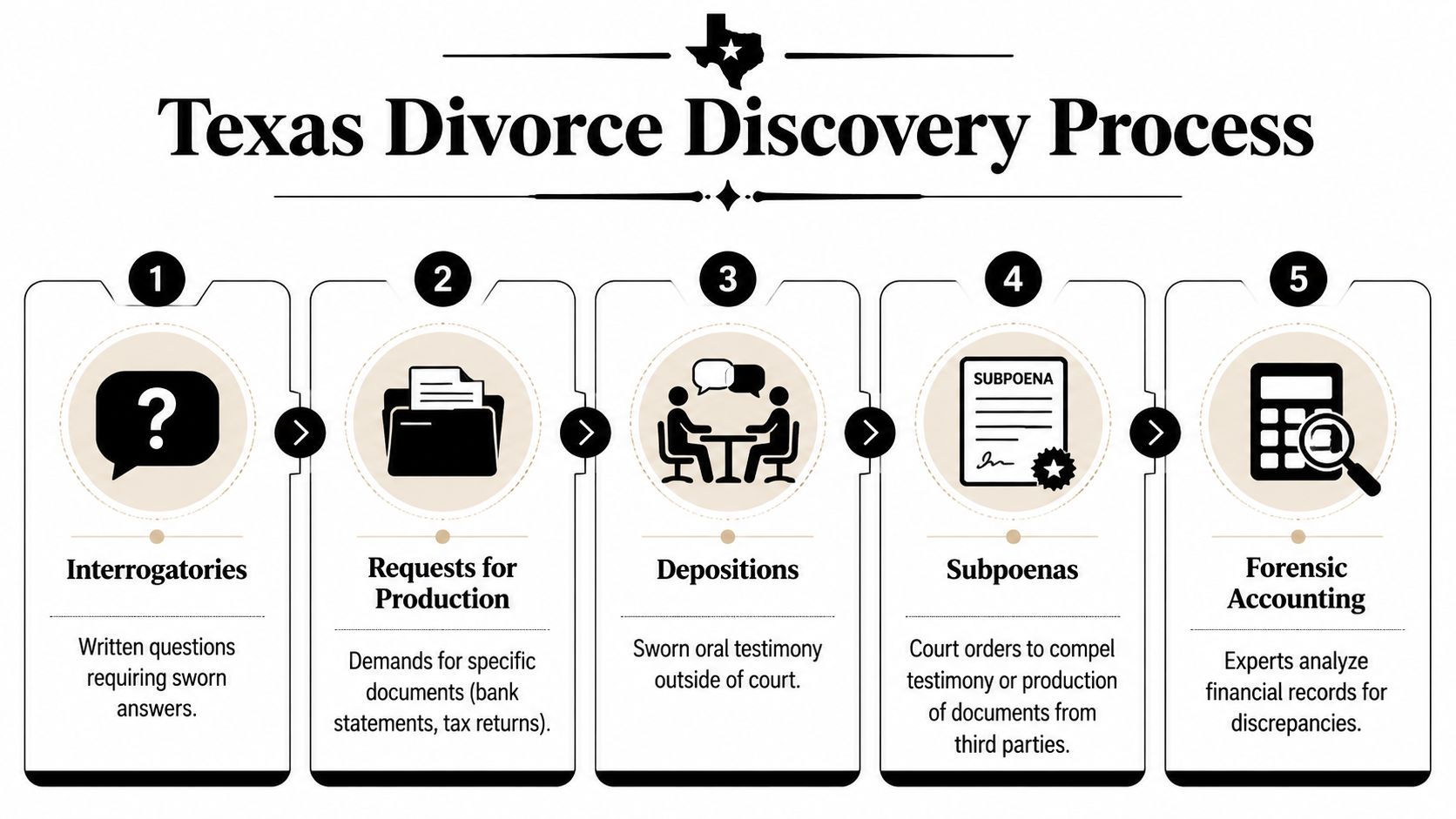
The discovery stack that actually finds hidden assets
Lawyers who handle these cases don't rely on one dramatic reveal. They build a discovery stack. That means combining records and legal tools until inconsistencies become impossible to ignore.
Common parts of that stack include:
- Interrogatories: Written questions that require sworn answers about accounts, income, transfers, business interests, and debts.
- Requests for production: Demands for actual documents such as tax returns, bank statements, credit card records, payroll records, ledgers, and loan applications.
- Depositions: Sworn testimony outside court. During these, vague written answers often fall apart.
- Subpoenas: Orders sent to banks, employers, business partners, or other third parties for records the spouse didn't volunteer.
- Forensic analysis: A deeper review of account flows, spending patterns, and discrepancies.
If you want a plain-English primer on how accountants approach financial tracing, this guide to financial investigations is a useful background resource.
Pattern matching beats excuses
Texas hidden-asset cases are often proved by patterns. The legal and financial review may combine financial records, tax returns, credit reports, public-property searches, business records, and digital evidence with interrogatories, depositions, subpoenas, and forensic analysis. Lifestyle analysis can reveal spending that exceeds reported income, and public-record or corporate searches can expose real estate, vehicles, business interests, or digital accounts that were never disclosed, as described in this Texas article on how hidden assets are discovered.
A simple example helps. If your spouse reports limited income but keeps making expensive purchases, paying travel costs, or funding a business expansion, that mismatch becomes evidence. Not final proof by itself, but evidence that justifies a deeper dive.
For a more focused look at one common issue, this local page on finding hidden bank accounts in a Texas divorce adds practical context.
Why procedure matters in Harris County
In my opinion, the biggest mistake people make is waiting for voluntary honesty. That almost never improves with time. Once financial games start, your lawyer should be thinking about deadlines, motions to compel, sworn testimony, third-party records, and whether sanctions should be requested during the case.
The process is technical. That's why it works.
Practical Steps for Atascocita Residents What Red Flags to Look For
A lot of clients in Atascocita and Humble don't begin with a smoking gun. They begin with a series of odd facts that don't fit together. That's normal. Hidden-asset cases often start as pattern recognition.
Red flags that deserve attention
Have you noticed one of these situations?
- New secrecy around mail or email: Statements stop arriving at the house, or financial notices suddenly go digital and inaccessible.
- Unexplained cash movement: Large withdrawals, repeated ATM use, or transfers that don't match household expenses.
- A business suddenly looks weaker: Your spouse says the company is struggling, but personal spending doesn't slow down.
- Friends or relatives enter the picture: Property gets "sold," "gifted," or "borrowed against" under terms that don't make sense.
- Debt appears out of nowhere: New credit cards, personal loans, or claims that money is tied up in obligations you've never heard about.
A familiar local scenario
A Humble-area spouse tells the court he has little disposable income. At the same time, the family truck gets upgraded, weekends away continue, and business meals never stop. That doesn't prove hidden assets by itself. But it does create a pattern worth testing against tax returns, card statements, bank records, and business documents.
Another common scenario involves real property. A spouse may insist there are no other real estate interests, but county records later show a parcel, rental, or ownership interest that was never disclosed. Public records often matter more than excuses.
When spending stays high and reported income drops, pay attention. Hidden-asset cases are often built from that mismatch.
What to gather before meeting with an attorney
Don't overcomplicate this. Bring the records you already have legal access to and organize them by category.
A simple checklist helps:
| Document type | Why it matters |
|---|---|
| Joint tax returns | Shows income, deductions, accounts, and business activity |
| Bank and credit card statements | Reveals transfers, spending patterns, and hidden accounts |
| Pay stubs and bonus records | Helps compare reported pay with actual compensation |
| Loan applications | People often tell lenders more than they tell the divorce court |
| Property tax notices and deeds | May reveal real estate interests or ownership changes |
| Business records you lawfully possess | Useful if a spouse controls a closely held company |
What not to do
You can hurt your own case if you get reckless.
- Don't break into private accounts: If you don't have lawful access, stay out.
- Don't confront too early: Once warned, a dishonest spouse may move money again or destroy records.
- Don't rely on memory alone: Dates, copies, screenshots, and organized files are far more useful.
If your focus is protecting what you've built while the case is pending, this local resource on how to protect assets during divorce is a good next read.
After the Divorce Is Final Can You Still Take Action
Yes, sometimes you can.
One of the most important things people miss is that a hidden asset problem doesn't always end when the divorce decree is signed. If an asset existed during the marriage but wasn't included in the decree because it was concealed or omitted, Texas law may allow a post-divorce suit to divide undivided property.
That matters for ordinary accounts and for newer forms of property such as cryptocurrency.
The timeline issue people worry about
For post-divorce claims, the standard two-year statute of limitations can be tolled, or paused, if the concealing spouse's fraud prevented discovery. This becomes especially important with digital assets like cryptocurrency, where proving fraudulent concealment can be central to extending the deadline. Texas appellate rulings have also shown a rise in motions to toll the statute due to digital asset concealment.
The key issue isn't just when the divorce ended. It's whether the other spouse's fraud prevented you from discovering the asset earlier.
What you need to prove
A post-divorce claim isn't automatic. You need evidence showing the asset existed and evidence supporting the concealment. That can include records, transaction history, contradictory sworn statements, exchange records in a digital asset case, or documentation showing intentional omission.
If you discover a hidden asset after divorce, don't assume you're too late. Have a lawyer evaluate the timeline before you rule yourself out.
For Atascocita residents, this comes up more often than people expect. A forgotten brokerage account, cash position, investment holding, or crypto wallet can stay hidden until a refinancing application, tax issue, or third-party record exposes it.
Why a Local Atascocita Attorney Is Your Strongest Ally
In a hidden-asset case, local knowledge isn't a bonus. It's part of the strategy.
An attorney who regularly works in Harris County family courts understands how local procedure plays out. That includes how discovery disputes get presented, how to build a sanctions record, when to push for third-party subpoenas, and how to prepare a property case so the judge can act on it instead of sending everyone back for more paperwork.

Why local representation changes the approach
A local lawyer can usually spot the practical issues faster. Which records should be pursued first. Whether business documents need a deeper review. When a case needs a forensic accountant. Whether the other side is stalling and needs to be forced into compliance.
The Law Office of Bryan Fagan – Atascocita TX Lawyers handles divorce and property-division matters for local residents, including disputes involving concealed marital property. If your concern is specifically hidden property, this page about working with a hidden assets divorce lawyer in Atascocita is a practical starting point.
My recommendation
If you suspect hidden assets, act early. Get your documents together. Stop informal arguments about money. Put the issue into a legal process where records, deadlines, and sworn testimony matter.
You should also make sure your broader divorce strategy covers both the divorce itself and the property division issues tied to it. Local pages on divorce representation and property division can help you understand the scope of what needs to be addressed.
If you're dealing with financial secrecy in a divorce, schedule a free consultation with Law Office of Bryan Fagan – Atascocita TX Lawyers. We'll help you assess the red flags, preserve the records you already have, and build a strategy suited to your case in Atascocita, Humble, or anywhere in northeast Harris County.