Skip to content
A parent in Texas generally cannot deny court-ordered visitation on their own, even for safety reasons, unless they first get a court order such as a Temporary Restraining Order. If you withhold the child without that order, you can face enforcement, contempt, fines, makeup visitation, and even jail time.
That answer feels cruel when you're the parent standing in your kitchen in Atascocita, looking at a packed overnight bag and wondering whether sending your child is a mistake. Maybe your child is crying. Maybe you've seen bruises, heard disturbing details, or watched the other parent spiral with alcohol, drugs, or rage. Your instinct is to protect first and ask questions later.
I agree with the first part. Protect your child. But in Harris County family court, you also need to protect yourself by using the legal process fast and correctly. If you make a unilateral decision and the judge later decides you didn't have legal authority to do it, your effort to protect your child can be turned against you.
The better approach is simple. Move quickly, document carefully, and get emergency relief through the court. Regarding whether Can a Parent Deny Visitation for Safety Reasons in Texas Atascocita, the practical answer is no, not alone. The law gives you tools, but it expects you to use those tools instead of self-help.
Your Child's Safety is Everything But You Must Act Legally
It is 6:30 p.m. in Atascocita. Pickup is in thirty minutes. Your child is crying, refusing to go, and saying something happened at the other parent's home. That is the moment parents make choices that either protect their child and their case, or damage both.
Start with the right priority. Protect the child. Then protect yourself by following the order and using the court process the right way.
Fear does not change the order. Evidence and emergency filings do.
A Harris County judge will care about safety. The judge will also expect you to respect the existing possession order until the court changes it. If you decide on your own to stop visitation, you hand the other parent an argument that you are interfering with access. That can become a serious problem fast.
If there is immediate danger, call 911. If the danger is not happening this minute but the risk is real, get emergency relief from the court right away. Emergency requests are built for short-term protection while the judge reviews what is happening. They are not permission for a parent to create a private suspension of visitation.
Practical rule: If your child may be unsafe, move fast through the court. Do not make yourself the only decision-maker.
What Harris County judges want to see
Judges in this area hear "I was protecting my child" all the time. Words alone do not carry much weight. Specific facts do.
Say what happened, when it happened, who saw it, what your child said, what marks or behavior changes you observed, and what you did next. If your child is refusing visitation because of fear, panic, or emotional distress, do not brush that aside. That issue matters, especially when the child's reaction is consistent, severe, and tied to identifiable events. But you still need proof a judge can evaluate, not just a general statement that your child does not want to go.
That point is especially important in Atascocita cases. Parents often face a harder situation than obvious physical injury. A child may shut down before exchanges, vomit, beg not to go, or report screaming, intimidation, drinking, or unsafe people in the home. Courts take emotional harm seriously when it is documented clearly and presented through the proper filing.
Use this crisis checklist:
- Call 911 if the child faces immediate danger.
- Save the evidence. Keep texts, photos, school messages, medical records, and notes about dates, times, and witnesses.
- Write down your child's statements carefully. Use their words. Do not coach, edit, or dramatize.
- Contact a family law lawyer fast. Harris County emergency filings move quickly, and sloppy paperwork hurts.
- Ask for targeted protection. A judge can order supervised visitation, a safe exchange site, or a temporary change while the court investigates.
You are allowed to take safety seriously. You are expected to do it in a way the court can defend. That is how you protect your child without risking your custody case.
Why You Cannot Unilaterally Deny Visitation in Texas
Texas starts from a clear policy choice. The law presumes children benefit from frequent contact with both parents, and that policy shows up in court every day.
Under Texas Family Code § 153.001, both parents are presumed to benefit from frequent contact with their child, and denying access on your own can trigger enforcement under § 157.001. If a parent denies visitation without a TRO, the other parent can seek enforcement, makeup time, fines, and contempt sanctions including jail time, as reflected in the Texas Family Code provisions on possession and access.
A custody order stays in effect until a judge changes it. A parent doesn't get to rewrite it at the curb during pickup.
What the court sees when you deny visitation on your own
Parents often think the judge will focus first on their motive. In reality, the judge often focuses first on your conduct.
If there is a valid order and you block visitation anyway, the court may view that as interference with the parent-child relationship. That doesn't mean your safety concern is ignored. It means the court expects you to present it through a motion, affidavit, testimony, and evidence.
A simple way to think about it is this:
| Situation | Court's likely view |
|---|---|
| You deny visitation with no filing and no evidence | You may look obstructive |
| You file emergency papers with specific evidence | You look protective and credible |
| You request supervised visitation or safer exchanges | You look focused on safety, not punishment |
The rule exists for a reason
Some parents abuse “safety concerns” to control the other parent. Courts know that. Some parents ignore danger signs until it is too late. Courts know that too.
So Texas draws a hard line. The judge decides. Not the parent with possession that day.
That is why the phrase can a parent deny visitation for safety reasons in Texas Atascocita needs a precise answer. You can raise safety concerns. You can seek emergency protection. You can ask for supervision, suspension, or modified exchanges. But you can't become your own judge.
For many families in northeast Harris County, that is frustrating. It's also the legal reality you have to work within if you want to protect both your child and your custody position.
Immediate Legal Actions to Protect Your Child in Harris County
It is Friday afternoon in Atascocita. Your child is crying, begging not to go, and telling you something happened at the other parent's home. This is the moment to stop texting, stop arguing, and start building an emergency court response.
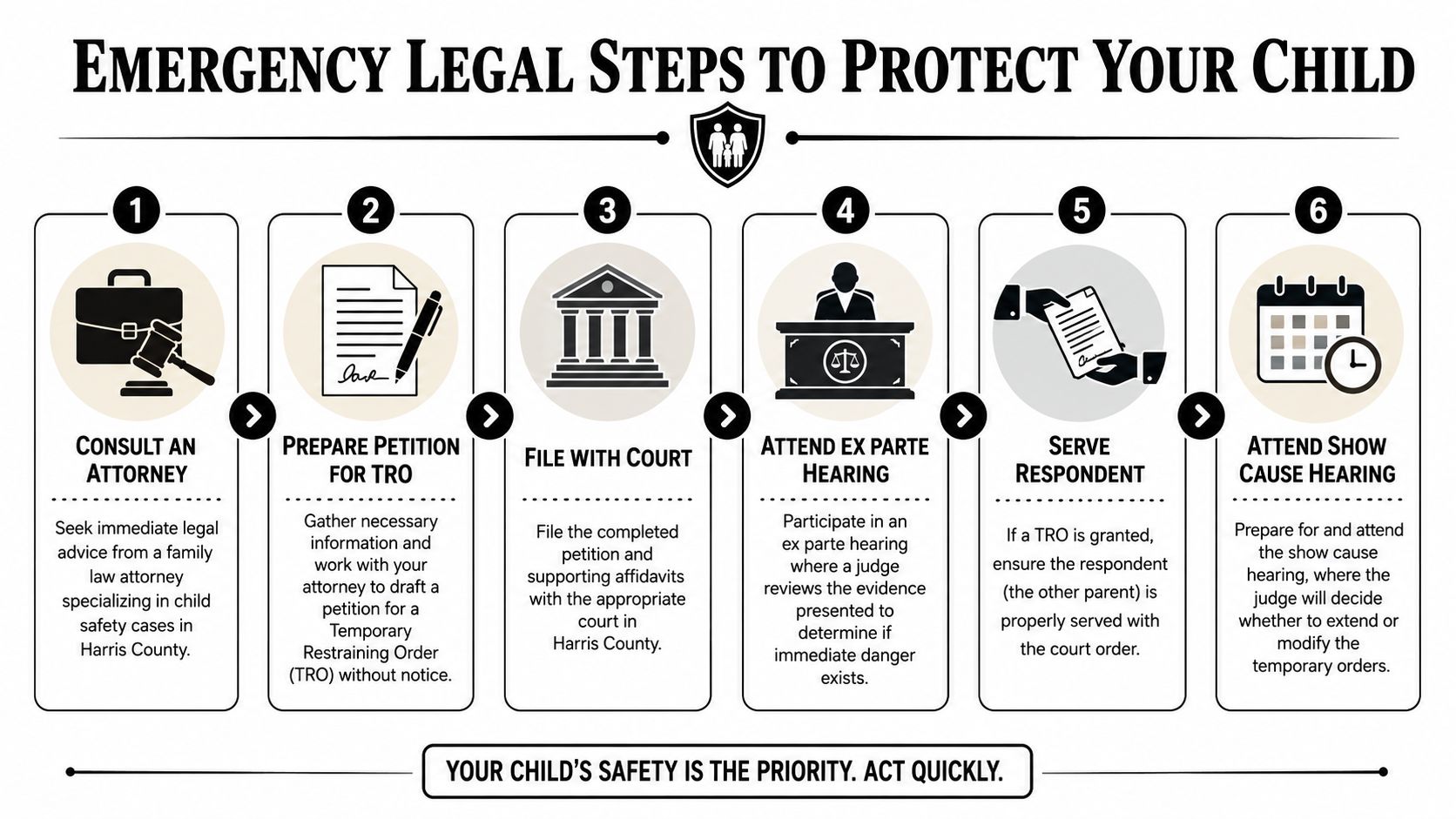
If the danger is immediate, ask the court for emergency relief fast. In Harris County, that usually means requesting a Temporary Restraining Order, or TRO, in your family case. A TRO can temporarily stop or limit visitation until a judge can hold a fuller hearing. The point is simple. Put the safety issue in front of the judge now, not after you have already violated the order and put yourself on defense.
The steps that matter right away
Write down exactly what happened. Include dates, times, injuries, statements, witnesses, missed school, panic attacks, threats, intoxication, or anything else you can describe with specifics. If your child is refusing visitation because of emotional distress, document the behavior carefully. Crying at exchange, vomiting, hiding, refusing to get out of the car, nightmares, regression, and fear statements all matter when they are recorded clearly and tied to dates.
Call a family lawyer in Harris County immediately. Local procedure matters. Judges in Harris County want specific facts in sworn form, and they expect the requested relief to match the risk. Asking for supervised visits, safer exchanges, or a temporary pause can be smarter than asking for the maximum order without enough proof.
File an emergency motion or TRO request. Your filing should explain the danger in plain English and attach an affidavit with concrete facts. If your concern involves a new dating partner around the child, gather names and facts before you file. Parents who need to confirm who is around their child sometimes start with tools that explain how to verify dating profiles.
Ask for the right temporary protection. A judge may be more willing to grant supervised visitation, no overnight possession, counseling conditions, or police station exchanges than a total cutoff unless the facts show a clear immediate threat.
Go to the emergency hearing prepared. The judge may hear from you quickly, sometimes before the other parent appears. Stay focused. Explain what happened, why the child is at risk, and what short-term order would keep the child safe.
Get ready for the follow-up hearing immediately. Temporary relief is only the first round. The next hearing is where weak claims collapse and well-documented claims hold up.
Parents who want a practical overview of filings and timing can review this local guide on emergency custody in Atascocita without a lawyer. In a real safety case, though, self-filing is a risk. You get one chance to make a strong first impression.
TRO versus protective order
These remedies do different jobs.
A TRO is usually the tool for temporary custody and visitation restrictions inside the family case. A protective order is used when the facts involve family violence, threats, stalking, harassment, or assault. Some cases call for both.
Do not guess which one applies. If the other parent has been violent, has threatened you or the child, or has created a serious safety risk tied to drugs, weapons, or assaultive behavior, raise that directly with counsel and ask whether a protective order should be filed alongside the custody request.
This short video gives additional context on urgent child custody and safety issues:
What to ask the judge for
Ask for relief that solves the actual danger.
You may ask for:
- Supervised visitation if contact can happen safely with monitoring
- Therapeutic or professionally supervised exchanges if your child's distress shows up at handoff
- Public-place or police-station exchanges if the transfer itself is unsafe
- No overnight visitation if the risk increases when the child is alone overnight
- Temporary suspension of visitation if the facts show a serious immediate threat
- Counseling or reunification conditions if the child is refusing contact because of fear, trauma, or severe emotional distress
Harris County judges see the difference between a parent trying to protect a child and a parent trying to control the schedule. Your request should show restraint, specificity, and a child-focused plan. That is how you protect your child and protect your case at the same time.
Gathering Evidence a Judge Will Take Seriously
Judges don't issue emergency orders because a parent is scared. They issue them because the evidence shows a serious risk.
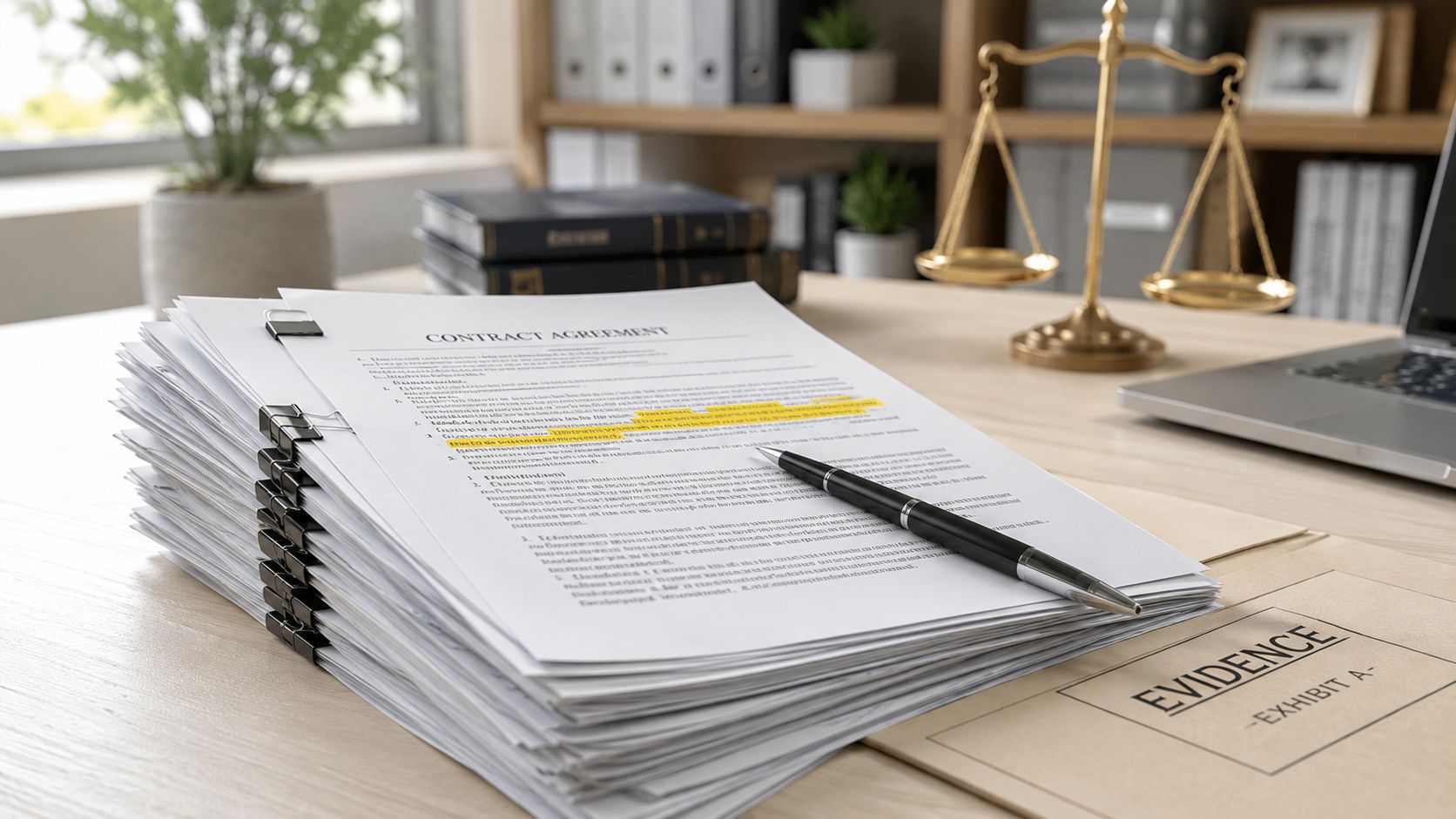
In Harris County, a TRO request needs specific, corroborated evidence, not mere suspicion, and a child's reluctance to go to visitation does not by itself satisfy the legal threshold. That standard is discussed in this article on Texas visitation denial and substantial risk in Harris County.
Strong evidence versus weak evidence
Here is the blunt version. “I have a bad feeling” is weak. “I have a police report, urgent care record, photos, and threatening texts” is strong.
Use this comparison:
| Weak proof | Strong proof |
|---|---|
| General fear | Specific incident details |
| Hearsay from unknown people | Sworn witness statements |
| Child says “I don't want to go” | Therapist records, school reports, documented behavioral changes |
| Verbal accusations | Photos, messages, police logs, CPS documentation, medical records |
What you should start collecting today
- Police involvement: If officers were called, get the incident information and preserve it.
- Medical documentation: Urgent care, pediatric records, or discharge paperwork can matter.
- Electronic communications: Save texts, emails, call logs, voicemails, and social media messages.
- Third-party observations: Teachers, counselors, relatives, neighbors, and coaches may have useful observations.
- A detailed timeline: Write out dates, pickup issues, disclosures from the child, intoxication concerns, injuries, and missed school.
If your concern involves a new romantic partner around the child, don't rely on rumors. Background concerns should be checked carefully and lawfully. In some situations, tools that explain how to verify dating profiles can help a parent gather basic public-facing information before bringing concerns to counsel. That is not proof by itself, but it can help you ask better questions.
Emotional harm and a child refusing to go
Many parents get trapped at this point.
A child may be terrified, anxious, or emotionally dysregulated about visitation, and still the court may expect the parent to make reasonable efforts to comply unless there is enough evidence for emergency relief. The child's refusal alone usually won't carry the case.
If your child is resisting visits, document the behavior and the surrounding facts. Don't turn the child into the decision-maker.
For emotional harm cases, judges tend to look for patterns and corroboration:
- Repeated panic or trauma symptoms tied to visitation periods
- School problems that line up with exchanges or returns
- Therapist or counselor observations that identify concerns in a professional setting
- Statements showing coercion, threats, or manipulation by the other parent
- Your efforts to comply safely, such as trying counseling support or proposing safer exchanges
If you're building a broader custody case around dangerous parenting behavior, this local guide on how to prove a parent is unfit in a Texas custody case can help you understand how courts evaluate evidence.
The Serious Risks of Ignoring Your Custody Order
Parents sometimes think, “I'll just keep the child home this weekend and explain it later.” That is one of the most expensive mistakes in family court.
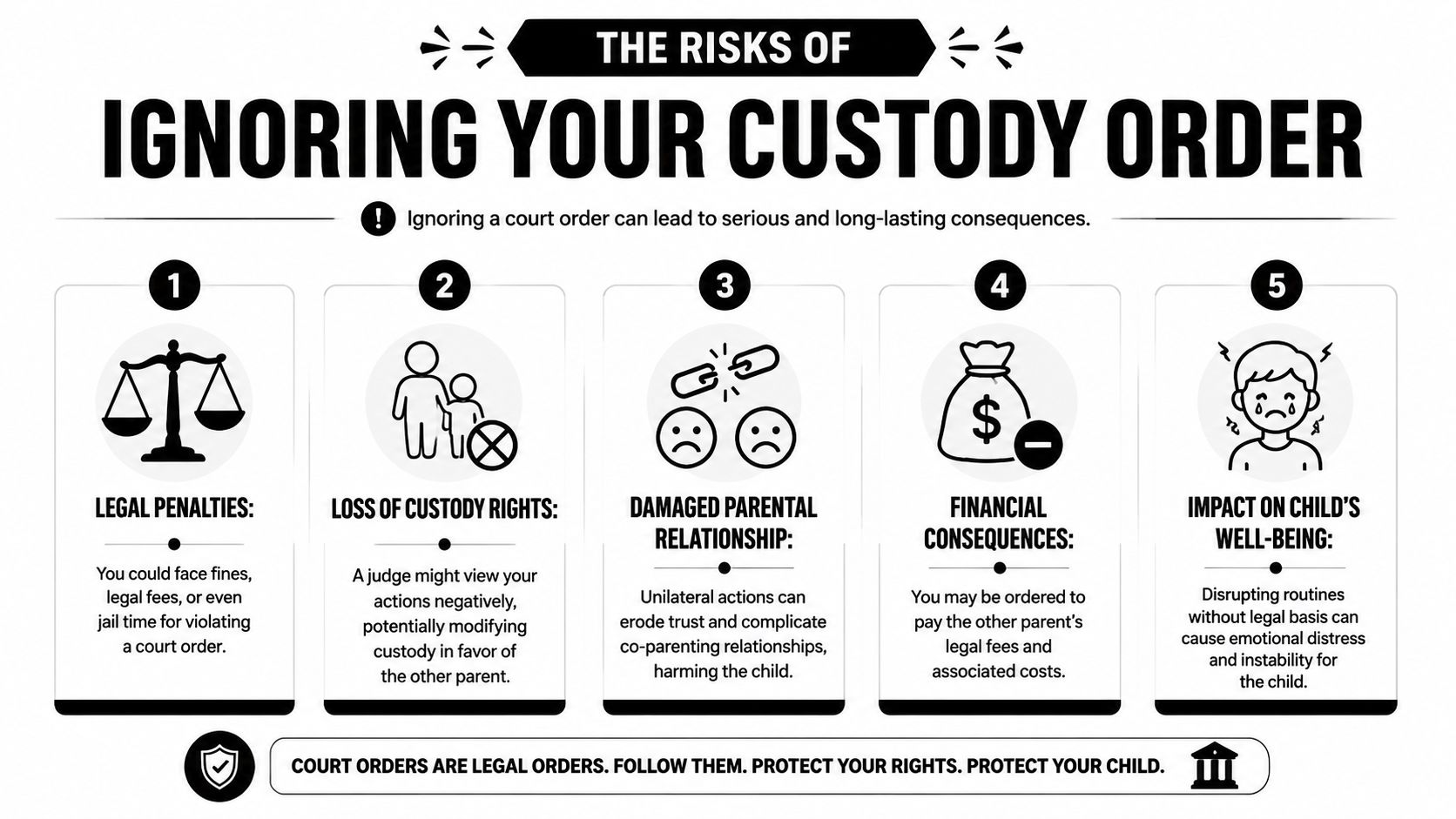
Texas courts treat visitation interference seriously. A denied parent can file for enforcement, and documented denials strengthen that case. Texas Access warns that violating a court order can lead to contempt, jail time, fines, and even a criminal record. See Texas Access guidance on enforcement of visitation orders.
What can happen if you take self-help too far
The consequences are not abstract. They show up in court orders.
- Makeup visitation: Judges often award additional time to the parent who was denied access.
- Contempt findings: If the court believes you knowingly violated the order, the penalties can escalate quickly.
- Financial punishment: You may be ordered to pay fines and possibly the other side's legal costs depending on the circumstances.
- Damage to your custody case: A judge may begin to see you as the source of instability rather than the parent trying to solve it legally.
The risk most parents underestimate
The biggest danger isn't just a sanction. It's credibility.
If the court decides you acted first and gathered evidence later, your claim of danger may lose force. Worse, the other parent may frame your actions as alienation or manipulation, especially when the dispute involves emotional harm rather than visible injury.
Courts respond much better to parents who document, file, and ask for specific protection than to parents who break the order and ask for forgiveness.
That is why unauthorized denial is such a bad strategy. Even when your concern is sincere, the wrong process can make you look reckless. In a hard custody case, perception matters almost as much as proof.
Your Action Plan for Child Safety in Atascocita
It is 6:15 p.m. Exchange time is coming. Your child is crying, refusing to get in the car, and saying they do not feel safe. That is when parents make mistakes that follow them into a Harris County courtroom.
Slow down and get strategic. Protect your child first. Protect your credibility at the same time.
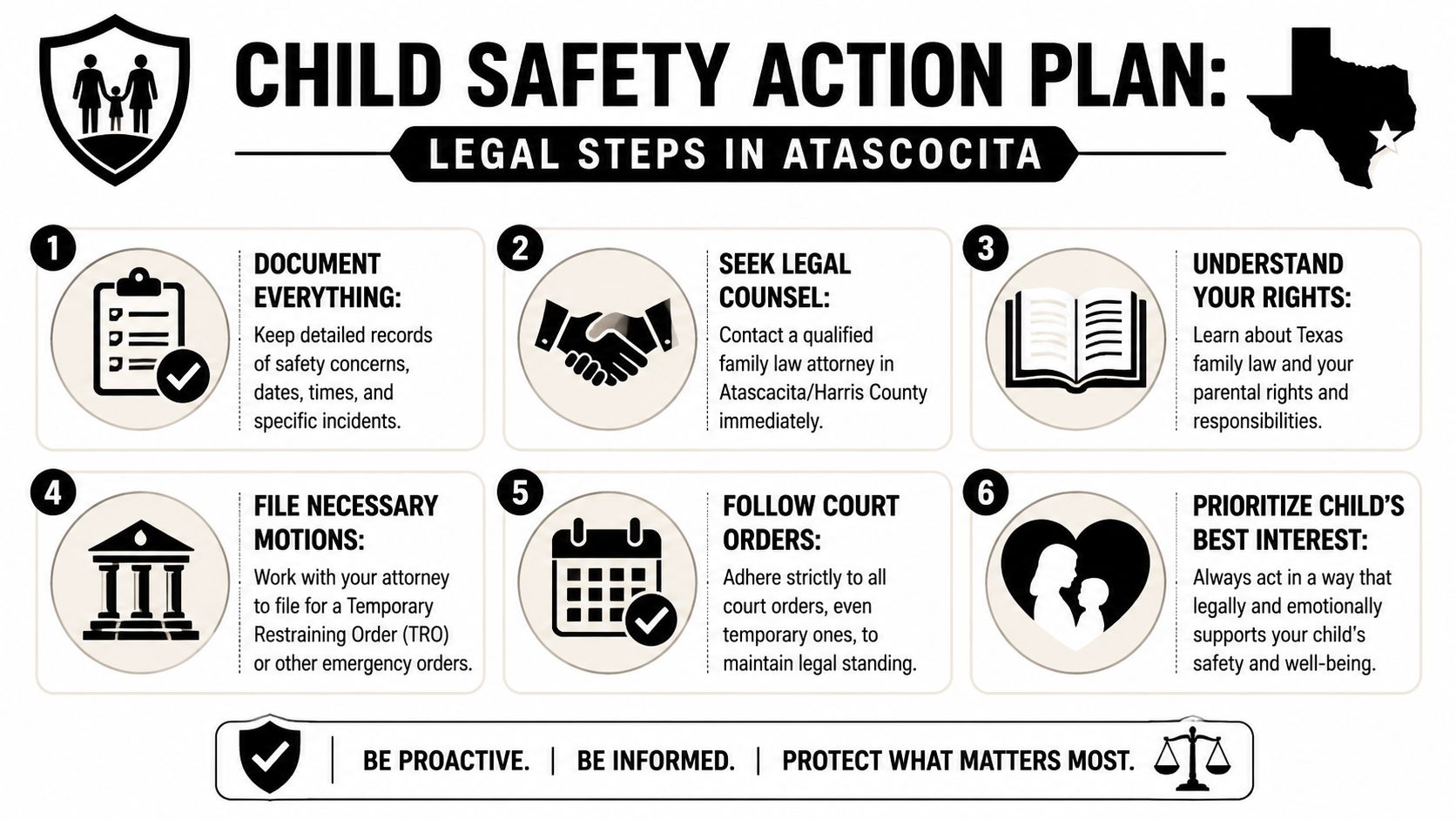
Follow this checklist in order
- Deal with immediate danger first. If there is an active threat, call 911 or law enforcement right away.
- Make a clean timeline. Write down dates, times, what your child said, what you observed, who was present, and what happened at prior exchanges.
- Save the proof. Keep screenshots, photos, medical records, school reports, counseling records, and any prior police or CPS paperwork.
- Get legal advice fast. Emergency custody issues in Harris County move on paperwork, timing, and proof.
- Ask the court for targeted protection. Request the narrowest restriction that fits the facts, such as supervised visits, a neutral exchange location, or temporary suspension.
- Follow the next court order exactly. Temporary orders still control your case.
If your child is refusing visitation because of fear or emotional distress
This is the issue many parents in Atascocita struggle to explain. The child is not bruised. There may be no police report. But the fear is real, the panic is real, and a judge will still expect you to handle it the right way.
Do this. Listen carefully, document the exact words your child uses, and get the child into counseling if appropriate. Tell the court what you saw and what steps you took. Ask for a solution that addresses safety without looking punitive.
Do not do this. Do not tell your child they never have to go again. Do not coach a script. Do not send angry texts accusing the other parent of abuse unless you are prepared to prove it.
If the facts support monitored contact instead of a complete stop, review your options with a supervised visitation attorney in Atascocita. Judges often respond better to a measured request than to an all-or-nothing demand.
What local courts want to see
Judges handling family cases affecting Atascocita and the Humble area are looking for parents who stay child-focused, organized, and reasonable under pressure. They want specifics. They want records. They want to see that you tried to solve a safety problem through the court, not through impulse.
That means your action plan should be simple. Keep the child safe. Keep your evidence clean. File for the protection you can justify.
The Law Office of Bryan Fagan – Atascocita TX Lawyers handles family law matters involving custody, visitation, modifications, and emergency relief in Atascocita, Humble, and Harris County.
Your child's safety comes first. Your next step needs to hold up in court.