Skip to content
You get a text. Or a phone call. Or your child casually says, “Mom says we might be moving.”
That moment hits hard. Your stomach drops, your mind races, and the same question keeps coming up: Can my ex move away with my child in Texas, in Atascocita, without my permission?
If you're in Atascocita, Humble, or elsewhere in northeast Harris County, don't treat this like a routine co-parenting disagreement. Treat it like a legal issue that needs immediate attention. In Texas, relocation with a child is often tied directly to the custody order, the parent's rights under that order, and whether a judge believes the move serves the child's best interest.
Panic won't help. A fast, organized response will.
That Dreaded Conversation Your Ex Wants to Move
A lot of parents first hear about a move in a sloppy way. Not formal notice. Not a serious discussion. Just a passing comment: “I'm looking at jobs in another city.” Or, “My lease is up, and I may need to move closer to family.” Then the deeper meaning becomes clear. They're not just moving. They're talking about moving with your child.
If that's where you are right now, your reaction is normal. You may feel angry, blindsided, or scared that your relationship with your child is about to get reduced to phone calls and holiday visits.
That fear makes sense. In Atascocita, kids build lives around routines. School in Humble ISD. Practice after school. Weeknight dinners with one parent. Grandparents in Kingwood. Church, neighbors, birthday parties, the same route down FM 1960 or West Lake Houston Parkway. A relocation fight is about much more than a change of address.
Practical rule: Don't assume your ex can move first and sort it out later. In many Texas cases, relocation is handled as a court-order issue, not an informal parenting dispute.
I've seen parents make the same early mistake over and over. They freeze. They hope the move won't happen. Or they send emotional texts instead of taking legal steps. That gives the other side time, momentum, and a cleaner story to tell the court.
You need the opposite approach. Stay calm. Get your paperwork. Read your order. Figure out who has the right to determine the child's primary residence. Then act before the move becomes a fait accompli.
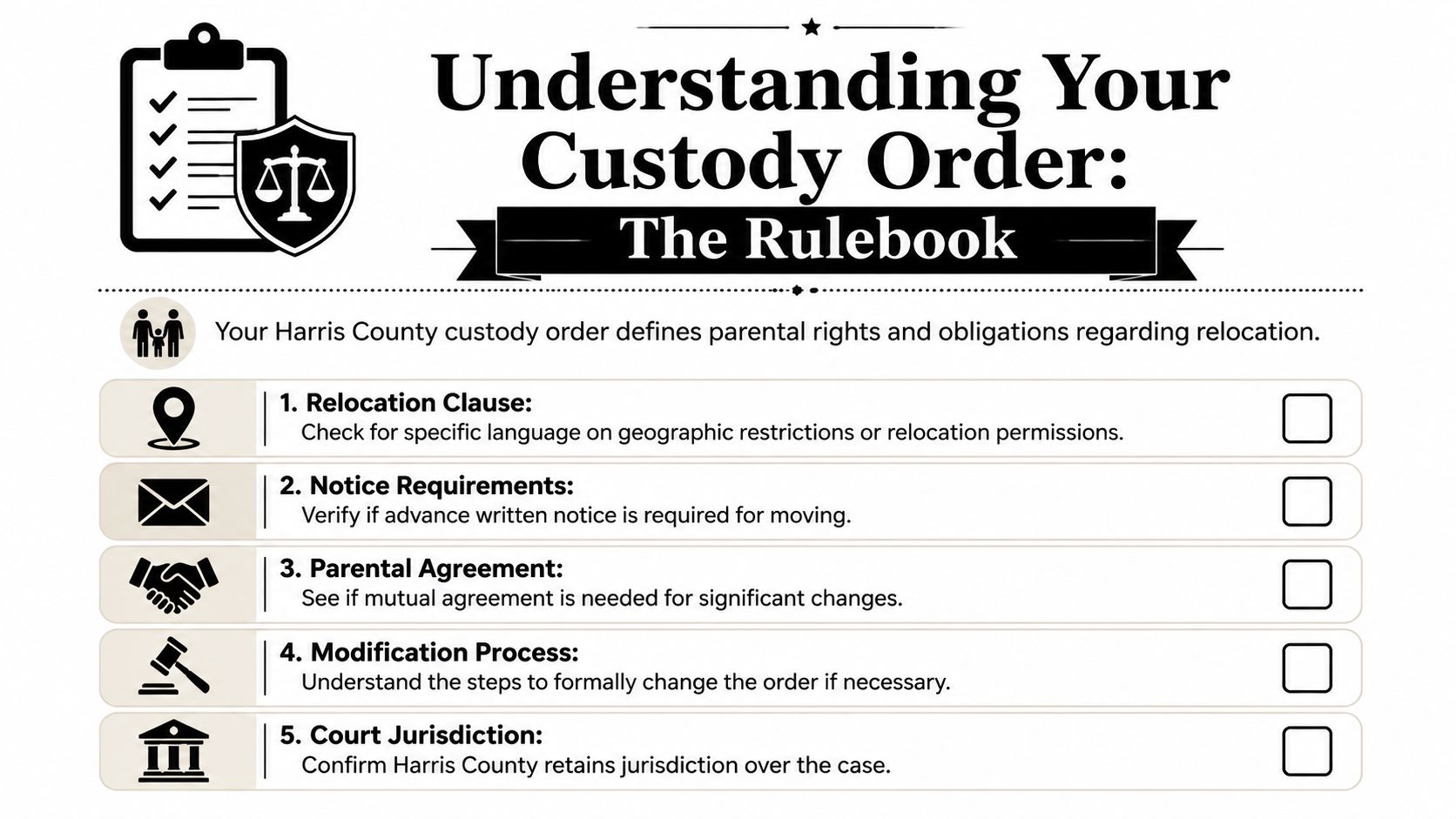
Your Harris County Custody Order is the Rulebook
Your first answer is not in a text message from your ex. It's in your Final Decree of Divorce or your Order in Suit Affecting the Parent-Child Relationship. That document is the rulebook.
In Texas relocation cases, the most important starting point is usually the parent's right to determine the child's primary residence. A Texas custody resource explains that the parent with that right can control where the child lives, while the other parent generally must seek a modification or enforcement order if a move would interfere with possession, access, or the parenting plan. That same resource notes Texas courts use a best-interest standard, and a judge may interview a child who is at least 12 years old if requested, but the child's view is only one factor and does not decide the case by itself, as explained in this Texas custody discussion from Cordell & Cordell.
Find the two clauses that matter most
Start reading your order with a pen in your hand. Don't skim it. Look for these sections:
Geographic restriction
This is the “home zone” for your child. It may limit the child's residence to Harris County, a list of surrounding counties, or another defined area.Primary residence language
One parent may have the exclusive right to designate the child's primary residence. If your ex has that right, that matters. If you have it, that matters even more.Possession and access terms
A proposed move may wreck the current schedule even if the other parent argues it's technically allowed.Notice provisions
Some orders contain additional relocation language beyond the standard framework.
Don't guess what your order means
Parents often tell me, “I thought joint custody meant neither of us could move.” That's not always true. “Joint” doesn't automatically mean equal authority on every issue. Texas orders split rights in very specific ways.
Here's a simple way to look at it:
| Order issue | Why it matters in a relocation dispute |
|---|---|
| Geographic restriction | It may block a move outside the allowed area without court action |
| Right to designate primary residence | It often determines who starts with decision-making authority |
| Current possession schedule | It shows how much the move would disrupt parent-child contact |
| County of continuing jurisdiction | It tells you where the case is usually handled |
If you're not sure how your possession terms interact with a relocation dispute, review a local explanation of the Texas Standard Possession Order. It helps many Harris County parents understand what courts expect when distance starts interfering with access.
The custody order is not background paperwork. It's the document the judge will return to first.
If you're searching “can my ex move away with my child Texas Atascocita,” the initial analysis begins. Before you argue fairness, motives, or convenience, know what the current order says.
What a Judge Considers The Best Interest of the Child
Once the order is on the table, the next question is harder. Even if one parent wants to move, should the court allow it?
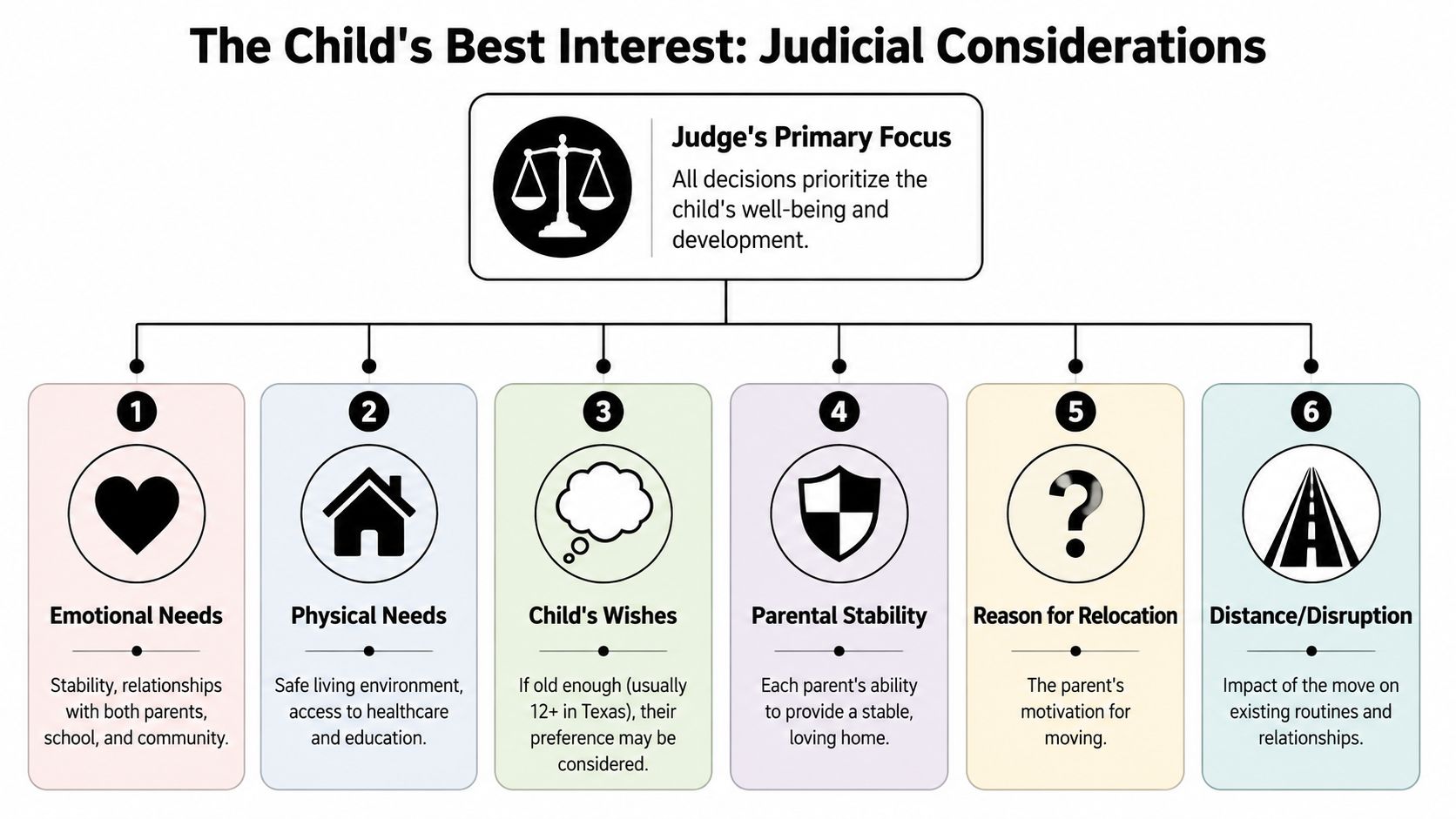
Texas courts decide relocation disputes under the best-interest-of-the-child standard. One Texas discussion of relocation says judges weigh factors such as schooling, distance, family ties, and each parent's involvement. It also warns that moving without approval can lead to contempt of court, fines, custody changes, or even an order requiring the child's immediate return, as discussed in this Texas relocation video overview.
Judges look at the child's real life
A relocation case is not won by saying, “I want a fresh start,” or “This is better for me.” A judge is looking at the child's day-to-day world.
That usually includes things like:
School stability
Is the child thriving where they are now? Are they connected to teachers, programs, or support systems in the Atascocita or Humble area?Parent-child contact
Will the move preserve a meaningful relationship with the other parent, or will it turn an involved parent into an occasional visitor?Family network
Nearby grandparents, cousins, and long-term caregivers matter. Courts notice when a child has deep roots in one community.Practical distance
A move that sounds manageable on paper can destroy a working schedule once traffic, school nights, and travel time become real.
For many families, emotional strain on the child becomes part of the story too. If your child is struggling with anxiety, divided loyalties, or the stress of conflict, outside support may help. In some cases, families also explore resources like Kelowna youth counselling services to better understand how transitions affect children, even if the legal case stays firmly in Texas.
A local discussion of how judges decide custody in Harris County, Texas can also help you understand how courts view stability, consistency, and each parent's involvement.
Here's a short overview that can help frame the issue:
The parent seeking the move needs a solid case
A move isn't automatically bad. But it isn't automatically allowed either.
If your ex wants to relocate, they need more than a preference. They need a reasoned explanation of why the move benefits the child and how the child will keep a real relationship with you. Better housing for the parent, a new relationship, or vague claims about opportunity may be part of the conversation, but they do not end it.
Courts care less about the parent's excitement and more about the child's disruption.
In Atascocita cases, that often means the details matter. What happens to school pickup? Counseling? Sports? Extended family dinners? Who handles homework now? Who attends doctor visits? A judge is not deciding an abstract philosophy question. The judge is deciding what happens to a child's actual routine.
The 60-Day Notice Rule and Your Immediate Options
Your ex says they are moving. Your stomach drops. Here is the part that matters right now. Treat that conversation like the starting gun.
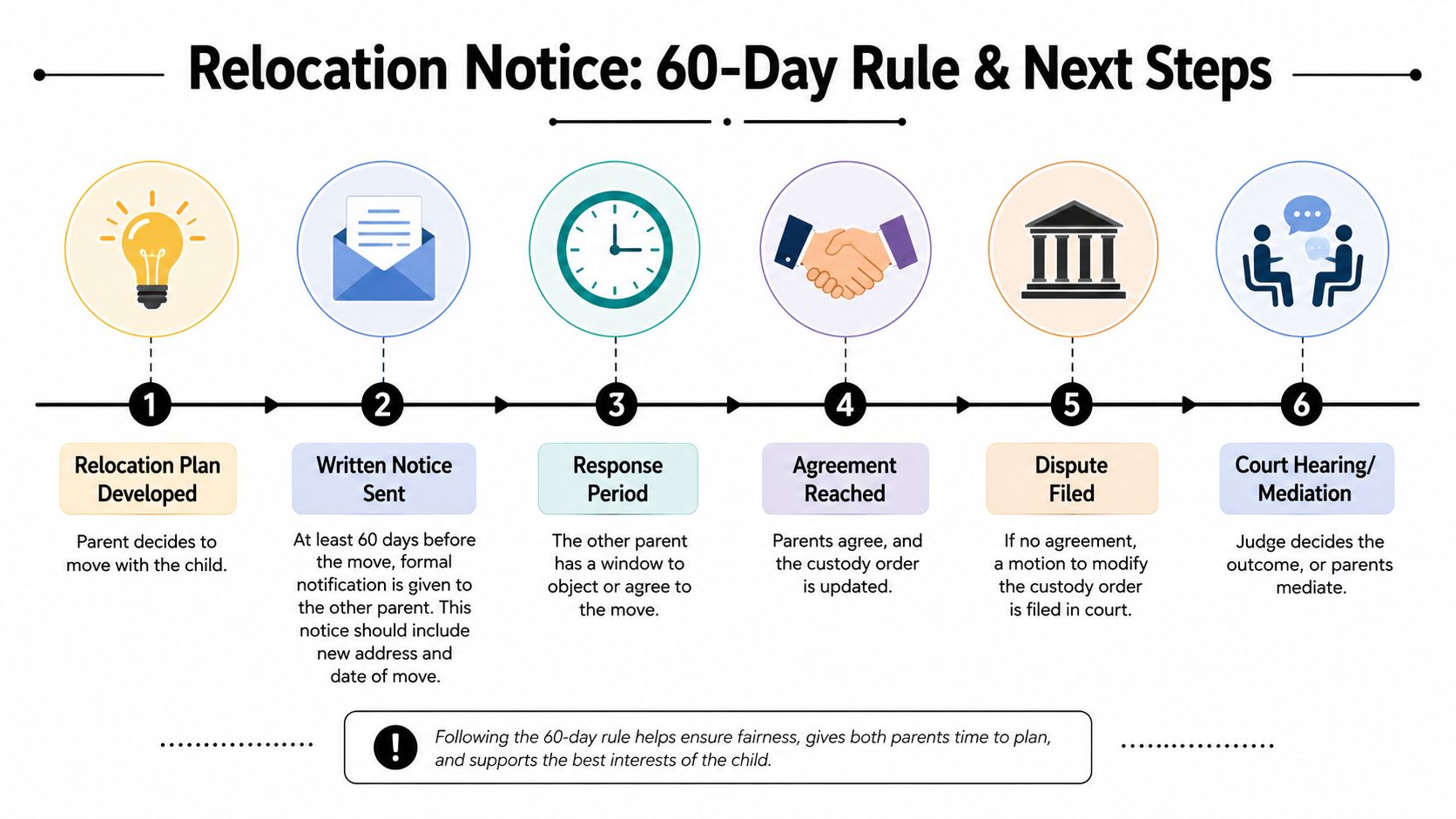
In many Texas custody cases, the order requires advance written notice before a parent changes the child's residence. A geographic restriction may also limit where the child can live without court approval. The point is simple. You do not have time to “see how this plays out.”
That notice period is your chance to get ahead of the problem. Use it.
What to do in the first few days
Start with the paper trail. Pull your final decree, SAPCR order, any modification orders, and any signed agreements that changed possession or pickup terms. Read the sections on the child's primary residence, geographic restriction, notice, school enrollment, and travel.
Next, preserve every message about the move. Save texts, emails, voicemails, screenshots, and social media posts. Keep them in one folder. Do not clean them up or rewrite them in your own words.
Then build a timeline. Write down when your ex first mentioned the move, the city they named, the proposed move date, and anything said about school, childcare, medical care, or a new job. Details win these cases.
You also need to stop making casual statements that can be spun later as consent. Do not say “we'll figure it out” or “that might be fine” just to keep the peace. Be polite and brief. Nothing more.
If you need a practical local overview of how these cases are handled, review this page on Atascocita child custody relocation disputes.
What not to do
Do not keep the child out of spite or panic. That can hurt you fast.
Do not accuse your ex of kidnapping because they talked about moving. The order controls. The facts matter.
Do not wait for a packed U-Haul or a new school registration before you get legal advice. By then, the other parent may be trying to turn a threat into a new normal.
Prompt, organized action gives you options. Delay gives the other side momentum.
If your ex has raised the issue, assume the clock is running. Get your order, save your proof, and get legal guidance right away.
Challenging the Move How to Formally Object in Court
If your ex is serious about leaving with the child, court is where you stop a plan from turning into a new routine.
The goal is simple. Keep the current order in place while the judge decides whether the move should happen at all. In Harris County, that usually means filing for a modification and, if time is short, asking for temporary orders or a temporary restraining order to block the move until a hearing.
The two court tools that matter most
Legal labels can sound bigger than they are. What matters is what each filing does.
Petition to modify the parent-child relationship
You file this when the proposed move would change who determines the child's residence, your possession schedule, or the child's day-to-day stability. You are asking the court to revisit the current order because the move changes the facts on the ground.Temporary restraining order or temporary orders
You ask for this when you need the judge to act fast. The point is to preserve the child's current living situation long enough for the court to hear both sides. If you wait, the other parent may argue that the child is already settled somewhere else.
If you want a practical local overview of how these cases are handled, review what an Atascocita custody relocation dispute lawyer does in these hearings.
Your objection needs proof
A judge does not care that the move feels insulting. A judge cares whether the move hurts the child and conflicts with the current order.
Bring evidence that shows the child's life works here and that your involvement is real, steady, and important. Good proof often includes school records, attendance history, report cards, counseling records, medical appointment logs, activity schedules, and a clean calendar showing when you exercised parenting time. Messages from your ex matter too, especially if they reveal the timing, destination, or reason for the move.
Witnesses can help. Teachers, coaches, childcare providers, family members, and counselors can explain the child's routine, support system, and connection to this area.
Frame your case the right way
Bad arguments are common in relocation fights. They also lose.
| Weak argument | Better argument |
|---|---|
| “I don't want my ex to move.” | “The move would disrupt the child's school, routine, and regular contact with me.” |
| “This is unfair to me.” | “The child benefits from stability here, and the proposed move weakens that stability.” |
| “My ex is doing this to make me miserable.” | “The move interferes with the existing order and would damage the child's established relationships.” |
That shift matters. Judges hear plenty of anger. What gets traction is a clear record that the child is rooted in Atascocita or nearby, depends on the current schedule, and would lose meaningful contact with you if the move goes through.
If timing is tight, act like it
Emergency cases reward speed and discipline.
File quickly. Organize your exhibits. Keep your communications short and polite. Show up looking like the parent who can protect stability, follow orders, and put the child first. That is the parent judges trust in close cases.
One more hard truth. If the child has already moved, already started a new school, and already been there for a while, the case gets harder. Not impossible. Harder. That is why formal objection should happen early, before the other side can argue that the relocation is already the child's normal life.
Protecting Your Family in Atascocita Your Next Step
By the time most parents start searching online, they're already under pressure. They've heard the move is coming. They're not sleeping well. They're trying to figure out whether to stay calm, fight hard, or do both.
The right answer is both.
Stay calm enough to think clearly. Fight hard enough to protect your child and your rights under the current order. In these cases, hesitation is expensive. Not always in money first, but in lost time, lost advantage, and lost stability.
Keep your focus narrow and practical
You do not need to solve your entire co-parenting relationship this week. You need to solve the relocation problem in front of you.
That means:
Read the order carefully
Find the geographic restriction and the residence designation language.Preserve the evidence
Save every communication about the move.Act before the move becomes the new normal
Courts can address these disputes, but a parent who waits often gives the other side a head start.
For families in Atascocita, Humble, and nearby Harris County communities, the issue usually comes down to a handful of real-world questions. Does the order allow this? Does the move damage the child's relationship with the other parent? Does it disrupt school, family ties, and routine? Can the parent asking for the move show that it benefits the child?

You don't need to figure this out alone
Relocation cases are stressful because they combine two hard things at once. Family conflict and strict legal procedure. One bad assumption can cost you. One delayed response can narrow your options.
If you're asking can my ex move away with my child Texas Atascocita, the safest approach is simple. Get the order reviewed. Get a strategy. Move quickly enough to protect the child's routine before a judge has to untangle a mess that could have been prevented.
A good consultation should leave you with answers to practical questions such as:
- Does my order block this move?
- Should I file for enforcement, modification, or emergency relief?
- What evidence should I gather this week?
- What should I stop saying to my ex right now?
That kind of clarity matters. It lowers panic and replaces it with a plan.
If your child lives in Atascocita, goes to school in the Humble area, or has deep roots in northeast Harris County, those community ties may matter in a relocation dispute. Local facts are not side details. They are often the core of the case.
If your ex is planning to move with your child, don't wait for the situation to get worse. Schedule a free consultation with Law Office of Bryan Fagan – Atascocita TX Lawyers and get clear guidance based on your actual Harris County order, your child's current routine, and the facts of your case. Our Atascocita office serves families throughout Atascocita, Humble, and northeast Harris County with practical, compassionate legal help when custody and relocation issues turn urgent.