 Skip to content
When the other parent announces they want to move away with your child—or when a life-changing opportunity requires you to relocate—it’s a deeply personal and stressful moment. For families in Atascocita, Humble, and across northeast Harris County, the thought of disrupting your co-parenting relationship and your child's stability can feel overwhelming.
These aren't just logistical problems; they are high-stakes legal battles known as custody relocation disputes. Navigating them successfully requires a deep understanding of Texas law and, just as importantly, a local attorney who understands the dynamics of the Harris County court system. At The Law Office of Bryan Fagan, we're not just lawyers; we're your neighbors, dedicated to helping local families find practical, compassionate solutions.
Understanding Child Custody Relocation in Atascocita

For parents in Atascocita, Humble, and the surrounding communities, the threat of a move can feel overwhelming. You worry about losing precious time with your child, disrupting their school and friendships, and unraveling the life you've carefully built for them. We get it. This isn't just a legal file; it's your family's future, and we are here to support you.
What Is a Geographic Restriction?
At the core of almost every Texas custody relocation case is a legal clause called a geographic restriction. Think of it as the official boundary line for your child's primary home. It’s a standard part of most custody orders for a reason: to ensure both parents can maintain a consistent, meaningful relationship with their child.
In our experience with local courts, a typical Harris County order will designate the child's residence to Harris County and its contiguous (adjoining) counties.
This restriction is the legal starting point. If a parent wants to move the child outside this approved zone, they can't just pack up and leave. They must either get written permission from the other parent or, more commonly, go back to court and ask a judge to modify the custody order.
What Atascocita Parents Can Expect
Whether you are the parent who needs to move for a new job in a different city or you're the parent staying behind in Atascocita, the legal standard is the same. A Harris County judge’s decision will hinge entirely on one question: What is in the best interest of the child?
This isn't a simple coin toss. The judge will carefully examine how the move would affect your child's emotional well-being, their relationship with each parent, their stability, and their access to school and community resources. To learn more about how courts view these boundaries, check out our guide on geographic restriction and custody in Atascocita.
Facing a potential move requires immediate, strategic action. Below is a step-by-step guide to help you get started.
Immediate Actions for a Custody Relocation Dispute
This table outlines the crucial first steps for any Atascocita parent involved in a relocation dispute, whether you are the one moving or the one opposing the move.
| Action Item | Why It's Critical | Local Atascocita Tip |
|---|---|---|
| Review Your Custody Order | Your current order is the rulebook. You need to know the exact wording of the geographic restriction. | Look for the section titled "Parental Rights and Duties" or "Possession and Access." The restriction is usually defined there. |
| Document Everything | Create a timeline of events, save all communications (texts, emails) about the move, and note the reasons for or against it. | Judges in the Harris County Family Law Center value clear, organized evidence. A simple journal can be incredibly powerful. |
| Avoid Verbal Agreements | Never agree to a move or promise not to oppose one without speaking to an attorney. A verbal "okay" can be used against you. | Harris County courts require formal, written agreements filed with the court to be enforceable. Anything less is a major risk. |
| Consult a Local Attorney | An experienced family lawyer can explain your rights, outline a strategy, and file the necessary legal documents to protect your position. | Time is critical. The sooner you act, the more options you have to either file a petition to move or file an injunction to stop one. |
Taking these initial steps can significantly influence the outcome of your case. The legal journey can be tough, but you don't have to face it alone. At The Law Office of Bryan Fagan, our local Atascocita team is here to protect your family and give you a clear path forward.
Understanding Texas Law on Parental Relocation
When you're trying to move with your child or prevent a move, Texas law can feel like a tangled web. Our job is to untangle it for you. We’ll walk through the legal landscape together, translating the courtroom jargon into plain English so you can feel confident and in control of your situation here in Atascocita.
At the very center of any custody decision a Harris County judge makes is a single, powerful principle: the “best interest of the child.” This isn't just a catchphrase; it's the legal standard defined in the Texas Family Code. The court’s primary focus isn't what's convenient for the parents. It’s about what will genuinely support the child’s physical and emotional well-being.
Think of your current custody order as your family’s co-parenting roadmap. It clearly lays out the rules, schedules, and boundaries. Asking the court to let you relocate is like asking to completely redraw that map, which changes the journey for everyone.
The Best Interest of the Child Standard
So, what does a judge at the Harris County Family Law Center actually consider when deciding if a move is in a child’s best interest? They use a set of criteria, often called the “Holley Factors,” to guide their decision. These aren't just a checklist; they are deeply personal questions about your child's life.
- The child's emotional and physical needs: Will the move help or hinder their development?
- The stability of the proposed new home versus the current environment in a community like Atascocita.
- Each parent's ability to care for the child, looking at everything from parenting skills to financial stability.
- The child’s own wishes, especially if they are 12 or older and can clearly express a preference.
- Any potential danger to the child, whether in their current home or the proposed new location.
The parent who wants to move has to prove to the court that the relocation is a positive step forward for the child, not just an opportunity for the parent. Frankly, that's a high bar to clear.
Modification vs. Enforcement
In any relocation battle, you’ll hear two key legal terms: a suit to modify and a suit for enforcement. It's crucial to know the difference.
A modification suit is the legal action the parent wanting to move must file. You are essentially asking the court to change the current custody order by lifting the geographic restriction and creating an entirely new possession schedule. For example, a Standard Possession Order in Texas works great when parents live nearby, but it becomes completely unworkable if one parent moves from Atascocita to Austin or another state.
On the flip side, an enforcement action is what the non-moving parent would file if the other parent moves without the court's permission. This suit asks the judge to uphold the original order, forcing the other parent and the child to return.
Let us be clear: Texas courts do not take it lightly when a parent ignores a geographic restriction. An unauthorized move can trigger serious legal penalties, from being held in contempt of court to facing fines. In some cases, it can even lead to the judge changing custody and giving the parent who stayed behind more rights.
Grasping these fundamental rules is the first step in building a solid case. Whether you are the parent hoping to start a new chapter elsewhere or the parent fighting to keep your child close, understanding what the judge is looking for is absolutely vital. An experienced Atascocita attorney can help you weave the facts of your life into a compelling legal argument for the court.
How to Build Your Case for a Harris County Court
When you walk into the Harris County Family Law Center for a relocation dispute, it’s not about who has the more emotional argument. It’s about who has the more compelling evidence. The judge’s decision will hinge entirely on the facts you present, whether you’re the parent hoping to move or the one fighting to keep your child here.
Think of it this way: building your case is like assembling a puzzle for the judge. Each piece of evidence—every document, every testimony—must fit together to create a clear picture. That picture has to show that your position serves the best interest of the child. This isn't just a legal catchphrase; it's the single most important standard your entire case must be built around.
The process itself can feel overwhelming, but it follows a logical path.
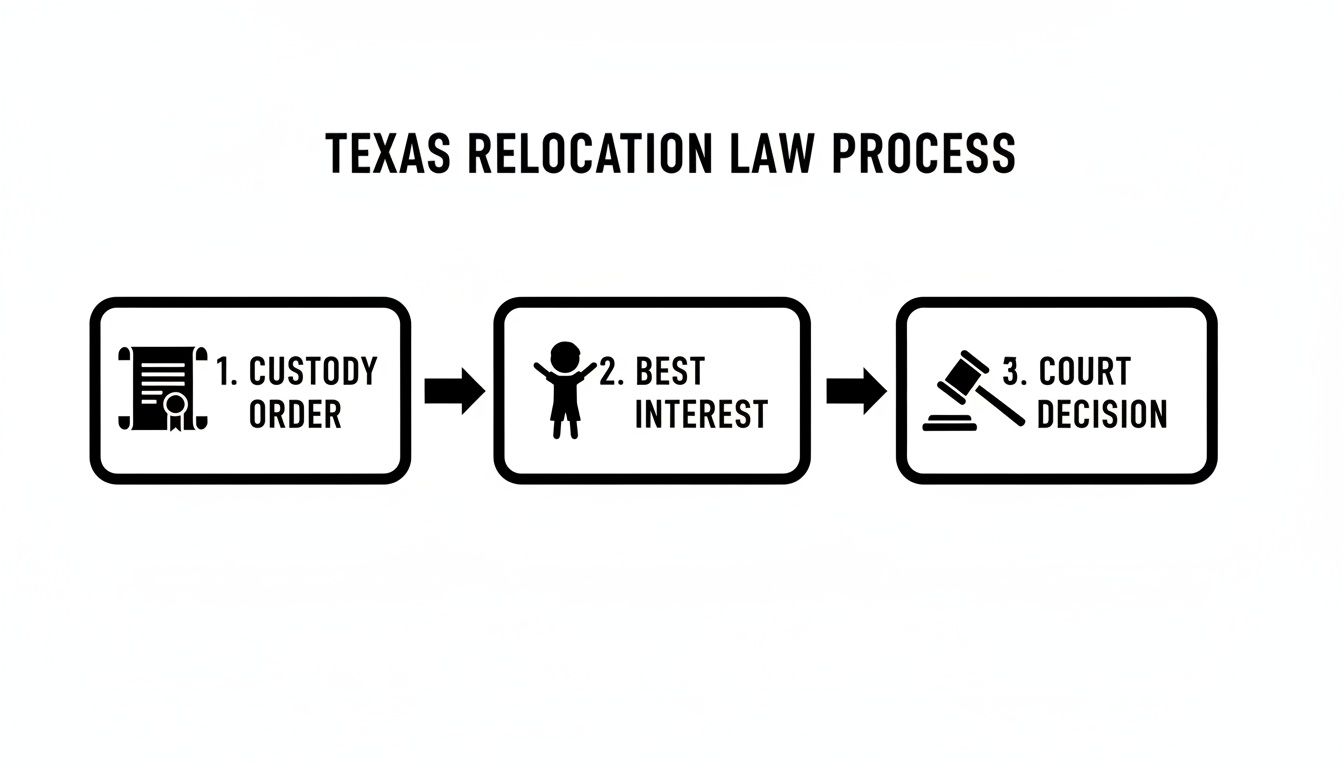
As you can see, everything flows from your existing custody order and moves toward the court's final ruling. That ruling is always centered on what’s best for the child, which is why the evidence you gather is so critical.
If You Are the Parent Requesting the Move
If you're the one asking to relocate, your mission is to prove that the move will tangibly improve your child's life. It’s not enough to say you found a better job or want a change of scenery. You have to connect the dots for the judge and show exactly how this move benefits your child.
Your evidence needs to tell a compelling story about the new opportunities. Consider focusing on these areas:
- Economic Stability: Don't just mention a new job. Present the formal offer letter with the new salary, benefits, and schedule. Explain how this financial boost will directly improve your child’s quality of life—better housing, more resources, less financial stress at home.
- Educational Opportunities: Research the schools in the new city. Come prepared with school ratings, unique programs, or extracurricular activities that are a step up from what’s available in Humble ISD or Atascocita. Show the judge you’ve done your homework.
- Family Support System: Are you moving closer to grandparents, aunts, and uncles who will be an active part of your child’s life? Get affidavits or even live testimony from these family members to demonstrate the strength of that support network.
- A New Possession Schedule: This is crucial. You must propose a detailed, realistic long-distance possession schedule. Show the court exactly how the other parent can and will maintain a strong, frequent, and loving relationship with the child.
A Harris County judge needs to see a well-thought-out plan, not just a wish. A vague desire for a "fresh start" won't fly. You have to prove, with evidence, that this move is a significant net positive for your child.
If You Are the Parent Opposing the Move
As the parent fighting the move, your job is to demonstrate the harm this relocation would cause. You need to show the judge that uprooting your child would disrupt the stability they need and that maintaining the current situation is in their best interest.
Your case should be built on the strength of your child’s current life right here in the Atascocita area. Focus on:
- Community and School Ties: Your child isn't just a name on a school roster. Show their life. Gather report cards, awards, letters from beloved teachers, photos with lifelong friends, and proof of their involvement in local sports or activities.
- The Parent-Child Relationship: This is the heart of your case. Your bond is a critical piece of evidence. Create a log of your communication (texts and calls), a journal detailing your daily involvement (from homework help to soccer practice), and photos that illustrate the strength and consistency of your relationship.
- The Negative Impact of Distance: Make it concrete. Explain how you won't be able to attend a last-minute parent-teacher conference at their elementary school or cheer them on at a game at Turner Stadium. Show how distance would fundamentally damage your ability to be an involved, day-to-day parent.
- The Child’s Wishes: In Texas, if a child is 12 or older, the judge can interview them to understand their preference. While it’s not the only factor, a mature child's clear desire to stay can be incredibly persuasive.
To give you a clearer idea of how to organize your thoughts, here’s a look at the kind of evidence both sides should be gathering.
Evidence Checklist for Your Relocation Case
| Evidence Type | For the Relocating Parent (Proving Benefit) | For the Opposing Parent (Proving Detriment) |
|---|---|---|
| Financial/Employment | Formal job offer letter, salary details, proof of better cost of living in the new location. | Evidence of your stable employment and financial contribution to the child's life in the current location. |
| Educational | School district ratings, specific academic/extracurricular program details, acceptance letters. | Report cards, teacher letters, awards, and proof of your involvement in the child's current school (PTA, etc.). |
| Family & Community | Affidavits/testimony from family in the new location, photos of the new home and neighborhood. | Photos with local friends/family, proof of membership in community groups (church, sports, clubs). |
| Parent-Child Bond | A detailed, workable long-distance possession schedule, plans for travel, and communication tech. | Communication logs (texts/calls), journals of daily activities, photos showing your consistent involvement. |
| Child's Wellbeing | Expert reports (if applicable) suggesting the move would be positive. Information on better medical care. | Evidence of the child thriving in their current environment. Testimony about the child's anxiety or opposition to the move. |
This checklist is a starting point. Every case is unique, and the most powerful evidence will be specific to your family's circumstances.
Putting together this level of detail is a massive undertaking, and how you present it matters. For more general advice on getting ready for any custody proceeding, you can learn more about how to prepare for your custody hearing in our guide.
Ultimately, whether you're trying to prove a benefit or a detriment, your evidence must be organized, clear, and compelling. This is where having an experienced Atascocita custody lawyer by your side can make all the difference. We help you find the story in the facts and tell it in a way that protects your child and your rights.
What To Do When The Other Parent Moves With Your Child Without Permission
That gut-wrenching moment you find out the other parent has taken your child and moved away without your permission—or the court's—is a nightmare. For any parent, but especially for those of us here in the Atascocita area, it feels like the ultimate betrayal of trust and a direct violation of your rights. And it is.
The good news is that Texas law is not on their side. You have strong, immediate legal options to protect your relationship with your child, but you absolutely have to act fast.
When a parent ignores a geographic restriction in your custody order, they are breaking the law. There’s no gray area here. They are in direct violation of a judge's order, and the longer you wait to respond, the more complicated it can become to bring your child home.
Your First Moves in a Legal Emergency
The very first thing you need to do is call an attorney who handles custody disputes in Harris County. This isn't a DIY situation. With your lawyer's help, you can take decisive action, starting with filing a Suit to Enforce the Possession Order. This is the formal legal document that tells the court your ex has violated the order.
At the same time, your lawyer will almost certainly file for a Temporary Restraining Order (TRO). Think of a TRO as an emergency brake. It’s a powerful court order that can force the other parent to return the child to Harris County immediately, stopping them from setting up a new home and school life for your child while the legal process unfolds.
The Consequences for a Parent Who Breaks the Rules
Let us be clear: Harris County judges take this very seriously. A parent who just decides to up and move, ignoring a court order, is going to face a very unhappy judge. The fallout for them can be severe and can permanently damage their own custody rights.
The parent who moved could be looking at:
- Contempt of Court: This isn't just a slap on the wrist. It can mean heavy fines, being ordered to pay all of your attorney’s fees, and in the most serious cases, even jail time for disobeying the court.
- Losing Custody Rights: A judge is likely to see this unilateral move as proof that the parent doesn't care about fostering your relationship with your child. This can be grounds for stripping them of their right to be the "primary" parent who decides where the child lives.
- Flipping the Custody Order: The court has the power to completely reverse the roles, making you the primary parent and drastically cutting back the other parent's time with the child.
When a parent moves without permission, they’re telling the court that their own desires are more important than the law and, most importantly, the child's need for both parents. Judges see this for what it is—an act that is not in the child's best interest—and the legal consequences are designed to reflect that.
Relocation battles are on the rise across Texas, and our Harris County courts are handling thousands of these cases annually. A huge number of them stem from one parent moving without authorization. In communities like Atascocita and Humble, we see it all the time—breaking a geographic restriction often ends with a contempt charge and can lead to the court naming the parent who stayed behind as the sole managing conservator. Discover more insights about how Texas courts handle these violations.
If you're facing this terrifying scenario, do not wait another day. Your time with your child is what's at stake. Calling a lawyer is the single most critical step you can take to enforce your rights and get your child back home safely and quickly.
What a Relocation Dispute Lawyer in Atascocita Actually Does for You

When your relationship with your child is on the line, trying to navigate a custody relocation case by yourself is a huge gamble. These disputes are deeply personal, emotionally taxing, and tangled in complex legal rules. The real value of an experienced custody relocation dispute lawyer in Atascocita isn't just having someone to speak for you in court; it's about having a strategic partner protecting you and your child every step of the way.
Think of an attorney as your guide and your shield through this process. We manage the complicated legal work—from filing the right petitions to meeting every strict deadline—so you can stay focused on your child. Just as importantly, we offer the objective, clear-headed advice you need when anxiety and uncertainty are running high. We’re here to be that steady hand.
Building a Winning Case Strategy
Success in a relocation case doesn’t happen by accident. It requires a solid, well-thought-out plan. At The Law Office of Bryan Fagan, we start by mapping out a strategy based on the unique facts of your life. This means digging into the details to build a story that makes sense to a Harris County judge.
We guide you in finding and organizing the evidence that will make the biggest impact. This often includes:
- Compiling text messages, emails, and other communication logs to show clear patterns.
- Finding credible expert witnesses, like a child psychologist, if their testimony can help.
- Presenting financial documents, school records, and other papers in a clear, persuasive way.
Our job is to take the raw facts and shape them into a compelling legal argument. We know what local judges are looking for and how to present your case effectively, making sure no crucial detail gets missed.
Finding Solutions Through Negotiation and Mediation
Many parents assume a relocation dispute is a one-way ticket to a long, ugly court battle. While we are always ready to fight for you at trial, a huge part of our work is finding more peaceful and practical solutions first.
In Harris County, mediation is a standard step in most family law cases. It’s a confidential meeting where you, the other parent, and a neutral mediator work to find a solution you can both live with, outside of the courtroom.
Having a skilled lawyer by your side during mediation is a game-changer. We champion your interests, help you weigh potential compromises, and make sure any final agreement is fair, enforceable, and protects your rights. A successful mediation can save you thousands of dollars and, more importantly, reduce the emotional strain on your entire family.
Understanding the Financial Investment
The cost of hiring a lawyer is a real and valid concern. For a relocation dispute in Atascocita, most child custody lawyers in Texas charge an hourly rate. The total cost can range from a few thousand dollars for a straightforward agreement to significantly more for a contested battle that involves custody evaluations or crosses state lines. Recent Harris County court data shows a large number of custody modifications are triggered by relocation attempts. The Law Office of Bryan Fagan has seen that parents without legal help face a much higher risk of an unfavorable outcome, especially in cases involving an unauthorized move. You can discover more about how attorneys approach these complex custody evaluations on our blog.
Try to see legal representation not as an expense, but as an investment in your family's future. The potential cost of a poorly handled case—losing significant time with your child, getting stuck with an unworkable custody order, or facing years of return trips to court—is far higher. We believe in being completely transparent about our fees and providing exceptional value. Here, you’re not just a case number; you’re our neighbor in the Atascocita community, and we are committed to fighting for the best possible future for you and your child.
Your Next Steps with The Law Office of Bryan Fagan
You’ve just absorbed a lot of information about one of the toughest challenges a parent can face: a potential relocation. It’s normal to feel overwhelmed, but the goal of this guide is to replace that uncertainty with a clear plan. You now have the foundational knowledge, and the next step is to apply it to your specific situation. You don't have to do that alone.
At The Law Office of Bryan Fagan, we're your neighbors. Our team lives and works right here in the Atascocita and Humble communities. This means we don’t just understand the law; we understand the local Harris County courts, the judges, and what it takes to build a case that resonates here. Our focus is on protecting your family with practical, effective legal support.
How to Schedule Your Free Consultation
Getting sound legal advice shouldn't be another source of stress. We've made the process of getting in touch as easy as possible because we know your plate is already full. Here is our step-by-step process for getting you the help you need:
- Call or Message Us Online: When you're ready, reach out. You'll connect with a member of our team who is prepared to listen, understand the basics of your situation, and schedule your free, confidential consultation at our Atascocita office.
- Meet with Our Team: This meeting is all about you. It's your opportunity to explain what's happening, ask all your questions, and get a feel for how our local team can support you.
- Get a Clear Assessment: We’ll give you our honest, straightforward opinion on your case. We'll walk you through your rights and start outlining a strategy that makes sense for you and your child.
Think of this first consultation as a conversation, not a sales pitch. Our goal is for you to walk away feeling heard, informed, and supported. It’s about giving you real information so you can make empowered decisions for your family.
A relocation case is heavy, both emotionally and legally. Carrying that weight by yourself is a massive burden. Our dedicated team is here to share that load, fighting to protect your relationship with your child and work toward a stable future.
Let our local Atascocita attorneys give you the support and experienced representation you need. Schedule a free, no-obligation consultation with us today and take the most important step toward finding a resolution. We're here and ready to help.
Frequently Asked Questions About Custody Relocation
When you’re thinking about moving or your ex is planning a move with your child, the questions can feel overwhelming. Here in Atascocita, we get a lot of the same questions from parents just trying to figure out their next steps. Let's walk through some of the most common ones with clear, plain-English answers.
How Far Can I Move Without the Court's Permission in Texas?
This is the big one, and the answer surprises most people. Texas law doesn't set a specific mileage limit. There is no automatic "50-mile rule" or anything similar.
Instead, the answer is found in your specific custody order. Nearly every Texas custody decree includes a geographic restriction, which names the specific area where your child is supposed to live. This is often defined as Harris County and any county that touches it (contiguous counties). If you want to move outside that specific zone—even to a neighboring county not on the list—you need permission. That means getting a formal, written agreement from the other parent or getting a new order from the court.
What if My Ex-Spouse Is Moving for a Military Deployment?
Military moves are handled differently. While the court's top priority is always the "best interest of the child," Texas law has specific protections for service members who are deployed.
Federal laws like the Servicemembers Civil Relief Act (SCRA) work alongside the Texas Family Code to ensure a parent isn't permanently punished for serving their country. A judge can't use a deployment against you to strip your custody rights. These cases are delicate, and it’s critical to have a custody relocation dispute lawyer in Atascocita who knows the unique rules for military families to get the temporary orders right.
How Long Does a Relocation Case Typically Take in Harris County?
This really depends on one thing: whether the parents agree. If you're on the same page, your attorney can draft an agreed order, and a judge can often sign off on it within a few weeks. It's a relatively fast process.
A contested case, however, is a different story. If you can't agree and have to fight it out in court, you're looking at a much longer timeline. A disputed relocation that goes all the way to a final trial at the Harris County Family Law Center can easily take several months, and sometimes more than a year, depending on the court’s schedule and how complicated the situation is.
The most important thing to remember is that time is not on your side. Waiting to get legal advice can make your case much harder. Acting quickly almost always leads to a better, more efficient outcome.
Can We Agree to a Move Without Going to Court?
Yes, and courts encourage parents to work together. But a simple text message or a verbal "okay" is completely unenforceable and offers you zero legal protection.
To make an agreement stick, it must be put into a formal legal document, like a Mediated Settlement Agreement or an Agreed Order Modifying the Parent-Child Relationship. This document then has to be signed by a judge. Without that judge's signature, your old custody order is still in effect, and you could be hauled back to court for violating it.
Every family's situation is different, and the stakes are always high when your children are involved. You shouldn't have to guess about your rights or the best way forward. The team at The Law Office of Bryan Fagan – Atascocita TX Lawyers is here to give you clear answers and fight for your family.
Schedule a free, no-obligation consultation with us or call us today to get the help you need.


