Skip to content
When your child may be in danger, you don't have the luxury of calmly researching family law for a week. Parents in Atascocita and Humble often start searching for emergency custody without lawyer texas atascocita late at night, after a frightening call, a missed exchange, a violent incident, or a message that makes their stomach drop.
The hard truth is that Texas courts reserve emergency custody for urgent child-safety situations. The good news is that if the danger is real and you present it correctly, Harris County courts can act fast. The challenge for a self-represented parent isn't just being right. It's proving the emergency in the form the court expects.
Determining If Your Situation is a True Emergency
Fear can be legitimate and still not meet the court's emergency standard. That distinction matters. If you file an emergency request based on conflict that isn't legally urgent, the court may deny it, and you may hurt your credibility for the next hearing.
Texas treats emergency custody as a tool for immediate child protection, not as a shortcut around the normal custody process. Under Texas law, temporary emergency jurisdiction may apply when a child is present in Texas and has been abandoned or needs protection from mistreatment, abuse, or neglect, and emergency removal is commonly tied to imminent danger to the child's physical health or safety, as discussed in this Texas emergency custody jurisdiction guide. Courts expect sworn affidavits and supporting proof, not accusations.

What usually looks like an emergency
Judges are looking for facts that show a child needs protection now. In practice, the strongest emergency filings usually involve recent and specific danger.
- Physical abuse or recent violence: Injuries, assault, family violence in the home, or threats tied to actual conduct.
- Serious neglect: A child left without supervision, food, necessary medical care, or safe housing.
- Substance abuse tied to child safety: Not just suspicion, but facts showing impairment affected parenting or put the child at risk.
- Abduction risk: Credible signs the other parent may hide the child, flee, or refuse to return the child in violation of existing orders.
- Abandonment: A child left without appropriate care.
A judge doesn't need a dramatic speech. A judge needs a clean timeline and credible proof.
Practical rule: If your facts would make a reasonable person say, "a child could be harmed before the normal hearing process runs," you may be in emergency territory.
What usually does not qualify
A lot of painful custody problems aren't emergency-custody problems. That doesn't mean they aren't serious. It means they usually belong in a standard temporary-orders request, enforcement action, or modification case.
Here are common examples that often don't justify emergency relief by themselves:
| Situation | Likely court view |
|---|---|
| The other parent is rude, manipulative, or difficult | Usually not enough without child-safety facts |
| Frequent lateness at exchanges | Frustrating, but not usually an emergency |
| Different parenting styles | Not an emergency by itself |
| New boyfriend or girlfriend you dislike | Not enough without actual danger |
| Verbal arguments between parents | Usually not enough unless tied to threats or violence affecting the child |
That line is hard for parents because everyday custody conflict can feel overwhelming. But Harris County courts separate bad co-parenting from immediate danger.
Ask yourself these questions before filing
If you're thinking about going to the courthouse without a lawyer, slow down long enough to answer these questions:
- What happened most recently? Emergency requests need current facts, not just a long history of conflict.
- How does this put the child in immediate danger? The connection must be direct.
- What proof do I already have? Police reports, photos, texts, records, witness names.
- What order am I asking for? Temporary possession, no unsupervised contact, supervised visitation, exchange restrictions, or another narrow protective measure.
For many parents, a standard custody filing is the better legal route. If you're unsure where your facts fit, this guide on getting custody fast before a court date in Texas can help you compare emergency relief with other fast-moving options.
Emergency custody isn't for proving the other parent is difficult. It's for showing the child needs immediate protection before the regular court process can safely play out.
Gathering Essential Evidence for Harris County Courts
A Harris County judge can only act on what you can prove. In emergency custody cases, proof beats outrage every time.
Parents often come in with screenshots scattered across a phone, a vague sense of dates, and a strong feeling that something is wrong. That feeling may be valid. But the court needs an organized record that shows what happened, when it happened, who saw it, and why the child needs protection now.
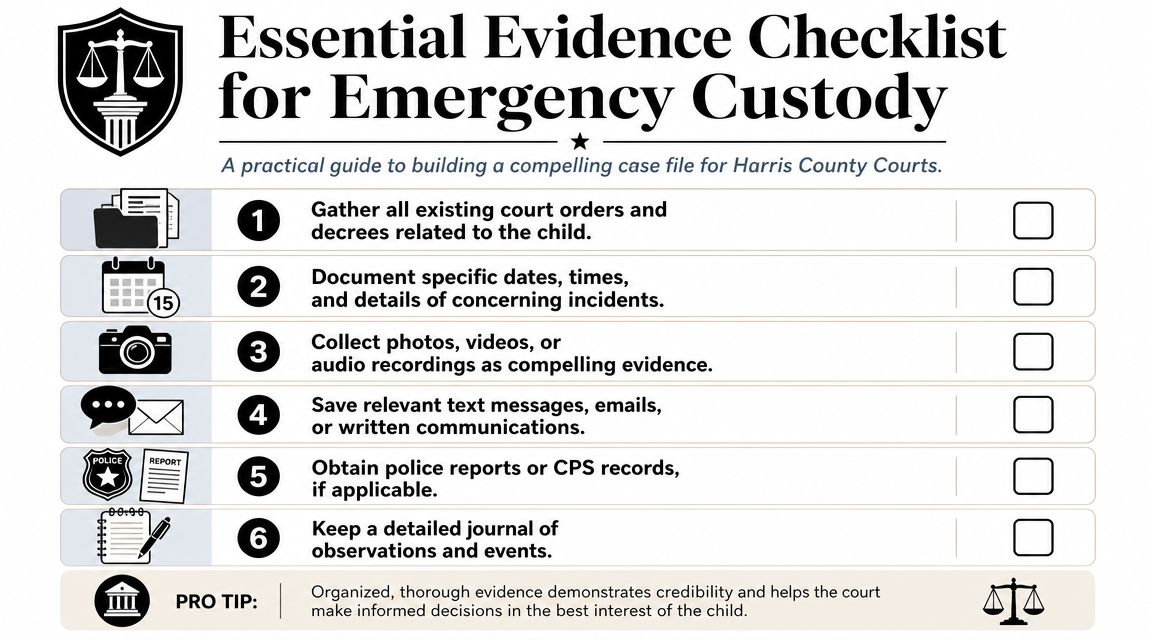
Harris County judges look for proof of immediate danger and may review affidavits, police reports, medical records, photos, CPS documentation, or texts, as explained in these emergency custody order tips for Harris County practice. One of the biggest problems in pro se filings is that parents bring evidence of conflict, but not evidence of emergency.
Build a court packet, not a pile of papers
Think like you're handing your case to a stranger who knows nothing about your family. Your packet should make the problem understandable in minutes.
Start with these core items:
- Existing court orders: Bring any divorce decree, SAPCR order, modification order, or protective order involving the child.
- Incident log: Write out dates, times, locations, and what happened. Keep it factual.
- Screenshots and messages: Save texts, call logs, emails, and social media posts that directly relate to danger or refusal to return the child.
- Photos and videos: Use only material you can identify and explain.
- Agency records: Police reports, CPS paperwork, medical discharge papers, or school communications if they relate to the safety issue.
- Witness list: Include people with firsthand knowledge, not people who only heard your version later.
What makes evidence persuasive
Judges tend to trust evidence that is specific, recent, and tied to the child. "He's unstable" is a conclusion. "On Tuesday at exchange, he arrived slurring, could not stand steady, and Humble PD was called" is a fact pattern.
Use this checklist when deciding what to include:
| Evidence type | Why it helps |
|---|---|
| Police report information | Shows an outside agency was involved |
| Medical records | Connects injury or treatment to a documented event |
| Photos | Helps the court see conditions or injuries |
| Text messages | Captures threats, admissions, or refusal to return the child |
| Witness statements | Supports what happened from another person's perspective |
| Your affidavit | Tells the judge the full story under oath |
Bring fewer strong documents rather than a thick stack of irrelevant material. Volume doesn't create urgency. Specificity does.
Write your affidavit like a timeline
Your affidavit is often the heart of the emergency request. It should read like a clear report, not a venting session.
A useful format looks like this:
- Identify yourself and the child.
- State the existing custody status, if any.
- Describe the most recent dangerous event first.
- Add short background facts only if they help explain the current risk.
- Explain why the child faces immediate danger if the court doesn't act.
- State exactly what temporary relief you're requesting.
Keep your sentences plain. Use names, dates, places, and direct quotations only when necessary. Avoid guessing about motives unless you have facts to support the conclusion.
For parents trying to preserve voicemails, recorded interviews, or difficult audio, a practical resource on choosing transcription for legal firms can help you think through how to turn spoken material into something easier to review and organize. That doesn't replace legal advice or evidence rules, but it can help you prepare cleaner documentation.
What to bring to the courthouse
Before leaving Atascocita or Humble for downtown, make sure you have:
- Multiple copies of everything: One for filing, one for your use, and one to organize for service or hearing prep.
- Government identification: You'll want it for courthouse logistics and notary needs.
- A proposed order: If you're asking for a TRO or specific restrictions, draft them clearly.
- A notary plan: Your affidavit usually needs to be sworn properly.
- A calm summary: Be ready to explain the case in a few sentences.
If you're missing one key item, don't assume the clerk or the judge will fix it for you. In emergency filings, missing paperwork often means lost time.
Navigating the Filing Process at the Courthouse
You can have real safety concerns and still lose time at the courthouse if the filing is not set up correctly. In Harris County, judges usually want to see a proper case on file before they consider emergency relief. For a parent coming in from Atascocita or Humble, that procedural step matters as much as the story you need to tell.
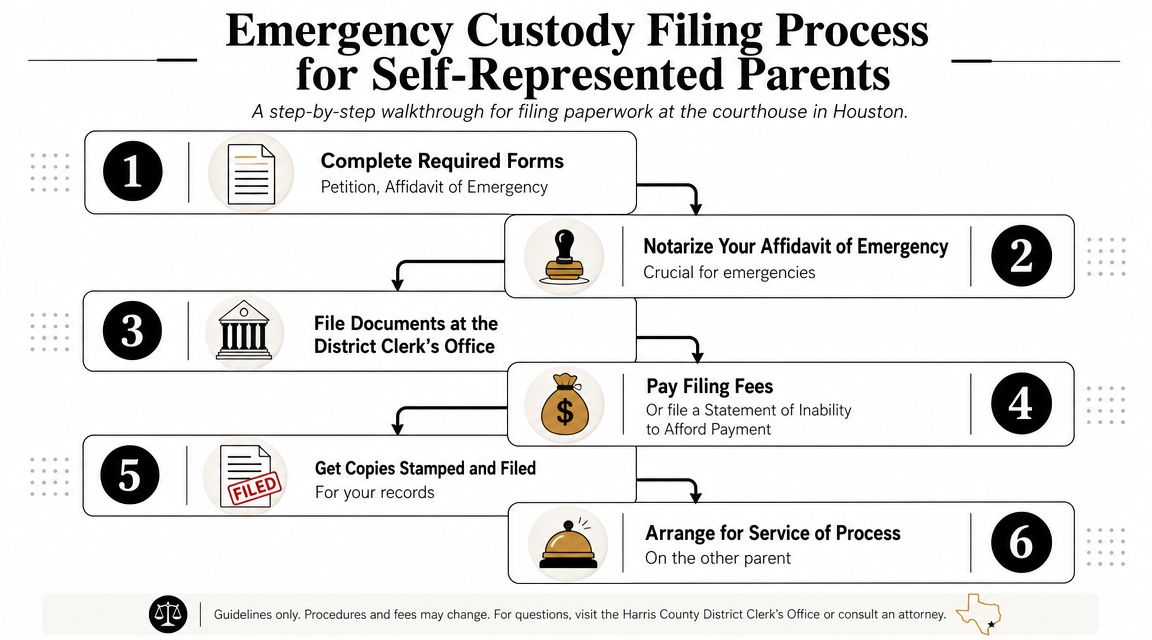
A common mistake is showing up ready to explain the danger, but filing only part of what the court needs. The usual pro se sequence is to open the underlying family-law case first, then file a sworn affidavit and a request for emergency relief. This Texas emergency custody filing workflow gives a general outline, but local practice still controls how smoothly your papers move through clerk intake and to a judge.
Start with the right underlying case
Emergency custody requests usually sit inside a larger case. In Harris County, that is often one of three case types:
- Divorce if married parents are separating
- SAPCR if parents were never married and need custody orders
- Modification if there is already a custody order and the facts have changed in a dangerous way
If you file an emergency request without the case it belongs to, the clerk may accept papers that do not put you in a position to get relief quickly. That is a painful mistake when a child may need protection now.
Build a filing packet the court can use
A workable packet usually includes more than one form. The judge needs a file that is organized, sworn, and specific enough to sign.
| Document | Purpose |
|---|---|
| Underlying petition | Opens the custody case |
| Sworn affidavit | Gives the facts under oath |
| Request for TRO or temporary orders | Asks for immediate protective relief |
| Proposed order | Gives the judge clear language to sign |
| Civil filing documents required by the clerk | Completes intake requirements |
The proposed order matters more than many parents expect. If your affidavit describes a danger during exchanges, but your proposed order asks for broad control over every issue, the mismatch hurts credibility. Judges are more receptive to targeted requests tied to the risk in front of them.
Write for a judge, not for an argument
At the courthouse, emotionally charged accusations usually weaken an emergency filing. Clear facts work better.
State what happened, when it happened, how it affected the child, and what temporary protection you want right now. Short background facts are fine if they explain the current risk, but the filing should stay focused on present danger.
For example, "temporary sole custody because the other parent is unstable" is too vague to do much work. A request for temporary exclusive possession, supervised visitation, or a pickup restriction based on a recent assault, intoxication during possession, or refusal to return the child gives the court something concrete to evaluate. If you need a clearer picture of how urgent requests differ from ordinary temporary relief, this overview of temporary custody orders in Texas is a useful reference.
A short video can also help you visualize the process before you head downtown.
Harris County courthouse realities
Parents in Atascocita and Humble are usually dealing with a trip downtown, security lines, clerk counters, and time pressure all at once. Plan for that. Bring organized copies, carry your ID, and assume no one in the building will fix a missing document for you.
A few practical points come up again and again:
- Your affidavit must be sworn properly. If it is unsigned or not notarized when required, the court may treat your facts as unsupported.
- Your request must stay narrow. Emergency orders are for child safety. They are not a way to punish the other parent.
- Your documents must match each other. The affidavit, petition, and proposed order should tell the same story and ask for the same type of relief.
- Service still matters. If the court sets a return hearing, proper service on the other parent is usually part of keeping the case on track.
Some parents use self-help forms and file on their own. Some pay for limited-scope review before filing. Some hire a lawyer only for the emergency stage because that is where mistakes cost the most. Law Office of Bryan Fagan – Atascocita TX Lawyers handles family-law matters in this area, including custody and emergency requests.
Filing habits that cause delay
Certain problems show up over and over in self-filed emergency cases:
- Long statements with no dates
- Stacks of texts with no explanation
- No proposed order
- No sworn affidavit
- Requests based on fairness instead of safety
- Waiting so long that the court questions whether the danger is immediate
Good emergency paperwork is usually concise. It gives the court a clear timeline, a sworn factual basis, and a narrow order the judge can sign without guessing what you mean.
What to Expect at Your Emergency Court Hearings
The hearing room feels very different from your kitchen table. What seems obvious at home may sound incomplete in court if you don't present it clearly.
Texas emergency custody matters can move fast. In true emergencies, a judge may sign a TRO within 1 to 2 business days, sometimes the same day, an ex parte hearing can happen within 24 to 48 hours, and a follow-up hearing is often set within about 14 days, according to this Texas emergency petition timeline overview. Those short timelines exist because courts are trying to protect children quickly while still giving both sides a chance to be heard.
The ex parte hearing
At the first stage, the judge is not deciding the entire custody case. The judge is deciding whether immediate temporary protection is justified before the other parent can respond in full.
That hearing is usually short. Expect the judge to focus on a few points:
- What happened most recently
- Why the danger is immediate
- What proof supports your statement
- What order you want signed right now
Your job is to be factual and brief. If the judge asks, "Why is this an emergency?" you need a direct answer tied to the child's safety.
Say what happened, when it happened, and what the child needs today. Save side issues and old relationship grievances for another setting.
The follow-up hearing
The second hearing often matters more than parents expect. By then, the other parent may appear, deny your allegations, bring their own documents, and challenge your credibility.
A common courtroom pattern looks like this: one parent arrives believing the emergency filing already proved the case, while the other side arrives ready to fight every detail. That's why you should treat the second hearing as a full preparation event, not a formality.
Use this simple comparison:
| Hearing stage | Main purpose |
|---|---|
| Ex parte stage | Immediate short-term protection |
| Follow-up hearing | Broader review with both sides present |
Bring your organized evidence again. Bring your timeline. Bring witness information if allowed and relevant. Most of all, keep returning to the child's safety, not your frustration with the other parent.
How to speak in the courtroom
Parents who do best in emergency hearings usually share one habit. They stay grounded.
That means:
- Answering only the question asked
- Avoiding interruptions
- Referring to documents clearly
- Not arguing with the other parent directly
- Not exaggerating facts you can't prove
If you're nervous about how to present yourself, this guide on how to prepare for a custody hearing is worth reviewing before your court date.
The judge doesn't need to know everything that has gone wrong in the relationship. The judge needs enough reliable information to protect the child and manage the case responsibly.
If the judge denies ex parte relief, don't assume the court thinks your concerns are fake. It may mean the court sees the matter as serious but better suited for a standard temporary-orders setting with notice to both sides. That still leaves room for protective orders, modified possession terms, or expedited hearings, depending on the facts.
The Realities and Risks of Representing Yourself
Parents often ask whether they can file without a lawyer. The answer is usually yes. The harder question is whether they should.
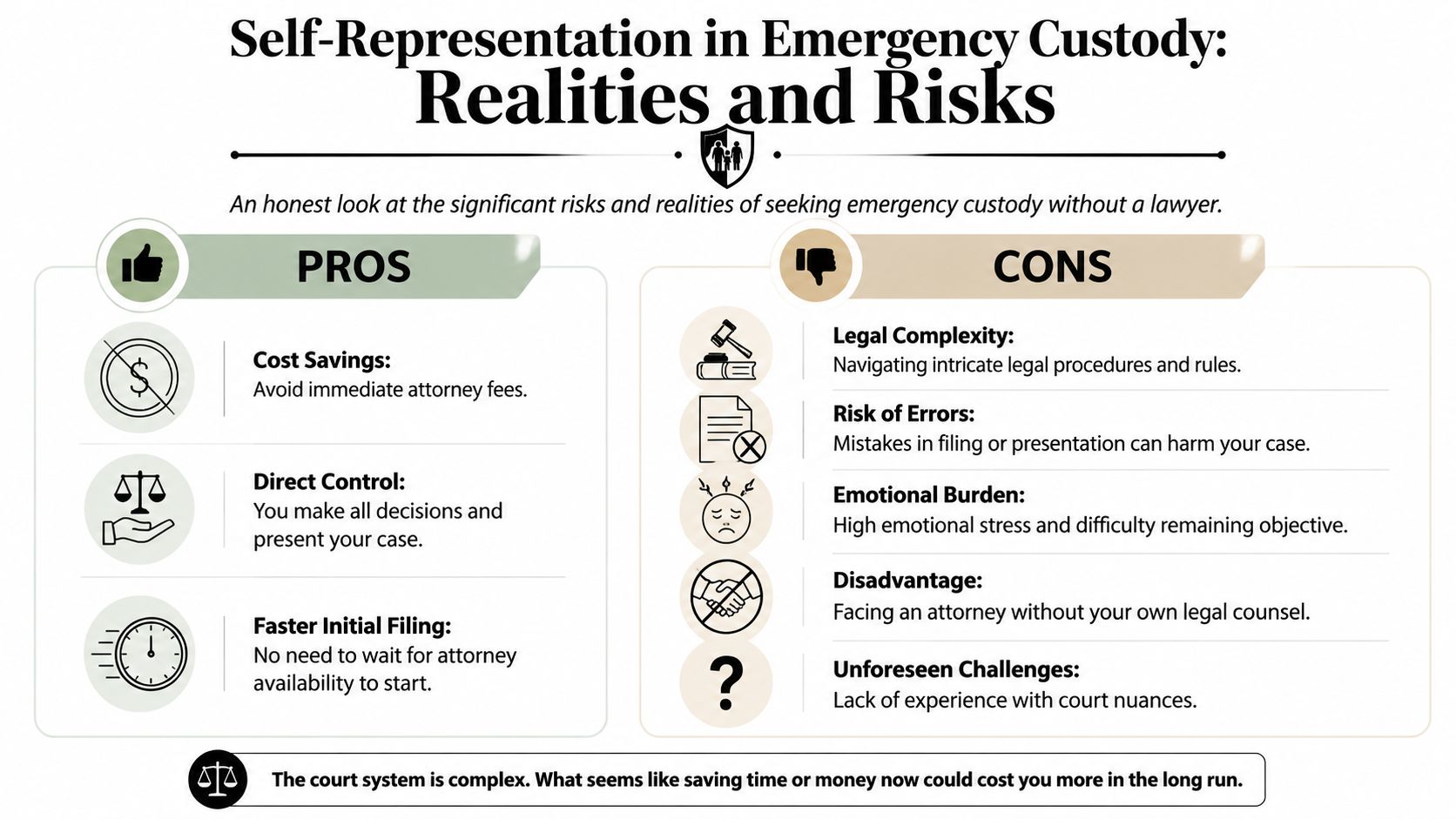
In a true crisis, self-representation can feel like the only realistic option. You may need immediate action, you may feel shut out, or you may not know who to call. But emergency custody cases are unforgiving. A small procedural mistake can undercut a legitimate safety concern.
The main risk is not just paperwork
It's often assumed the biggest danger is filling out a form incorrectly. That is a risk, but it isn't the only one.
Self-represented parents also struggle with:
- Choosing the right legal vehicle: Emergency request, modification, enforcement, or standard temporary orders.
- Asking for usable relief: Courts respond better to targeted protections than broad punishment requests.
- Separating proof from suspicion: Strong feelings don't substitute for admissible, organized evidence.
- Managing courtroom pressure: It's hard to stay calm when the subject is your child.
A lot of parents also underestimate how quickly credibility can erode. If you overstate one allegation, include claims you can't support, or present old conflict as a current emergency, the judge may become cautious about everything else you say.
The other side may have counsel
The gap quickly widens. A represented parent may challenge service, object to hearsay, point out missing pleadings, argue jurisdiction, or frame your filing as strategic rather than protective.
That doesn't mean a self-represented parent can't succeed. It means you need to recognize the uneven ground. Family court is still a rules-based system, even when the subject matter is emotional.
You can be telling the truth and still lose ground if you present the truth in the wrong procedural form.
Interstate and relocation cases are especially dangerous
One of the most misunderstood situations is when the child is outside Texas, the family recently moved, or another state may already be involved. In those cases, the legal path can depend on whether Texas is the child's home state, whether another state has an existing order, and whether the request is indeed protective, as noted in this discussion of emergency custody and out-of-state complications. Self-represented parents face serious risk when they file the wrong emergency petition in these jurisdiction-heavy cases.
Here is what can go wrong:
| Problem | Why it matters |
|---|---|
| Child is outside Texas | The court's power may be limited |
| Another state has an order | Texas may need to defer or coordinate |
| Recent move | Jurisdiction may be disputed |
| Parent files in panic | Wrong filing can waste critical time |
These cases are not impossible, but they are poor candidates for guessing. A parent who files the wrong case may lose precious time while the child remains in an unstable situation.
When getting legal help makes practical sense
If any of the following are true, legal help becomes much more than a convenience:
- There is family violence or a serious safety event
- The other parent has a lawyer
- There is already a custody order
- The child may be moved across state lines
- You aren't sure whether your facts fit an emergency standard
- You need immediate courtroom advocacy, not just form help
There is no shame in starting on your own and then deciding the case needs counsel. That is often the smart move. Emergency custody without lawyer texas atascocita searches usually begin because a parent is scared. Fear is understandable. Filing strategically is still necessary.
Protecting Your Child and Your Rights in Atascocita
When a child may be at risk, hesitation can be costly. So can rushing into the wrong filing. The safest path is the one that matches the facts, uses credible proof, and asks the court for focused protection.
For families in Atascocita, Humble, and northeast Harris County, the practical lesson is simple. Emergency custody is available for real danger, but the court expects disciplined preparation. You need facts, documents, a sworn statement, and a clear request that puts child safety first.
Emergency orders are also temporary by design. They can create immediate stability, but they don't end the larger custody case. A parent who files successfully still needs to prepare for the next hearing, the larger evidence fight, and the long-term plan for the child.
If you're facing that decision tonight or this week, trust your instincts about safety, but test them against the legal standard before you file. If the situation is urgent, act quickly and carefully. If it isn't an emergency under Texas law, there may still be a strong path through temporary orders, modification, or another protective remedy.
If you're dealing with a child-safety crisis in Atascocita, Humble, or nearby Harris County communities, schedule a free consultation with Law Office of Bryan Fagan – Atascocita TX Lawyers. We can help you understand whether your case calls for emergency action, what paperwork the court will expect, and how to protect both your child and your rights.