Skip to content
Your phone buzzes. It's the school. Or a neighbor. Or your child. Something happened, and your first thought isn't legal strategy. It's simple: how do I protect my child today?
That's usually when parents in Atascocita, Humble, and northeast Harris County start searching for how to get custody fast before court date texas atascocita. They want the court to act now, not weeks from now. They want someone to explain the actual process without legal fog, false promises, or scare tactics.
If that's where you are, take a breath. Texas courts can move quickly in the right case, but fast relief usually doesn't mean skipping court entirely or getting a final custody result overnight. It usually means asking for emergency temporary protection first, then preparing immediately for the next hearing. If you need help with that process, this overview of an emergency custody order attorney in Atascocita is a useful starting point.
A Parent's Guide to Emergency Child Custody in Atascocita
A parent in Atascocita finds out the other parent is driving with the child after drinking. Another parent in Humble learns the child has been left alone again. A mother in northeast Harris County sees bruising, gets vague answers, and realizes she can't just wait for the next scheduled hearing. These are the moments when ordinary custody disputes stop feeling ordinary.
In that situation, most parents ask the same question in different words. Can I get custody before the court date? Can a judge do something now? Can I keep my child safe tonight?
Sometimes, yes. But the answer depends on what kind of danger exists, how well it can be shown on paper, and which court procedure fits the facts. That matters because Texas judges don't grant emergency relief just because co-parenting has broken down or because one parent is frustrated, late, dishonest, or difficult. Judges look for immediate safety concerns and credible proof.
A practical mindset helps: don't focus on “winning custody fast.” Focus on showing the court why your child needs protection right now, and why your request is narrow, credible, and supported.
For many families in Atascocita, the right first move isn't a dramatic courtroom fight. It's a disciplined emergency filing, backed by records, sworn facts, and a plan for the hearing that follows. That's where smart preparation changes the pace of a case.
Understanding the Legal Standard for Emergency Action
The court's first question isn't whether you're the better parent overall. The court asks whether immediate intervention is necessary.
That distinction is where many emergency filings succeed or fail. Texas courts treat emergency requests differently from standard custody disputes because emergency relief is meant for urgent protection, not for deciding every long-term parenting issue at once.

What counts as a real emergency
In plain English, a real emergency usually means facts suggesting the child faces immediate physical or emotional harm if the court doesn't act quickly.
That can include situations like these:
- Family violence or threats: A parent has become violent in front of the child, threatened abduction, or made credible threats of harm.
- Substance abuse tied to caregiving: The concern isn't just past use. It's current impairment while supervising or transporting the child.
- Serious neglect: The child is being left alone, exposed to dangerous people, or denied necessary care.
- Medical or safety crises: The child's condition is being ignored, hidden, or made worse by the current arrangement.
By contrast, many painful disputes are still not emergency cases. A parent being rude, missing exchanges, violating routine terms, or making bad co-parenting decisions may justify court action, but not necessarily ex parte emergency relief.
The difference between urgent and merely important
Think of it this way. An emergency filing tells the judge, “If the court waits, the child may be harmed before the other side can be heard in the usual way.” That is a high bar.
A standard temporary-orders request says something different. It says, “There's a serious dispute and the court needs to set rules soon.” Both matter. They just serve different purposes.
Courts in Texas weigh a difficult question in these cases: what evidence is strong enough in Harris County to justify ex parte relief, and when is it better to give notice and seek temporary orders instead? Guidance discussing emergency custody in Texas notes that speed matters, but overreaching can backfire if the facts look like a standard custody dispute rather than immediate harm. Courts want evidence quality that matches the urgency of the request, as discussed in Texas emergency custody guidance focused on ex parte relief and notice strategy.
That's why parents shouldn't assume “faster” always means “without notice.” Sometimes the stronger strategy is to give notice and ask for temporary orders on an accelerated basis. Judges often respond better to a request that fits the facts than to one that sounds more dramatic than the evidence supports.
Questions to ask yourself before filing
Use these questions:
- What happened, exactly? Dates, times, names, and locations matter.
- What is the immediate risk to the child? Not general concerns. Actual present danger.
- What proof exists right now? Messages, reports, photos, witnesses, records.
- What order are you asking for? Keep it tied to safety.
- Would a judge see this as urgent protection or a custody argument dressed up as an emergency?
A parent in Atascocita who answers those questions carefully is already in a stronger position than a parent who walks into court with broad accusations and no documentation.
What judges usually don't like
Some filings fail because they ask for too much. Others fail because they're vague.
A judge may narrow or deny emergency relief if the papers rely on conclusions instead of facts. “The other parent is unstable” is weak. “On Tuesday, the other parent sent texts saying he was too intoxicated to drive, then picked up the child anyway” is stronger because it is specific and testable.
Here's the practical rule. Urgency without proof is weak. Proof without urgency may belong in a regular temporary-orders hearing. The goal is to match the legal tool to the actual danger.
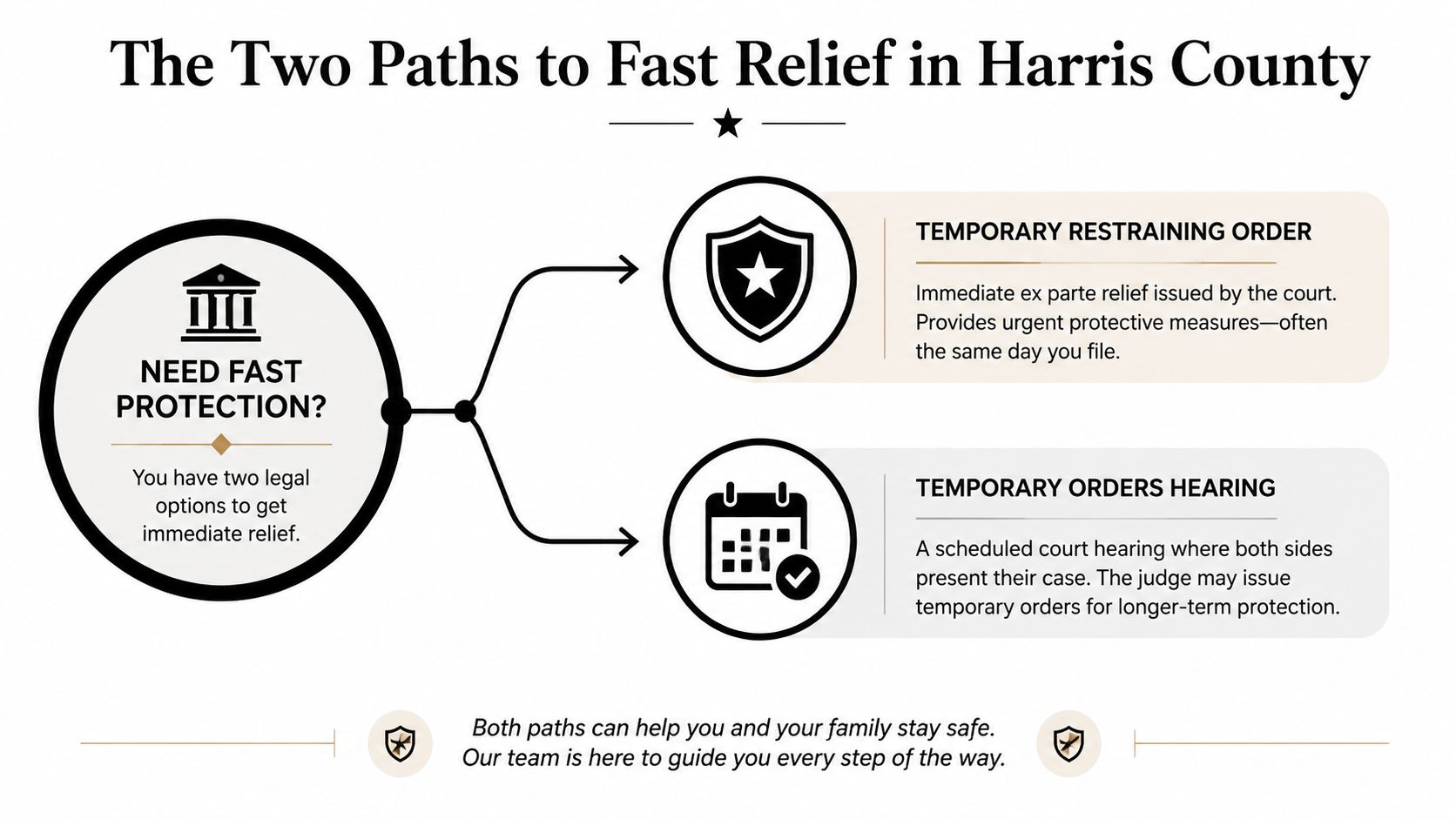
The Two Paths to Fast Relief in Harris County Courts
Parents usually think there is one emergency process. In practice, there are two strategic paths when you need custody-related relief quickly in Harris County.
One path is the ex parte route. The other is a noticed temporary-orders route. Each can be the right choice, depending on the facts.
Path one, ex parte emergency relief
“Ex parte” means the judge reviews the request without the other parent being present at that first stage. This is the fastest option when the danger is immediate and giving notice could increase the risk.
This route may fit facts like:
- Risk of flight: You believe the other parent may take the child and disappear.
- Immediate violence: There was a recent assault, threat, or dangerous incident.
- Active impairment: The child is with a caregiver who is currently unsafe.
- Immediate retaliation risk: Giving advance notice could trigger worse conduct.
This is often what people mean when they ask how to get custody fast before court date texas atascocita. They're asking whether a judge can do something before the ordinary hearing cycle plays out.
For Harris County parents, emergency custody often unfolds in two phases. Phase 1 is the ex parte hearing, where the judge decides whether immediate intervention is needed. Phase 2 is a full adversary hearing, typically within 14 days, where both sides present evidence. Guidance discussing emergency filings in Texas stresses that preparing for both phases at once matters because defects in the initial filing can cost you the temporary-relief window, as explained in this discussion of emergency custody filings and the two-phase hearing process.
Path two, temporary orders with notice
Sometimes the facts are serious, but not so immediate that an ex parte request is the best fit. In those cases, a parent may be better served by filing for temporary orders and moving for a prompt hearing with notice to the other side.
That path may be stronger when:
- The danger is concerning, but not unfolding by the hour.
- You have good evidence and want the court to hear a fuller version quickly.
- The emergency label may look exaggerated.
- The court is more likely to grant targeted relief after both sides are heard.
A noticed request can still move quickly. It also reduces the argument that you used emergency procedure to gain an unfair tactical advantage in an ordinary custody fight.
Side-by-side comparison
| Path | Best fit | Main strength | Main risk |
|---|---|---|---|
| Ex parte emergency request | Immediate harm, flight risk, urgent protection needs | Speed and immediate judicial review | Weak facts can make the filing look inflated |
| Temporary orders with notice | Serious dispute needing fast rules, but not secret intervention | More balanced presentation and often broader record | It may not move as fast as a true emergency filing |
The strongest emergency strategy is often the one that looks measured. Judges are more receptive when the request is tailored to the specific danger instead of trying to rewrite the entire custody arrangement in one motion.
What works and what doesn't
What works:
- A narrow request tied to safety.
- Papers that tell a clean, dated story.
- Relief that makes practical sense, such as temporary possession limits, supervised contact, or immediate return of the child.
What usually doesn't work:
- Turning old grievances into an “emergency.”
- Asking for sweeping conservatorship changes without a focused safety rationale.
- Filing first and gathering evidence later.
Parents in Atascocita often feel pressure to “do something now.” That instinct is understandable. But in Harris County court practice, the better question is usually, which fast path fits these facts best? Choosing the wrong path can waste time you don't have.
Gathering Evidence That a Harris County Judge Will Value
Emergency custody cases are won with specific, contemporaneous, corroborated evidence. Judges don't have time for a pile of suspicions. They need a short, credible record that shows what happened, when it happened, and why the child needs immediate protection.
That means your evidence should do two jobs at once. It should show urgency, and it should survive scrutiny when the other parent gets a chance to respond.

Start with records created by other people
The most persuasive evidence usually isn't a parent's opinion. It's a document made in the ordinary course of events by someone else.
For families in Atascocita, Humble, and greater Harris County, emergency custody requests often rely on police reports, medical records, photographs, CPS documentation, and sworn affidavits. Texas family-law guidance also notes that in many cases an attorney can get the materials drafted, filed, and presented to a judge within 24 to 48 hours when the evidence is ready, as discussed in this overview of emergency custody orders in Texas and the role of supporting records.
Here's how to think about the main categories:
- Police reports: Helpful when officers responded to violence, threats, welfare checks, or dangerous conduct.
- Medical records: Strong when they connect the child's condition to neglect, injury, or unsafe supervision.
- School or daycare reports: Useful when attendance, behavior, pickups, visible injuries, or caregiver conduct are documented.
- CPS records: Important when there has already been state involvement or a report tied to child safety.
Build a digital proof file the right way
Texts, emails, call logs, and social posts can be powerful, but only if they are preserved clearly.
Use screenshots that show dates, names, and the full exchange. Save messages in order. Don't crop out context unless you also keep the complete version. If there are voicemails, preserve them. If there are posts showing intoxication, threats, or unsafe behavior, capture the date and account details.
A lot of parents make digital evidence weaker by editing, annotating too much, or forwarding fragments that lose context. Keep originals whenever possible. If social posts are part of the problem, this discussion of how judges view social media in custody cases in Texas helps explain why presentation matters.
Save first, explain later. Your job is to preserve the record, not to rewrite it.
Use affidavits to fill the gaps
Judges often need more than attachments. They need a sworn affidavit that explains what the documents mean and why the timing matters.
A good affidavit is factual, not theatrical. It should identify the child, the relationship of the parties, the recent events, the immediate danger, and the exact relief requested. If a teacher, relative, neighbor, counselor, or other witness has direct knowledge, a separate sworn affidavit can add weight.
Good witness affidavits usually share three features:
- They are firsthand. “I saw,” “I heard,” “I observed.”
- They are dated and concrete. Not “things have been bad for months.”
- They stay in their lane. Witnesses should describe facts, not diagnose people.
Create a clean incident log
When events are unfolding quickly, memory gets messy. An incident log helps.
Your log should include:
- Date and time
- What happened
- Who was present
- What evidence exists
- What happened next
This doesn't replace official records. It helps organize them. It also helps your lawyer draft a petition that reads like a timeline instead of a scramble.
Evidence that often hurts more than helps
Some material makes parents feel prepared but doesn't persuade judges much.
Examples include:
- Long written arguments with no exhibits
- Character attacks from friends who didn't witness anything
- Old complaints unrelated to current risk
- Repetitive screenshots that bury the key facts
A Harris County judge is looking for a short chain of proof. Event. Record. Safety concern. Requested relief. If you can assemble that chain quickly, your request becomes easier to understand and harder to dismiss.
How to File Your Emergency Petition in Atascocita
A lot of parents call after a bad night and ask the same question: can I get in front of a judge today? In Harris County, sometimes yes. But speed usually depends on whether the paperwork is filed in the right case, in the right court, with a sworn affidavit that gives the judge a clear reason to act now.

Start with the correct case
Emergency relief does not stand alone. In most Atascocita custody emergencies, you need an underlying Suit Affecting the Parent-Child Relationship, or a filing tied to an existing parent-child case. If orders are already in place, the request usually belongs in that same Harris County court. Filing a new case when one already exists can cost you time you do not have.
The usual filing package includes:
- The SAPCR petition or modification pleading
- The request for emergency or temporary relief
- A sworn affidavit based on firsthand facts
- A proposed order the judge can sign
Parents often focus on the fear that brought them in. The court focuses on whether the filing gives it legal authority to act and enough specific facts to justify immediate action.
How the filing process usually works in Harris County
Most emergency custody filings for Atascocita parents go through eFileTexas. After the clerk accepts the filing, the practical issue becomes getting the emergency request in front of the assigned family court promptly. That step is not identical from court to court. Some Harris County courts want a call to the coordinator. Some require presentment steps. Some expect a proposed order in a particular format.
That is why filing is only part of the job.
A strong emergency packet is organized for a busy judge reading fast. Your affidavit should match your exhibits. Your proposed order should ask for relief the court can grant on short notice. If you are assembling paper copies for chambers, service, or a hurried hearing notebook, clean presentation matters more than many parents expect. Services like Camelot legal printing can help with readable exhibit sets, affidavits, and hearing binders when time is short.
What to do before you hit submit
I tell parents to slow down for ten minutes before filing so they do not lose two days fixing preventable mistakes.
Use this check:
- Confirm the correct court and county. If there is an existing order, review the caption and cause number.
- Make the affidavit specific. Name dates, times, places, and what happened.
- Match each exhibit to a fact in the affidavit. Judges should not have to guess why a screenshot or record matters.
- Ask for targeted relief. Temporary possession changes, no removal from the county, supervised exchanges, or law enforcement assistance are easier to evaluate than broad demands.
- Review names, birthdays, and addresses carefully. Small errors create real delay.
- Prepare for service and follow-up. A signed order is only the beginning of enforcement.
Ask for relief that fits the emergency
Parents sometimes file papers that read like a final trial brief. That usually does not help. An emergency petition should stay tight and practical. What danger exists right now? What order reduces that danger before the other side can be heard in full?
For many families, the immediate goal is not permanent custody that same day. It is a short-term order that protects the child, controls possession, and gets the case set quickly. If you want a broader explanation of how short-term relief fits into the larger case, this guide to temporary custody orders in Texas gives that background.
Here's a short walkthrough that helps many parents visualize the process before they file:
Filing mistakes that slow urgent cases down
In Harris County, delay often comes from avoidable filing problems, not from a lack of concern.
Common examples include:
- Filing in the wrong court
- Using an affidavit full of conclusions instead of facts
- Attaching too many exhibits without a clear order
- Requesting relief far broader than the emergency supports
- Failing to follow the assigned court's procedure after e-filing
- Assuming the clerk will put the papers directly in front of the judge
A family-law practice such as the Law Office of Bryan Fagan – Atascocita TX Lawyers handles SAPCR filings, temporary orders, and emergency custody requests for parents dealing with these issues in Harris County. Even if you file on your own, use the same standard. Give the court a clean, credible, fact-driven request that can be acted on quickly.
You Have the Order What Happens Now?
A judge signed the emergency order. Your next job is to protect that order from falling apart at the follow-up hearing.
In Harris County, emergency relief buys time, not certainty. The court moved quickly because the allegations suggested an immediate risk to the child. The other parent still gets a chance to respond, and judges often revisit the exact terms soon after the first order is signed. Parents who treat the order like a final win are often surprised by how much the next hearing matters.
The next hearing decides whether the protection holds
The period right after an emergency order is short. In many cases, the court sets a prompt hearing so both sides can be heard and the judge can decide whether to keep, adjust, or end the restrictions.
That hearing is often the point where the case either settles into a workable temporary structure or changes direction.
I tell parents the same thing every week. The emergency papers got the court's attention. They do not prove every point you will need once the other side appears and pushes back.
Use the time after the order like preparation time, not recovery time
Read the order carefully the day you get it. Then read it again.
Small details matter in Harris County courtrooms. Exchange locations, school pickup rights, who can contact the child, whether supervised possession applies, whether travel is restricted, and what law enforcement can or cannot do under the order all need to be understood before anyone makes a mistake. If a term is unclear, get that answered quickly. Confusion leads to violations, and violations hurt credibility fast.
Focus on a few practical jobs right away:
- Follow every term exactly: Do not hand the other side an argument that you ignored the court's instructions.
- Calendar every deadline and hearing date: Harris County dockets move quickly, and missing a date can undo good work.
- Collect the records you did not have on filing day: Medical records, school attendance records, counseling notes, police updates, and daycare incident reports often matter more at the follow-up hearing than they did at the emergency stage.
- Organize your evidence in order: Put events in timeline form so the judge can follow what happened without guessing.
- Prepare your testimony: Keep it factual, specific, and centered on the child's immediate safety and routine.
If your affidavit mentioned text messages, bring the full thread, not just screenshots of the worst line. If you referenced bruising, have the dated photos ready and know who took them. If a teacher or counselor observed a change in the child's behavior, find out whether that person can appear or provide records the court can consider.
Expect the other parent to attack urgency, motive, and credibility
The other side usually does not walk into court and admit the emergency was real. In Harris County, the common defense is more often that the problem was exaggerated, stale, taken out of context, or raised for strategic reasons during a custody fight.
Expect arguments like these:
- The situation was upsetting, but not an emergency
- The child was never in immediate danger
- Important context was left out
- You waited too long to file for this to be urgent
- The restrictions go further than the facts support
That is why disciplined testimony matters. A parent who sticks to dates, events, records, and observed effects on the child usually presents better than a parent who turns the hearing into a running list of every grievance in the relationship.
A useful structure is simple. What happened. When it happened. How you know. Why it put the child at risk. What narrow relief you are asking the court to keep in place.
Courtroom presentation affects how your facts are received
Judges hear emergency requests often. They know the difference between fear that is grounded in evidence and fear that is fueled by anger.
Keep your answers tight. Do not argue with the other parent while you are on the stand. Do not guess. Do not overstate. If you only know part of the story, say that. Honest limits can improve credibility. Exaggeration destroys it.
Bring clean, labeled exhibits. Put the strongest items first. If you hand the court a disorganized stack of papers, you create work for the judge at the exact moment you want the judge focused on the child.
One practical trade-off comes up often. Parents want to tell the whole history because the whole history feels important. Sometimes it is. But at an early hearing, the judge may care more about the recent event, the present risk, and whether the requested limits are reasonably tied to that risk. Long background testimony can bury your best point.
Be ready for the order to change
The follow-up hearing can end a few different ways. The judge may leave the emergency protections in place, rewrite them into more detailed temporary orders, add conditions such as supervised exchanges or communication rules, or dissolve the emergency relief if the proof falls short.
That does not mean the first order was pointless. It means the court is shifting from immediate triage to a more structured temporary plan.
For many Atascocita parents, that shift marks the true beginning of the custody case. The court starts looking beyond the immediate incident and asks harder questions about who is making sound decisions, who follows court orders, who supports the child's stability, and what arrangement can hold while the case continues.
Start building the longer case immediately
Once the immediate danger is addressed, your conduct matters every day. Keep communications calm. Save messages without baiting the other parent into new conflict. Maintain school, medical, and counseling routines. Stay off social media. Keep a dated log of new incidents, but do not turn the child into a witness-gathering project.
Parents often ask how to get custody fast before the court date. A better question after the order is signed is this: how do you keep emergency relief in place and build a record the court will trust two weeks from now, two months from now, and at final orders?
That usually comes down to discipline. Follow the order. Prepare for the next hearing. Bring proof, not conclusions.
The Law Office of Bryan Fagan – Atascocita TX Lawyers works with parents in Atascocita, Humble, and across Harris County on emergency custody filings, temporary orders, and the hearings that follow. Schedule a free consultation with the Atascocita office to review your facts, your evidence, and the fastest lawful step to protect your child.