Skip to content

You post a photo from dinner in Humble. Your child isn't in the picture. It feels harmless. Later, the other parent prints it, puts it next to a string of comments, tags, and messages, and argues that it proves bad judgment, poor priorities, or a lifestyle that doesn't fit what you told the court.
That's the part many parents in Atascocita miss. Social media doesn't enter a custody case as a single post. It enters as a story. The court looks at timing, tone, patterns, and whether your online life matches your sworn statements.
If you're worried about how judges view social media in custody cases texas atascocita, your concern is justified. Harris County family courts don't treat Facebook, Instagram, TikTok, Snapchat, text messages, or private DMs as background noise. Judges increasingly treat them as a direct window into your judgment, emotional control, honesty, and willingness to put your child first.
A lot of parents tell me the same thing. “My account is private.” “I deleted that already.” “It was just a joke.” In custody court, those are weak defenses. Privacy settings don't stop discovery. Deleting content can create its own problem. Jokes land badly when they involve drinking, anger, threats, or public fights with a co-parent.
The good news is that this is manageable if you act early and act smart. You don't need to panic. You do need to treat your digital life like potential evidence starting now.
Your Digital Life on Display in a Harris County Courtroom
A lot of parents in Atascocita learn this too late. They walk into a Harris County courtroom expecting questions about pickup times, school performance, and doctor visits. Then the other side pulls out screenshots from Instagram, Facebook, TikTok, texts, and private messages and uses them to challenge that parent's judgment.

That happens here. Harris County judges and associate judges see digital evidence all the time, and they do not treat it as side drama. They treat it as potential proof of how a parent acts outside the courtroom. Posts, photos, videos, comments, direct messages, stories, check-ins, tagged photos, group chats, texts, and even supposedly deleted material can all become part of the case.
Privacy settings do not solve this. Deleting a post usually does not solve it either.
What matters is the pattern your digital life creates. A single birthday photo from a restaurant in Humble may not hurt you. A string of late-night bar tags, angry posts about your co-parent, flirtatious messages during a standing possession dispute, or videos that contradict what you filed with the court can hurt you fast. In Harris County, credibility matters, and social media often gets used to attack it.
What judges are really looking for
Judges look for judgment.
They want to see whether you act like a parent who puts the child first, follows court orders, avoids unnecessary conflict, and tells the truth. Social media can support your credibility or tear it apart. If your online behavior suggests impulsive decisions, substance abuse, unmanaged anger, harassment, or poor boundaries, the court may view that as a parenting issue, not a private one.
The court also looks for consistency. If you tell the judge you avoid conflict, but your Facebook comments show repeated online fights, that inconsistency matters. If you claim you cannot co-parent, but your messages show you provoking arguments, that matters too. If your case involves a custody evaluation in Texas, expect your digital conduct to get even more attention.
Treat every post like it could end up printed, enlarged, and handed to the judge.
The local reality in Atascocita and Humble
Parents in Atascocita and Humble often assume local courts care only about testimony from teachers, counselors, and family members. Those witnesses matter. Your phone matters too.
Harris County family courts deal with high-conflict custody cases every day. Lawyers here know how to preserve screenshots, subpoena records, compare timestamps, and line up posts against school calendars, possession schedules, and sworn filings. That local practice point matters. The issue is not just what you posted. The issue is whether the timing and surrounding records let the other side turn it into a believable story about your parenting.
That is why I tell clients to run a digital audit before litigation gets ugly. Review your accounts, old posts, tagged photos, cloud backups, and message threads. Check what friends and relatives can still see and share. Save what helps you, stop creating new problems, and assume that anything “deleted” may still be recoverable through a device, an app archive, or a third party. In newer cases, parents also need to watch for AI-edited images, fake screenshots, and altered audio. Those issues are showing up more often, and you need to be ready to challenge them with real metadata and proper authentication.
Social media is not a side issue in a Harris County custody case. It is evidence waiting to be organized.
The Best Interest of the Child Standard in the Digital Age
You say you are a steady parent. Then the other side shows the judge a week of late-night posts, a nasty exchange with your co-parent, and photos that conflict with your version of events. In a Harris County custody case, that kind of mismatch hurts fast.
Texas law starts in one place. The child's best interest comes first. Under Texas Family Code §153.002, judges deciding conservatorship and possession focus on what best protects the child's safety, stability, emotional health, and long-term development. Social media matters because it can give the court a day-by-day record of judgment, impulse control, and co-parenting behavior.
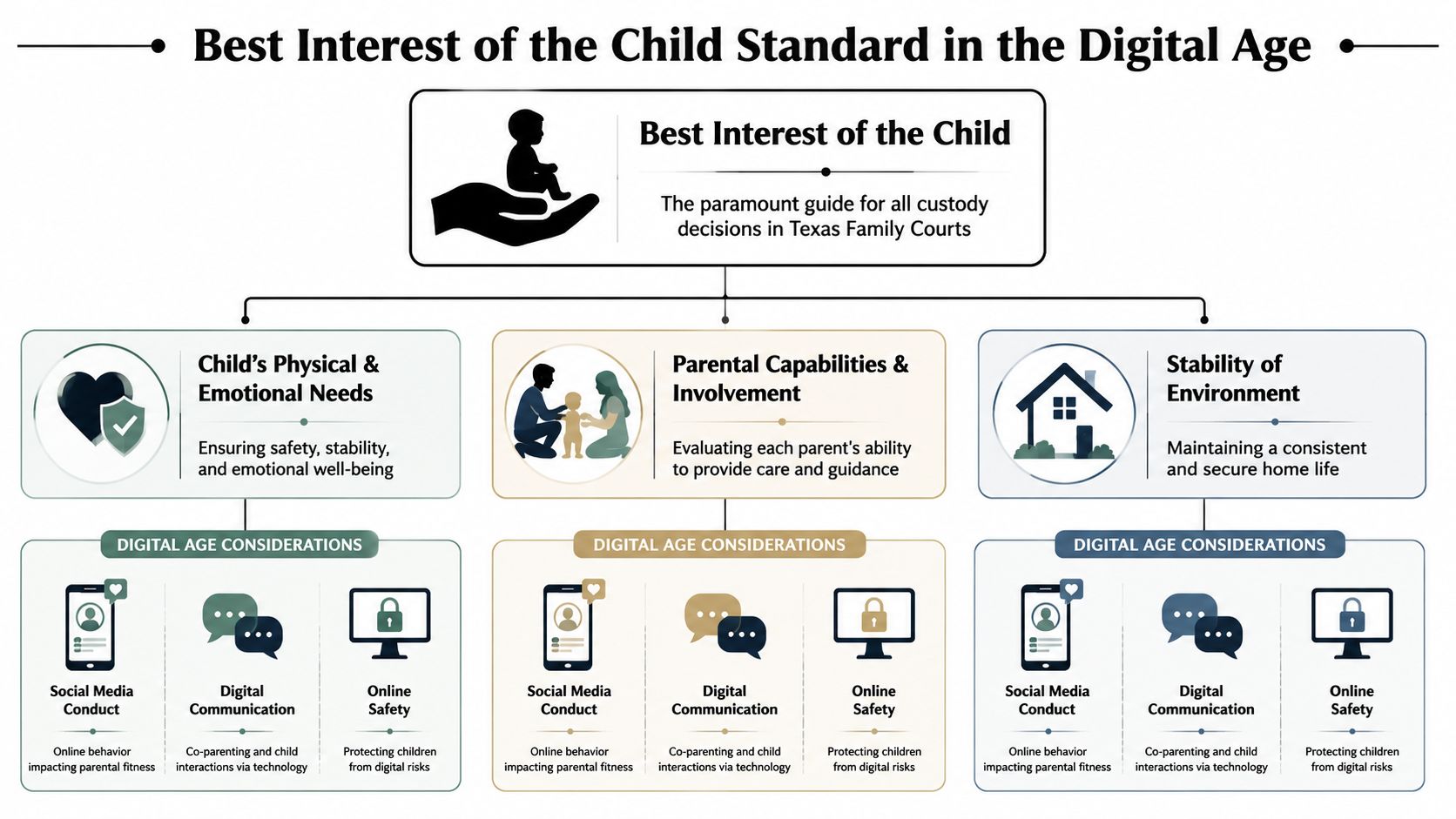
Judges in Harris County are not grading your personality. They are deciding whether your conduct supports a stable routine for your child. A post does not need to mention your son or daughter to become relevant. If it shows poor judgment, dishonesty, volatility, substance use, or a refusal to support the other parent's relationship with the child, it can fit squarely into the best-interest analysis.
How social media fits the legal test
In plain English, the court wants to know whether your online behavior matches the responsibilities of a parent asking for decision-making power or parenting time.
A judge may look at social media for signs of:
- Emotional control: angry rants, threats, harassment, or repeated online drama
- Judgment: posts showing risky behavior, intoxication, unsafe companions, or reckless choices
- Co-parenting: public insults, ridicule, or efforts to turn the child against the other parent
- Honesty: content that contradicts sworn statements, financial claims, work schedules, or possession facts
- Priorities: a pattern showing attention on conflict, partying, or image instead of the child's routine and needs
This is often where parents make a serious mistake. They assume a single post is the issue. The overarching problem is the pattern the other lawyer builds from many posts, messages, tags, and timestamps.
Judges look for conduct, not slogans
Every parent says, “I love my child.” That does not decide custody.
Courts look for behavior that shows patience, sound decisions, and a willingness to put the child first even during conflict. If your case involves a social study, investigation, or formal evaluation, learn what those professionals are examining. This guide on what a custody evaluation involves will help you understand how communication, consistency, and judgment are assessed.
Here is the practical rule I give clients in Atascocita. If your online content would make a reasonable stranger question your maturity or truthfulness, assume a Harris County judge may have the same reaction.
The digital version of “best interest” is broader than many parents realize
Years ago, custody cases leaned more heavily on live witnesses and paper records. Now the court may see location-tagged photos, direct messages, deleted-but-recovered content, shared videos, and altered media that requires authentication.
That matters in local practice. Harris County family courts regularly deal with electronic evidence, and lawyers who handle these cases know how to compare online activity against school schedules, exchanges, restraining order terms, and sworn filings. Newer disputes also involve fake screenshots, cloned voices, and manipulated images. Parents need to know that these issues can be tested through metadata, device records, and proper authentication. For a useful overview of those problems, see this discussion of digital forensics and AI fakes.
The point is simple. Your digital life can support your case or undercut it. If your posts show calm, consistency, and respect for your child's routine, that helps. If they show chaos, spite, or deception, do not expect the court to ignore them.
From Facebook Post to Courtroom Exhibit The Evidence Process
A parent in Atascocita posts a photo on Saturday night, deletes it on Sunday, and sits in a Harris County courtroom weeks later while the other side hands that post to the judge as an exhibit. I see versions of that problem all the time. The issue is not just what you posted. The issue is how quickly online content turns into evidence once a custody case starts.

Discovery is how your posts get pulled into the case
Texas custody cases give each side tools to demand relevant information. Lawyers call that discovery. In practice, it can reach social media posts, direct messages, account records, screenshots, texted images, and data stored on a phone or with the platform itself.
If your online activity relates to parenting time, honesty, substance use, spending, new relationships, or compliance with court orders, expect the other side to ask for it. Harris County judges do not treat a private account as off-limits if the content is relevant to the custody dispute.
Privacy settings help with strangers. They do not stop a discovery request.
Authentication decides whether the judge can rely on it
A screenshot alone is not enough. Under Texas Rule of Evidence 901, the party offering social media evidence must show the content is genuine and tied to the person who supposedly posted it.
Courts and lawyers usually look at several details together:
- Metadata: Dates, times, URLs, and device information
- Witness testimony: Someone with personal knowledge who can identify the account or message
- Context clues: Profile photos, usernames, reply chains, nicknames, and linked conversations
- Platform records: Material produced through subpoena or formal request
That is why fake or altered content can be challenged, but only if your lawyer handles it correctly. A useful plain-English resource on digital forensics and AI fakes explains why source data, metadata, and verification matter more now than ever.
The real evidence file is usually bigger than the screenshot
Parents tend to focus on the single post that looks bad. Lawyers look wider. They compare the post to school calendars, exchange times, sworn pleadings, bank activity, location data, and the rest of the message thread. A cropped image may become a full conversation. A deleted post may still exist in another parent's screenshots, a synced device, a cloud backup, or platform records.
This matters in Harris County because family courts regularly see electronic evidence fights. The side that organizes the digital record first usually has the advantage.
If you are getting ready for litigation, treat your online history the same way you treat your paperwork. This guide on how to prepare for a custody hearing should be part of that preparation, and your digital evidence needs to be reviewed early, not the night before court.
Here's a short video that helps illustrate how digital evidence gets used in Texas family law cases:
The mistakes that hurt parents most
Deletion is the first mistake. It often solves nothing and can create a new problem if the court thinks you were trying to hide evidence.
The second mistake is assuming context will fix everything. Sometimes it does. Often it does not. Judges do not like being asked to excuse a bad post because it was a joke, sarcasm, or “taken the wrong way.”
My advice is simple. Before the other side starts collecting your digital history, do your own audit. Save what helps you, identify what can be misread, stop posting about the case, and talk to your lawyer before you delete, edit, or respond to anything.
Content That Helps or Hurts Your Atascocita Custody Case
Not all online content carries the same weight. Judges usually care less about the platform and more about what the content suggests about your priorities, honesty, and ability to provide a safe environment for your child.
Texas courts view substance-abuse imagery, financial boasting that clashes with support claims, and especially rants about an ex-spouse very negatively. Courts may interpret those rants as parental alienation. Even a single photo of a child at an inappropriate party or posts introducing a new relationship too quickly can become ammunition, as explained in this discussion of when social media can hurt a Texas custody case.
Social Media Posts in the Eyes of a Judge
| Potentially Damaging Content (Red Flags) | Neutral or Potentially Helpful Content (Green Flags) |
|---|---|
| Photos or videos showing heavy drinking, drug use, or reckless behavior | Ordinary family-safe posts that don't expose the child to conflict or risk |
| Angry posts attacking your ex, mocking them, or inviting others to pile on | Respectful, restrained communication that doesn't discuss the case |
| Check-ins or nightlife posts during times you're supposed to be caring for your child | Community involvement, school events, or child-focused activities presented appropriately |
| Luxury purchases or vacations that contradict claims of financial hardship | Content that reflects a steady routine and a stable home life |
| Posts featuring the child in situations that look unsafe, inappropriate, or chaotic | Positive moments with your child that show involvement without oversharing |
| New romantic relationship posts that create instability concerns or expose the child too quickly | Neutral content unrelated to the case and free of drama |
| Tagged photos from friends that suggest partying, conflict, or unsafe company | Minimal posting and careful account management |
| Threats, crude jokes, or impulsive comments that suggest hostility | Silence. In many custody cases, the safest content is no content |
The content judges tend to punish hardest
Some posts are worse than others.
Hostility toward the other parent is one of the fastest ways to damage your case. Judges don't like seeing a parent use social media as a weapon. Public insults can suggest you're more interested in punishing your ex than protecting your child's relationship with both parents.
Financial contradiction is another problem. If you tell the court you can't afford support, therapy, or a parenting expense, but your feed shows trips, designer purchases, bottle service, or bragging about money, that contradiction can stick.
Then there's the “it was only one night” defense. Sometimes that's true. But one photo can still become persuasive if it fits a larger narrative of instability.
Judges look for patterns of sound judgment and a safe environment, not polished excuses after the fact.
What can actually help
Helpful content exists, but I'd be careful here. Parents sometimes try to manufacture a “good parent” image online, and judges can spot staged behavior.
Content is most useful when it appears natural and consistent with the rest of your life. Think calm, age-appropriate, child-focused, and conflict-free. A photo from a school function is usually different from a long caption about how the other parent never shows up. The first may reflect involvement. The second creates conflict.
If your case includes accusations that the other parent is poisoning the child's relationship with you, the issue may overlap with how to prove parental alienation. That's a separate legal issue, and online behavior can feed it from either side.
My blunt advice on posting
Don't try to out-post your custody problem.
Don't respond to attacks. Don't explain yourself online. Don't “subtweet” your ex. Don't use your child as proof that you're the better parent. Courts care far more about disciplined behavior than digital performance.
A Parent's Proactive Strategy for Social Media
Your custody dispute starts on Monday. On Saturday night, a friend tags you in photos from dinner in Humble, your sister posts a joke about your ex, and an old TikTok pops back up because someone shared it again. By the time you sit down in a Harris County courtroom, that digital mess can be Exhibit A.
Treat your online life like evidence now, before the other side does.
In Harris County family courts, social media problems usually come from patterns, timing, and contradictions. A single post may not decide a custody case. A string of posts that clashes with what you told the court can do real damage. That is why I tell Atascocita parents to stop treating social media as casual during a custody dispute. It is part of your case.
Start with a digital audit before the case gets ugly
A digital audit is a private review of everything that could surface later. Do it early. Do it carefully. Do not start deleting first and asking questions later.
Check every account you use or used recently. That includes Facebook, Instagram, TikTok, Snapchat, X, dating apps, YouTube, Venmo, parenting groups, and messaging apps. Then go beyond your own posts. Review tagged photos, old comments, shared albums, cloud backups, and anything a friend or new partner can post about you.
Use this checklist:
- List every platform and login. If you forgot an old account, the other side may find it before you do.
- Review your public-facing content. Look at bios, profile photos, captions, comments, likes, and tags.
- Flag risky material. Focus on anger, insults, substance use, explicit content, reckless behavior, spending that conflicts with your financial claims, and posts that undercut your parenting story.
- Preserve before changing anything. If a case is likely, your lawyer needs to know what exists before you remove or edit it.
- Tighten privacy and account security. Change passwords, turn on two-factor authentication, and limit tagging where you can.
- Warn your inner circle. Tell friends, relatives, and a new partner not to post about you, your child, or the case.
This step matters more in Atascocita than many parents realize. Harris County cases often move fast once temporary orders are on the table. If you wait until after service, after a hearing is set, or after accusations start flying, your options shrink.
During the case, go quiet and stay disciplined
Silence is usually the smartest social media strategy in a custody fight.
Do not post about your child, your schedule, your dating life, your money, your stress, your vacations, your health, or the other parent. Do not comment on other people's posts about those topics either. Private messages count too. So do jokes, memes, reactions, and disappearing content.
You also need to manage what other people post. A relative can create problems for you without meaning to. A birthday picture with alcohol on the table, a caption about "finally having freedom," or a new partner posting family-style photos too soon can all become evidence.
Tell people close to you exactly what you need. No tags. No custody commentary. No photos of your child without your approval.
Avoid the mistakes that make judges suspicious
Mass deletion after a dispute starts is a bad move. In court, that can raise spoliation issues. Judges do not like the appearance that a parent cleaned up evidence once the case became serious.
Switching to a different app is not a fix either. Snapchat, encrypted messaging, burner accounts, and private groups still create evidence trails. Deleted content may still be recoverable. That is one reason a pre-litigation audit is so useful. It gives you a chance to identify problems before panic sets in.
Do not play detective in reckless ways. Save public posts from the other parent if they matter. Send them to your lawyer. Skip fake profiles, bait messages, and online arguments. Those tactics often backfire.
If you are worried about fake images, recycled photos, or someone posting you out of context, tools for verifying image sources using PeopleFinder AI can help you sort out where a picture came from and whether it has been reused elsewhere online.
Make social media part of your legal strategy
The right approach is simple. Audit first. Preserve what exists. Tighten security. Stop posting. Get legal advice before making changes.
That advice is even more important if you expect a fight over temporary orders, primary residence, or decision-making rights. Those early stages often shape the entire case. If you need help with the full legal side of the dispute, review your options for child custody representation in Atascocita.
Emerging Digital Challenges in Harris County Family Courts
You walk into a temporary orders hearing in Harris County expecting a fight about schedules, school, and parenting time. Instead, the other side holds up a screenshot, a clipped audio file, and a short video that looks terrible. That is the situation now. Social media evidence is no longer limited to obvious Facebook posts.
Custody cases involving Atascocita and Humble parents increasingly raise problems with disappearing messages, edited screenshots, reposted content, and AI-made fakes. Judges and lawyers are dealing with a wider mix of digital proof, and you need to treat your entire online footprint like potential evidence.

Disappearing apps still create courtroom problems
Parents often assume Snapchat, Instagram Stories, and disappearing chats are safer because the content does not stay visible for long. That assumption causes damage. A recipient can screenshot it. A device can store part of it. A backup, synced account, or notification preview can preserve more than you expected.
In Harris County family cases, the practical question is simple. Can the other side show the judge something persuasive and tie it to you? If the answer is yes, the fact that an app labels content as temporary will not save you.
Private groups create the same risk. So do alternate accounts and shared message threads. If you sent it, received it, saved it, forwarded it, or reacted to it, talk to your lawyer before you assume it is gone or harmless.
AI fakes have changed the evidence fight
Edited screenshots used to be the main authenticity problem. Now parents also face altered audio, cloned voices, face-swapped videos, and fabricated text exchanges that look real at first glance.
That cuts both ways. False material can be used against you. Real material can also be challenged as fake. Both problems matter in custody litigation because a judge deciding conservatorship or possession needs reliable facts, not digital theater.
Harris County courts already have the usual tools for handling authenticity disputes. Lawyers can question who created the file, where it came from, how it was stored, whether metadata exists, whether a witness recognizes it, and whether the content matches other records such as texts, emails, timestamps, or device exports. In serious cases, an expert may be needed.
A smart parent asks better questions early
Do not limit your concern to your own posts. Ask broader, more useful questions.
- What content exists on any account connected to me?
- What has been tagged, reposted, or shared by other people?
- What files sit on old phones, cloud backups, tablets, or synced laptops?
- What material could be cropped, edited, or taken out of context?
- What suspicious content do I need to challenge before it gains traction?
That is why I advise Atascocita parents to do a digital audit before the case turns ugly. Review accounts, devices, cloud storage, and old message platforms with your lawyer. Preserve what matters. Flag what looks misleading. Identify what could require authentication if it shows up in a Harris County courtroom.
One more point. Panic makes people do foolish things. Do not start deleting, editing, or messaging others about cleaning up posts. In family court, the cover-up often becomes its own problem.
Frequently Asked Questions from Atascocita Parents
Are my private DMs and text messages safe
Usually, no. If the messages are relevant to custody issues, the court can order production during discovery. Private does not mean protected from a lawful request in a family case.
Can a post from years ago be used against me
Yes, if it still matters. Older posts can come in when they show a pattern, contradict your testimony, or help explain current concerns about judgment or stability. Age alone doesn't make a post irrelevant.
What if a friend tags me in a bad photo
That can still hurt you. Judges may not care who uploaded it if the image appears to show your conduct, your surroundings, or your choices. Untag yourself if appropriate, ask for removal, and tell your lawyer about it before the other side raises it first.
I already deleted my account. Am I in trouble
Not automatically. It depends on timing and what was deleted. If you shut down an account before litigation and before any duty to preserve evidence arose, the issue may be minor. If you deleted content after a case started or after you knew a dispute was coming, the court may view that more seriously.
Should I post positive parenting content to help my case
Usually, no. It often looks staged, and it can invite more scrutiny. Quiet consistency in real life helps more than online branding.
Can the other parent use fake screenshots against me
They can try. But fake or altered content can be challenged. Authentication matters, and courts can require enough proof to show a screenshot or video is genuine.
Should I confront the other parent online if they lie about me
No. That almost always backfires. Screenshot it, save the URL or identifying details if available, and give it to your lawyer. Public fighting makes both parents look worse, and sometimes the parent who “responded emotionally” ends up taking the bigger hit.
If you're worried about what your social media history could do to your custody case, get legal advice before you post again, delete anything, or respond to the other parent. The Law Office of Bryan Fagan – Atascocita TX Lawyers helps parents in Atascocita, Humble, and northeast Harris County protect their parental rights with practical, strategic guidance. Schedule a free consultation with the Atascocita office and get a clear plan for your custody case.