 Skip to content
If you're in Atascocita or Humble and your divorce suddenly doesn't add up, you're not imagining things. You may be looking at bank activity that feels off, a spouse who used to be casual about money but is now guarded, or a business owner spouse whose reported income no longer matches the way your family has been living.
That kind of suspicion is exhausting. It also creates a hard question: are you being overly cautious, or is your spouse trying to push income out of sight before the court divides property?
In many cases, that uneasy feeling starts with small things. A missing statement. A delayed bonus. A sudden claim that business is down, even though the trucks are still moving, clients are still calling, and the household lifestyle hasn't really changed. For many families in northeast Harris County, especially where one spouse is self-employed, works on commission, or handles cash, hidden income is one of the most contested parts of divorce.
Texas law gives you tools to deal with it. Significantly, Harris County courts are used to looking past surface-level numbers when the financial story doesn't make sense. If you've been searching for what if spouse hides income in divorce texas atascocita, the practical answer is this: act early, preserve documents, and treat your concern like a legal issue that can be proven, not just a personal grievance.
Navigating a Divorce When You Suspect Hidden Income in Atascocita
A common local scenario looks like this. A couple in Atascocita separates. One spouse has always handled the books, tax prep, online banking, and business accounts. During the marriage, money seemed available for home upgrades, travel, car payments, and kids' expenses. Once divorce begins, that same spouse suddenly says income has dropped, clients have slowed down, and there's not much to divide.
That change matters.
In Texas, most income earned during the marriage is generally treated as part of the community estate. If one spouse is trying to make that income appear smaller than it really is, the divorce can become unfair unless the issue is addressed head-on. That's why people often need more than general divorce advice. They need a strategy built for disputed finances, business records, and hidden cash flow. If that describes your situation, it helps to start with guidance from an Atascocita divorce lawyer who understands how these cases play out in Harris County.
What this often feels like on the ground
You may already be seeing signs such as:
- Income that changes at a convenient time. A spouse who always had steady earnings now claims a sudden downturn once divorce is filed.
- Financial access shrinking overnight. Passwords change, statements stop arriving, or you get told that certain accounts are "business only."
- A gap between reported income and real life. The paperwork says one thing, but spending, travel, equipment purchases, or property activity say something else.
You don't need absolute proof before talking to a lawyer. You need enough concern to start preserving records before they disappear.
In Atascocita-area cases, the most useful first move is usually calm documentation. Screenshots, copies of statements, tax returns, payment app histories, and business records often matter more than arguments about who's telling the truth.
Common Warning Signs Your Spouse May Be Hiding Income
Some spouses hide income dramatically. More often, they do it in ordinary-looking ways that only make sense once you line up the records. Texas family-law sources identify common red flags such as unexplained withdrawals from joint accounts, sudden large cash purchases, refusal to provide tax returns or bank statements, and new business ventures. Those same sources note that modern divorce litigation often relies on tracing bank statements, tax filings, and public records to expose concealment, as discussed in this Texas guide on hiding assets in divorce.

Red flags that deserve attention
- Frequent cash withdrawals. Cash is harder to trace than direct electronic spending. Repeated withdrawals without a clear household reason can signal money being diverted before division.
- Transfers to accounts you don't recognize. If money leaves a joint account and lands somewhere unfamiliar, that deserves follow-up. Hidden income cases often begin with tracing where transfers went.
- A sudden drop in reported income. This is especially important if your spouse earns commissions, controls a business, or can delay billing. Timing can be manipulated.
- Refusal to share routine documents. A spouse who won't provide tax returns, bank statements, or business records may be trying to control the financial narrative.
- Large purchases in cash. Big-ticket items bought outside normal banking channels can be a way to convert traceable funds into something less visible.
- New business activity. A side venture, a new LLC, or unexplained vendor payments may point to income streams not being disclosed.
Why these signs matter in a Texas divorce
Texas is a community property state. That means the court doesn't just care about whose name is on an account or which spouse handled the finances day to day. The court cares about whether community money was earned, moved, reduced, or concealed during the marriage.
A spouse's conduct also matters because patterns tell a story. One unusual withdrawal may mean nothing. A sequence of withdrawals, missing statements, reduced payroll, and unexplained business expenses may show intent.
Practical rule: Don't accuse first and investigate second. Quietly gather records, make a timeline, and look for patterns that can be verified.
What usually doesn't work
People often make two mistakes here.
First, they rely too heavily on intuition. Your instincts may be right, but courts decide property issues based on documents, testimony, and traceable financial facts.
Second, they focus only on a single account. Hidden income often shows up across several places at once. Tax returns, merchant processors, business software, payroll records, property records, and even payment apps can all reveal pieces of the same picture.
Understanding 'Fraud on the Community' in Texas Law
When a spouse hides income in a Texas divorce, the law doesn't treat it as a minor bookkeeping problem. Texas law treats concealment as part of fraud on the community. Under Texas Family Code Chapter 7, judges can reconstitute the estate, meaning they can estimate what the community property would have been without the concealment and divide the case based on that corrected value, as explained in this discussion of fraud on the community under Texas law.
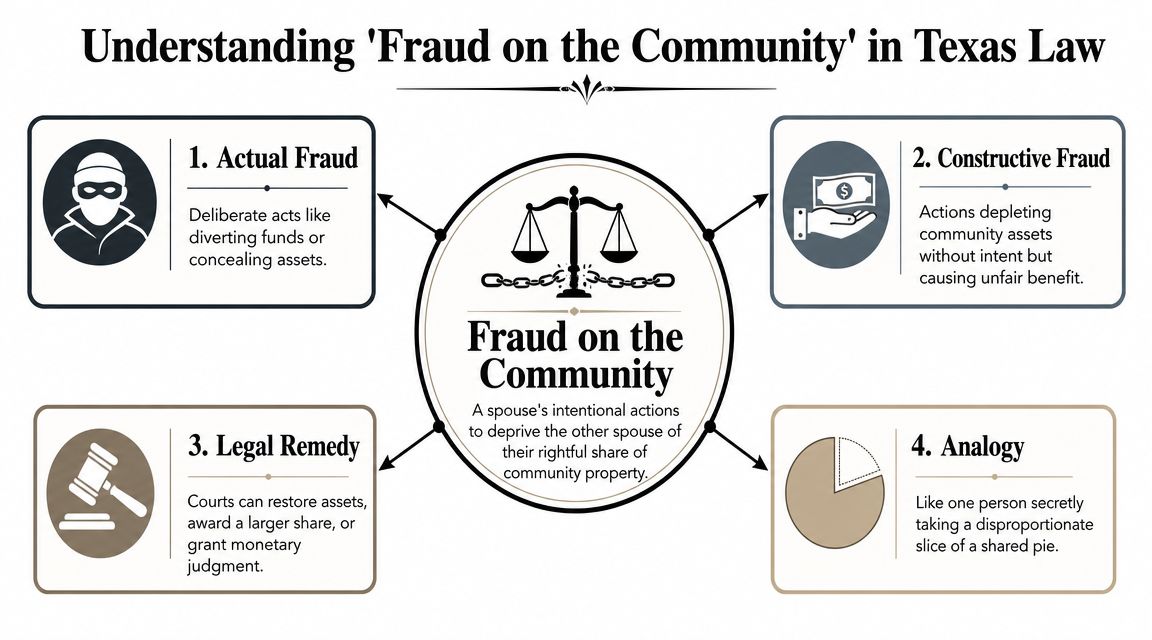
A simple way to think about it
Think of the marriage like a shared pie. If one spouse secretly removes slices before the pie is divided, the court doesn't have to accept the smaller pie as reality. The judge can look at what should have been there and divide from that corrected picture instead.
That matters in Atascocita divorce cases involving:
- Self-employed spouses
- Commission-based compensation
- Bonus structures
- Owner-operated businesses
- Cash-heavy work
What the court is really examining
The core issue is whether one spouse deprived the marital estate of value that should have been available for a fair division. That can happen through underreporting income, shifting money into another account, delaying receipt of funds, or disguising personal income as a business expense.
Texas courts divide community property in a just and right manner. That phrase matters because it gives judges room to respond when one spouse has not played fairly.
Why this legal concept helps the honest spouse
A lot of people worry that if they can't find every dollar, they can't win the issue. That's not how these cases always work. If the evidence shows concealment, the court has tools to correct the distortion rather than rewarding the spouse who hid money more effectively.
Hidden income doesn't become safe just because it was moved around. Courts can look at the larger pattern and correct the estate accordingly.
The practical takeaway is that fraud on the community gives the court a framework for fixing financial unfairness. It also changes how an attorney prepares the case. The goal isn't only to catch a lie. The goal is to show how the lie affected the community estate and why the property division should reflect that.
Your Legal Toolkit for Financial Discovery in a Divorce
Your spouse says business is slow, but the mortgage is current, the truck payment is paid, and cash keeps showing up for dinners, trips, or equipment. In Harris County, suspicions like that have to be turned into admissible proof. The cases that go well usually do not involve the most paperwork. They involve the right paperwork, requested early and tied to a clear theory of where the income went.
Discovery is the formal process for getting that proof. Done well, it pins down income sources, forces explanations under oath, and gets records from third parties before anything disappears. Done poorly, it burns time, runs up fees, and produces stacks of documents nobody can use.
The main tools and what they do
| Discovery Tool | What It Is | Best Used For | Example |
|---|---|---|---|
| Requests for Production | Formal requests for documents | Bank records, tax returns, QuickBooks files, contracts, ledgers | Asking for business statements and credit-card records tied to a spouse's company |
| Interrogatories | Written questions answered under oath | Locking in explanations and timelines | Asking a spouse to identify all accounts, income sources, and entities they control |
| Depositions | In-person sworn testimony | Testing credibility and getting detail beyond paperwork | Questioning a business-owner spouse about cash handling or vendor payments |
| Subpoenas | Orders directed to third parties | Getting records directly when voluntary disclosure is unlikely | Obtaining records from a bank, employer, PayPal, Square, or accountant |
How these tools work in real Harris County cases
Requests for Production usually carry the most weight at the start. They let your lawyer ask for specific categories of records instead of broad accusations. In an Atascocita case involving a self-employed spouse, that may include invoices, estimates, deposit slips, job calendars, merchant processor records, customer communications, and bookkeeping exports.
Interrogatories serve a different purpose. They force the other side to commit to details in writing. If a spouse swears there are no side jobs, no deferred commissions, no business cash, and no accounts outside the ones already disclosed, those answers become useful later when bank records or customer payments tell a different story.
Depositions are more expensive, so they should be used with a reason. I usually recommend them when the records are incomplete, the spouse controls a business, or the paper trail does not match the family's actual spending. Under questioning, people often give away the structure of the concealment even if they do not admit it directly. They explain who collects cash, how invoices are tracked, or why a relative's account was used for deposits.
Subpoenas are often what change the direction of a case. Banks, payroll companies, payment apps, accountants, and merchants may have cleaner records than the spouse you are divorcing. If income is being filtered through a business or paid outside normal payroll, third-party records can matter more than what appears on a tax return.
Choosing the right tool instead of asking for everything
Good discovery strategy depends on the type of income at issue.
If the problem is underreported wages, start with pay records, W-2s, tax returns, and bank deposits. If the problem involves a business owner or independent contractor, ask early for ledgers, account statements, invoices, customer lists, and bookkeeping files. If the spouse works heavily in cash, combine documents with sworn testimony and third-party subpoenas because cash cases rarely prove themselves through one record alone.
That trade-off matters. Broad discovery can look aggressive, but judges in Harris County usually respond better to requests that are specific, time-limited, and tied to a real issue in the case.
Organizing messy records can make or break the claim
A hidden-income case often turns on ordinary records that arrive in unusable form. PDFs are out of order. Statements are missing pages. Business and personal charges are mixed together. Someone has to sort that out before the evidence means anything.
Tools can help with that first layer of organization. In some cases, DigiParser AI for bank statements can help convert statement data into a format that is easier to review and compare before your attorney or expert traces the flow of money.
Preserve records before the case gets more hostile
One practical mistake I see often is waiting too long to save documents that are still easy to access. Download account statements. Save tax returns, 1099s, K-1s, pay stubs, bookkeeping reports, and account histories while they are still available. Screenshot transaction histories if necessary. If a spouse controls the business systems, records can become harder to get once the divorce turns openly adversarial.
If you suspect concealed income and need a more focused plan, this guide from an Atascocita hidden assets divorce lawyer explains how lawyers build those requests around business records and nontraditional income sources.
One more point matters here. Discovery is not only about proving what exists today. It also creates a record that may matter later if you learn after the divorce that income was hidden more extensively than anyone realized. Clear requests, sworn answers, and subpoenaed records can become very important if the fraud surfaces after the decree is signed.
Records clients often overlook
Useful evidence is often sitting in plain sight.
Venmo and Zelle histories, merchant processor deposits, fuel purchases, appointment calendars, mileage logs, text messages with customers, and bookkeeping exports can all help reconstruct income. A spouse may hide the headline number. Smaller records still show how money moved, who paid it, and when it was received.
Uncovering Hidden Income from a Business or Cash-Based Work
The hardest cases usually involve a spouse who controls how income is reported. W-2 employees can still hide compensation, but self-employed spouses, small-business owners, and cash workers have more room to blur the line between business revenue and personal income.
That doesn't mean the money can't be found. It means the investigation has to be smarter.
A Texas family-law source addressing hidden assets highlights several practical methods for proving hidden income in these cases: bank-deposit analysis, comparing lifestyle to reported income, subpoenaing merchant processors such as Square or PayPal, and reviewing QuickBooks files. It also notes that family courts often have to separate legitimate business expenses from personal spending disguised as business costs, as described in this Texas discussion of proving hidden business income.
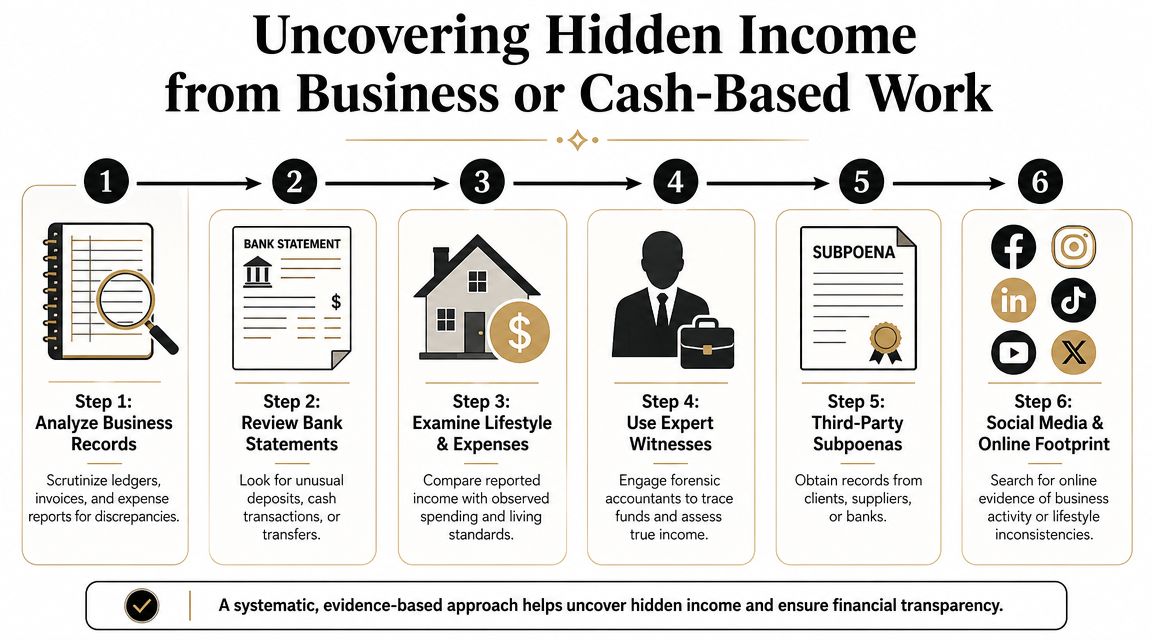
Where attorneys and experts usually look first
In Atascocita and Humble, common examples include contractors, trucking operators, home-service businesses, online sellers, real estate professionals, consultants, and anyone who gets paid through apps, transfers, or cash.
The first question is rarely "What did the tax return say?" The better first question is "Where did money flow?"
That often leads to:
- Business bank statements
- Merchant processor records
- QuickBooks or other accounting exports
- Customer invoices
- Deposit slips
- Credit-card processing summaries
- Loan applications
- Messages discussing jobs, billing, or collections
Bank-deposit analysis
Bank-deposit analysis is one of the most practical tools in a hidden-income case. If a spouse says income was low, but regular deposits tell a different story, the deposits may reveal actual cash flow better than a self-prepared profit-and-loss statement.
This method is especially useful when the spouse:
- Deposits customer payments inconsistently
- Mixes personal and business accounts
- Accepts multiple payment forms
- Reports losses while still showing regular incoming funds
Lifestyle comparison
Lifestyle comparison is straightforward and persuasive. If a spouse reports modest income but continues paying for vehicles, travel, private expenses, equipment, or frequent discretionary spending, the court may question whether the reported number reflects reality.
This doesn't mean every comfortable lifestyle proves hidden income. Some people borrow, receive family help, or spend irresponsibly. But when spending patterns line up with missing records, cash deposits, or vague explanations, the lifestyle evidence becomes more important.
If the books say one thing and daily life says another, both deserve scrutiny.
Business expenses that are really personal spending
One of the most common issues in owner-operated businesses is personal spending run through the business. That can include meals, fuel, travel, devices, subscriptions, vehicle costs, or household purchases labeled as business expenses.
The legal fight often isn't whether the business spent the money. It's whether the spending should reduce income for divorce purposes.
A spouse may say, "That's business revenue, not personal income." Sometimes that's true. Sometimes the business is paying personal costs that free up cash elsewhere. Courts often have to sort out that difference carefully.
When a forensic accountant helps
Not every case needs a forensic accountant. In lower-asset divorces, the cost may not make sense unless there's a clear trail and meaningful exposure. But in business-owner cases, a forensic accountant can be useful for:
- Tracing unexplained deposits
- Reviewing accounting software
- Reclassifying questionable expenses
- Comparing business activity to reported income
- Explaining patterns in a way the court can follow
If your divorce includes a closely held company, partnership interest, or disputed owner compensation, it may also help to understand how business valuation in an Atascocita divorce intersects with hidden-income claims.
What usually doesn't persuade the court
Two weak arguments show up often.
First, broad accusations with no records behind them. Judges hear emotional claims all the time. The cases that move the needle are the ones built on documents, testimony, and a clear theory of where the missing income went.
Second, assuming all business revenue equals spendable personal income. That's too simplistic. Some revenue must cover legitimate operating costs. The stronger argument identifies which expenses are genuine, which are inflated, and which are personal in disguise.
Legal and Financial Consequences for Hiding Assets in Harris County
Proving hidden income can change the outcome of a Harris County divorce in a meaningful way. A judge is not limited to adding the missing money back into the spreadsheet and moving on. Under Texas law, hiding community income or assets can support a finding of fraud on the community, which gives the court room to adjust the property division and address the misconduct directly.

What that can mean in practice
In Harris County, consequences usually depend on two things. How strong the proof is, and how much the concealment affected the overall case.
A judge may respond by awarding a disproportionate share of the community estate to the spouse who was kept in the dark. If community funds were diverted, the court may also order reimbursement or another form of monetary relief to address the loss. In cases where one spouse's dishonesty forced extra hearings, discovery fights, or expert work, attorney's fees and sanctions may also come into play.
Credibility matters too. A spouse who is caught hiding income from a cash business, skimming receipts, underreporting tips, or running personal expenses through a company often loses credibility on other disputed issues. That can affect property division, support arguments, and the judge's willingness to accept that spouse's version of events.
In more serious cases, there can be consequences outside the property division itself. False sworn testimony, disobeying court orders, or refusing to produce financial records can create contempt issues or other legal exposure, depending on what happened and when.
Why timing affects the result
Early action usually produces better evidence.
Bank records, payment app histories, QuickBooks files, invoices, mileage logs, point-of-sale reports, and tax documents are easier to get before records disappear, accounts change, or a business owner starts cleaning up the paper trail. That is especially true in self-employed and cash-heavy cases around Atascocita, where the dispute is often less about one hidden account and more about income that was never reported accurately in the first place.
Early proof also changes settlement posture. A spouse who knows the records exist and can be traced is often more realistic about resolving the case.
Here's a useful overview on how courts view these disputes in contested divorce cases:
Courts take financial misconduct seriously because it interferes with the court's ability to make a fair division in the first place.
The trade-off
Pursuing a hidden-income claim takes money, time, and focus. Sometimes that means formal discovery. Sometimes it means hiring a forensic accountant. Sometimes the honest answer is that the amount at stake does not justify a long fight.
But in a case involving self-employment, cash payments, side jobs, owner-controlled payroll, or disputed support, letting concealment slide can affect far more than one line item. It can shape the property division, temporary support, final support arguments, and your ability to rebuild after the divorce.
Is It Too Late? Options After the Divorce is Final
This is one of the most painful versions of the problem. The divorce is over. Then tax season arrives, a bonus gets paid, an account turns up, or a business reconciliation reveals income that should have been disclosed earlier.
The answer isn't always "you're stuck." Texas law does allow post-judgment relief in some cases involving intentional fraud, but the standards are high, timing matters, and the cost-benefit analysis has to be honest. A Texas family-law source discussing this issue notes that post-divorce relief may be available in some fraud cases, while also warning about strict timing limits, demanding proof requirements, and the reality that litigation costs may outweigh recovery if the concealed amount is relatively small, as discussed in this overview of post-divorce remedies for hidden assets.
What options may exist
The exact remedy depends on what was hidden, when you discovered it, and how the original decree was structured. In broad terms, a lawyer may evaluate options such as:
- Post-judgment motions tied to enforcement or clarification issues
- A bill of review in the right circumstances
- A separate fraud-based claim when the facts support it
- Discovery after judgment to identify what occurred
These aren't interchangeable. Each has different procedural requirements, and success usually depends on proving more than simple unfairness. You typically need evidence of intentional concealment or a legal basis strong enough to justify reopening a settled matter.
What makes these cases difficult
Post-divorce claims are harder than in-case discovery for a simple reason. Courts value finality. Once a decree is signed, the law doesn't make it easy to revisit property division just because new frustration appears later.
That means your case needs a disciplined review of:
- When the hidden income existed
- Whether it was intentionally concealed
- When you learned about it
- What records now prove the omission
- Whether the likely recovery justifies the cost
When pursuing the claim may make sense
These cases are stronger when there is a clean documentary trail. Examples include a concealed account uncovered through tax records, bonus compensation that was intentionally delayed or omitted, or business income later confirmed through reconciled accounting records.
These cases are weaker when the issue is based mostly on suspicion, or when proving the concealment would require expensive reconstruction with limited upside.
The right question isn't only "Can I file something?" It's "Can I prove intentional concealment well enough to make this worth pursuing?"
Don't sit on new information
If you discover hidden income after divorce, don't assume time is on your side. Preserve the records, avoid alerting your ex prematurely if documents may still be accessible, and get the timeline reviewed quickly. In post-judgment fraud matters, delay can damage both legal options and practical influence.
Protect Your Rights and Secure Your Future in Atascocita
When a spouse hides income, the damage isn't just financial. It affects trust, settlement discussions, support calculations, and your ability to walk away from a marriage with a stable footing. The good news is that these cases are often more provable than people think, especially when the response is organized and timely.
The path that usually works
The strongest approach usually follows a simple sequence.
First, notice the patterns. Unexplained withdrawals, missing statements, payment app activity, sudden income drops, business secrecy, and cash-heavy behavior all matter.
Second, preserve what you can. Financial screenshots, tax returns, account statements, bookkeeping exports, and digital records often become the backbone of the case.
Third, use the right discovery tools. Good subpoenas, targeted document requests, and careful questioning do more than broad accusations ever will.
Fourth, treat business and self-employment cases differently. Hidden W-2 wages and hidden small-business income are not the same problem. They require different proof strategies.
Finally, weigh the remedy realistically, especially if you discover the issue after the divorce is final. Some claims are worth pressing hard. Others may cost more than they return.
What people in Atascocita and Humble should remember
Local families often face a practical challenge: one spouse knows the money system and the other doesn't. That imbalance can feel overwhelming, but it doesn't mean the case is lost. Courts in Harris County regularly deal with disputed financial disclosures, owner-controlled businesses, and incomplete records.
What matters most is not whether you can explain every accounting detail on day one. What matters is whether you can start gathering the right records, ask the right questions, and build a traceable story.
If your spouse controlled the finances during the marriage, you don't need to become a forensic accountant overnight. You need a clear legal plan and the discipline to preserve evidence.
Regarding what if spouse hides income in divorce texas atascocita, the practical answer is this: don't ignore the signs, don't rely on confrontation alone, and don't wait for the other side to become transparent on their own. Fair outcomes usually come from early action, careful documentation, and local legal guidance grounded in how Harris County courts handle these disputes.
If you're worried that your spouse is hiding income, or you've already found records that don't make sense, Law Office of Bryan Fagan – Atascocita TX Lawyers can help you evaluate your options in a free consultation. Whether you're in Atascocita, Humble, or elsewhere in northeast Harris County, the firm can help you protect community property, preserve critical financial records, and pursue a fair outcome with clear, practical guidance.


