 Skip to content
You may be sitting in your car outside your child's school in Atascocita, replaying the same worries over and over. Maybe your child came home talking about being left alone. Maybe exchanges in Humble have become tense, unpredictable, or frightening. Maybe you've seen signs of drug use, violent behavior, or neglect, and now you're asking the question no parent wants to ask: how do I prove the other parent is unfit?
That question usually comes from fear, not anger. Parents don't reach this point because of minor disagreements about routines, snacks, or bedtime. They reach it because something feels unsafe, unstable, or harmful.
Texas law gives parents a path to protect their children, but it sets a high bar. In custody cases, the legal focus is the child's best interest, not a vague accusation that the other parent is a bad person. Texas Family Code §153.002 requires custody decisions to be based on the child's best interest, and §153.131 starts from the presumption that parents should be appointed joint managing conservators unless that would significantly impair the child's physical health or emotional development, as discussed in this overview of proving unfitness in Texas custody cases. Texas Family Code §153.004 also directs courts to consider a history or pattern of family violence, child neglect, or abuse.
That matters in Harris County. Judges don't want broad claims. They want facts tied to child safety.
Facing a Custody Battle The Health and Safety of Your Child Comes First
A parent in northeast Harris County often comes in with a mix of urgency and uncertainty. They know something is wrong, but they aren't sure whether the court will see it the same way. That's one of the hardest parts of these cases. Your concern may be real, but concern alone isn't enough.
The court isn't deciding who is more frustrated, more organized, or more persuasive in conversation. The court is deciding whether the child needs protection and what custody arrangement serves that child's safety, stability, and development.
What parents usually fear
In Atascocita and Humble custody disputes, the concerns tend to sound familiar:
- Unsafe supervision: A child is left with inappropriate caregivers, left alone, or exposed to risky situations.
- Substance issues: The other parent appears impaired during exchanges, while driving, or while responsible for the child.
- Violence in the home: The child sees or hears domestic violence, threats, or repeated aggression.
- Neglect of basic needs: The child isn't getting proper food, hygiene, medical attention, or a safe place to sleep.
Those concerns deserve to be taken seriously. They also need to be translated into evidence that a Harris County judge can act on.
Practical rule: The court is not looking for a label. The court is looking for proof that the child faces real harm or a serious risk of harm.
The legal question is narrower than many people expect
Many who look into how to prove parent is unfit in texas custody case atascocita often assume the case turns on whether the other parent is generally irresponsible. It doesn't. The legal question is whether that parent's conduct creates a level of danger or instability that affects the child's physical health or emotional development.
That difference changes everything. It changes what evidence matters. It changes what should go in your journal. It changes how you speak in court.
If you're preparing for a custody fight in Harris County, your job is to move from fear to documentation, from conflict to facts, and from accusations to child-focused evidence. That's where strong cases are built.
What "Unfit Parent" Actually Means in a Harris County Courtroom
“Unfit parent” is common language, but it isn't a magic phrase that wins a case. In a Harris County courtroom, the judge is measuring conduct against legal standards, not reacting to labels. That means you need to know what behavior matters and what behavior probably won't move the court.

The difference between troubling and legally significant
Many parents describe behavior that is frustrating, immature, or selfish. A judge may agree that the behavior is poor parenting. That still may not be enough to justify major custody restrictions.
Here is the practical distinction:
| Situation | Usually not enough by itself | More likely to concern the court |
|---|---|---|
| Home conditions | Clutter, laundry, messy rooms | Hazards, filth, exposed drugs, unsafe sleeping arrangements |
| Parenting style | Different discipline, different rules | Conduct that creates fear, trauma, or danger |
| Communication | Rude texts, missed updates, arguments | Threats, coercion, repeated instability affecting the child |
| Mental health | A diagnosis alone | Impaired functioning tied to parenting risk |
| Substance use | Past use without current child impact | Use that affects supervision, driving, judgment, or safety |
A messy house is not the same as a dangerous house. A parent can be difficult and still retain significant rights. The court usually needs more than interpersonal conflict.
Conduct that often becomes central
The cases that gain traction usually involve a documented pattern in one or more of these areas:
- Family violence: Violence in the child's presence, threats, injuries, protective-order history, or repeated police involvement.
- Child neglect: Failure to supervise, failure to obtain medical care, chronic unsafe living conditions, or repeated lack of basic care.
- Substance abuse: Alcohol or drug use that affects parenting, exchanges, transportation, supervision, or home safety.
- Severe instability: Constant moves, dangerous companions in the home, abandonment, or repeated inability to care for the child.
- Criminal conduct tied to child safety: Not every arrest matters equally. The issue is whether the behavior puts the child at risk.
One useful way to think about it is this. The judge asks, “What happened, how often did it happen, how do we know it happened, and how did it affect the child?”
Harris County judges often want a documented pattern, not a one-time dispute dressed up as an emergency.
The court still looks at alternatives
Even if you can show serious problems, the court also asks what arrangement protects the child. Sometimes that means supervised visitation. Sometimes it means limiting decision-making rights. In more serious cases, it can support sole managing conservatorship or restrictions on possession.
If your concern is severe enough that you're considering whether rights should be cut off entirely, that is a different legal path. You can read more about termination of parental rights in Texas because termination is not the same as proving unfitness for custody restrictions.
What doesn't work well in court
Some approaches hurt a case more than they help:
- General attacks: “He's a narcissist” or “she's unstable” without records, witnesses, or specific incidents.
- Old grievances: Complaints that are unrelated to present child safety.
- Gatekeeping without proof: Blocking access first and gathering evidence later.
- Exaggeration: Overstating facts damages credibility fast.
Parents in Atascocita often feel pressure to prove everything at once. That usually backfires. Strong custody cases are narrower and more disciplined. You don't need to prove the other parent is bad in every way. You need to prove the child needs protection for specific, documented reasons.
Building Your Case How to Gather Evidence of Unfitness
Cases are won or lost based on evidence. A parent may have a legitimate safety concern, but if the evidence is scattered, emotional, or incomplete, the court may never see the full picture. The strongest cases are built like a file, not like an argument.
Texas family-law sources emphasize that judges often consider photos, audio or video, arrest records, medical records, witness statements, and formal social studies or custody evaluations when deciding whether a parent is unfit. They may also order psychological evaluation or release of mental-health records when impaired functioning is at issue. The practical benchmark is a coherent chronology with dates, incidents, witnesses, available records, and the effect on the child, as described in this discussion of how Texas courts determine unfitness.
Start with a chronology, not a conclusion
Do not begin with “the other parent is unfit.” Begin with dates and incidents.
A useful evidence file usually includes:
A running incident log
Record the date, time, place, who was present, what happened, and what the child experienced.A document folder
Save police reports, school records, medical records, photographs, screenshots, and written communications.A witness list
Identify teachers, neighbors, relatives, daycare staff, coaches, counselors, or medical providers who observed relevant events.A category system
Sort each incident into a risk category so the court can see a pattern.
Evidence Guide for Proving Parental Unfitness
| Area of Concern | Evidence Examples | How to Collect |
|---|---|---|
| Neglect | Photos of unsafe conditions, school attendance issues, medical records showing missed care, witness observations | Keep dated photos, request school records through counsel, save appointment records, write down who saw what |
| Substance abuse | Texts referencing use, videos of impairment, arrest records, witness statements, exchange notes | Screenshot communications, preserve voicemail, note behavior at pickup and drop-off, identify officers or witnesses |
| Domestic violence | Police reports, photos of injuries or property damage, threatening messages, protective-order records | Save messages, photograph injuries promptly, obtain report numbers, tell your lawyer about prior incidents |
| Unstable housing | Photos, witness accounts, repeated address changes, unsafe home conditions | Track addresses and dates, save messages about housing, document conditions during exchanges if lawful |
| Abandonment | Missed visits, long periods of no contact, failure to respond regarding the child | Keep a calendar, save unanswered messages, maintain records of attempted contact |
| Criminal conduct | Court records, arrest information, conditions that expose the child to dangerous people or situations | Gather publicly available case information, keep notes on how the conduct affected the child |
| Mental health concerns affecting parenting | Records ordered through the case, witness observations, behavior tied to inability to care for the child | Document observable conduct, not diagnoses, and discuss whether formal evaluation is appropriate |
What judges tend to find persuasive
Not all evidence carries the same weight. Parents often bring long text threads and hours of venting. A judge usually responds better to concise, corroborated proof.
The most useful evidence often has these features:
- It is dated.
- It comes from a neutral source when possible.
- It shows repeated conduct.
- It connects the conduct to the child's safety or emotional condition.
A school record showing repeated absences can matter more than a family member saying the other parent is careless. A police report usually lands harder than a verbal accusation. A short, clear video can be stronger than pages of interpretation.
Don't just preserve what happened. Preserve when it happened, who saw it, and how it affected your child.
Handle digital evidence carefully
Texts, emails, app messages, and social media posts can be useful, but only if you preserve them well. Take screenshots that show the date, time, sender, and the full conversation where needed. Don't crop out context if context matters.
Keep the original device if possible. Don't edit screenshots. Don't bait the other parent into making damaging statements.
If your case may involve claims that you're interfering with the parent-child relationship, be disciplined in your communications. A good starting point is understanding how to prove parental alienation so you can separate genuine safety concerns from arguments the other side may try to use against you.
Witnesses matter, but choose them wisely
Family members can help, but they aren't always the strongest witnesses. Harris County courts often listen more carefully to people with a direct role in the child's life or a neutral perspective.
Consider whether any of these people have relevant observations:
- Teachers or school staff: Changes in attendance, hygiene, behavior, or emotional state.
- Doctors or therapists: Missed appointments, injuries, developmental concerns, or concerning disclosures.
- Neighbors or caregivers: Repeated incidents, intoxication, yelling, unsafe supervision.
- Coaches or activity leaders: Pick-up issues, visible distress, unreliable attendance.
Good witness testimony is specific. “I saw him slurring his words at pickup on these dates” is useful. “He's not a good dad” is not.
Common evidence mistakes
Parents under stress often make avoidable errors:
- Mixing fact with opinion: “She was obviously high” is weaker than describing the actual behavior.
- Waiting too long: Important texts disappear. Photos get lost. memories fade.
- Submitting hearsay-heavy narratives: The court wants firsthand evidence and records whenever possible.
- Ignoring your own role: You still need to present a workable plan that serves the child's best interest.
A strong file tells a clean story. It shows a pattern. It stays child-focused. It gives the judge a reason to act, not just a reason to worry.
The Court Process Steps for Presenting Your Case
Once the evidence starts coming together, the next question is how it gets in front of the court. Many parents assume they'll just walk into a courtroom in Harris County, tell the judge what happened, and get a decision. That isn't how these cases usually work.
A custody case moves through stages. Each stage has a different purpose, and each one gives you a different opportunity to protect your child.
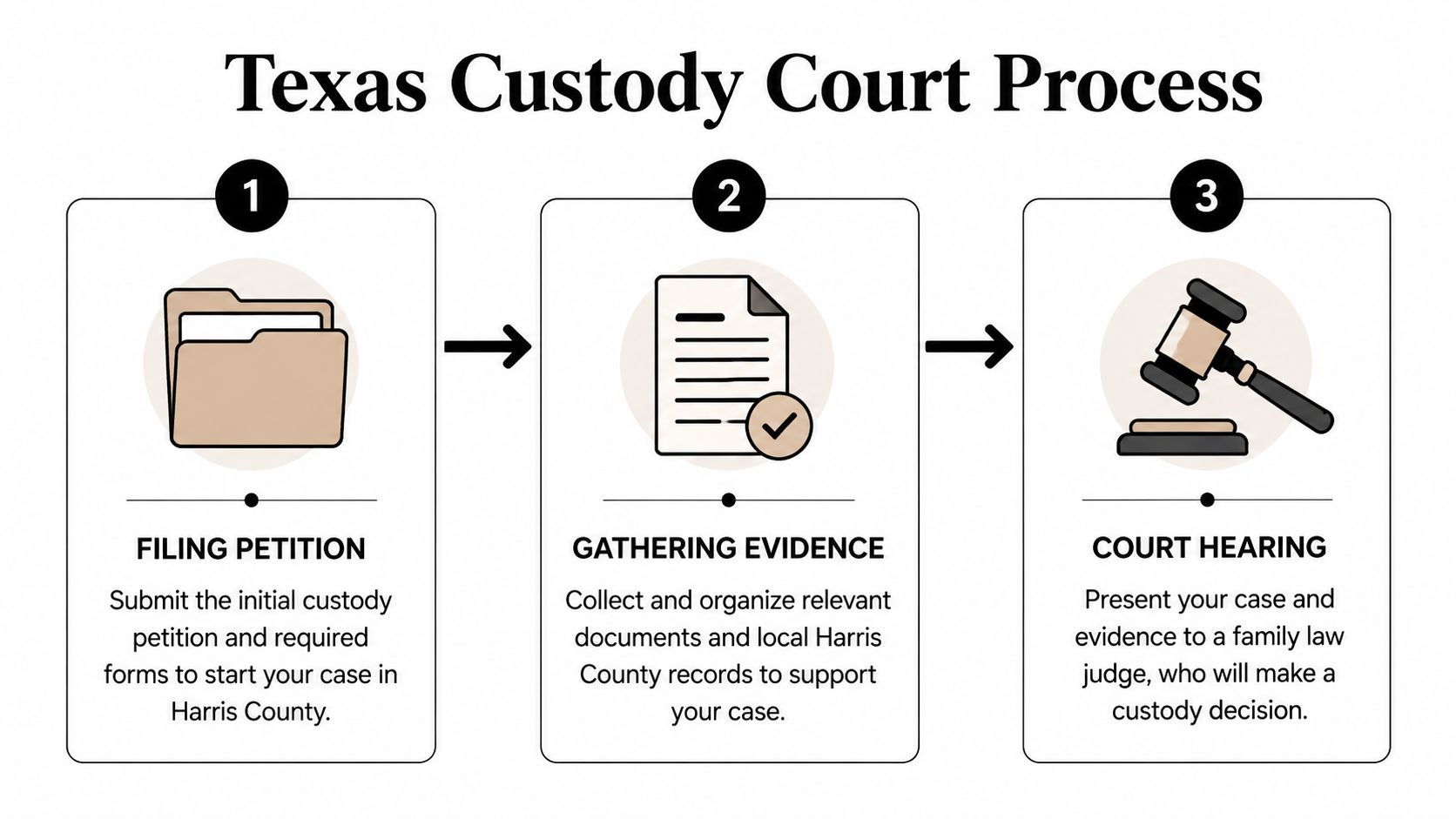
Filing the right case
If there are no existing custody orders, the case usually begins with an original suit affecting the parent-child relationship. If orders already exist, you may need a modification case.
The filing itself matters because it frames what relief you're asking for. If there is immediate danger, temporary relief may need to be requested right away. If the risk is ongoing but not immediate, the case may focus on changing conservatorship rights, possession terms, or requiring safeguards.
Temporary orders often shape the case early
In many Harris County custody cases, the first major hearing is on temporary orders. This hearing can determine where the child stays while the case is pending, who makes decisions, and whether supervision or restrictions are necessary.
That's why early preparation matters. A parent who arrives with organized records, clear facts, and a workable parenting proposal usually stands on better footing than a parent who arrives with broad claims and no documentation.
If you're preparing for that first appearance, review how to prepare for a custody hearing so your presentation matches what the court expects.
Discovery is where allegations are tested
After filing, the case often moves into formal information gathering. Lawyers may request records, written responses, and other materials from the opposing side. Witnesses may also be questioned before trial in depositions.
For parents who have recordings or lengthy interviews to organize, a tool like WhisperAI can be useful for understanding how deposition and transcript preparation fit into court use. Accuracy matters when a statement may later be quoted, challenged, or compared to other evidence.
Here's the basic flow many parents see:
- Document exchange: Medical, school, police, counseling, and communication records may come into the case.
- Written questions and responses: Each side may have to answer formal questions under oath.
- Depositions: A witness or party answers questions under oath outside the courtroom.
- Pre-hearing preparation: Your legal team organizes what will be presented and what issues need proof.
The court may appoint investigators or evaluators
Texas courts use formal investigative tools in serious custody disputes. Texas Family Code §107.101 authorizes custody evaluations, typically performed by trained professionals such as social workers or psychologists who may interview both parents and the child, inspect each home, and speak with teachers or doctors. In practice, those evaluations are often paired with police reports, CPS records, medical records, and psychological assessments, as described in this analysis of proving parental unfitness in Texas.
That matters because an “unfit” claim is not self-proving. It becomes a documented, tested allegation through records, expert involvement, and corroborating testimony.
The strongest cases don't rely on courtroom drama. They rely on records that hold up when a neutral professional reviews them.
Some cases also involve an amicus attorney or another court-appointed professional focused on the child's interests. If that happens, your cooperation, credibility, and consistency matter a great deal.
A short overview can help if you prefer to see the process visually:
Mediation and final hearing
Many custody cases in Harris County reach mediation before trial. Mediation can be productive, but only if your safety concerns are backed by actual evidence. Allegations with weak support often lose force in mediation because the other side knows the court may not act on them.
If no agreement is reached, the case may proceed to a final hearing or trial. By that point, the judge has often seen temporary-orders evidence, reviewed investigator input, and heard how each side handled the case. That's why consistency from day one is so important.
The parent who is calm, organized, and child-focused usually presents better than the parent who treats the case like a running feud.
Strategic Advice for Your Custody Case and Your Well-being
A common mistake in Harris County custody cases is focusing so hard on the other parent's conduct that you overlook how the judge is reading yours. In a close case, the court is not just asking whether the other parent made poor choices. The court is also watching which parent shows steadier judgment, protects the child from conflict, and follows through on day-to-day responsibilities.
That can be frustrating. It still affects outcomes.

Protect your credibility while the case is pending
Judges in this area pay attention to conduct outside the courtroom. They notice which parent sends hostile texts, ignores pickup times, argues in front of the child, or turns every disagreement into a crisis. They also notice the parent who keeps school on track, gets the child to appointments, and communicates in a way that is clear and controlled.
Use that to your advantage.
A few habits help more than parents expect:
- Write as if the judge may read it later: Keep messages short, factual, and about the child.
- Follow current court orders: If a true safety emergency exists, address it through your lawyer or the proper authorities instead of taking matters into your own hands.
- Maintain routines: Attendance, homework, counseling, medication, meals, and sleep patterns help show stability.
- Stay off social media with case-related frustration: Even a single angry post can distract from legitimate safety concerns.
Keep the child out of the proof
In my experience, one of the fastest ways to hurt a strong case is to pull the child into the middle of it. A scared parent may feel tempted to ask leading questions after visits or to have the child report back about the other home. That usually creates new problems.
Judges want to protect children from adult litigation. A parent who treats the child like a source of evidence, a messenger, or a teammate can lose credibility quickly.
If there is damaging online material, false public accusations, or posts that could affect your family during the case, guidance on removing harmful content during family disputes may help you address the issue carefully while preserving useful evidence.
Keep records that read like evidence, not argument
Good documentation is plain. It is dated. It is specific. It does not sound like a running commentary on the other parent's character.
A useful journal entry might note that the child arrived without prescribed medication, appeared unusually tired, had a bruise on the upper arm, and said a particular adult was supervising. It should also note what you did next, such as contacting the doctor, sending a neutral message to the other parent, or seeking medical care. That kind of entry gives the court something concrete to evaluate.
Poor notes usually do the opposite. They drift into insults, assumptions, and conclusions you cannot prove.
Play the long game
Many custody cases in Harris County are shaped over time. Temporary hearings matter, but so do the weeks in between. Parents who stay organized and child-focused tend to present better than parents who react to every provocation.
That may mean getting counseling support for your child, using a parenting communication app, asking teachers or providers for records early, and working with counsel who understands local Harris County procedure. You do not need to look perfect. You do need to look steady.
Steady parents are often the ones judges trust with hard decisions.
You Are Not Alone Expert Legal Guidance for Your Family's Future
Trying to prove a parent is unfit is one of the heaviest things a mother or father can face. You're not just asking for a schedule change. You're asking a court to recognize danger, instability, or harm and to act before your child suffers more of it.
That is why these cases require discipline. Not panic. Not revenge. Not a pile of screenshots with no context. The court needs a focused, well-supported showing that connects the other parent's conduct to real risk for the child.
Local experience matters in practical ways
Harris County courts have their own rhythm. So do the judges, evaluators, and procedures that shape custody cases in this area. A parent in Atascocita or Humble doesn't just need someone who knows the Family Code. They need someone who understands how these issues are typically presented, challenged, and tested in local court.
That includes knowing:
- What evidence should be gathered first
- When temporary orders are worth pursuing
- How to frame concerns without sounding exaggerated
- Which records and witnesses often carry the most weight
- How to stay focused on child safety instead of getting pulled into side fights
The goal is protection, not punishment
A lot of parents feel guilty for taking action. They worry they'll look vindictive. They worry the child will blame them. They worry they're overreacting.
If your concern is grounded in facts and tied to your child's well-being, asking the court for protection is not punishment. It is parenting.
Sometimes the right legal result is supervised time. Sometimes it is tighter restrictions, more structure, or a shift in decision-making authority. Sometimes the evidence is not yet strong enough, and the immediate task is to document properly and act strategically. Honest advice matters just as much as aggressive advocacy.
A clear next step helps
If you're searching for how to prove parent is unfit in texas custody case atascocita, you probably need more than general information. You need someone to look at your facts, tell you what is legally significant, and help you decide what to do next.
Bring the messages. Bring the calendar. Bring the school records, report numbers, photos, and notes. A careful review can often separate what feels important from what the court is likely to care about most.
Your child's future shouldn't depend on guesswork. A custody case involving safety concerns needs a plan, a timeline, and evidence that holds up under scrutiny.
If you live in Atascocita, Humble, or elsewhere in northeast Harris County and you're worried about your child's safety with the other parent, schedule a free consultation with Law Office of Bryan Fagan – Atascocita TX Lawyers. Our team can review your situation, explain your options under Texas law, and help you take practical steps to protect your child and your future.


