 Skip to content
Staring at your phone late at night, wondering what hurts your custody case texas atascocita, you're probably carrying a heavy fear. You may be in Atascocita, Humble, or somewhere else in northeast Harris County after an argument, wondering whether one bad text, one missed pickup, or one mistake at home could cost you time with your child.
That fear is real. Custody cases feel personal because they are personal. You're not just dealing with paperwork. You're dealing with school drop-offs, doctor visits, bedtime routines, and the possibility that a judge who doesn't know your family will make decisions that shape your child's daily life.
The good news is that custody cases are not random. Texas courts follow a legal standard. Once you understand how a Harris County judge is likely to view your conduct, your messages, your routine, and your choices, you can start making better decisions right away.
Navigating Your Atascocita Custody Case With Confidence
A parent in Atascocita may think the biggest issue is whether the court sees them as a “good parent.” That's part of it, but not in the way many individuals assume. In court, the question is usually more specific. Can this parent provide a safe, stable, child-focused environment, and can this parent work with the other parent without creating more stress for the child?
That difference matters. A parent can love their child and still hurt their own case by acting impulsively, arguing through text, skipping routines, or focusing on what feels fair instead of what the judge sees as workable.
Many parents in Humble and northeast Harris County also get tripped up by “normal life” issues. They assume a judge only cares about major misconduct. In reality, judges often look at patterns. A missed medical appointment here, a late school drop-off there, a new partner introduced too quickly, a hostile text thread, a move that makes school transportation harder. Taken together, those details can shape how the court sees your parenting.
Practical rule: In a Texas custody case, the court is always asking one basic question. Does this choice help the child feel safer and more stable, or does it make the child's life harder?
If you understand that lens, you can better understand what helps and what hurts. You can also avoid common mistakes before they grow into courtroom problems.
The Guiding Principle The Best Interest of the Child Standard
Texas custody law starts with one controlling idea. The court decides conservatorship and possession based on the best interest of the child under TexasLawHelp's explanation of the best-interest standard. Texas courts also use Holley factors, which include issues like emotional and physical danger now and in the future, parental abilities, and home stability.
That sounds abstract until you put it into plain English. A judge in Harris County is often building a profile of each parent. Not a profile of who is more upset, who earns more, or who argues more forcefully. A profile of who looks safer, steadier, and better able to meet the child's everyday needs.
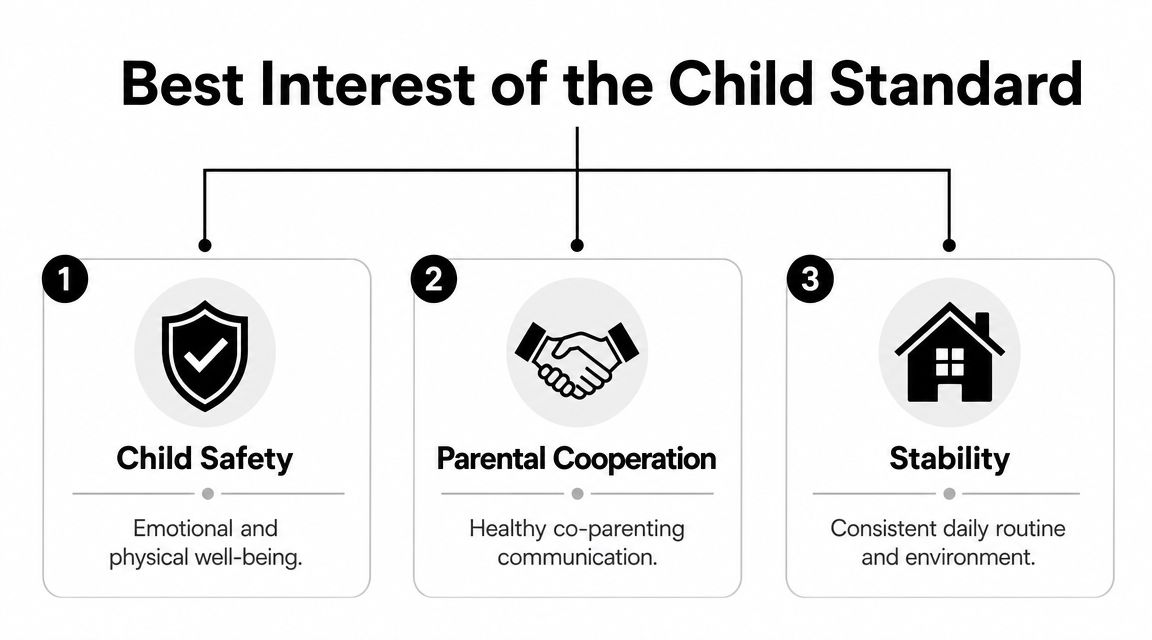
The questions a judge is really asking
A judge may not use conversational wording in court, but many custody decisions come down to questions like these:
- Who keeps the child safe: Is there any evidence of violence, dangerous behavior, neglect, or poor judgment that puts the child at risk?
- Who handles daily parenting: Who gets the child to school, schedules medical care, manages homework, and handles ordinary responsibilities without constant conflict?
- Who offers stability: Which home is more predictable, calmer, and more likely to support a routine the child can rely on?
- Who cooperates: Which parent can communicate, share information, and support the child's relationship with the other parent?
- Who shows insight: If there has been a problem, did the parent address it, or did the parent deny it and continue the same conduct?
That last point gets overlooked. The court can be more concerned about unsafe conduct plus no corrective action than about a problem that a parent recognized and addressed responsibly.
Fairness is not the test
Parents often walk into a custody dispute thinking in terms of fairness. “I'm the parent too, so I should automatically get equal time.” That's understandable. It's also not the legal test.
The court's job is not to divide time like property. The court's job is to decide what arrangement best serves the child. If one parent presents a realistic, stable, child-centered plan and the other parent presents a plan built mostly around personal preference, the first parent usually looks stronger.
A short way to think about it is this:
| What parents often focus on | What the court focuses on |
|---|---|
| What feels fair to me | What works best for the child |
| What I want | What I can prove |
| One bad event | The full pattern over time |
| Promises | Records, conduct, and credibility |
The judge is not looking for the perfect parent. The judge is looking for the parent who creates the least risk and the most stability for the child.
For parents in Atascocita and nearby communities, that means your daily life matters. School routine, transportation, communication, housing, scheduling, and emotional control all fit into the best-interest analysis.
Major Red Flags That Jeopardize Your Parental Rights
Some facts trigger immediate concern because they go straight to child safety. In a Harris County custody case, these are the issues that can quickly change the tone of the case from “how should time be divided?” to “what restrictions are necessary?”

Family violence and abuse
Family violence is one of the most serious red flags in any custody dispute. Modern Family Law's Texas family-law breakdown reports that 40% of women and 34.9% of men in Texas experience some form of intimate partner violence, stalking, or both in their lifetimes, and that 150 women in Texas were killed by male romantic partners in 2019, compared with 31 men killed by female partners. Those numbers help explain why courts treat allegations or findings of violence with such urgency.
If the record shows family violence, a judge may limit or deny joint managing conservatorship, restrict possession, or require tighter safeguards. The reason is direct. Violence conflicts with the child's best interests because it raises concerns about danger, fear, instability, and impaired judgment.
Substance abuse and alcohol misuse
Substance issues are damaging for the same reason. They create uncertainty about supervision, transportation, emotional regulation, and decision-making. A parent doesn't always lose time because of an accusation alone, but a repeated pattern of intoxication, drug misuse, or impaired parenting can become central evidence.
Parents sometimes think the court only cares if a child was physically harmed. That's too narrow. Judges also look at risk. If a parent appears unable to supervise safely, keep routines, or make sound decisions, that concern can affect conservatorship and possession.
If you're dealing with addiction and trying to get healthy while protecting your relationship with your children, this Children Psych guide for parents in recovery offers thoughtful, practical support.
Criminal activity and CPS concerns
A criminal charge does not automatically end a custody case. But criminal conduct can still hurt in several ways. It can raise questions about safety, impulse control, credibility, and the overall environment around the child.
CPS involvement works similarly. The court will want to know what happened, what documentation exists, and whether the parent took the concern seriously. In these cases, details matter.
- Police reports matter: They can give the court a timeline and context.
- Medical records matter: They may support or challenge claims about injuries, treatment, or substance use.
- Texts and emails matter: They often show what was happening before and after an incident.
- Corrective action matters: Counseling, treatment, parenting classes, and compliance with recommendations can change how a judge sees the situation.
Unsafe conduct is damaging. Unsafe conduct combined with denial, excuses, or no change is far more damaging.
For local parents, strategy matters at this stage. A serious issue should never be minimized, but it also shouldn't be handled casually or emotionally. It needs to be addressed with records, honesty, and a clear plan.
How Instability and Poor Co-Parenting Weaken Your Case
A custody case can be damaged without violence, drugs, or criminal conduct. Many parents are surprised by how strongly courts react to instability and conflict. In Texas, the law generally presumes joint managing conservatorship is in the child's best interest, but that presumption can be weakened by conduct that shows poor cooperation or a chaotic lifestyle, as explained in this Texas custody overview from Super Lawyers.
Instability does not have to look dramatic
Instability often shows up in ordinary ways. A parent moves repeatedly. Work hours change so often that pickups become unreliable. The child's clothing, school supplies, or medication don't consistently make it from one home to the other. Homework gets forgotten. Bedtime shifts wildly from one week to the next.
None of those facts alone always decide a case. The problem is the picture they create. A judge may see a parent who is still organizing their own life, while the child needs a routine that works now.
In communities like Atascocita and Humble, school logistics can be a major part of that picture. If one parent proposes a schedule that keeps the child's school week smooth and the other parent proposes a schedule that creates transportation confusion, tardiness, or constant last-minute changes, the first parent often appears more credible.
Co-parenting behavior is courtroom evidence
Parents often think communication problems are private. They aren't. If you block communication, interfere with parenting time, refuse to share school or medical information, or make unilateral decisions, the court may read that as a refusal to put the child first.
Consider how these behaviors can be framed:
- Blocking calls or messages: This can look like control, not protection, unless there is a documented safety reason.
- Refusing schedule flexibility: If every request becomes a fight, you may appear rigid and child-unfocused.
- Relocating in a way that fragments routines: Even a move within the broader Harris County area can create transportation and school disruptions.
- Bad-mouthing the other parent: This can suggest you are pulling the child into adult conflict.
Here is the practical issue. Courts want parents who can make a schedule work in real life. A parent who is difficult on purpose may lose credibility, even if that parent insists they are only “standing up for their rights.”
A judge often compares conduct side by side
One useful way to think about it is comparison. If both parents have flaws, the court may still favor the parent who appears calmer, more responsive, and more solution-oriented.
| Conduct | How a judge may view it |
|---|---|
| Sharing school updates promptly | Child-focused cooperation |
| Ignoring requests about medical care | Unreliable co-parenting |
| Encouraging contact with the other parent | Emotional maturity |
| Creating repeated exchange conflicts | Conflict-driven parenting |
Parents in custody disputes sometimes want to “win” interactions. That instinct can hurt them. In family court, the parent who reduces friction often looks stronger than the parent who escalates every disagreement.
Common Procedural and Digital Missteps in Harris County
Some custody problems have nothing to do with your parenting ability and everything to do with your choices during the case. Harris County judges pay attention to credibility. Once the court starts doubting your judgment, even small violations can become bigger than you expect.

Ignoring orders and assuming joint custody means 50 50
One common mistake is treating temporary orders like suggestions. They are not. If the court sets exchange times, communication rules, support obligations, or restrictions on travel, follow them carefully. A judge may forgive confusion once. Repeated noncompliance can make you look unreliable or defiant.
Another major misunderstanding involves conservatorship. MBH Texas Law's discussion of Texas divorce and custody statistics explains that Texas Family Code Section 153.135 makes clear that joint managing conservatorship does not require equal or nearly equal possession and access. The same source notes that published Texas family-law summaries report fathers receive about 33% of custody time in Texas, or roughly 120.5 days per year, while mothers receive about 65% nationally. The lesson is not that one parent always gets more. The lesson is that courts do not automatically split time evenly.
If you demand 50/50 because it feels fair, without proving why it serves the child's best interests, you can look unprepared or unreasonable.
Your phone is part of your evidence file
Text messages, emails, app messages, and social media posts often become evidence. Parents in Atascocita are sometimes shocked by what the other side saves. Screenshots of insults, late-night rants, pictures that contradict courtroom claims, and posts that make parenting look secondary can all become part of the case.
For a closer look at this issue, see how judges view social media in custody cases in Texas Atascocita.
A few simple digital rules can protect you:
- Pause before sending: Angry messages rarely age well in a courtroom.
- Stick to child topics: School, health, exchanges, and logistics are safer than emotional arguments.
- Avoid sarcasm and threats: Tone is often clear on a screenshot, even without context.
- Don't post to impress anyone: If a post conflicts with your “child-first” position, expect it to be noticed.
A short video can also help frame how courts think about these cases.
Relocation and sloppy records
Moving without proper agreement or court approval is another high-risk mistake. Parents often assume a local move is harmless. But if the move changes school transportation, exchange locations, commute times, or the child's routine, it can become a custody issue fast.
Poor record-keeping also causes avoidable damage. If your calendar is incomplete, your messages are messy, and your version of events changes over time, your testimony can lose weight.
Written communication should read like a parent solving a problem, not like a person trying to win an argument.
The Silent Saboteurs Everyday Choices That Impact Your Case
Many custody cases turn at this point. A parent avoids major misconduct, but daily choices still create a picture of instability. Judges increasingly look at these patterns, and Onda Family Law's discussion of co-parenting missteps in Texas notes that inconsistent school routines, missed medical appointments, unstable housing, or a social media presence that contradicts a child-first claim can all be framed as best-interest issues.
Small facts can become a larger story
A single late pickup may not matter much. A pattern of lateness can suggest poor time management. One rescheduled dentist visit may be understandable. Repeated missed appointments can suggest disorganization or lack of follow-through.
That is how custody litigation works. Lawyers don't just present isolated events. They assemble a narrative.
In Harris County courtrooms, these facts can become persuasive when they point in the same direction:
- School inconsistency: missed conferences, repeated tardiness, weak involvement with teachers
- Medical inconsistency: missed appointments, confusion over medication, poor follow-up
- Housing disruption: frequent changes, unstable household members, unclear sleeping arrangements
- Lifestyle contradictions: spending, social activity, or online conduct that doesn't match a child-centered image
New relationships and divided attention
A new romantic relationship is not forbidden. But introducing a new partner too quickly, allowing conflict around that relationship, or changing the child's routine around an adult relationship can raise concerns.
The issue is usually not morality. It is stability. If a judge sees that your focus shifted away from the child's routine, emotional needs, or peaceful co-parenting, that relationship may become part of the custody analysis.
The same is true with alienating behavior. Parents sometimes make subtle comments, share adult details, or pressure a child to take sides. If that sounds familiar, read more about how to prove parental alienation, because courts can take a dim view of conduct that harms the child's relationship with the other parent.
Everyday choices that usually help and hurt
| Choice | Likely impression in court |
|---|---|
| Consistent school and bedtime routine | Stability |
| Last-minute childcare chaos | Poor planning |
| Calm handling of schedule changes | Maturity |
| Social posts that conflict with testimony | Credibility problems |
Judges often ask a quiet question beneath the legal arguments. Does this parent's daily life support a predictable childhood?
For many parents, this part of the case feels unfair because the issues look ordinary. But that is exactly why they matter. Custody is about ordinary life. School mornings, meals, sleep, communication, and emotional steadiness are where parenting is measured.
Protecting Your Rights Practical Steps for Atascocita Parents
Once you know what can hurt your case, the next move is simple. Start building a record that shows judgment, consistency, and child-focused conduct. In high-conflict cases, Texas Advocates' discussion of high-conflict child custody battles notes that disregarded court orders, interfered visitation, or substance abuse can increase court scrutiny, and that a past DWI or mental health concern may not automatically damage a case unless it shows an ongoing pattern of impaired parenting capacity.

Build your paper trail
You do not need fancy software to start. A notebook, a calendar, and organized digital folders can go a long way. If you want a cleaner system, tools like OurFamilyWizard, AppClose, Google Calendar, and a simple scan app can help you keep records in one place.
Track the things that matter:
- Parenting time: pickups, drop-offs, missed periods, and schedule changes.
- School and medical information: report cards, notices, appointments, prescriptions, and teacher communication.
- Expenses and support items: only if they are relevant and your lawyer tells you to keep them.
- Communication logs: save messages that show cooperation, requests, and responses.
Keep your notes factual. Dates, times, who was present, what happened. Skip editorial comments.
Make your communication boring
That advice is more useful than it sounds. Boring communication often looks responsible in court. If the other parent sends an emotional message, respond only to the child-related issue. If there is no child-related issue, you may not need to respond at all.
Try to make every message fit one of these categories:
- Scheduling: pickup times, exchange locations, changes, confirmations
- Health: symptoms, medication, appointments, school nurse updates
- Education: homework, meetings, grades, school events
- Logistics: clothing, supplies, transportation, activity schedules
The more your communication sounds like case management for your child's life, the less ammunition you give the other side.
Stabilize what you can control locally
You may not be able to control the other parent's behavior. You can control your home, your routine, and your records. For Atascocita and Humble parents, that often means keeping school attendance steady, planning transportation early, and avoiding last-minute disruptions around exchanges.
Useful local supports may include the Harris County Dispute Resolution Center, parenting classes, counselors familiar with family conflict, and legal guidance early in the case. If you need help creating a practical strategy, Law Office of Bryan Fagan – Atascocita TX Lawyers handles family law matters involving custody, visitation, and related court proceedings in this area.
A steady routine is evidence. Consistent school mornings, timely exchanges, calm communication, and follow-through can all strengthen your position.
If there has been a real problem in your history, deal with it directly. Complete treatment. Follow recommendations. Show change over time. Courts often respond better to accountability than to denial.
Take Control of Your Case with a Trusted Atascocita Advocate
Parents often assume custody cases are won by whoever argues hardest. In reality, many are shaped by who appears safer, steadier, and more focused on the child's day-to-day well-being. That is the core of what hurts your custody case texas atascocita. The court is watching for risk, instability, poor cooperation, and choices that make a child's life less predictable.
That can feel overwhelming at first. It can also be reassuring. Once you understand the lens, you can start making decisions that support your position. Follow court orders. Keep your communication calm. Protect your child from adult conflict. Build records. Keep routines as stable as possible in Atascocita, Humble, or wherever your child's daily life is centered.
If you are facing allegations, a difficult co-parent, or a complicated schedule issue, local legal advice matters. A lawyer who handles custody cases in this area can help you evaluate your facts, organize evidence, avoid preventable mistakes, and prepare for the way a Harris County court is likely to view your case.
If you need more direct information about legal help for conservatorship, possession, and related custody issues, visit this page for an Atascocita child custody lawyer.
You do not have to sort through this alone. The earlier you get clear advice, the easier it is to protect your rights and avoid turning a stressful family dispute into a lasting legal disadvantage.
If you're dealing with a custody dispute in Atascocita, Humble, or northeast Harris County, schedule a free consultation with Law Office of Bryan Fagan – Atascocita TX Lawyers. Our office helps parents understand how Texas courts view safety, stability, communication, and parenting conduct, so you can make informed decisions and protect your relationship with your child.


