Skip to content

You may be sitting in the same house where your kids get ready for school, where you know which floorboard creaks, and where every room carries part of your marriage. In Atascocita and Humble, the family home often isn't just another asset. It's the center of daily life, a major financial issue, and the hardest question in the divorce.
When people ask who gets the house in a divorce in Texas Atascocita, they're usually hoping for a simple answer. Texas law rarely gives one. The result depends on how the home was acquired, whether it's part of the marital estate, what a fair division looks like in your situation, and whether keeping the home is realistic after the divorce.
If you're trying to sort through this while also thinking about mortgage payments, Harris County court paperwork, school routines, and where everyone will live next, that confusion is normal. The good news is that there is a clear framework. Once you understand the steps, the problem becomes much more manageable.
Is Your Atascocita Home Community or Separate Property
The first question isn't who wants the house. The first question is what kind of property the house is under Texas law.
Texas treats the marital home as part of the broader community estate in many divorces because Texas is a community property state, and courts divide community property in a “just and right” manner under Texas Family Code Section 7.001 as discussed here. That doesn't require a fixed half-and-half split. It also means the court looks closely at how and when the home was acquired, not just whose name appears on the deed.
Think of property as shared and personal containers
A simple way to understand this is to picture two types of containers.
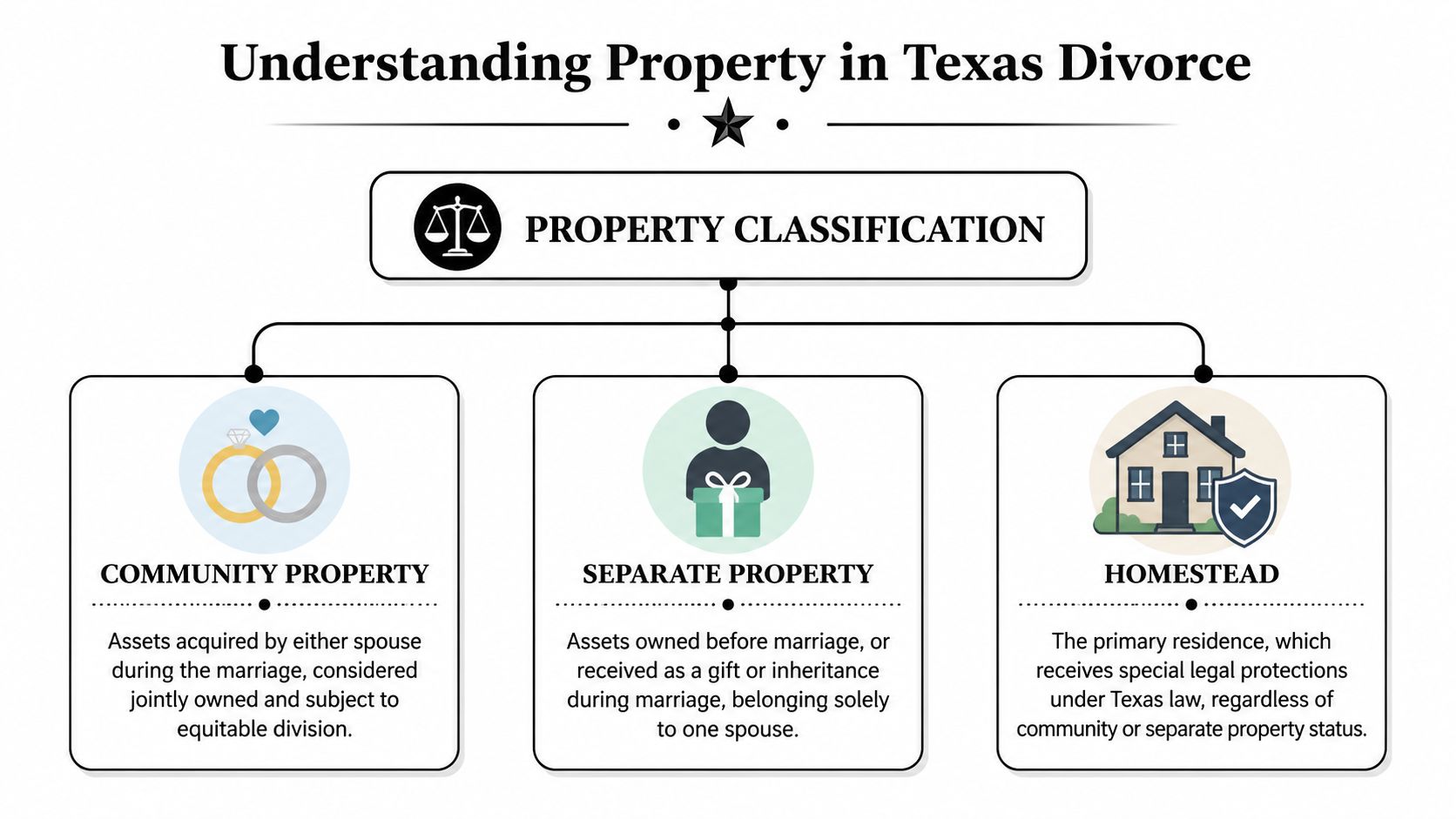
One container is the shared marital container. Property acquired during the marriage often goes there. The other container is a personal container for one spouse's separate property. A house owned before marriage, or received by gift or inheritance, generally belongs in that personal container.
That distinction matters more than title alone.
Practical rule: A spouse's name on the deed can matter for paperwork, but it doesn't automatically decide whether the home will be divided in divorce.
Common local examples
An Atascocita example helps. If you and your spouse bought a home in Fall Creek during the marriage using marital earnings, the house will usually be treated as community property. If one spouse owned a house in Eagle Springs before the marriage, that house is generally separate property.
Here's where people often get tripped up:
- Bought during marriage: The home is generally presumed to be community property.
- Owned before marriage: The home is generally separate property.
- Received by gift or inheritance: The home is generally separate property.
- Only one spouse on the deed: That fact alone doesn't settle the issue.
A second point creates confusion. Even if a home started as separate property, money paid toward it during the marriage can still raise other issues about fairness, reimbursement, or offsets. Those details are case-specific and often need close review of records.
Why value still matters early
Once you identify the property category, the next issue is value. In a place like Atascocita, where homeowners pay close attention to neighborhood sales, school zones, and condition, getting a realistic number matters. If you're comparing buyout options or considering a sale, it helps to start with a grounded idea of the home's worth. This primer on understanding fair market value gives a plain-English overview of how people think about value in a real estate setting.
If you want a deeper look at the legal side of classification, this page on community property in Texas is a useful companion.
How Texas Courts Determine a Just and Right Division
Once the home is treated as community property, the court has to decide what to do with it. That's where many people assume the answer must be a strict split. Texas doesn't work that way.
Property acquired during marriage is presumed community property, and if the house is community property, a judge has broad discretion to award it to one spouse, order a sale, or create a property-offset solution under the state's “just and right” standard rather than a fixed equal split, as summarized in this explanation of who gets the house in a Texas divorce.

What judges usually look at
A Harris County judge doesn't pull a result out of thin air. The court looks at the whole family picture and asks what division is fair.
That may include practical questions like these:
- Children's living needs if one parent will provide most day-to-day care
- Earning differences between spouses
- Ability to pay housing costs after divorce
- Whether one spouse can refinance
- What other assets exist that could balance out the house
A home can be emotionally important and still be financially impossible to keep. Judges and lawyers often have to separate those two realities.
Fair doesn't always mean identical
Consider two different Atascocita households.
In one, a parent who will continue caring for the children in the home may ask to remain there, with other assets allocated differently. In another, neither spouse can comfortably carry the mortgage alone, and a sale may be the cleaner result.
A “just and right” division is about fairness in the full context of the marriage, not a mechanical formula.
That's why a house may go to one spouse without that person receiving a windfall. The court can balance the overall estate elsewhere. If your case involves retirement accounts, debt, or business interests along with the home, a property division attorney in Atascocita can help sort out how those pieces fit together.
Some families also look into a local Property Division Lawyer in Atascocita when the divorce involves community property and complex assets.
Your Three Main Options for the Marital Home
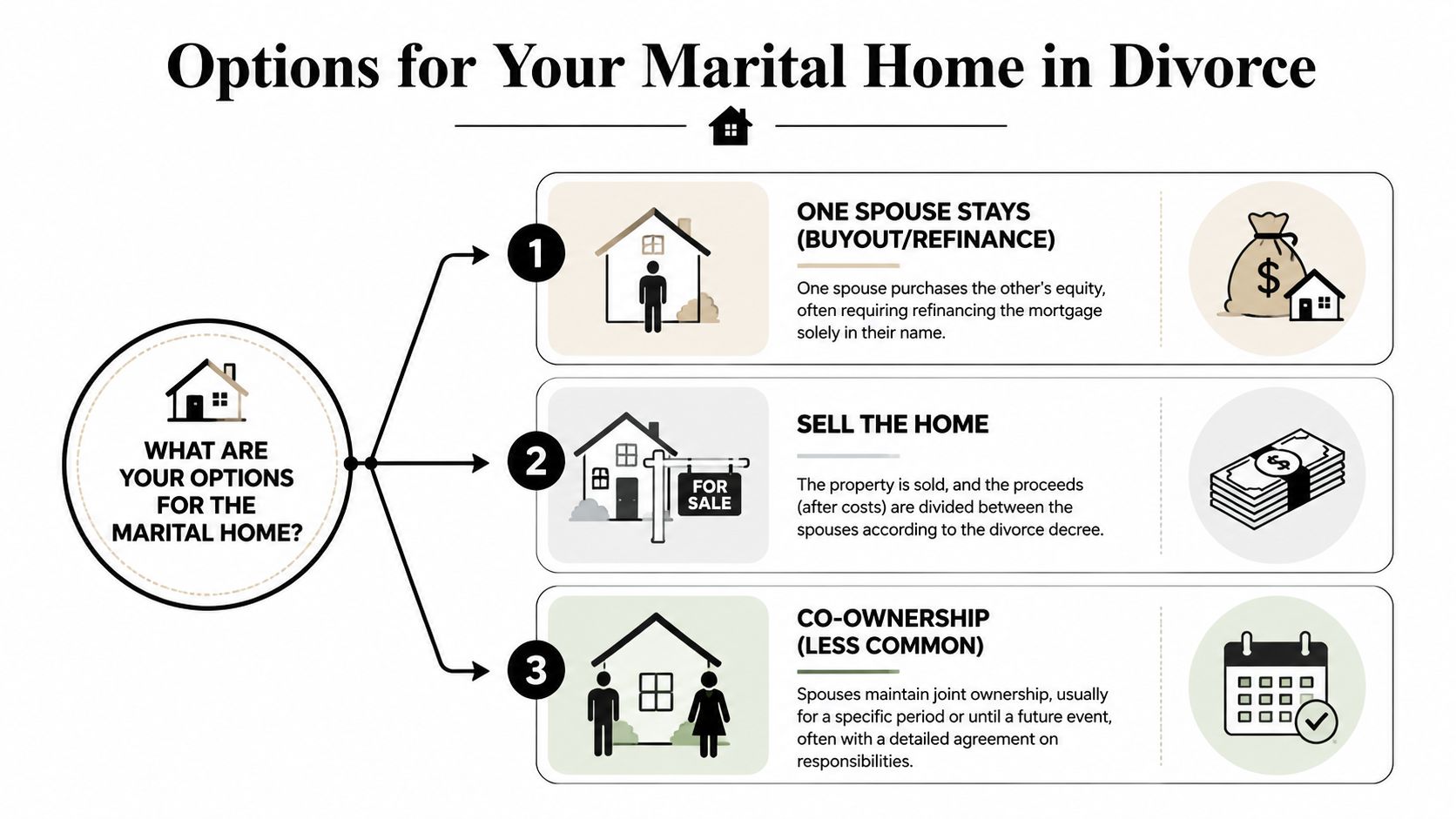
Most divorcing couples in Atascocita end up in one of three lanes. One spouse keeps the house. The house gets sold. Or both spouses stay tied to the property for a period of time.
Each option can work. Each comes with tradeoffs.
A quick visual can help before diving into the details.
One spouse keeps the house
This is the option many people hope for first. The spouse staying in the home usually compensates the other for that person's share of equity, often through refinancing or by offsetting the value with other assets. The divorce decree should assign the home, mortgage responsibility, and related expenses, and the spouse leaving the home typically signs a deed transferring their interest. Texas Law Help also notes that the decree itself does not automatically change the mortgage contract with the lender, which is why refinancing often becomes central to this option, as explained in this guide on divorce and real estate.
That last point matters a lot. If both names remain on the loan, the lender can still look to both borrowers even if your decree says one spouse is “responsible.”
A buyout often makes sense when:
- The children need stability in the same school and neighborhood
- One spouse can qualify alone for the mortgage
- Other marital assets exist to offset the equity
- The home is affordable long term, not just for the next few months
Selling the house
Selling is often the cleanest break. It converts a complicated asset into cash that can be divided under the decree, and it reduces the chance of future conflict over repairs, taxes, insurance, or missed payments.
For many couples in Humble and Atascocita, this option is emotionally difficult but practically strong. If neither spouse can refinance comfortably, or if the monthly cost no longer fits either post-divorce budget, a sale may protect both people from deeper financial strain.
If you're preparing a property for sale, presentation affects buyer interest. This resource on home staging techniques offers practical ideas that can help homeowners think through that process.
Co-owning after divorce
This is the least common path, but it does happen. Some couples agree to keep the home jointly for a period of time, often tied to a future event such as a school transition or planned sale.
Here's the problem. Co-ownership after divorce requires a clear written agreement on who lives there, who pays the mortgage, who handles repairs, how taxes and insurance are paid, and what triggers the eventual sale.
If you co-own after divorce without very specific written terms, routine home issues can become new legal disputes.
To compare the three options side by side:
| Option | Best fit | Main risk |
|---|---|---|
| Keep the house | One spouse can afford it and refinance | Loan liability can linger if refinance doesn't happen |
| Sell the house | Both want a clean split | Timing and moving can be stressful |
| Co-own temporarily | There's a short-term reason to wait | Ongoing conflict over money and upkeep |
A short video can help you think through these choices from a practical angle.
When spouses are close to agreement but stuck on the details, divorce mediation in Atascocita may give them a structured setting to work out the house issue. Some people also speak with a local Divorce Lawyer in Atascocita, TX for divorce representation in Atascocita and Harris County while evaluating these options.
Special Considerations for Atascocita Homeowners
Local homeowners often focus first on ownership and equity. That makes sense, but several practical issues can shape daily life long before the final decree.

Who stays in the house during the divorce
Many people assume filing for divorce automatically decides who remains in the home. It doesn't. Temporary arrangements often need to be worked out early, especially when children are involved or when tension in the home is high.
Those early decisions can affect:
- Who pays the mortgage
- Who covers utilities and insurance
- Who handles upkeep
- How parenting time works while the case is pending
If you live in Atascocita or Humble, those temporary arrangements can matter as much as the final result because they affect school routines, commuting, and immediate cash flow.
Homestead and real-world housing pressure
Texas homestead issues can add another layer of protection and complexity for a primary residence. People often hear the word “homestead” and think it automatically answers the divorce question. It doesn't. It can affect how the home is treated and who remains there in certain circumstances, but it doesn't eliminate the need for a clear property division.
The emotional pressure is also real in this area. Homeowners in northeast Harris County often feel torn between preserving stability and making a financially sound decision. A house may carry sentimental value, but monthly ownership costs continue after the decree. Property taxes, insurance, repairs, and HOA obligations don't disappear because the marriage ends.
If you're reviewing ownership costs, this guide for protesting Harris County property tax can help you understand one piece of the larger budget picture.
Your divorce decree doesn't control the lender
This is one of the most important practical points in any house case. Your divorce decree binds you and your spouse. It does not rewrite the loan documents with your mortgage company.
If your decree says your spouse must pay the mortgage, but your name is still on the loan, the lender may still hold you to that contract if payments aren't made. That's why refinancing, sale deadlines, or detailed enforcement language matter so much in divorce orders involving homes.
A decree can assign responsibility between spouses. It usually does not remove a borrower from the mortgage by itself.
That issue catches many people off guard. In neighborhoods where families stretched to buy the home in the first place, keeping the house after divorce may sound comforting but still be unrealistic once one income disappears or household costs split in two.
Practical Next Steps for Your Harris County Divorce
When the house is on the line, clarity starts with paperwork. You don't need to have every answer today, but you do need a clean starting file.
Gather the core documents
Start pulling together:
- The deed to the property
- Recent mortgage statements
- Property tax records
- Homeowners insurance information
- Any refinance or home equity loan documents
- Records showing when and how the home was acquired
If you think the home may be separate property, records from before the marriage become especially important.
Get a reliable value and test affordability
An independent appraisal or another credible valuation method can help anchor the discussion. Don't rely only on online estimate tools or neighborhood gossip. The house in your subdivision that sold quickly may not have had the same updates, condition, lot, or timing as yours.
Then test the monthly reality. Ask what the mortgage, taxes, insurance, maintenance, and routine repair costs look like after divorce. The core question isn't just “Can I keep the house?” It's “Can I keep it without creating a new financial crisis?”
Build a local plan
A financial professional can help you compare a buyout, sale, or temporary holding arrangement. A lawyer can help you make sure the decree, deed transfer, and loan-related terms protect you.
If you're sorting out who gets the house in a divorce in Texas Atascocita, one practical option is speaking with Law Office of Bryan Fagan – Atascocita TX Lawyers about divorce and property division issues affecting Atascocita, Humble, and Harris County residents.
Frequently Asked Questions About the House in a Divorce
What if my name isn't on the deed, but we bought the house together?
Your deed status doesn't automatically answer the ownership question in a Texas divorce. What matters first is usually when and how the home was acquired. If it was purchased during the marriage, it may still be treated as part of the marital estate even if only one spouse's name appears on the deed.
Can I force my spouse to sell our Humble home?
Sometimes a sale becomes the practical outcome, but it usually depends on the full property division picture. If you and your spouse can't agree, the court can decide how the house will be handled as part of the divorce. In some cases, one spouse keeps it. In others, the court may prefer a sale or an offset with other assets.
What happens if we disagree on the house value?
That's common. Spouses often look at the same home and arrive at very different numbers, especially when emotion is involved. A neutral appraisal or other credible valuation evidence often helps narrow the dispute and gives the court something more dependable than competing opinions.
Does moving out mean I lose my rights to the house?
Not necessarily. People move out for many reasons during divorce, including safety, conflict reduction, or making parenting schedules workable. Leaving the home doesn't automatically give up your legal claim, but it can affect practical issues, so it's wise to get legal advice before making that move if possible.
If you're facing divorce and need clear guidance about your home, your options, and the Harris County process, schedule a free consultation with Law Office of Bryan Fagan – Atascocita TX Lawyers. We help people in Atascocita, Humble, and nearby communities understand their rights, prepare the right documents, and make informed decisions about the house and the rest of the divorce case.