You're in your Atascocita home when an argument turns physical, a child is crying, and the other person refuses to leave. You may be unsure whether the situation is “serious enough” for 911, worried about what deputies will do, or afraid that calling will make the danger worse. Those concerns are common, but active danger requires a prompt response.
For families in Atascocita, Humble, and northeast Harris County, the Harris County Sheriff family violence response follows a connected path. It starts with emergency dispatch, continues through a deputy's scene investigation, and may lead to an arrest, an emergency protective order, victim-services support, or a longer-term protective-order application. Understanding that path can help you give clear information and make safer decisions during the first 24 hours.
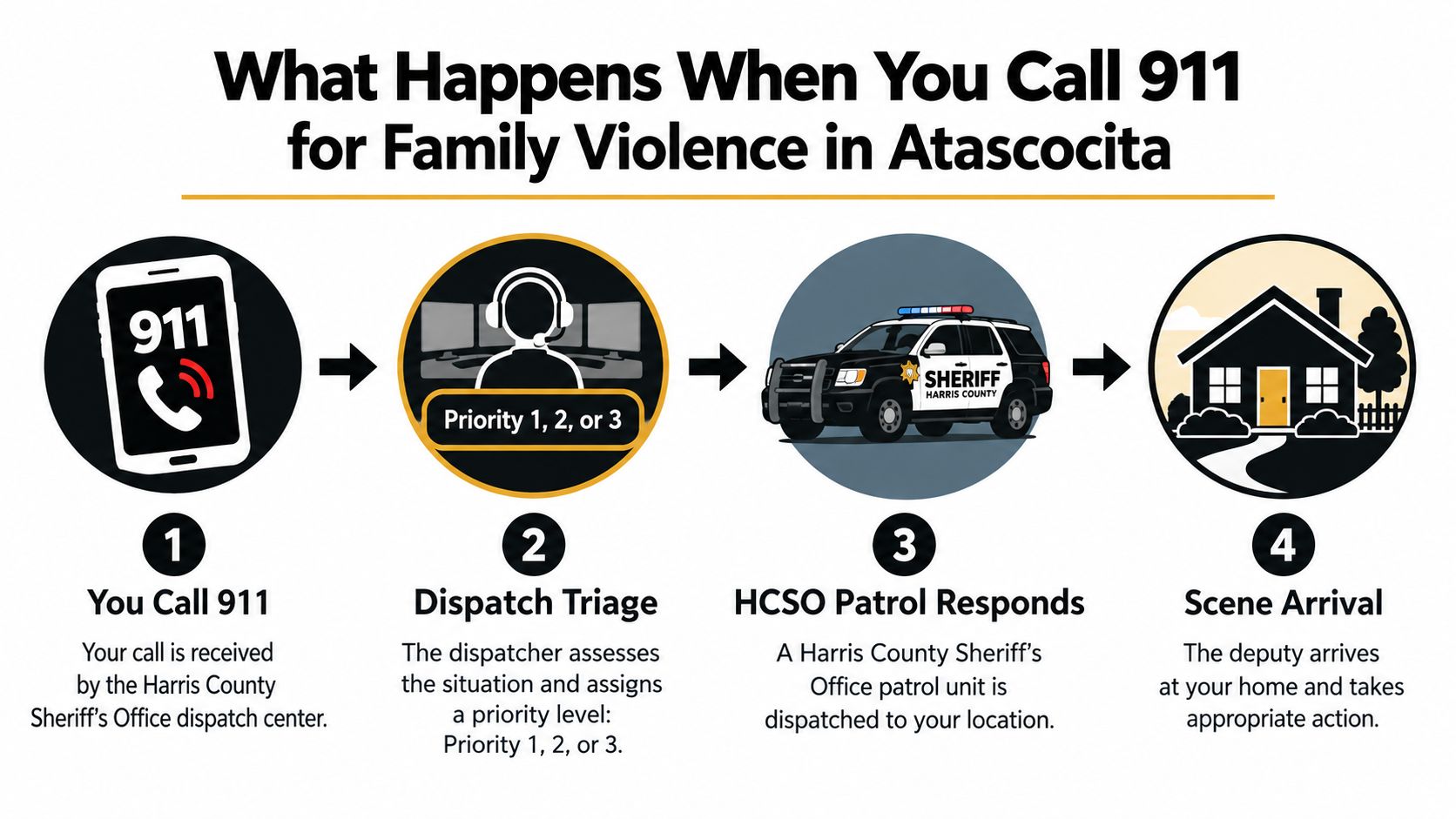
What Happens When You Call 911 for Family Violence in Atascocita
Consider a common Atascocita situation. A couple is separating, one person blocks the doorway, and a child sees an object thrown across the room. The person at risk calls 911 from a bathroom. The dispatcher's first job is to identify where help is needed and whether danger is still active, not to decide who is legally right over the telephone.
Tell the dispatcher the address, whether anyone has been injured, whether the alleged aggressor has a weapon, whether children or other household members are present, and whether the person remains nearby. If you can safely provide your name and phone number, do so. If speaking could increase danger, follow the dispatcher's directions and communicate only what you safely can.
Dispatch priorities and the wait for deputies
Harris County uses priority classifications to help direct emergency resources. A Priority 1 call generally reflects an immediate threat requiring urgent action, while lower classifications may involve circumstances that aren't actively life-threatening. The dispatcher may keep you on the line, tell you where to move, or ask you to remain in a secure location.
Response time matters for more than comfort. A fast arrival can interrupt violence, help protect children, preserve physical evidence, and allow deputies to observe the scene while accounts and conditions are still fresh. Harris County's TeleDeputy expansion set an operational target to reduce Family Violence response times by 10 minutes across patrol districts, with the broader program aiming for about a 30% reduction in Priority 1 response times. In District 1, the stated benchmark was a change from 1:14:01 to 1:04:01. These figures show that family-violence response is treated as a measurable public-safety issue, not merely a routine patrol assignment. Harris County's TeleDeputy materials describe the connection between faster arrival and urgent intervention.
Practical rule: If danger is happening now, call 911. Victim-services contacts are important, but they aren't a substitute for emergency dispatch.
Keep away from rooms containing weapons, avoid confronting the other person, and move children toward a safer exit if you can do so without increasing the risk. Don't clean, delete, or rearrange anything after the incident unless necessary for immediate safety.
How Harris County Sheriff Deputies Respond on Scene
When Harris County Sheriff's Office deputies arrive at an Atascocita or Humble residence, they first address scene safety. They may separate the people involved, check for weapons, identify anyone who needs medical care, and determine whether the alleged aggressor is still present. Separation allows each person to speak without immediate pressure or intimidation.
A deputy may ask adults and children what happened, where each person was standing, whether anyone was struck or threatened, and whether earlier incidents occurred. Children may have information even if they weren't the direct target. Their presence can also affect safety decisions, custody concerns, and the need for additional services.
What deputies look for
The investigation generally develops from several sources rather than one answer:
-
Statements. Explain what happened in chronological order. Use direct language. Say whether you were hit, pushed, choked, restrained, threatened, or prevented from leaving. If you're afraid the violence will continue after deputies leave, say so clearly.
-
Physical conditions. Deputies may photograph injuries, damaged doors, broken phones, overturned furniture, or other changes at the scene. Medical records and photographs taken later can also help document harm.
-
Witness information. Neighbors, relatives, children, and other people who heard or saw events may be relevant. Text messages, voicemails, emails, social-media messages, and video may also help establish what occurred.
-
Prior conduct and current risk. Tell the deputy about earlier assaults, threats, stalking, weapons, escalating conduct, or attempts to return after being told to leave. Those facts can affect whether officers view the situation as an isolated argument or an ongoing safety threat.
Texas law and law-enforcement policies can permit an arrest without a warrant when an officer has probable cause to believe a person assaulted a family or household member and caused bodily injury. A policy example used in Texas also allows officers to seek an emergency protective order when the victim requests one or when officers believe there's a significant danger of future assaults. The Texas law-enforcement policy example illustrates why a clear description of injury and future fear matters.
A resident may also want broader information about Protective Orders in Atascocita when domestic violence or family safety concerns continue beyond the initial scene response. An officer can document facts and make an arrest decision, but a court controls protective-order terms.
Evidence Arrest Decisions and Emergency Protective Orders on the Spot
An arrest and a protective order are related, but they aren't the same thing. An arrest is a criminal-law action based on probable cause and the alleged offense. An emergency protective order is a court-issued civil protection tool that may restrict contact, travel, or proximity for a temporary period.
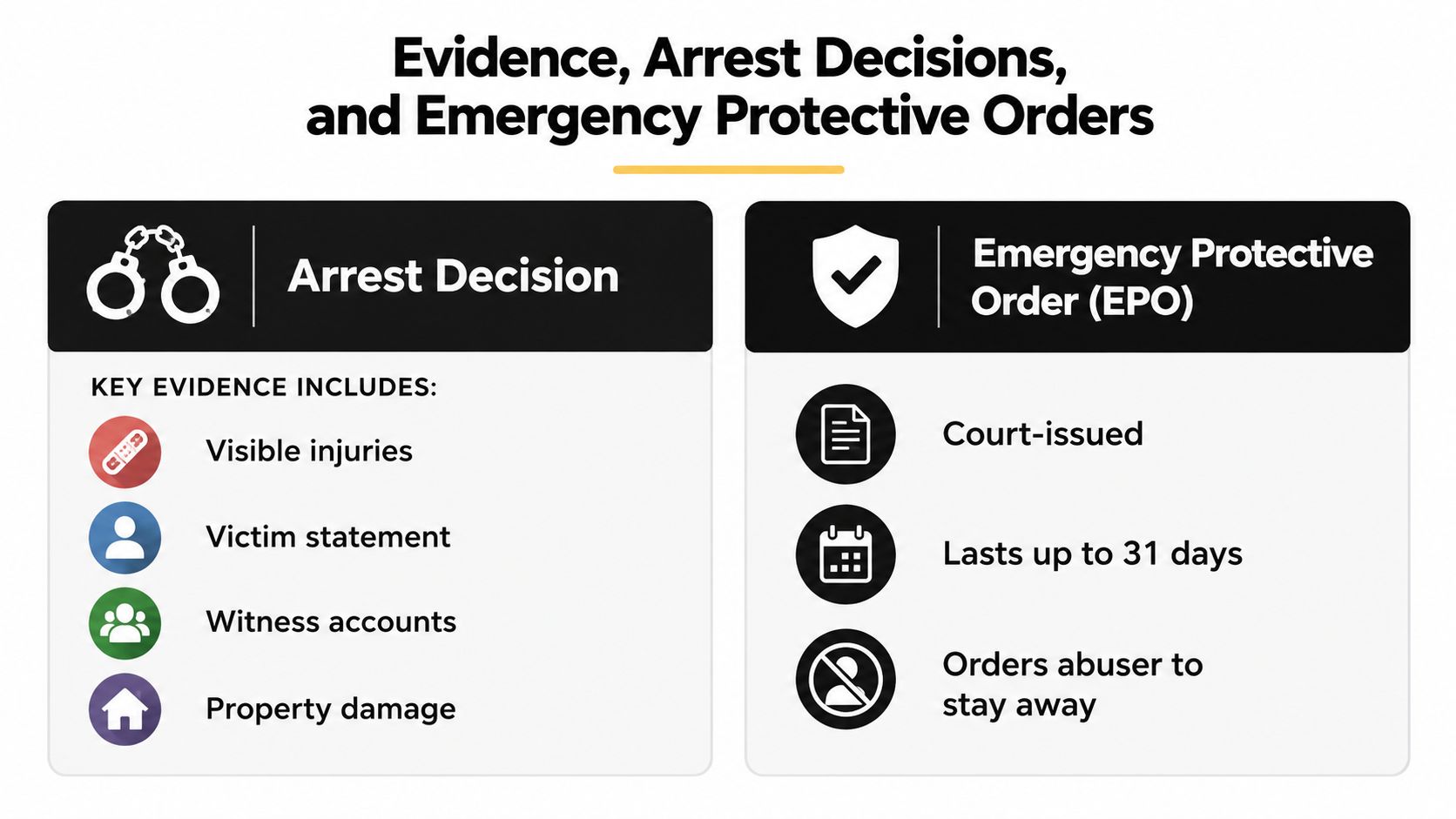
Deputies may collect photographs, witness accounts, recordings, damaged-property evidence, medical information, and statements from the people involved. They may compare those sources for consistency and assess whether the facts support probable cause. A person doesn't need to wait for a visible bruise before describing violence. Threats, restraint, prior conduct, and continuing danger should also be reported accurately.
Why timing affects an emergency order
Texas protective-order law provides that a magistrate may issue a specific emergency protective order only at the time of an arrest for a family-violence or sexual-assault offense. The order is temporary. It isn't a general order that a resident can request whenever they choose, days after an incident, without the required arrest event. TexasLawHelp's explanation of emergency protective orders describes that limitation.
That rule creates an important practical distinction. If deputies arrest someone and the victim asks for emergency protection, the request may be considered through that arrest-related process. If no arrest occurs, the victim may still have other protective-order options, but the particular magistrate emergency order isn't available on demand.
The infographic identifies a temporary emergency order as lasting up to 31 days and directing an alleged abuser to stay away. Because protection terms depend on the order issued, read the paperwork carefully and ask what conduct is prohibited. Don't assume that a verbal instruction to leave has the same legal effect as a court order.
For information about the criminal consequences of an allegation or arrest, see assault involving family violence in Atascocita. If you're arrested, don't discuss the facts with the alleged victim or post about the incident. Ask for a lawyer and follow every release condition.
Your Rights and Immediate Safety Steps After Deputies Leave
The hours after deputies leave can feel confusing, particularly when the other person wasn't arrested or when children, pets, shared accounts, and housing make separation difficult. A police response doesn't automatically create a long-term safety plan. You may need to take several separate steps, and you can take them in a careful order.
Harris County Sheriff's Office guidance says victims should tell the investigating peace officer immediately if a child or household resident has been injured, or if danger is expected after the officer leaves. The same guidance recognizes a victim's right to ask the local prosecutor to file a criminal complaint and to apply to a court for a protective order. HCSO victim guidance provides those rights and reporting directions.
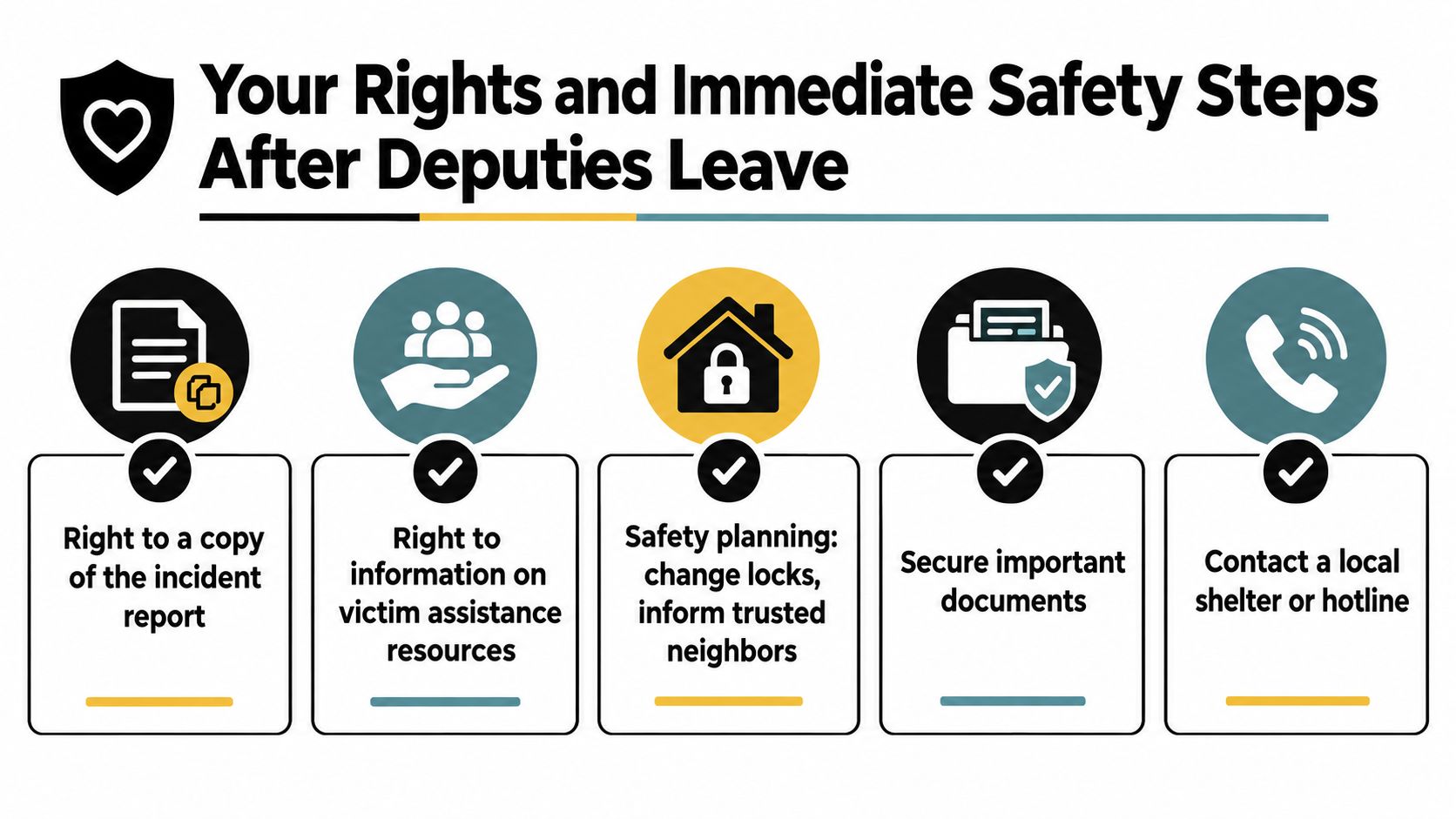
A first-day safety checklist
-
Confirm immediate shelter. Stay with a trusted person, use a local shelter, or choose another location the aggressor doesn't know. Don't announce your location publicly.
-
Preserve evidence safely. Photograph injuries and property damage, save messages and voicemails, and write down what happened while your memory is fresh. Store copies somewhere the other person can't access.
-
Plan for children. Tell a trusted caregiver or school contact what's happening when appropriate. Keep essential medications, identification, school information, and comfort items available.
-
Secure important documents. Gather passports, birth certificates, financial records, insurance information, prescriptions, and custody paperwork. If taking documents creates danger, prioritize safety and obtain replacements later.
-
Follow up with victim services. The Crime Victim Assistance Unit is staffed Monday through Friday from 7:00 a.m. to 4:00 p.m., with return calls by the next business day. It can be reached at 713-274-9369, and text questions are accepted at 832-470-6772 in English or Spanish. The HCSO Family Violence Unit can be reached at 713-274-9370. Harris County victim-services information lists the distinction between emergency calls and follow-up support.
If a child is injured or remains at risk, report that directly rather than assuming another person has done so. A family may also need to address wills, beneficiary designations, and guardianship concerns. Estate Planning Attorney in Atascocita covers wills, trusts, and estate plans for Atascocita families.
How to Obtain a Protective Order in Harris County
An emergency protective order connected to an arrest is only one possible form of protection. A person experiencing family violence may also pursue a protective order through the Harris County court process. The court, not the responding deputy, decides whether to issue that order and what restrictions it contains.
Start by collecting a clear account of the conduct. Include dates when known, threats, physical acts, stalking or unwanted contact, children's involvement, weapons, injuries, property damage, prior police calls, and why you believe future harm is possible. Attach safe copies of photographs, messages, medical records, witness information, and incident details where the filing process permits.
The court process in practical terms
-
Identify the correct filing path. Harris County residents may need to work through the appropriate county protective-order process. Ask the clerk or an attorney which forms and filing location apply to your circumstances.
-
Describe the requested protection. Explain whether you need no-contact terms, stay-away provisions, protection for children, or other restrictions. Use facts rather than conclusions. “He threatened to return tonight and showed me a firearm” is more useful than “I feel unsafe” by itself.
-
Prepare for a hearing. The respondent may receive notice and have an opportunity to participate. Bring organized records and be prepared to answer questions directly. If appearing in person creates a safety concern, raise that concern with the court or your attorney before the hearing.
-
Follow the issued order exactly. Read the effective dates, protected people, locations, and prohibited conduct. Keep a copy accessible. If the respondent violates the order, preserve proof and contact law enforcement when the violation creates an immediate threat.
Temporary separation and emergency custody can overlap with divorce or custody litigation. A protective order doesn't automatically decide every custody issue, and a custody dispute doesn't make active violence a merely civil disagreement. The facts determine which legal tools are appropriate.
Residents looking for a plain-language overview can review what a protective order means in Texas. If an existing divorce decree or custody order conflicts with new safety concerns, Enforcement of Court Orders in Atascocita addresses enforcing divorce decree and custody-order provisions in Harris County.
When and How an Atascocita Attorney Can Help With Family Violence Cases
Legal help can be useful even when the immediate police response is over. A victim may need assistance preparing a protective-order application, addressing temporary separation, requesting safer possession and access arrangements, or coordinating family-law filings involving divorce, custody, or support. A person accused of violence may need separate criminal-defense advice and must avoid contacting the alleged victim in ways that could create new allegations or violate release conditions.
The legal problem often has more than one track:
-
Safety and protection. A protective-order lawyer can help organize facts, identify requested restrictions, and prepare for a hearing.
-
Family law. Violence allegations can affect temporary orders, possession schedules, exchanges, conservatorship, and the children's immediate living arrangements.
-
Criminal defense. An arrest can lead to criminal proceedings independent of the victim's wishes. The accused person should preserve evidence and communicate through counsel where appropriate.
-
Long-term planning. A separation may require changes to beneficiaries, powers of attorney, access to accounts, and guardianship planning. Those choices should be made carefully and lawfully.
Bring the incident number, court papers, bond or release conditions, photographs, medical records, messages, witness names, and a written timeline to a consultation. If children are involved, include school schedules, existing custody orders, and any information about unsafe exchanges. Don't delete messages or alter digital evidence because it seems embarrassing.
The Law Office of Bryan Fagan – Atascocita TX Lawyers handles family law, criminal defense, estate planning, and civil matters for residents of Atascocita, Humble, and Harris County. A local attorney can help you understand which court process applies, what immediate restrictions may be available, and how a family-violence allegation may affect related custody or criminal matters. Information about a restraining-order attorney in Atascocita is one starting point for residents seeking case-specific guidance.
Taking the Next Step Toward Safety and Legal Protection in Atascocita
The local response is not limited to the moment a deputy arrives. It may involve 911 dispatch, HCSO deputies, victim advocates, prosecutors, magistrates, protective-order courts, and family courts. Each part has a different role, so knowing what one part can do prevents dangerous gaps in the plan.
If danger is active, call 911 and tell dispatch where you are, who is at risk, whether weapons or injuries are involved, and whether children are present. When deputies arrive, describe injuries, prior violence, threats, and the danger you expect after they leave. Ask about victim-services follow-up, preserve evidence safely, and pursue court protection promptly when ongoing contact or separation makes the risk continue.
Harris County reported 46,059 family-violence incidents in 2022, or 961.4 incidents per 100,000 residents, even after an 8% decline from 2021. Intimate-partner homicides rose from 60 in 2021 to 64 in 2022, a 7% increase, and University of Houston researchers found the regional figure had risen from 32 in 2019 to 64 in 2022. The Harris County report summarizing these figures underscores why Atascocita residents should treat family violence as a serious safety and legal issue, even when the first incident doesn't result in an arrest.
You don't have to solve every legal question before asking for help. A calm conversation with an attorney can clarify protective orders, custody, divorce, criminal-defense concerns, and immediate safety planning for your household.
The Law Office of Bryan Fagan – Atascocita TX Lawyers provides guidance on protective orders, family law, criminal defense, custody, divorce, and estate planning for residents of Atascocita, Humble, and northeast Harris County. Schedule a free consultation through Law Office of Bryan Fagan – Atascocita TX Lawyers to discuss the next safe and practical step for your family.