Skip to content

You're in Atascocita, trying to understand what happens next after a late-night argument turned into an arrest, a 911 call, or a protective-order notice. Maybe you're the accused person, sleeping somewhere else because bond conditions prohibit contact. Maybe you're the person seeking safety, waiting for paperwork to be approved while wondering whether the respondent can be found and served. In either situation, the legal process moves quickly, and confusion creates risk.
Assault family violence cases in Atascocita are handled within Harris County, not through a local municipal court. The case may involve criminal charges, protective orders, bond restrictions, custody consequences, and evidence that affects several proceedings at once. This guide explains the Texas definitions, Harris County procedures, differences among emergency and civil protections, immediate steps for both sides, and practical defense issues.
Understanding Assault Family Violence in Atascocita
A parent in Atascocita gets a call after midnight. Their adult child has been arrested following a heated argument at home. The parent is frightened, the accused person is confused, and everyone assumes the alleged victim can “drop the charges.” That assumption is wrong. The Harris County District Attorney's Office decides whether a criminal case continues, not the person who made the report.
A different situation is just as urgent. A spouse in Kingwood returns home and finds a temporary protective order attached to the door. The order may restrict contact, access to the residence, and communication involving children. Even if the accused believes the allegations are exaggerated, ignoring the order can create a separate criminal problem and damage a related custody case.
Atascocita residents should understand the jurisdiction first. Harris County prosecutors handle these cases, and Houston-area courts hear them. A municipal court generally isn't the forum for resolving the criminal and family-law consequences of an assault family violence allegation. The location of the incident, the relationship between the people involved, and the facts documented by law enforcement all matter.
Why the relationship matters
Texas treats an assault differently when the alleged victim is a spouse, former spouse, dating partner, household member, family member, or person connected through a household or family relationship. The relationship can affect the charge, bond conditions, protective-order proceedings, and future custody analysis.
The consequences can also extend beyond a jail sentence or probation. A family-violence finding may affect firearm possession, employment, professional licensing, immigration status, housing, and parental rights. Those consequences depend on the charge, conviction, order, and individual circumstances, so early legal advice matters.
Practical rule: Treat the first police report, bond hearing, and protective-order filing as important evidence events. Don't wait for a formal indictment before protecting your rights or safety.
Harris County's family-law structure also matters when a criminal allegation overlaps with divorce or custody. Residents who need a local overview of how family-law cases proceed can review Harris County Family Courts: A Atascocita Resident's Guide, which addresses the Harris County courts serving Atascocita.
Texas Definitions and Penalty Tiers for Family Violence
Texas doesn't create one universal offense called “domestic violence.” Instead, prosecutors generally charge a specific offense, often assault under Texas Penal Code § 22.01, and the family or dating relationship supplies the family-violence context. Texas Family Code § 71.004 defines family violence through conduct intended to cause physical harm, bodily injury, assault, or sexual assault, along with threats that reasonably place a family or household member in fear of imminent harm. The statute also addresses abuse of a child and dating violence. These statutory definitions are summarized in the Texas Penal Code and Family Code materials discussed by Texas legal guidance on family assault definitions.
The charge can arise from more than a dramatic injury. Texas assault law includes conduct that intentionally, knowingly, or recklessly causes bodily injury, and bodily injury can include physical pain. A red mark after someone grabs an arm may become evidence of bodily injury even when no hospital visit occurred. Threats of imminent bodily injury and offensive physical contact can also support an assault allegation, depending on the facts and charging language.
The basic tiers
| Offense Level | Conduct Required | Penalty Range | Key Collateral Consequences |
|---|---|---|---|
| Class C misdemeanor | Certain threats or offensive-contact allegations, depending on the facts and charging statute | Fine exposure can reach $500 for a Class C offense | A family-violence finding can still affect custody, firearm rights, reputation, and later charging decisions |
| Class A misdemeanor | Bodily injury assault in a qualifying family, household, or dating relationship | Up to 1 year in county jail and a fine up to $4,000 | Firearm restrictions, custody concerns, employment consequences, and immigration risks may follow |
| Third-degree felony | Conduct such as continuous violence against the family or an assault enhanced by qualifying prior history | Felony punishment applies under the specific statute and charging theory | Felony record, firearm restrictions, professional consequences, custody impact, and immigration concerns |
| Second-degree felony | More serious conduct, such as aggravated assault involving serious bodily injury or a deadly weapon, depending on the allegations | Felony punishment applies under the specific statute | Severe liberty consequences and lasting restrictions can follow a conviction |
The table is a starting point, not a prediction. The exact charging document controls. A prior qualifying conviction can increase the severity of a later family assault charge, while allegations involving strangulation, serious bodily injury, or a deadly weapon can lead to felony treatment.
Continuous violence is cumulative
Texas Penal Code § 25.11 applies when a person commits at least two qualifying assault acts against a family member, household member, or dating partner within 12 months or less. The statute matters because the State may focus on a pattern rather than one isolated event. Prior incidents can affect criminal exposure, protective-order strategy, and custody-risk analysis even when the earlier event didn't result in a conviction. See the Texas courts' materials on continuous violence against the family for the statutory framework.
How Family Violence Cases Proceed in Harris County
The process often starts with arrest and booking, not with a leisurely investigation. An accused person may be taken to the Harris County Joint Processing Center, while the alleged victim begins dealing with law enforcement, prosecutors, advocates, and possible protective-order proceedings. The first decisions can affect where the accused sleeps, whether the parties can communicate, and how evidence is preserved.

Arrest, magistration, and bond
After booking, a magistrate addresses probable cause and bond-related conditions. This appearance commonly occurs within 48 hours, although the exact timing depends on the circumstances. A magistrate may impose no-contact terms, restrictions on returning to a shared residence, geographic limits, or other conditions. Violating those terms can lead to arrest, bond revocation, or additional charges.
The Harris County District Attorney's Office reviews the case through its domestic-violence functions and decides whether to file formal charges. The alleged victim's request to end the case doesn't automatically stop prosecution. Investigators may preserve 911 recordings, body-camera footage, photographs, medical records, witness accounts, and text messages before the case reaches a meaningful court setting.
For a plain-language explanation of the first formal court appearance, review what happens at an arraignment hearing. The accused should have counsel before making statements about the incident.
The waiting period creates practical problems
Harris County guidance says obtaining a protective order can take four to six weeks, beginning with a trained caseworker and prosecutor review before filing in family court. That timeline creates a serious safety concern when the respondent hasn't been served. A person may have completed an application yet still be waiting for the legal restrictions to reach the respondent in an enforceable way.
Service depends on a physical address. Relocations, hidden addresses, unstable housing, and evasive conduct can make service difficult. Harris County's protective-order process requires that the applicant or respondent live in Harris County, or that the violence occurred there, but satisfying venue requirements doesn't guarantee quick service.
The criminal case and civil protection process can also overlap with divorce or custody enforcement. Residents dealing with violations of an existing decree or custody order may need information about Enforcement of Court Orders in Atascocita, which concerns enforcing divorce decree and custody-order provisions in Harris County.
Protective Orders and Emergency Protections Explained
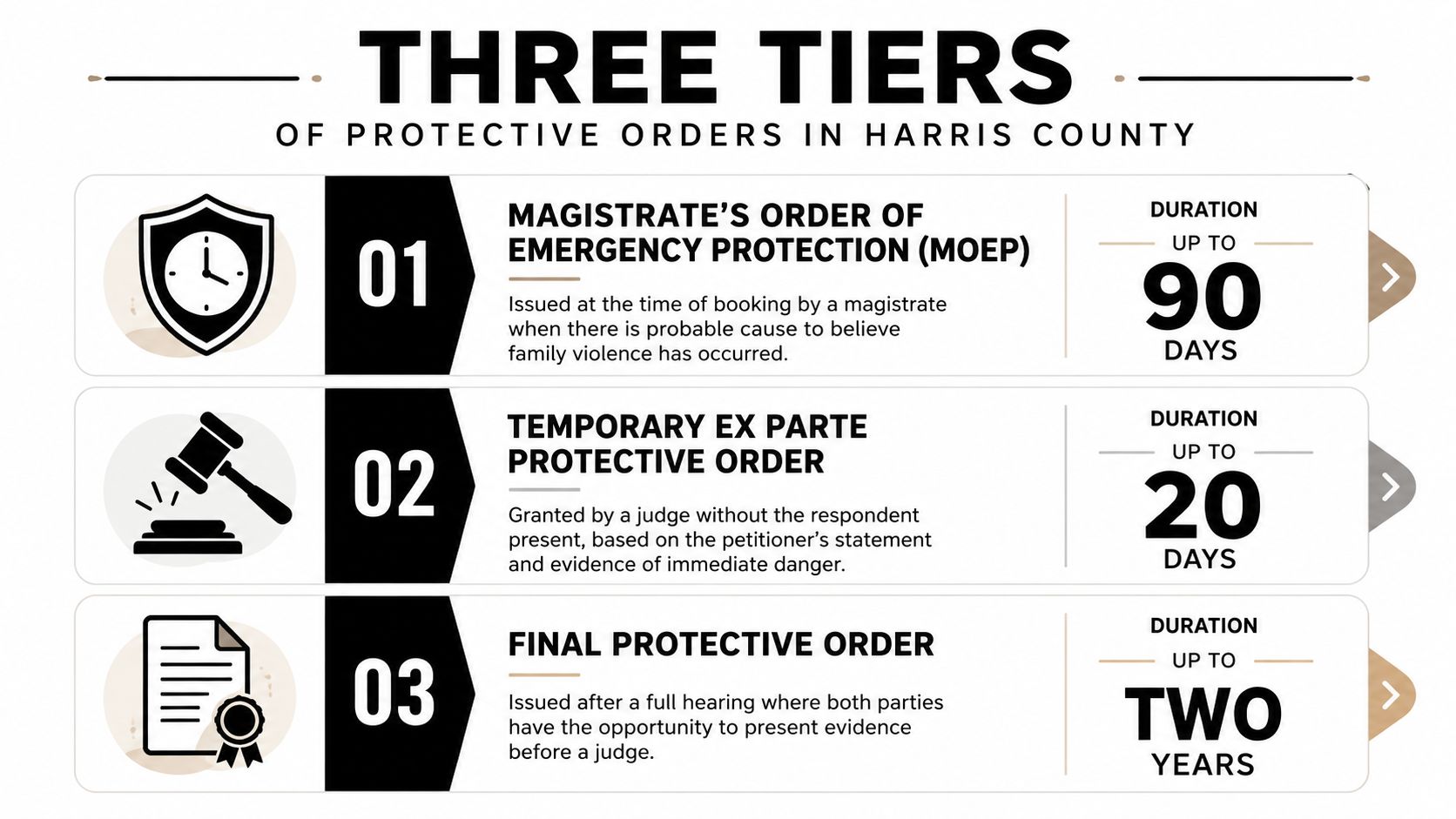
People often use “protective order” as if it describes one document. In Harris County, MOEPs, temporary ex parte protective orders, and final protective orders are different mechanisms. They arise through different procedures, depend on different facts, and create different enforcement risks.
Magistrate's Order of Emergency Protection
A Magistrate's Order of Emergency Protection, or MOEP, is connected to the criminal process after an arrest for family violence, stalking, or sexual assault. Harris County Constable Precinct 7 explains that a MOEP is intended to stop abusive, threatening, harassing conduct and contact with the victim. The magistrate must issue one when the charge involves serious bodily injury or the use or exhibition of a deadly weapon. See the Harris County Constable Precinct 7 explanation of MOEPs.
A MOEP isn't the same as a final civil protective order. Its terms control until it expires or is modified by the proper court. The accused must read every restriction, including limits involving the home, workplace, children, firearms, and third-party communication.
Temporary ex parte protective orders
A temporary ex parte order is requested through a civil protective-order process. The applicant presents sworn information to a judge, usually without the respondent present at that initial decision. Texas guidance states that a court may issue a protective order upon finding that family violence occurred, and the court doesn't need a separate finding that future violence will occur to grant the order. Review the Texas protective-order benchbook guidance.
The practical weakness is service. Harris County says the process can take four to six weeks to obtain, and the respondent must still be located and served. An applicant should ask about emergency safety options while waiting rather than assuming a filed application immediately creates enforceable protection.
Final protective orders
A final protective order follows notice and a hearing. The court evaluates the evidence presented by both sides. A final order can restrict contact, communication, residence access, and other conduct, and it can affect later custody proceedings.
A temporary order doesn't guarantee a final order. The applicant must prepare for a contested hearing, preserve corroborating evidence, identify witnesses, and attend court. Harris County states that the applicant must appear in person at the hearing or the case may be dismissed. For a broader overview, see what a protective order is.
Violating a protective order is a separate offense. The Texas State Law Library explains that a violation is generally a Class A misdemeanor, but it can become a felony in circumstances such as qualifying prior violations or conduct involving assault or stalking. Read the Texas State Law Library enforcement guidance before assuming a friendly text or an invitation to return home makes contact lawful.
Immediate Steps for Victims and the Accused
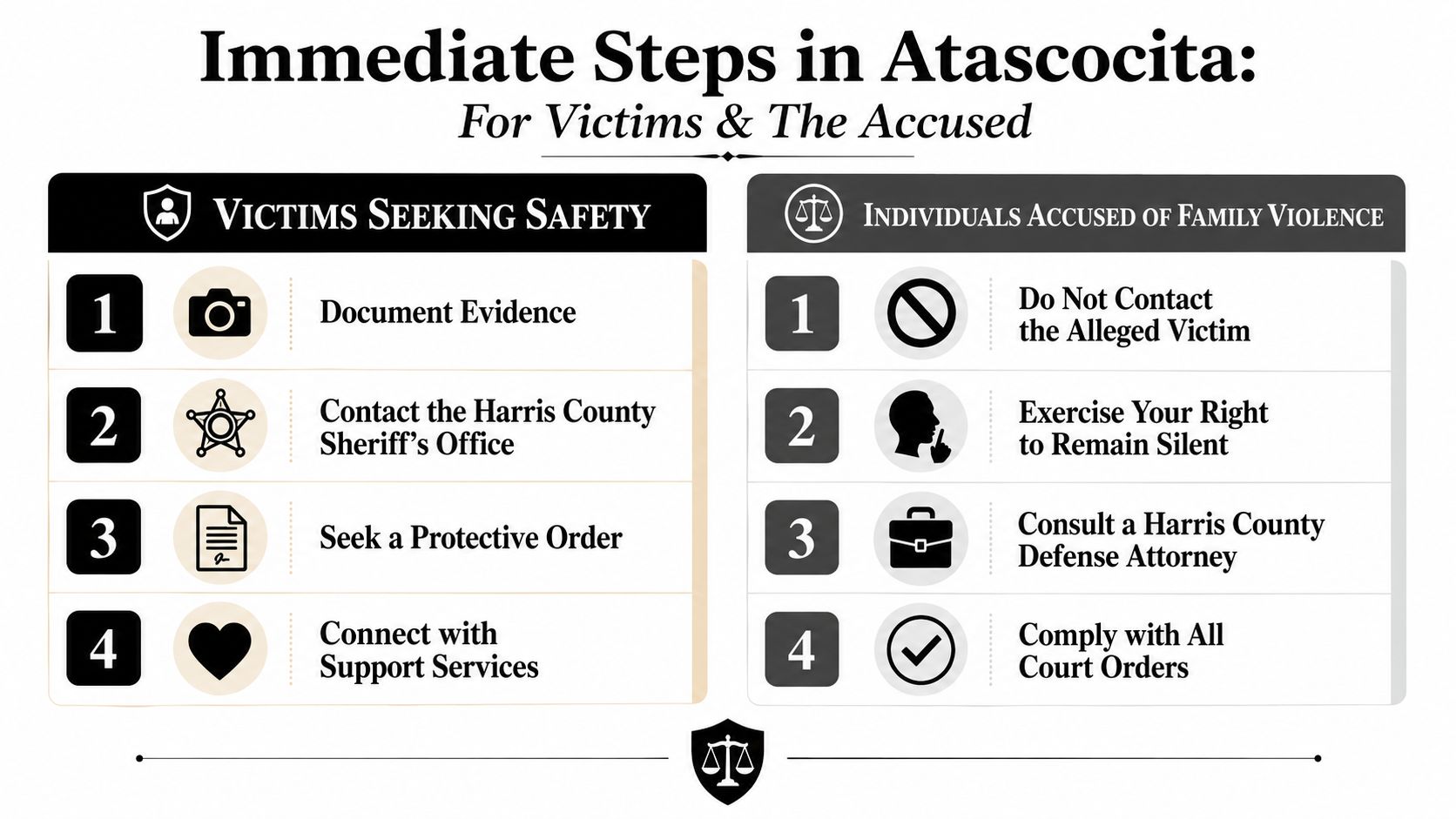
The first priority is safety. The second is preserving reliable evidence. The same incident can generate a criminal case, a protective-order case, and a custody dispute, so casual texts, deleted posts, or missed court dates can have consequences in more than one forum.
If you're seeking safety
- Move somewhere secure: If the shared home feels unsafe, stay with a trusted person or use an appropriate support resource. Don't announce the location publicly.
- Document injuries promptly: Take clear photographs and preserve medical records. Add dates and a short factual description, but don't alter the original files.
- Preserve communications: Keep threatening texts, voicemails, emails, social-media messages, and call records. Save copies somewhere the respondent can't access.
- Identify witnesses: Write down the names of people who saw the incident, heard threats, observed injuries, or saw what happened afterward.
- Ask about a temporary order: Contact the Harris County process through the trained caseworker and prosecutor review. Ask specifically what emergency safety measures are available while service is pending.
- Attend every hearing: Harris County warns that the applicant must attend the hearing in person or the case may be dismissed.
The process can require the respondent's physical address for service. If the person has moved, uses multiple addresses, or is difficult to locate, tell the caseworker immediately. Filing alone isn't the same as completed service.
If you're accused
Invoke your right to remain silent before answering questions from deputies or investigators. Don't contact the alleged victim directly, through relatives, through friends, or through social media. A single message can be treated as a bond violation or evidence of prohibited contact, even if the message sounds apologetic or the other person initiated the conversation.
Preserve your own evidence. Write down your timeline for counsel, identify alibi witnesses, request preservation of nearby surveillance footage, and avoid deleting messages or posting about the incident. Don't return to the shared residence unless the written bond terms or court order clearly allow it.
For a general explanation of how domestic abuse bail works from Blandon Bail Bonds, Inc., remember that bond release doesn't eliminate court restrictions. Read the actual bond paperwork and have an attorney explain unclear terms before acting.
Common Defenses Against Family Violence Charges
A family relationship doesn't prove an assault. The State still must prove the charged offense and each required element beyond a reasonable doubt in a criminal case. A strong defense starts by testing the evidence, not by assuming that a complainant's later change of heart will end the prosecution.
Self-defense and defense of others
Texas law recognizes defensive force in appropriate circumstances. The force must be connected to the perceived threat and legally justified under the facts. Photos, 911 recordings, body-camera footage, neighbor video, and witness accounts can support or undermine the claim.
An attorney should look for the sequence, not just the final injury. Who initiated contact? Was someone blocking an exit? Did the accused protect a child or another person? Did officers record statements that differ from the later account?
Accident, lack of intent, and disputed contact
Some allegations arise from a collision, an attempt to leave, mutual movement during an argument, or conduct the accused says wasn't intentional. Texas assault law can include reckless conduct, so “it was an accident” isn't automatically enough. Counsel must compare the physical evidence, witness accounts, photographs, and exact wording of the complaint.
A lack of visible injury also doesn't automatically defeat a bodily-injury allegation because Texas recognizes pain as bodily injury. Still, the State must prove the specific element alleged. Medical records, contemporaneous photographs, dispatch records, and inconsistent descriptions may expose a gap between the accusation and admissible proof.
Credibility and investigative failures
Custody or divorce conflict can create competing motives, but an attorney should rely on contradictions and objective evidence rather than labeling an allegation false. Compare statements made to deputies, medical personnel, family members, and child-protection investigators. Look for changes in timing, injury description, location, and claimed contact.
The defense may subpoena dispatch recordings, obtain Ring footage from nearby homes, interview witnesses, and preserve relevant digital evidence. Discovery violations can also require litigation under Texas Code of Criminal Procedure Article 39.14. Review the firm's criminal defense strategy guidance for the broader approach to investigating and challenging criminal allegations.
Consent or mutual combat arguments are highly fact-specific and can be misunderstood by jurors. The defense must explain exactly what happened, what contact was intended, and why the State's evidence doesn't establish the charged offense. Don't discuss those facts with the complainant or post an explanation online.
How the Law Office of Bryan Fagan Can Help
Assault family violence cases in Atascocita require coordination. The criminal case may involve Harris County prosecutors and criminal courts, while a protective-order case proceeds through family court and a custody or divorce case presents separate consequences. A lawyer who treats these as unrelated files may miss how one hearing, statement, or order affects the others.
The Law Office of Bryan Fagan – Atascocita TX Lawyers provides representation in criminal defense, family law, protective-order matters, custody, divorce, estate planning, and civil disputes. For a family-violence allegation, the work may include reviewing bond conditions, preparing for an emergency hearing, defending or pursuing a protective order, investigating recordings and witnesses, communicating with prosecutors, and coordinating the criminal strategy with custody or divorce proceedings.
Act before the situation hardens
The first 48 to 72 hours deserve immediate attention. During that period, the accused may face release conditions, no-contact terms, residence restrictions, and evidence that is still available from phones, cameras, and witnesses. A person seeking protection may need a safety plan, documentation, a caseworker interview, and a plan for service.
Don't assume the alleged victim can dismiss the criminal case. Don't assume a filed protective-order application has already been served. Don't assume a MOEP, temporary ex parte order, and final protective order impose identical restrictions. Get the actual paperwork reviewed and follow it precisely.
Schedule a confidential consultation with the Law Office of Bryan Fagan – Atascocita TX Lawyers if you're facing an allegation, an arrest, a protective-order hearing, or a custody dispute connected to family violence. Bring the charging paperwork, bond conditions, protective-order documents, relevant messages, photographs, and court dates so counsel can identify the immediate risks and the next lawful step.
The Law Office of Bryan Fagan – Atascocita TX Lawyers offers local criminal defense and family-law guidance for assault family violence allegations, protective orders, custody disputes, and related Harris County proceedings. Visit Law Office of Bryan Fagan – Atascocita TX Lawyers to schedule a free consultation and discuss your situation confidentially.