You're in the middle of an Atascocita divorce. One spouse will keep the Summerwood house, the decree assigns the mortgage, and everyone expects the property issue to be finished. Then an HOA notice arrives in the other spouse's name, a resale certificate is requested, an architectural violation appears, or unpaid assessments surface just as the property is being refinanced.
That surprise is common because Summerwood HOA deed restrictions in an Atascocita divorce operate on a track separate from the family court's property division. The decree can decide who receives the home, but it doesn't erase recorded covenants, unpaid assessments, unresolved violations, or transfer paperwork tied to the property.
When the House Stays but the HOA Keeps Calling
Consider a familiar Summerwood situation. During the divorce, the spouses agree that one parent will keep the home so the children can remain in the same Atascocita neighborhood. The decree awards that spouse the house and assigns responsibility for the mortgage. The departing spouse moves out, changes mailing addresses, and assumes the remaining paperwork is someone else's problem.
Months later, the HOA or its management company sends a notice addressed to the former spouse. The notice may concern an unpaid assessment, a resale certificate, an exterior modification, or a request for information needed for a refinance. The spouse who kept the home is frustrated. The former spouse argues that the decree transferred the property. Both are overlooking the same point: the divorce decree and the HOA's recorded rules answer different questions.
The family court determines how marital property is divided. The recorded restrictions govern the property's use and the owner's continuing obligations. Texas law treats an HOA deed restriction as a restrictive covenant recorded in a dedicatory instrument. Those restrictions can limit how the property is maintained, modified, occupied, or used, as explained by the Texas State Law Library's property owners association guidance.
Practical rule: Treat the Summerwood HOA file as part of the marital estate review, not as a post-divorce administrative detail.
The risk becomes sharper when the spouse keeping the home later wants to sell or refinance. A title company may need evidence that assessments are current, open violations are addressed, and the required resale or account documentation is available. A closing can slow down when the decree says who owns the home but says nothing about who must obtain the HOA documents or cure a fence, paint, roofing, or landscaping issue.
That's why the house should be analyzed in two ways before the decree is signed:
- As marital property: Determine whether the home is community or separate property, how its value and debt will be allocated, and whether one spouse will receive the property or the parties will sell it.
- As restricted real estate: Identify the recorded covenants, assessments, architectural requirements, occupancy rules, and transfer procedures that continue to affect the address.
- As a future transaction: Decide who will obtain HOA records, pay charges, correct violations, and deliver documents if the home is sold or refinanced.
A clean property award is helpful. It isn't a substitute for a coordinated transfer plan.
What Summerwood Deed Restrictions Actually Are
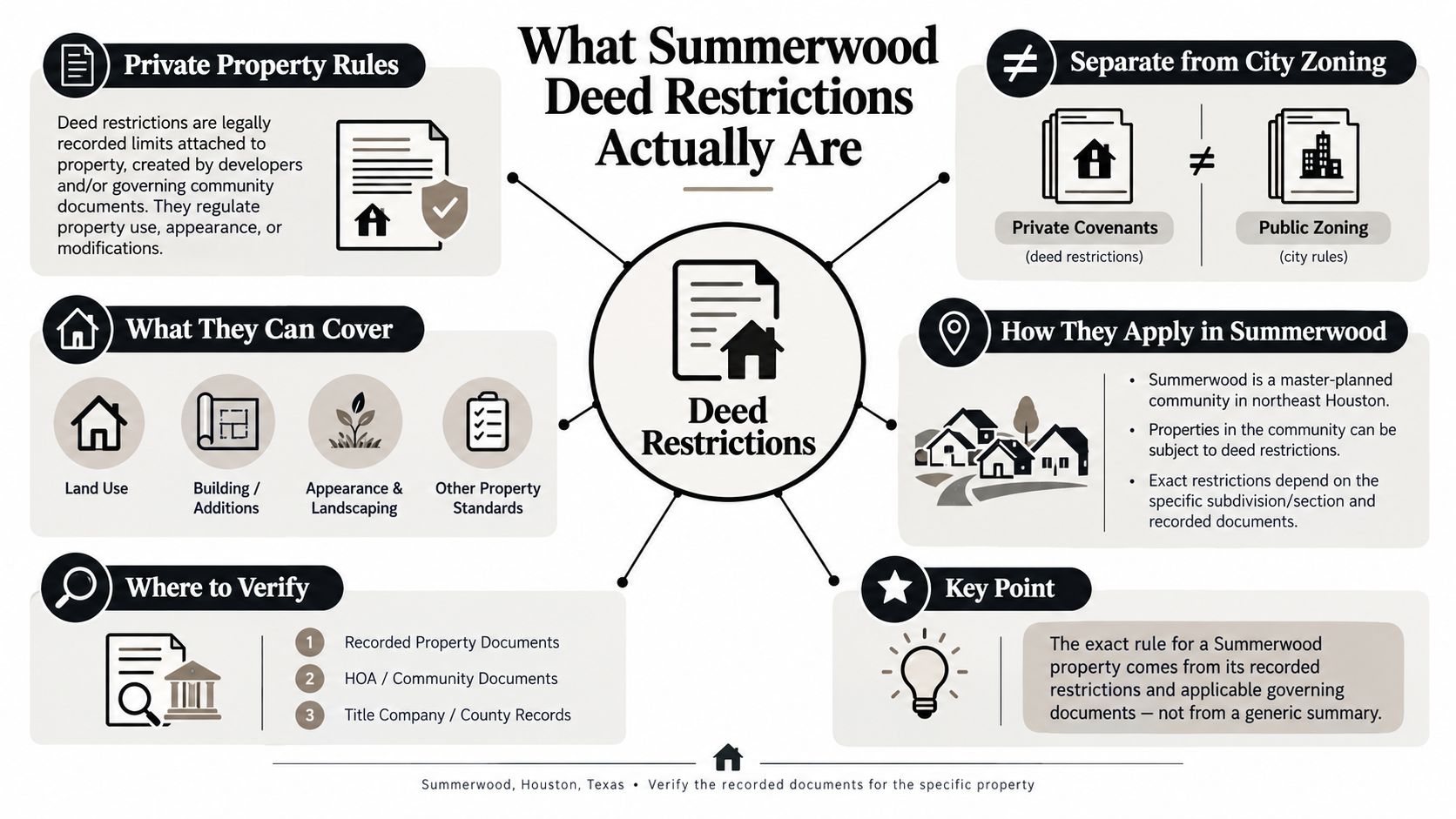
Think of deed restrictions as a rulebook attached to the address, not to the marriage. The rulebook may be recorded in the subdivision's declaration, plats, amendments, and related governing documents. If ownership changes, the rulebook generally stays with the land.
Texas materials describe CC&Rs as recorded documents that create a community's core restrictions and owner obligations. They generally apply to current and future owners because they run with the land. The City of Killeen's HOA and deed restriction guidance also explains the distinction between private deed restrictions and city enforcement. An HOA or property owners association typically enforces the private rules, while city zoning is a separate system.
Why the documents matter
The practical sequence is straightforward:
- Locate the recorded restrictions. Start with the current deed and the recorded declaration and amendments affecting the Summerwood property.
- Compare the documents with actual use. Review leasing, occupancy, exterior alteration, pet, vehicle, commercial-use, and maintenance requirements.
- Check the account. Request the assessment history, current balance, pending charges, and notices.
- Identify approval requirements. Find out whether an architectural control committee or management company must approve work before it begins.
- Build the findings into the decree. Assign responsibility for dues, violations, records, and future transfer costs.
The Harris County Clerk's records provide a way to trace the applicable rules. Restrictions filed after 1961 may be researched through the county's real property index by subdivision name, with entries such as RESTR or AMEND in the type field, as described by the Harris County deed restriction research guidance. Older restrictions may require microfilm research at the central location.
Community property law adds a separate layer. A house purchased during the marriage is generally community property regardless of whose name appears on the deed, unless separate-property funds can be proven. The court divides the marital property, but the spouse receiving the home takes the property subject to its recorded obligations. The divorce changes the ownership relationship between the spouses. It doesn't rewrite the subdivision's rulebook.
The Deed Restrictions That Hit Hardest During Divorce
Not every restriction creates the same problem. The most serious disputes usually involve rules that affect the home's value, its marketability, or a spouse's plan to use it after separation.
| Restriction Category | Typical Summerwood Rule | Divorce Impact |
|---|---|---|
| Leasing | Limits on leasing arrangements, tenant qualifications, or lease duration | A spouse may be unable to rent the home to cover the mortgage after moving out |
| Architectural control | Approval requirements for exterior changes, fences, colors, roofs, or additions | Unapproved work can create a violation that must be cured before a sale or refinance |
| Short-term rentals | Restrictions on transient or short-term occupancy | An Airbnb strategy may violate the private covenants |
| Pets and vehicles | Rules governing animals, parking, storage, or visible vehicles | A post-separation living arrangement may conflict with community requirements |
| Commercial use | Limits on business activity at the residence | Home-based business plans may require careful review |
| Maintenance | Standards for appearance and upkeep | A spouse keeping the home may inherit correction costs and compliance duties |
Leasing and occupancy
A spouse who moves out may want to rent the Summerwood home while the divorce is pending. That plan can fail if the governing documents impose leasing limits, minimum lease terms, tenant approval requirements, or other conditions. A decree awarding the house to one spouse doesn't create a right to rent it in a way the covenants prohibit.
The same issue arises when a custodial parent keeps the property but later needs rental income. The financial plan must account for the actual restrictions, not an assumption that any rental arrangement is permitted.
Architectural work
Exterior work deserves immediate attention. A fence replacement, new paint color, shed, driveway change, roofing material, or addition may require prior approval. Interior remodeling can also create problems when it changes exterior features or when the work affects a feature governed by the community documents.
Suppose one spouse began a kitchen and exterior renovation before trial and never obtained the required approval. The other spouse may argue that the work reduced value or created a liability. A buyer or lender may later demand documentation showing that the issue was approved or released. The dispute becomes part property valuation, part compliance, and part negotiation advantage.
Short-term rentals and household rules
Short-term rental activity can create a separate conflict from ordinary leasing. Pet, vehicle, parking, commercial-use, and maintenance provisions can also affect where a spouse lives, how the home is used, and what improvements are financially sensible.
The right approach is to obtain the actual recorded documents and current rules. Do not rely on a neighbor's interpretation or an old email from a former manager. The restriction that matters is the one that can be verified and enforced.
How the Divorce Court Splits the Home While the HOA Keeps Regulating It
A Summerwood property sits on two legal tracks during divorce. The first track is the family case. The second is the private covenant system attached to the land.
Texas law generally treats property and earnings acquired during marriage as community property. A divorce court divides community property under a just-and-right standard, rather than automatically dividing every asset equally. Separate property isn't divided, and the spouse claiming separate-property status must prove it with clear and convincing evidence, as explained in Texas property and debt division guidance.
The court may award the house to one spouse, order a buyout, or require a sale. It may also allocate the mortgage, taxes, insurance, repairs, and sale proceeds. But the court's order doesn't cancel HOA obligations or approve work that violated the covenants.
| Issue | Family Court Decides | Summerwood HOA Still Regulates |
|---|---|---|
| Ownership | Which spouse receives the property or whether it must be sold | The property remains subject to recorded covenants |
| Marital value | How equity and debt are allocated | Assessments and property-related charges remain attached to the account |
| Transfer | What each spouse must sign or deliver | Required HOA certificates, account information, and compliance records |
| Repairs | Which spouse bears the negotiated cost | Whether exterior work needs approval |
| Occupancy | Possession and use between the spouses | Community limits on leasing, occupancy, and permitted use |
The Texas guidance on who gets the house in a divorce is useful for understanding the family-law side, but the HOA file must be reviewed separately. The final decree should contain the complete legal description, and Texas homestead rules can restrict a sale, conveyance, or encumbrance without both spouses' joinder unless an exception applies. Those transfer requirements are addressed in the Texas Family Code materials on property division.
A spouse awarded the home may still face unpaid post-separation assessments, an unresolved fence issue, or a delayed account statement. If child support also affects the family's budget, a Child Support Attorney in Atascocita may address establishing, modifying, or enforcing support in Harris County while the property terms are being negotiated.
Enforcement Risks That Can Derail a Post-Divorce Sale
The closing problem usually starts earlier than the closing. Someone assumes the HOA account is current, an exterior project was approved, or the divorce decree itself will satisfy the management company. That assumption can leave the seller, buyer, lender, and former spouses arguing after a contract is already signed.
Account and certificate problems
A resale certificate, estoppel statement, or account status letter may reveal unpaid regular assessments, special assessments, transfer charges, administrative fees, or unreleased liens. The documents may also identify a pending violation or a requirement that must be satisfied before transfer. Texas law gives associations meaningful enforcement authority under recorded documents, and assessment liens can affect a transaction. A foreclosure or priority question requires attorney review, particularly where the parties dispute payment responsibility.
The decree should identify the assessment cutoff date and who pays charges incurred before and after separation. Without that allocation, the spouse keeping the home may pay first and try to recover the money later.
Architectural violations
An unapproved fence, shed, paint color, driveway, roof, or exterior alteration can delay a listing or refinance. The seller may need an approval letter, a retroactive application, corrective work, or written confirmation that the violation is closed. A buyer may negotiate a lower price when the cure is uncertain.
A decree that transfers the house but ignores an open violation transfers the problem too.
Leasing restrictions
A former spouse may plan to rent the home after moving out because the mortgage remains high or the buyout is not immediately possible. Community leasing rules may limit that strategy. Short-term rentals can create an additional issue if the documents prohibit transient occupancy.
These are not merely technical concerns. They can affect whether a spouse can preserve the asset, qualify for refinancing, or comply with the property division order.
When one spouse's failure to pay or obtain documents causes a transaction dispute, the resulting claim may involve contract duties as well as family-law enforcement. A lawyer reviewing that issue may also consider breach of contract remedies where the facts support it.
Practical Steps for Spouses and Attorneys Before Signing Anything
Do this work while the divorce is being negotiated. Waiting until after the decree or until a buyer is under contract is how avoidable delays become expensive disputes.
Start with a complete property file
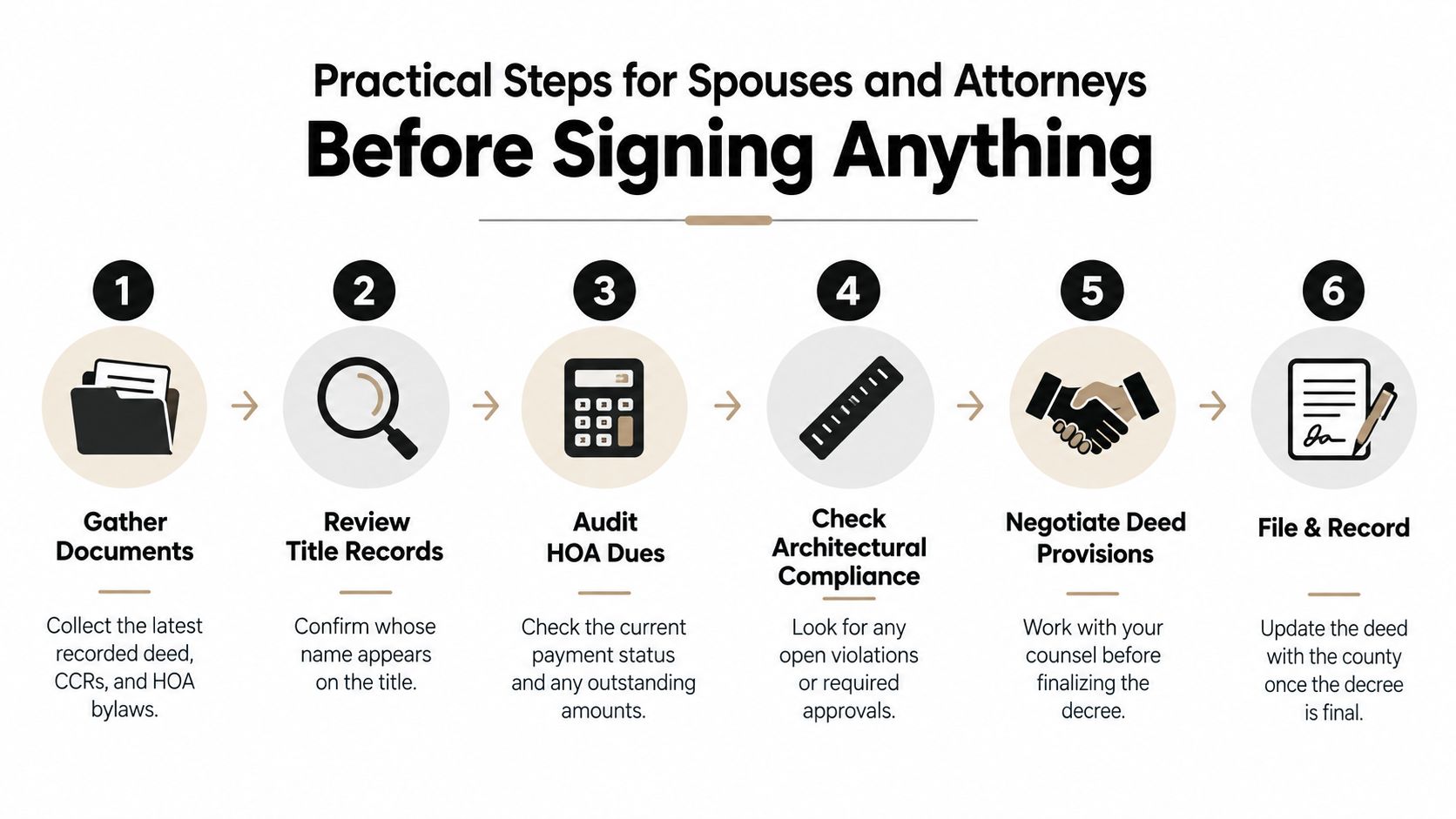
Collect the latest recorded deed, applicable Summerwood declarations and amendments, HOA bylaws and rules, prior architectural approval letters, assessment statements, violation notices, and the management company's contact information. Keep copies of emails about exterior work, leasing, or account balances. If either spouse has made changes to the property, list what was done, when it was done, and whether written approval exists.
The recorded restrictions should be verified through Harris County records rather than reconstructed from memory. The county index can help locate newer filings, while older records may require additional research.
Ask the HOA direct questions
Send a written request for:
- Account status: Ask for current regular assessments, special assessments, charges, credits, and payment history.
- Transfer requirements: Confirm whether a resale certificate, estoppel statement, account letter, or other document is required.
- Violation status: Request a written list of open notices and the steps required to close each one.
- Architectural records: Ask whether prior applications were approved and whether any work lacks documentation.
- Mailing information: Update the address for the spouse who will own the home after transfer.
A phone conversation can help, but written responses are easier to use when the spouses negotiate decree language or a closing instruction.
Put the agreement in the decree
The property provisions should address more than who receives the house. They should state who pays assessments from separation forward, who pays charges caused by a specific violation, who obtains resale or estoppel documents, and who must complete corrective work. If a spouse may rent the home, the agreement should account for the restrictions before relying on rental income.
The deed and the decree must also match. The legal description should be complete, and the post-decree deed should be prepared and recorded correctly. A transfer instrument that leaves the former spouse on title can create problems even when everyone believes ownership was resolved. The same disciplined review matters in estate planning documents, including questions addressed in what a lady bird deed is.
Coordinate the people involved
The family lawyer, title company, real estate agent, lender, and HOA management company should work from the same timeline. The agreement should identify who contacts each person and when. That coordination is especially important when the spouse keeping the home must refinance, when the parties are selling, or when a child's housing needs affect the timing of the transfer.
Your Next Steps and Local Help in Atascocita
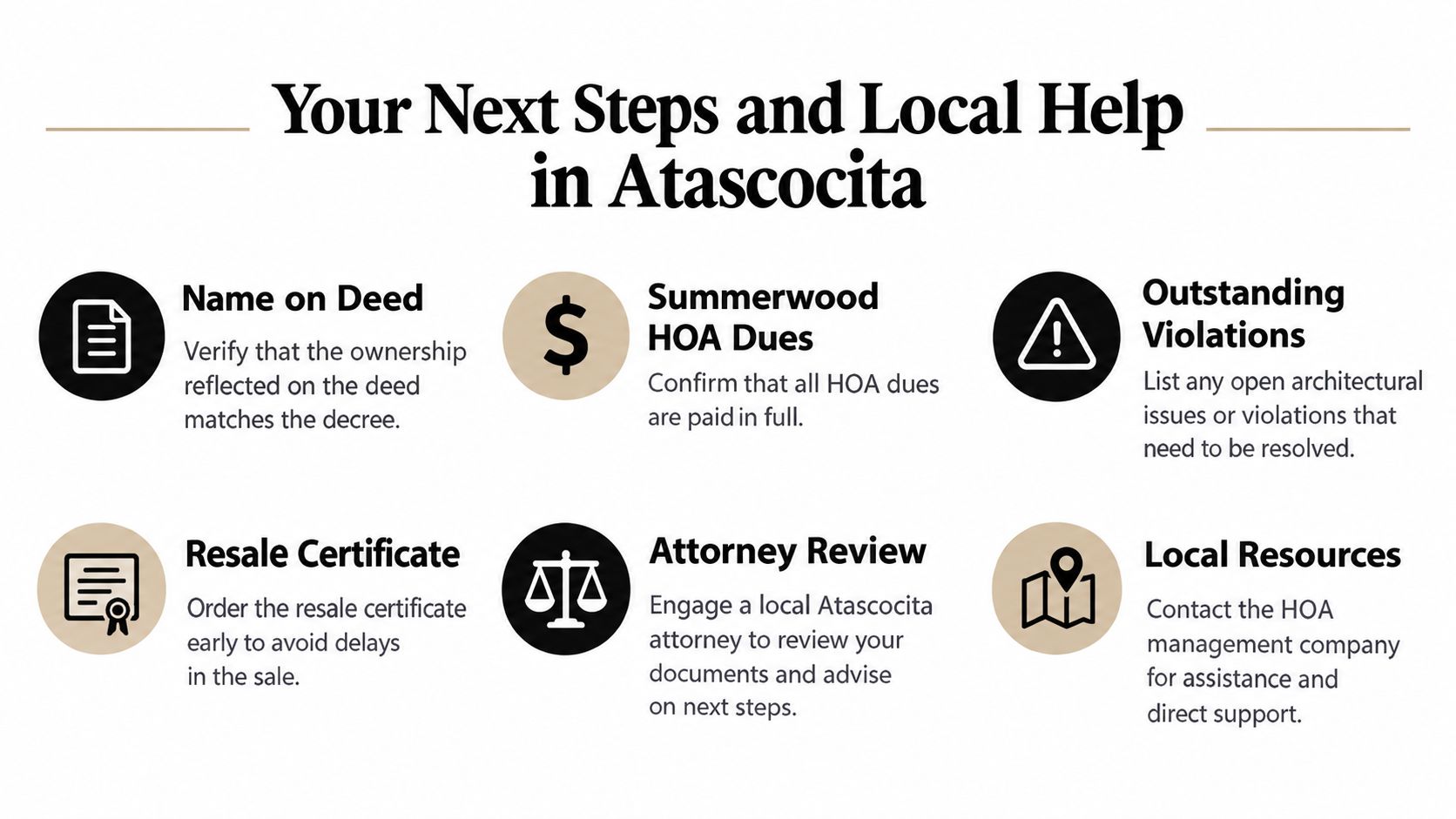
Before you sign a decree or list the Summerwood home, hand your attorney this checklist:
- Name on the deed: Confirm that the recorded ownership matches the divorce agreement.
- Summerwood HOA dues: Obtain written confirmation of payment status and identify any special assessment or balance.
- Outstanding violations: Get a current list of architectural or maintenance issues and the cure requirements.
- Resale certificate: Determine whether one is required and order it early if a sale or transfer is likely.
- Mailing address: Update the owner's address with the HOA or management company.
- Transfer paperwork: Make sure the decree, deed, title instructions, and HOA requirements are consistent.
Local records can answer different parts of the problem. The Harris County District Clerk can assist with case-record research, while the Harris County Appraisal District provides ownership and value information. The Summerwood HOA management company can explain account documentation, estoppel requests, and architectural forms. Your family-law attorney can then turn that information into enforceable decree language.
Timing matters. HOA paperwork, violation questions, and title issues often become visible near the end of a transaction, when the parties have less room to negotiate and a buyer expects answers. Starting early gives the spouses time to correct records, allocate costs, and decide whether keeping the home is financially workable after dues, repairs, transfer paperwork, and possible delays.
The best outcome isn't just awarding the house to one spouse. It's making sure that spouse can own, occupy, refinance, rent, or sell the property without inheriting an undisclosed compliance problem. A careful review turns the Summerwood rulebook into a manageable part of the divorce plan.

The Law Office of Bryan Fagan – Atascocita TX Lawyers can review your property division terms, coordinate the Summerwood HOA issues that affect the decree, and help you plan the deed, account, and closing documents. Visit Law Office of Bryan Fagan – Atascocita TX Lawyers to schedule a free consultation about your Atascocita divorce and the home you're trying to protect.