Under Texas law, unpaid cash medical support is a legally enforceable arrearage that a court can confirm as a cumulative money judgment, and delinquent support can generally accrue 6% simple annual interest. In Harris County, the Domestic Relations Office monitors and enforces this obligation alongside ordinary child support.
An Atascocita parent may discover the problem after an employer withholding change, a Medicaid notice, or a payment ledger that shows medical support separately from child support. The account may look like one debt, but it can contain different balances, different payment rules, and amounts owed to different recipients. A parent might owe the custodial parent for one period and the State of Texas for another.
That distinction affects what a lump-sum payment accomplishes, whether the Domestic Relations Office continues enforcement, and whether the right legal response is an accounting, prospective modification, credit request, or formal enforcement action. The practical starting point is always the controlling order and a reliable payment history.
What Cash Medical Support Arrears Are Under Texas Law
Cash medical support is a court-ordered contribution toward a child's medical coverage or medical expenses. It isn't merely an informal request that one parent reimburse the other after a doctor's visit. Texas treats unpaid medical support as an enforceable support obligation, and the wording of the order controls what was due, when it was due, and to whom it was payable.
Under Texas Family Code Chapter 157, when an enforcement motion requests a money judgment for medical-support arrears, the court must confirm the amount owed and render a cumulative medical-support judgment. That calculation may include unpaid medical support that hasn't previously been confirmed, balances from earlier medical-support judgments, and applicable interest.
Why the balance must be separated
Regular child-support principal, cash medical support, health-insurance premiums, and uninsured medical expenses can arise from different provisions of an order. Treating them as one undifferentiated figure makes it harder to identify a withholding error, prove a direct payment, or determine whether a state agency has an assigned claim.
Texas law generally imposes 6% simple annual interest on delinquent support exceeding the monthly periodic obligation, running from delinquency until payment or confirmation as a money judgment. The interest calculation and the underlying obligation should be reviewed against the order and account history, not estimated from memory.

A late payment doesn't automatically disappear because the parent later obtains insurance, loses a job, or disputes the amount. Those facts may support a request concerning future support, a credit, or an accounting, but a confirmation proceeding generally addresses what already accrued under the existing order. Parents can review the specific obligations and enforcement issues on the Atascocita cash medical support legal service page.
The timing also matters. A court may retain jurisdiction to confirm arrears if an enforcement motion is filed no later than the 10th anniversary of the date the support became due, as provided by Texas Family Code Section 101.004. That doesn't mean a parent should wait. Older records are harder to obtain, employers change, and payment evidence can become difficult to authenticate.
Practical rule: Before arguing about whether you paid enough, identify the exact support category, due date, recipient, and payment posting for every disputed period.
How Cash Medical Support Is Calculated and Tracked in Harris County
Cash medical support usually enters the picture when qualifying health insurance isn't available through a parent or another source. Under Texas Family Code Section 154.182, a court may order the obligor to pay the obligee up to 9% of the obligor's annual resources as cash medical support. The court must order it when the child receives Medicaid or another government medical-assistance plan, according to Texas Attorney General guidance on child support and public assistance.
That obligation is separate from guideline child support. A parent can therefore make every regular child-support payment and still have a medical-support arrearage if the medical-support line was missed or misallocated. The reverse can also occur. A ledger may show medical support paid while ordinary child support remains delinquent.
Read the order before reading the ledger
Start with the controlling decree or modification order. Look for:
- The monthly obligation: Identify the stated cash medical-support amount and the date it begins.
- The coverage provision: Determine whether the order requires insurance, premium payment, cash support, or a combination.
- The recipient: Check whether payment goes to the other parent, through the Texas Child Support Disbursement Unit, or through another designated process.
- The allocation language: Separate current child support, current medical support, prior arrears, insurance premiums, and uninsured expenses.
Then compare the order to the Texas Child Support Disbursement Unit payment ledger. Add insurance enrollment records, premium statements, medical bills, receipts, employer withholding records, and proof of any payment made directly to a provider. A payment made to an insurer or medical provider may be relevant to the accounting, but it may not have posted to the child-support account automatically.
The Medicaid assignment question
Medicaid can change who benefits from collection. When a child receives qualifying public medical assistance, the right to certain cash-medical-support collections may be assigned to the State of Texas. Collections can then be redirected to the Texas Health and Human Services Commission to reimburse Medicaid costs rather than paid entirely to the custodial parent.
That creates the hidden split in many cash medical support arrears Atascocita TX accounts. One balance may be owed directly to the custodial parent, while another is assigned to the state. Ask for an accounting that identifies the obligee for each portion. A single total without that breakdown doesn't tell you whether payment will restore household funds, reduce a state debt, or satisfy a current obligation first.
Harris County's support system operates at a substantial countywide scale. A Harris County budget document reports more than $176 million collected in child and medical support and identifies an 81% child-support collection rate. The figure combines child and medical support, so it isn't a measure of cash medical arrears alone, but it shows that these accounts function within an established collection system, not as isolated private reimbursements.
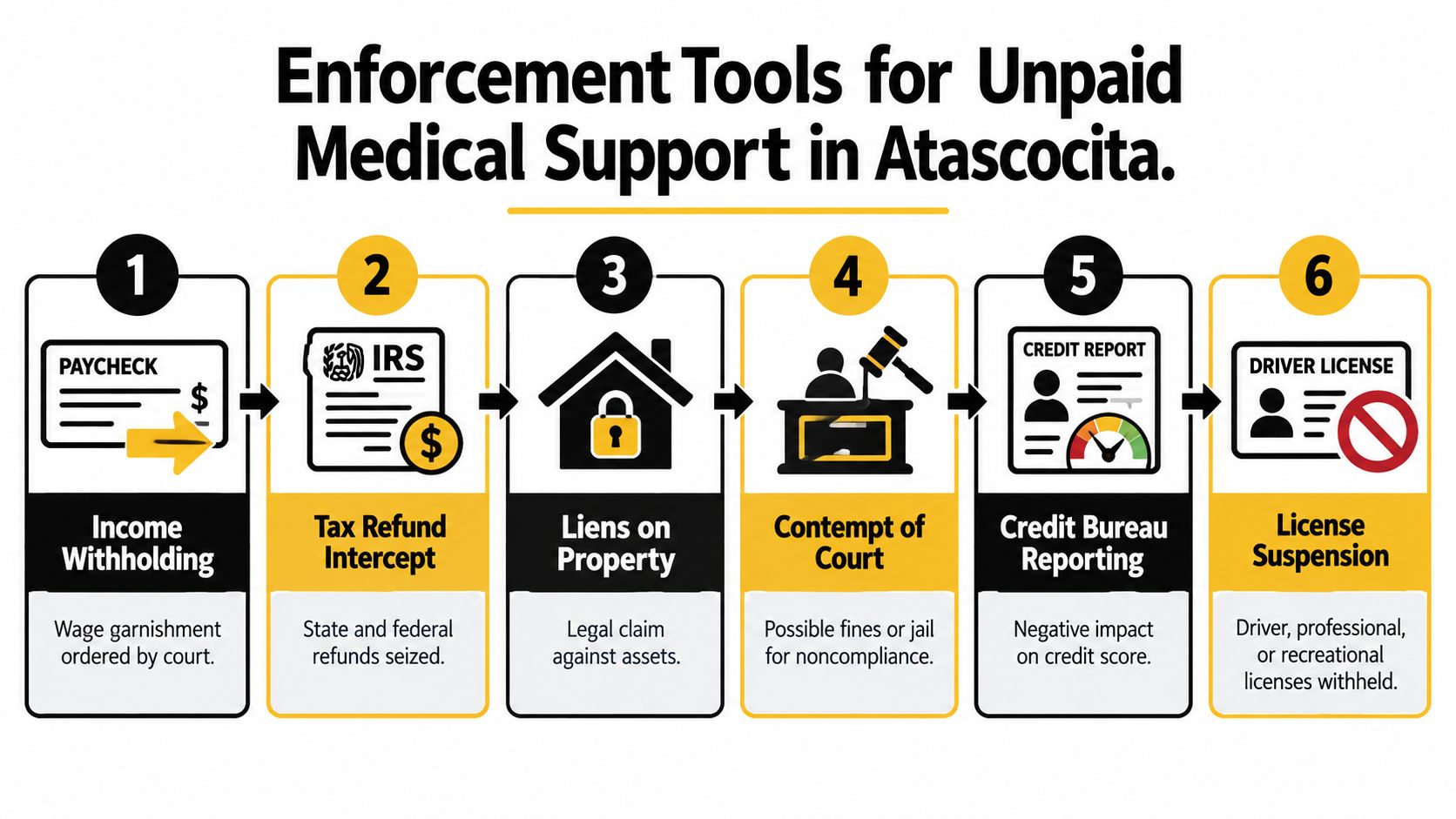
Enforcement Tools Available for Unpaid Medical Support in Atascocita
For an Atascocita case, the Harris County Domestic Relations Office can monitor and collect medical-support obligations through tools used for support enforcement generally. The county's FOCAS program coordinates monitoring and enforcement with the District Clerk and the Attorney General. A new lawsuit isn't necessarily required every time an account becomes delinquent, although a disputed balance or requested judgment may require a court hearing.
Common tools include:
- Income withholding, which directs an employer to deduct support from wages.
- Tax-refund intercepts, which can capture an eligible refund for qualifying arrears.
- Liens, which can affect property or other assets.
- Litigation and contempt proceedings, when the facts support a court-enforcement request.
- Other statutory remedies, depending on the order, account status, and enforcement history.
A parent who receives an enforcement notice shouldn't assume the stated total is automatically correct, but shouldn't ignore it either. Request the payment history, withholding records, current order, and itemized arrears calculation. Compare each document by date and category. An employer withholding error can explain a missing credit, but it doesn't automatically eliminate the underlying debt.
Confirmation is different from modification
A court confirming arrears generally determines what accrued under the existing order. It doesn't ordinarily rewrite the historical obligation during confirmation. A parent may still have arguments about credits, offsets, payments, or incorrect allocation, but those arguments need evidence.
A prospective modification is different. If insurance becomes available, income changes, or the child's coverage changes, the parent may need to seek a modification of future medical support. Filing for modification doesn't automatically erase amounts that accrued before the effective change. The Atascocita child support enforcement lawyer resource can help a parent distinguish an enforcement response from a request to change future support.
The local process can involve the Domestic Relations Office, the Attorney General, the District Clerk, and the court that issued or now has authority over the order. A careful strategy identifies the correct forum and avoids relying on informal assurances that a balance will be corrected later.
Real Payment Scenarios That Change How Arrears Are Resolved
The most common mistake is assuming that any payment immediately reduces the oldest medical-support arrears. Texas payment rules can produce a different result. Current monthly child-support and medical-support obligations are satisfied before payments are applied to arrears, so a lump sum may first cover current support rather than the balance the payer intended to eliminate.
Consider a parent in Humble who receives an enforcement notice and sends a large payment directly to the other parent. The payment may matter in an accounting, but it may not post through the Texas Child Support Disbursement Unit and may not qualify for the Attorney General's arrears incentive program. If Medicaid assignment exists, the payment may also fail to address the state-owed portion in the way the payer expected.
The Attorney General's Arrears Payment Incentive Program materials describe dollar-for-dollar matching credits for qualifying payments toward arrears assigned to the State of Texas. Those credits don't reduce the portion owed directly to the custodial parent. Qualifying payments generally must be voluntary or made through wage withholding and processed through the Texas Child Support Disbursement Unit. Direct payments to the custodial parent and certain involuntary collections, including tax-refund intercepts, liens, levies, and bond forfeitures, don't qualify for matching credits.
A cash payer also needs to account for posting time. The Attorney General's authorized cash-payment instructions explain that Smart e-Pay payments may take up to seven business days to post. The process uses the payer's name, Social Security number, and 10-digit Office of the Attorney General case number, and the listed cash-payment process carries a $2 fee per child-support payment. Keep the receipt, barcode details, and confirmation number.
A payment receipt proves what you submitted. It doesn't always prove how the system allocated or posted the money.
If no qualifying arrears payment is made for six months, the incentive program may remove the participant. That makes payment planning important, but it doesn't replace an account review. The right question isn't only, “How much can I pay?” It's also, “Which balance will this payment reach, and who will receive credit?”
Documents and Steps to Prepare Before Consulting an Atascocita Attorney
A productive consultation begins with records, not a reconstructed story from memory. Create one folder containing the current order and every later modification, then add the payment ledger and documents that show how medical support was supposed to work.
Build an itemized file
Use this checklist:
- Court order: Include the original decree, modifications, income-withholding orders, and any medical-support provisions.
- Payment history: Obtain the Texas Child Support Disbursement Unit ledger and mark payments you believe were misapplied or missing.
- Insurance records: Gather enrollment notices, premium statements, employer correspondence, termination notices, and proof of coverage.
- Medical-expense records: Keep itemized bills, receipts, provider statements, reimbursement requests, and evidence of payments made to providers or insurers.
- Communication logs: Preserve texts, emails, letters, and notices concerning payment disputes, coverage, enrollment, or repayment.
- Financial records: Bring income information and records relevant to a requested future modification or payment arrangement.
Before a consultation, request an itemized arrears calculation from the agency handling the account and ask whether it separates parent-owed and state-assigned balances. If you're facing an enforcement deadline, keep proof of when you requested the records and when you made any payment.
The Attorney General's incentive program has strict allocation rules. Qualifying payments must generally be processed through the Texas Child Support Disbursement Unit, current obligations must be satisfied first, and a payment toward state-assigned arrears cannot reduce the amount owed directly to the custodial parent. Those rules make payment method as important as payment amount.
Prepare focused questions for an Atascocita attorney:
- Does the order create a separate cash medical-support obligation?
- Does the ledger include Medicaid-assigned debt?
- Is the dispute about historical arrears, a credit, or future support?
- Do insurance premiums or provider payments support an offset?
- What enforcement action is pending?
- Can a prospective modification address changed insurance or financial circumstances?
The Atascocita family-law free consultation page provides a way to organize those questions with local counsel before choosing a legal response.
Common Misconceptions About Medical-Support Arrears in Texas
Myth one, medical support is just reimbursement. In Texas, medical support is its own enforceable support duty. It can include ordered cash medical support, health-insurance obligations, and certain uninsured expenses. That matters because unpaid amounts can be tracked and enforced on the same ledger as other support, even when a parent has been treating the issue like an informal payback dispute.
Myth two, visitation stops when support isn't paid. It does not. Possession disputes and support arrears travel on separate tracks in family court, so cutting off visits usually creates a new problem instead of fixing the old one. The better approach is to address denial of possession through the right enforcement process and address unpaid support through the account records and court remedies tied to that order.
Myth three, any payment goes where I want it to go. Parents get tripped up here all the time. A $1,200 payment made in March does not automatically cut an old arrears balance by $1,200 if the current monthly obligation for that period is $900. In that example, $900 satisfies the current amount due first, and only $300 reaches arrears. The ledger can also split the arrears by who is owed. Part may be owed directly to the other parent, while another part may be assigned to the State of Texas if Medicaid was involved.
Myth four, a confirmation hearing lets the judge rewrite the past. A confirmation case can sort out credits, offsets, and posting mistakes. It does not usually let the court retroactively lower the monthly amount that was in effect before a modification request was filed. If the central issue is that insurance changed or income changed, that is usually a modification problem, not a confirmation defense.
Myth five, the tenth anniversary wipes out every medical-support problem. The deadline issue is narrower than many parents assume. As noted earlier in the article's discussion of Texas Family Code Section 101.004, timing matters, but so do the due dates, the exact order language, and whether the balance is owed to the parent or the state. A Harris County ledger should be read line by line before anyone assumes an arrears claim is dead.
Next Steps for Atascocita and Humble Families Facing Medical-Support Arrears
A parent who finds a medical-support balance on a Harris County ledger should first obtain the controlling order and an itemized account history. Separate current support from historical arrears, then identify whether each balance is owed to the custodial parent, assigned to the State of Texas, or affected by a claimed credit.

The next legal choice depends on the problem. An enforcement action may be appropriate when the other parent or state is owed confirmed support. A prospective modification may address changed insurance or financial circumstances. An accounting, credit request, or offset argument may be necessary when the ledger omits withholding, provider payments, or insurance premiums.
Harris County parents should also ask whether the Domestic Relations Office or Attorney General has already initiated withholding, intercept, lien, or litigation activity. Bring payment receipts and posting confirmations, especially when a cash payment has taken time to appear.
The following video offers another accessible way to think about the financial and legal issues involved:
Atascocita and Humble families don't have to choose a strategy based on an unexplained total. A focused review can determine who is owed, what accrued, which payments posted, and whether the right path is enforcement, modification, or negotiated arrears resolution.
The Law Office of Bryan Fagan – Atascocita TX Lawyers can review your order, payment ledger, insurance records, and Medicaid-related allocation issues to help identify the practical next step. Schedule a free consultation through Law Office of Bryan Fagan – Atascocita TX Lawyers to discuss cash medical support arrears in Atascocita, Humble, or northeast Harris County.