Skip to content

You're sitting at the kitchen table with a mortgage statement, a retirement account balance, and a question neither of you knows how to answer: Who gets what? For a couple in Atascocita or Humble, the hardest part may not be agreeing that the marriage is ending. It may be figuring out whether either household can afford what comes next.
Property division in divorce is about more than dividing today's belongings. It's about making choices you can live with after the paperwork is signed, when the mortgage, grocery bills, and retirement needs become yours to manage separately.
Why Property Division Shapes Your Future After Divorce
Consider a hypothetical Lake Houston-area couple with a home near Atascocita, retirement savings, a family vehicle, and a small landscaping business. They assume they'll each keep some accounts, decide who stays in the house, and work out the rest.
Then the questions start. Does the business belong only to the spouse who runs it? Is keeping the house better than receiving retirement savings? What happens when a bank account contains both inherited money and marital earnings?
These aren't signs that someone has handled the family finances badly. They're normal questions when a household that operated as a single economic unit must support separate futures.
Think beyond the account balance
A useful way to approach the discussion is to ask what each asset will do for you. A house provides somewhere to live, but it also requires ongoing spending. A business may provide income, but owning it means accepting operating responsibilities and uncertainty.
For the hypothetical couple, the important questions include:
- Ownership: Which assets belong to the community estate, and which may belong separately to a spouse?
- Practical value: What remains after considering debt, taxes, access to money, and carrying costs?
- Future affordability: Will the proposed division support housing, everyday expenses, and retirement?
An agreement can look balanced on paper while leaving someone unable to pay ordinary bills. That's why an inventory alone isn't enough.
A useful starting point: Ask what you'll be able to spend, maintain, and save after the divorce, not simply what you'll be awarded.
You don't have to solve every question during the first conversation. Start by separating what you know from what you still need to document. For families across northeast Harris County, that shift can turn an overwhelming argument about fairness into a manageable discussion about evidence and choices.
Community, Separate, and Divisible Property Explained
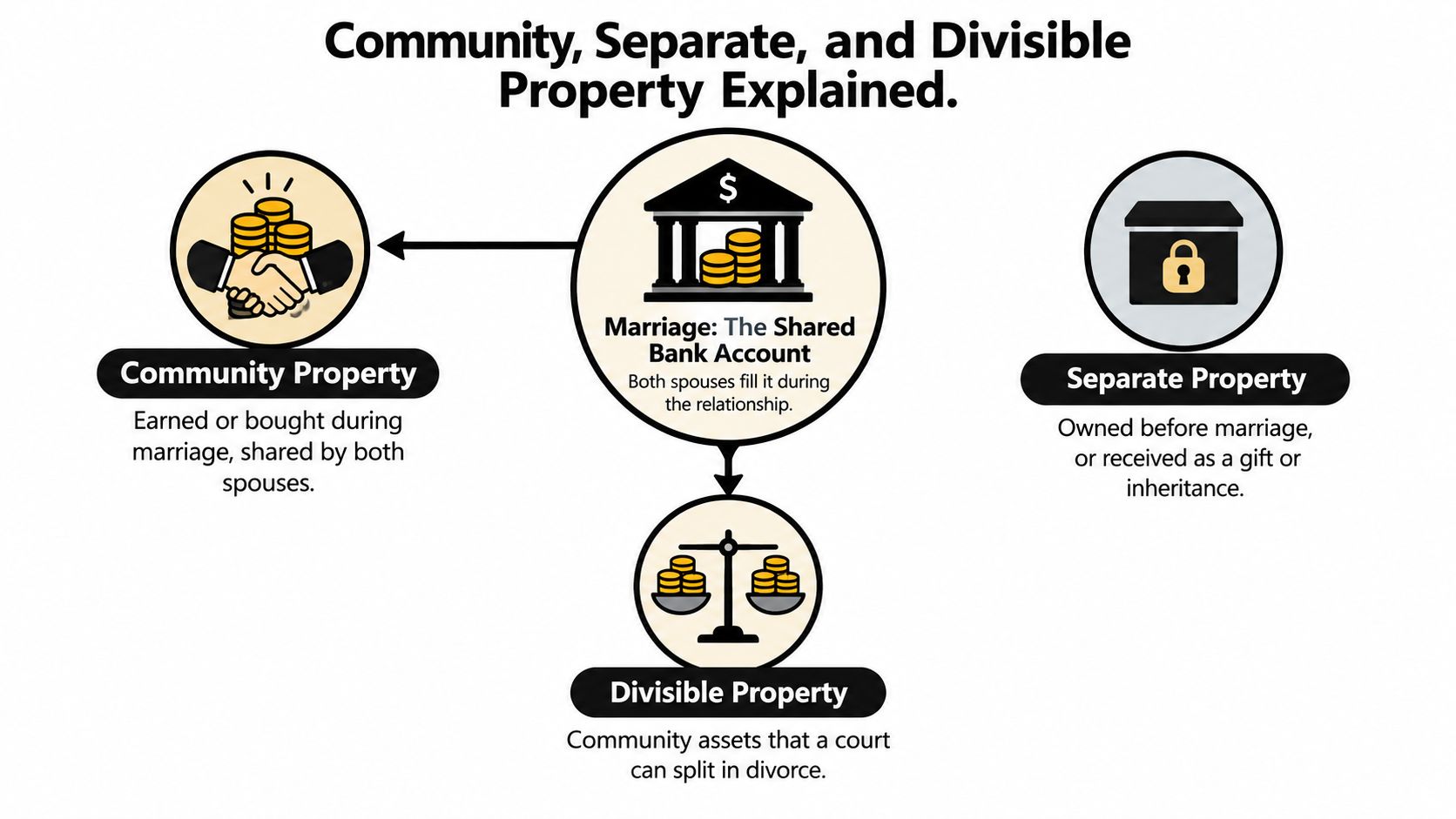
Think of marriage as a shared bank account that both spouses help fill. One spouse may contribute wages while the other handles childcare, household work, or the daily responsibilities that make paid employment possible.
Separate property is more like a personal savings box brought into the marriage or received individually through a gift or inheritance. The analogy helps, but legal ownership depends on acquisition history and evidence, not on where someone stores the money.
The following diagram illustrates the basic categories.
Start with how and when the property was acquired
Texas is one of ten states following community-property principles, alongside Alaska, Arizona, California, Idaho, Louisiana, Nevada, New Mexico, Washington, and Wisconsin; under those principles, marital acquisitions generally involve shared ownership even when only one spouse earned the income or holds title, as explained in the Michigan Bar Journal's discussion of community-property systems.
For an Atascocita household, sort the paperwork into these practical categories:
- Community assets: These can include marital wages, savings, a home purchased during marriage, and a vehicle titled in only one spouse's name.
- Separate assets: These generally include property owned before marriage and property received individually by gift or inheritance.
- Debts requiring allocation: List obligations alongside assets rather than assuming a positive account balance tells the whole story.
- Mixed or disputed funds: Flag accounts containing money from different sources so an attorney can evaluate their history.
The TexasLawHelp explanation of dividing property and debt describes the broad community-property presumption and why the account holder's name or purchaser's identity doesn't settle ownership.
Mixing funds creates an evidence problem
Suppose a Humble spouse deposits an inheritance into an account used for household expenses. Don't assume that the deposit automatically settles its legal character either way. The important question becomes whether records can identify the inherited funds and follow their movement.
Commingling isn't a substitute for tracing. Labels such as “my account” and “our account” are useful household shorthand, but they aren't enough to resolve a disputed claim.
“Divisible property,” in this discussion, means community assets available for allocation in the divorce. It isn't a separate Texas ownership category that replaces community and separate property. Once separate ownership is established, that property isn't divided as part of the community estate, as the TexasLawHelp financial guidance for divorcing spouses explains.
How Texas Courts Value and Divide Marital Assets
Texas doesn't automatically divide every marital estate 50/50. Texas Family Code Section 7.001 requires a division the court considers “just and right,” with due regard for each spouse's rights and the children of the marriage, according to the Texas State Law Library's property-division guide.
That distinction matters if one spouse earns substantially more, has a separate estate, or has different family responsibilities. It also means you shouldn't evaluate a proposed settlement by asking only whether the totals match.
Keep classification, valuation, and allocation separate
These are different jobs. Classification asks which estate owns an asset. Valuation asks what that asset is worth. Allocation determines how the community estate will be distributed.
A mortgage statement doesn't establish a home's market value. A vehicle title doesn't show its equity. And an account statement from an earlier period may not answer the valuation question your attorney needs to address.
A useful working schedule separates the information:
| Information | Why it matters |
|---|---|
| Acquisition date and ownership claim | Helps identify classification issues |
| Gross value and valuation date | Shows the amount being evaluated and when |
| Associated debt | Helps distinguish value from usable equity |
| Supporting documents | Allows others to check the claim |
| Proposed allocation | Shows how the overall arrangement would work |
For real estate, an appraisal may help resolve a disagreement. A closely held business may require a more detailed valuation review than its owner's estimate or current checking-account balance.
Fairness requires context, not assumptions
A spouse claiming separate ownership generally needs tracing evidence. Premarital statements, inheritance documents, purchase records, and transaction histories help connect a claim to an identifiable asset.
The financial context also matters. Research discussing equitable distribution highlights the difficulty of evaluating unpaid caregiving and reduced paid employment, while cautioning that those findings don't establish what a Texas judge will do in a particular case. The study on marital-asset allocation and unequal outcomes provides context, not a prediction for a Harris County family.
Equal arithmetic isn't the same as an economically workable result.
A parent who stepped away from paid work may need careful attention to future income and retirement resources. A business owner may need operating assets to continue earning. Present those circumstances with documentation rather than expecting the judge to infer them from a list of possessions.
Retirement Accounts, Homes, and Hidden Tax Costs
A retirement balance, home equity, and spendable cash aren't interchangeable. They may carry different tax treatment, access restrictions, and ongoing expenses, even when their stated values match.
The long-term concern is real. A 2025 report summarized by CBS found divorced households had approximately 30% less net financial wealth than comparable never-divorced households and about a 5% greater risk of exhausting retirement assets, as discussed in Netspar's review of divorce and retirement planning. Those findings aren't a forecast for your household, but they support taking retirement tradeoffs seriously.
Compare future use, not just present value
Before agreeing to keep a retirement account, ask about the plan's tax treatment, vesting, survivor benefits, withdrawal restrictions, and required division documents. A qualified domestic relations order may be necessary for certain plans, so review the qualified domestic relations order process before treating the account as ready-to-use money.
Keeping the family home deserves an equally practical review. Your budget should include insurance, property taxes, maintenance, utilities, and any financing changes. Familiar surroundings can be valuable, especially for children, but emotional value doesn't pay for repairs.
How Common Marital Assets Differ Beyond Their Account Value
| Asset Type | Key Question | Hidden Cost or Risk to Watch |
|---|---|---|
| Marital home | Can I afford the property on my post-divorce income? | Maintenance, insurance, taxes, financing, and limited liquidity |
| Retirement account | What future income can this provide? | Tax treatment, access restrictions, vesting, and division requirements |
| Pension | What benefits will I actually receive? | Payment timing and survivor-benefit arrangements |
| Appreciated investment or rental property | What would remain after a later sale? | Embedded gain, selling costs, and available basis records |
| Cash | How much must remain available for immediate needs? | Spending it now may reduce future reserves |
Tax basis can change the comparison
Adjusted basis is part of the tax history attached to an asset. It matters because a future sale may create taxable gain even when receiving the asset during divorce doesn't trigger an immediate tax bill.
For example, an asset worth $300,000 with an adjusted basis of $50,000 contains approximately $250,000 in unrealized gain, illustrating the basis issue addressed in the Texas State Law Library's community-property resources. The recipient generally receives the transferor's adjusted basis and holding period in a qualifying divorce-related transfer.
That embedded gain isn't itself the tax bill. Actual consequences require a separate tax analysis.
Before trading retirement savings for the house, ask: Can keeping this home leave me unable to retire? Before accepting appreciated property instead of cash, ask what its after-tax value could be.
Common Mistakes That Weaken Your Property Claim
Suppose a spouse in Humble remembers receiving an inheritance but can't find the deposit record. Years of transfers between household accounts make the original money difficult to identify.
The practical mistake wasn't merely using a joint account. It was losing the records needed to explain the transactions. Preserve the paper trail before relying on memory.
When one estate pays for another estate's benefit
Consider another hypothetical situation: marital savings paid down debt associated with a spouse's separately owned home. The spouse who helped make those payments may assume the money automatically purchased an ownership share or guarantees a refund.
Neither assumption is a safe starting point. The issue may involve a reimbursement claim, which needs its own legal and factual analysis.
Texas law requires the decree to address reimbursement claims and directs courts to apply equitable principles; reimbursement isn't automatically a dollar-for-dollar refund, under the Texas Family Code's property-division provisions. Bank statements, closing documents, and payment histories help identify which estate supplied the funds and what benefit another estate received.
Preserve the evidence: Save the documents showing where money came from, where it went, and what it paid for.
Other preventable problems
A landscaping business owner near Atascocita might focus on trucks and equipment while overlooking the records needed to evaluate the ongoing business. Another spouse might move money out of anxiety, then struggle to explain why the transfer occurred.
Practical fixes begin with ordinary habits:
- Avoid unsupported business estimates: Gather financial statements, tax returns, equipment records, and debt information for a valuation review.
- Document significant transfers: Keep the transaction record and a factual explanation. Ask your attorney before making unusual financial changes.
- Don't negotiate from social media posts: Avoid public claims about spending, assets, or the other spouse. Give relevant financial information to your legal team instead.
- Preserve original records: Don't edit account statements or discard documents because they seem unfavorable.
- Don't confuse possession with a final award: Keeping an item in your garage doesn't answer how it should be treated in the divorce.
The safest response to uncertainty is usually to pause, document, and ask. Trying to simplify the situation by moving assets or guessing at values can leave your attorney with a harder problem to solve.
Steps to Protect Your Assets Before and During Divorce
Start with a folder, not a confrontation. You don't need a perfect financial picture before seeking legal advice, but organized records give the conversation a useful starting point.
Gather documents you can lawfully access and keep them somewhere secure. Don't access the other spouse's private accounts without authorization or assume that knowing a password gives you permission.
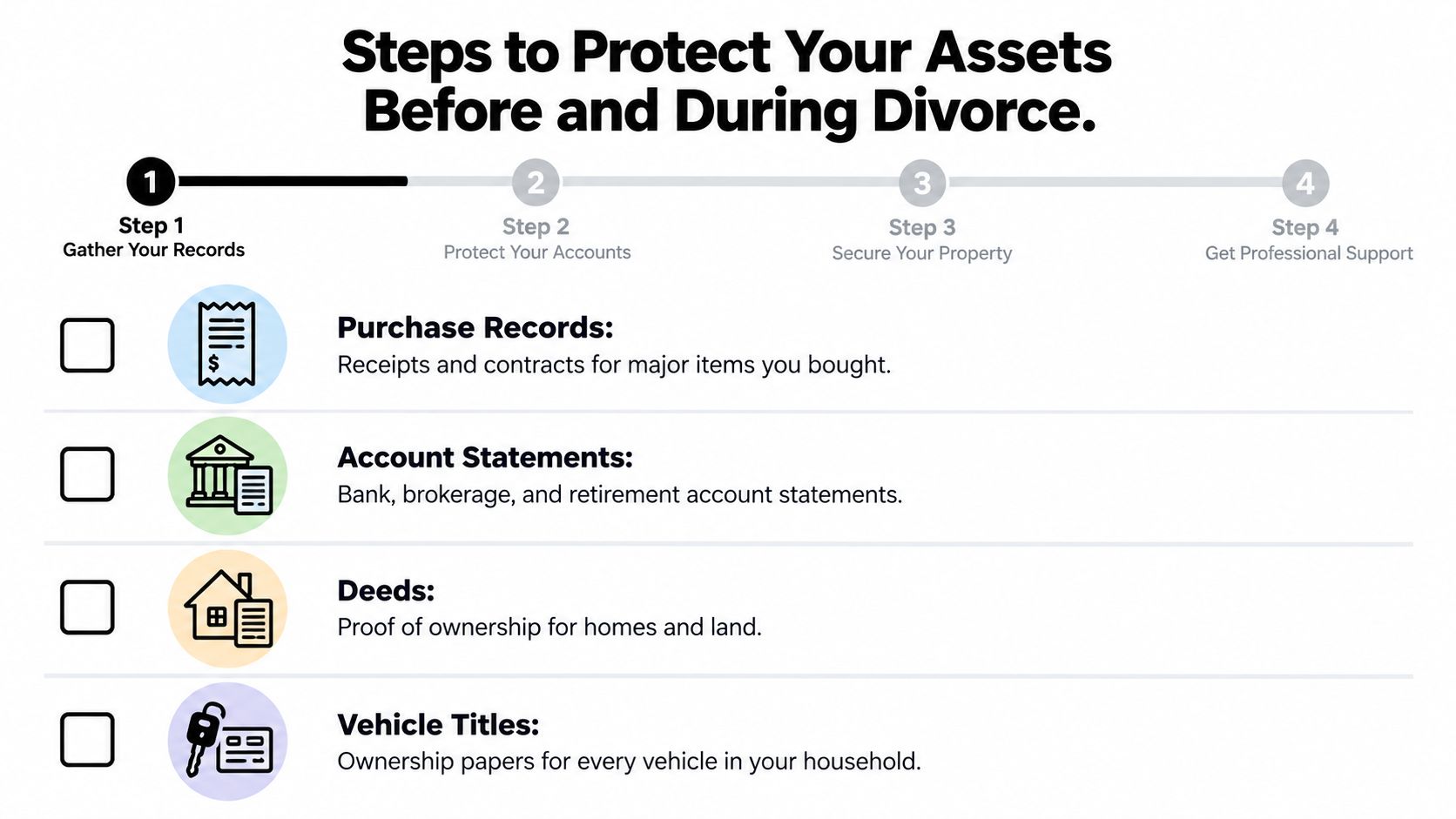
Use this checklist to begin collecting the core ownership documents.
Build a file someone else can understand
Collect purchase records, deeds, vehicle titles, bank and brokerage statements, retirement statements, inheritance documents, and tax returns. Include records from before marriage when they support a separate-property claim.
Tax records deserve their own folder. Under the transfer rules discussed earlier, the transferor must provide records sufficient to establish adjusted basis and holding period. Don't accept an investment or rental property without asking where that information is.
Prepare an asset-and-liability schedule with:
- Identification: Describe the asset or debt and list the title holder.
- Acquisition history: Record when and how it was acquired, along with the claimed classification.
- Value information: Include gross value, debt balance, proposed net value, and the date supporting those figures.
- Evidence location: Identify the statement, deed, receipt, or other document supporting each entry.
- Unresolved questions: Flag missing records, disputed ownership, and property outside Texas.
Use “unknown” when information is missing. An honest gap is more useful than an invented estimate.
Keep daily finances understandable
Continue documenting routine household spending. Before making large withdrawals, changing insurance coverage, or revising beneficiary designations, ask your attorney whether the proposed action is appropriate and whether any applicable order restricts it.
Keep communications factual. A message identifying a bill, due date, and payment is more useful than an argument about who has always been irresponsible.
For additional preparation, review the firm's guidance on how to protect assets during divorce. Bring questions about access to accounts, ongoing expenses, and document preservation to your consultation.
Preparation doesn't mean you must delay getting help until every statement arrives. It means you can show what's available, explain what's missing, and ask for a plan to obtain the rest. That gives an Atascocita or Humble family a more reliable foundation for negotiation.
Choosing Between Settlement and Trial in Atascocita
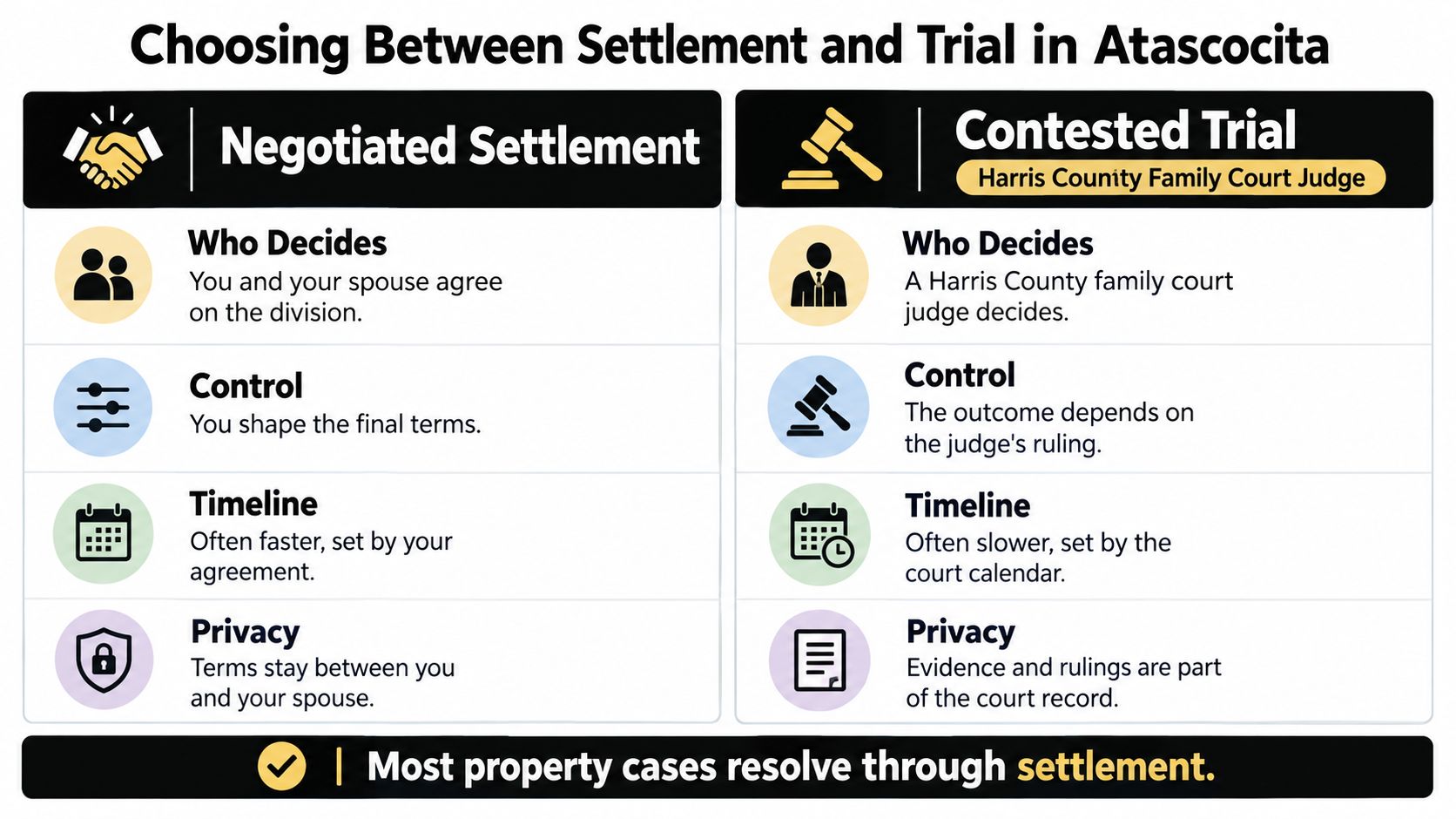
A negotiated settlement lets spouses propose an arrangement suited to their household. A contested trial asks a Harris County family court judge to decide unresolved issues based on the evidence and governing law.
Neither route should begin with a guess about what the estate contains. The same missing business records or disputed account history can complicate negotiations and trial preparation.
The comparison below offers a starting point, with an important privacy qualification: settlement discussions and filed divorce documents aren't the same thing.
Compare control with the need for a decision
With settlement, spouses can discuss the timing of a sale, document exchanges, and how to coordinate asset transfers. They can also reject a proposal that doesn't meet their needs.
Trial becomes an option when important disagreements remain unresolved. If a spouse won't provide financial information or the parties can't resolve a valuation dispute, continued negotiation alone may not produce a workable result.
Consider these decision points:
- Cost: Compare the work needed to reach an informed agreement with the work required to prepare disputed issues for trial.
- Timing: Negotiation depends on disclosure and cooperation. Trial also requires preparation and scheduling.
- Control: Settlement allows agreement on terms; trial places unresolved decisions with the judge.
- Privacy: Don't assume a settlement makes every document confidential. Ask which materials may be filed or disclosed.
- Risk: Evaluate the strength of the evidence, not only how strongly each spouse feels.
The firm's explanation of Texas divorce mediation can help you prepare questions about negotiating disputed property issues.
Apply the options to a household
Return to the hypothetical Atascocita couple with a home, retirement accounts, and a landscaping business. They could explore an arrangement in which one spouse retains the home and the other receives a larger retirement allocation, but only after checking affordability, tax treatment, and the business valuation.
That's a possible settlement structure, not a reported case or a recommendation for every family. If the business value remains unsupported, they may need further evidence before either agreeing or asking a judge to decide.
This video provides additional context for a discussion with your attorney.
The right question isn't whether settlement or trial sounds less stressful. It's which path can produce an informed, enforceable resolution without accepting financial terms you don't understand.
Talk With a Local Property Division Attorney
You don't need to arrive at an attorney's office knowing exactly what belongs to whom. You need a place to start, the records you have, and a candid explanation of what worries you most.
For some Atascocita families, that concern is keeping children in familiar surroundings. For a Humble business owner, it may be preserving the ability to earn a living. For someone approaching retirement, it may be avoiding a settlement that provides property but too little future income.
Bring your priorities alongside your paperwork
A useful consultation should connect legal ownership questions with everyday affordability. Bring your proposed household budget as well as your account statements, and explain which decisions feel most urgent.
Prepare to discuss:
- Your immediate needs: Housing, transportation, ordinary expenses, and access to available funds.
- Your disputed claims: Missing records, separate-property concerns, reimbursement questions, or uncertain business values.
- Your longer-term goals: Retirement income, manageable debt, and a realistic plan for maintaining any property you keep.
The firm's Property Division Lawyer in Atascocita service addresses division of community property and complex assets in Atascocita divorces. Families with extensive or complicated holdings can also ask about High-Net-Worth Divorce in Atascocita services and what their particular assets require.
Legal help may involve organizing an asset schedule, evaluating tracing records, coordinating retirement and tax questions, negotiating terms, or preparing disputed issues for trial. The appropriate work depends on the evidence and your circumstances, not a standard formula.
You're allowed to ask for an explanation before agreeing. A settlement should make sense to you in ordinary language, including what you'll receive, what you'll owe, and what must happen next. Local guidance can help you move from a stack of statements to a practical plan for life after divorce.
Visit Law Office of Bryan Fagan – Atascocita TX Lawyers to schedule a free consultation at the Atascocita office about property division in divorce. Bring your available financial records and your questions about the house, retirement accounts, or business so a local attorney can help you understand your options and next steps.