A police officer at the door on a quiet street off Atascocita Road, or a nurse asking whether you can get to the hospital right away, and then a sentence that rearranges your family's life. The days that follow are a blur of relatives, paperwork and decisions nobody trained for.
The legal questions arrive fast. Who is allowed to file a claim? How long do we have? What can our family recover, and who decides how it's divided? Most families in this position have never spoken to a lawyer before, and the vocabulary alone feels like a foreign language.
The scale of the problem is real. The Texas Department of Transportation's 2024 crash data counted 4,150 motor-vehicle fatalities statewide, down 3.29% from 4,291 deaths in 2023. Each of those numbers is a household like yours, trying to work out what comes next.
It isn't advice about your specific case, and it doesn't replace a conversation with a lawyer who can read the statutes with you.
Who Can File a Texas Wrongful Death Claim
A crash on a busy stretch of road near the lake takes a parent who lived in Atascocita and worked in Humble. Within a week, three relatives are asking the same question in different ways. The surviving spouse wants to handle everything alone, the adult daughter from an earlier marriage wants to be named on the case, and the decedent's brother assumes he can file because he's the one making the phone calls. Under Texas law, only some of them hold a claim.
A Texas wrongful death claim is a statutory claim, not a general claim held by whoever was closest to the person who died. The statute limits it to the surviving spouse, children and parents of the deceased, and it exists for their benefit. Those eligible relatives may file together, or one or more of them may bring the case for the benefit of everyone entitled. That matters in a community like ours, where siblings often live in different places, one in Atascocita, one in Humble, one in Kingwood, all with equal standing and none with automatic authority over the others. The Texas wrongful death statute sets out both the beneficiary list and the procedure that follows when nobody acts.
| Eligible party | Role in the claim | When it can act |
|---|---|---|
| Surviving spouse | Statutory beneficiary; may file for all beneficiaries | Any time within the two-year window |
| Surviving children | Statutory beneficiary; may file together with others | Any time within the two-year window |
| Parents of the deceased | Statutory beneficiary; may file together with others | Any time within the two-year window |
| Executor or administrator | Brings the claim for the estate when no eligible beneficiary has acted | Generally must act if no eligible spouse, child or parent has started suit within three calendar months after death, unless every eligible person objects |
| Unmarried partners and stepchildren | Not automatically statutory beneficiaries | Review individually with counsel |
The three-month rule most families never hear about. If no eligible spouse, child or parent has started the action within three calendar months after the death, the executor or administrator of the estate generally must bring and prosecute the claim, unless every eligible person asks that the executor or administrator not do so. For a family that hasn't opened probate yet, that's a deadline hiding inside a deadline. It also means the estate's representative may end up making litigation decisions for relatives they've never met.
Practical rule: before anyone signs a fee agreement or a settlement release, write down every surviving spouse, child and parent of the deceased, including children from earlier relationships, and note whether an estate has been opened.
Unmarried partners, stepchildren who were never adopted, and close friends fall outside the statutory beneficiary group. Their position needs individual review rather than a guess, because a survival claim through the estate or another theory may still exist.
Three things you can check this week:
- List every eligible relative. Names, relationships, birthdays of any minors, and current addresses.
- Confirm whether an estate has been opened. A probate appointment changes who has authority to act.
- Record who agrees to file. A short written note of who consents, and who objects, saves months later.
The Two-Year Deadline and Your First Steps
Deadlines are the part of a wrongful death case that can't be fixed later. Families often assume there's time, because the funeral is barely over and the criminal investigation is still open.

Under Texas Civil Practice and Remedies Code § 16.003(b), a lawsuit for an injury resulting in death generally must be filed no later than two years after the cause of action accrues, and the statute states that accrual occurs on the date the injured person dies, as the limitations chapter of the Texas civil practice code sets out. A death on March 3 starts a general clock that runs to March 3 two years later.
Treat that period as the starting point for review, not a promise that every claim carries the same filing date. Claims against a government body can require earlier written notice, and other statutory schemes add their own steps. The deadline is a reason to get advice now, never a reason to wait.
What the first thirty days should look like:
- Get the death certificate and the decedent's medical records. Request them in writing so the response is dated.
- Request the official crash or incident report. It carries the responding officer's account and the witness list.
- Send preservation letters. Ask nearby businesses, the vehicle owner and any carrier to hold surveillance video, event data and phone records.
- Identify every possible responsible party. Drivers, employers, vehicle owners, property owners and anyone who serviced the vehicle.
- Check for a government defendant. If a public entity or public employee is involved, note its notice requirements immediately.
- Open a damages file. Funeral bills, pay stubs, benefit statements and receipts for household help all belong in it.
Waiting costs evidence. Witnesses move and their memories soften, surveillance systems overwrite footage on a rolling schedule, and vehicles get repaired or sold for salvage. Families who also need an independent look at how someone died often find useful guidance in this Texas Autopsy Services on wrongful death, which covers the documentation side of the case.
If the death came from a collision, our Atascocita car accident lawyers can review the crash report and begin preservation the same week you call.
What You Must Prove and Evidence to Preserve
A wrongful death case is built as a chain, and every link has to hold. Start with the defendant's conduct, add the fault or breach that made that conduct careless or wrongful, connect it to a physical injury, and then show that the death followed from that injury. Break one link and the claim fails, no matter how sympathetically the facts read.
Texas Civil Practice and Remedies Code § 71.002 permits recovery of actual damages when an individual's death results from another person's wrongful act, neglect, carelessness, unskillfulness or default, if the deceased would have been entitled to bring a claim had the person survived, per the Texas civil practice and remedies statutes. A fatal outcome alone doesn't establish liability. The question is whether the injury behind it would have supported a personal injury claim while the person was alive.
| Evidence | Why it matters | Why it disappears |
|---|---|---|
| Surveillance video from nearby businesses | Shows the sequence of events and the parties involved | Often overwritten within days |
| Vehicle event data and dashcam footage | Shows speed, braking and impact timing | Vehicles are repaired or scrapped; data can be overwritten |
| Official crash or incident report | Provides the first official account and witness list | Must be requested; copies can be delayed |
| Medical and medical examiner records | Establishes the injury and cause of death | Requested from separate agencies and providers |
| Employment and wage records | Supports financial-support and household-loss claims | Employers may change payroll systems or be slow to respond |
| Text messages and phone records | Shows timing, distraction or impairment | Deleted or replaced when phones change hands |
| Witness contact details | Corroborates events | Witnesses move or forget details over time |
Harris County's traffic volume makes that evidence race sharper than expected. The county recorded 477 fatal crashes and 503 traffic deaths in 2025, along with 2,244 crashes involving suspected serious injury, according to TxDOT's county crash summary. The same summary reports 41 fatal commercial-motor-vehicle-involved crashes and 43 deaths in the county that year, which is why a single collision can involve several defendants and several sets of records.
A criminal charge doesn't settle the civil case. Prosecutors must prove guilt beyond a reasonable doubt, while a wrongful death claim is decided on the preponderance of the evidence, meaning more likely than not. A dismissal, a plea or an acquittal doesn't decide the civil claim either way, and the two investigations run on separate tracks with separate rules.
Where a commercial truck is involved, the carrier's hiring file, maintenance records, driver logs and dispatch communications can matter as much as the physical crash evidence. Our Atascocita truck accident lawyers handle that parallel investigation, from event data recorders to employer responsibility.
Damages Your Family Can Recover in Texas
Texas splits recovery into two tracks, and confusing them is one of the most common mistakes families make early. The wrongful death claim compensates the eligible relatives for their own losses. The survival claim belongs to the estate and covers the injuries the deceased could have sued over before death, which the statutory framework for wrongful death and survival actions treats as separate causes of action.
| Damage category | Who recovers it | Evidence that supports it |
|---|---|---|
| Lost financial support | Surviving spouse, children or parents who depended on the decedent | Wage and benefits history, tax records |
| Lost household services | Surviving spouse, children or parents | Household-service evidence, testimony about daily tasks |
| Loss of companionship and guidance | Surviving spouse, children or parents | Testimony about the relationship |
| Mental anguish | Surviving spouse, children or parents | Testimony, family and counseling history |
| Medical and funeral expenses | Party that paid the bills | Itemized bills, receipts, funeral contracts |
| Decedent's pain and suffering before death | Estate through the survival claim | Medical records, incident timeline |
| Exemplary damages | Awarded only on the separate showing the statute requires | Evidence of the defendant's conduct itself |
Consider a father who worked steady shifts at a plant near Beltway 8 and coached his kids' teams in Atascocita on weekends. His pay stubs and tax returns speak to the income the household loses. Testimony about who mowed the lawn, handled the car repairs and got the children to practice speaks to household services. His daughter describing who taught her to drive speaks to guidance and companionship. Each category needs its own proof, and one doesn't substitute for another.
Documentary losses are the simplest to establish, because a bill or a receipt does the work. Keep every medical invoice, every funeral contract and every receipt for travel to appointments.
The non-economic losses are described rather than calculated. Family members tell the story of the relationship in their own words, and the record grows from those accounts instead of from a formula. That's why an early insurer offer, made before anyone has gathered that testimony, tends to reflect only the visible bills.
No settlement offer should be accepted before every category of loss has been documented, including the ones that require a family's testimony to prove.
The proof list is broader than many assume. Relevant evidence can include wage and benefits history, tax records, household-service evidence, dependency information, medical expenses, funeral costs and testimony addressing relational losses, as the Texas limitations and damages provisions reflect in practice.
How a Case Moves from Investigation to Settlement or Trial
Most wrongful death cases end in a negotiated resolution, but they get there through stages that each take real time. Knowing the sequence helps a family understand why nothing seems to happen for weeks and then several things happen at once.
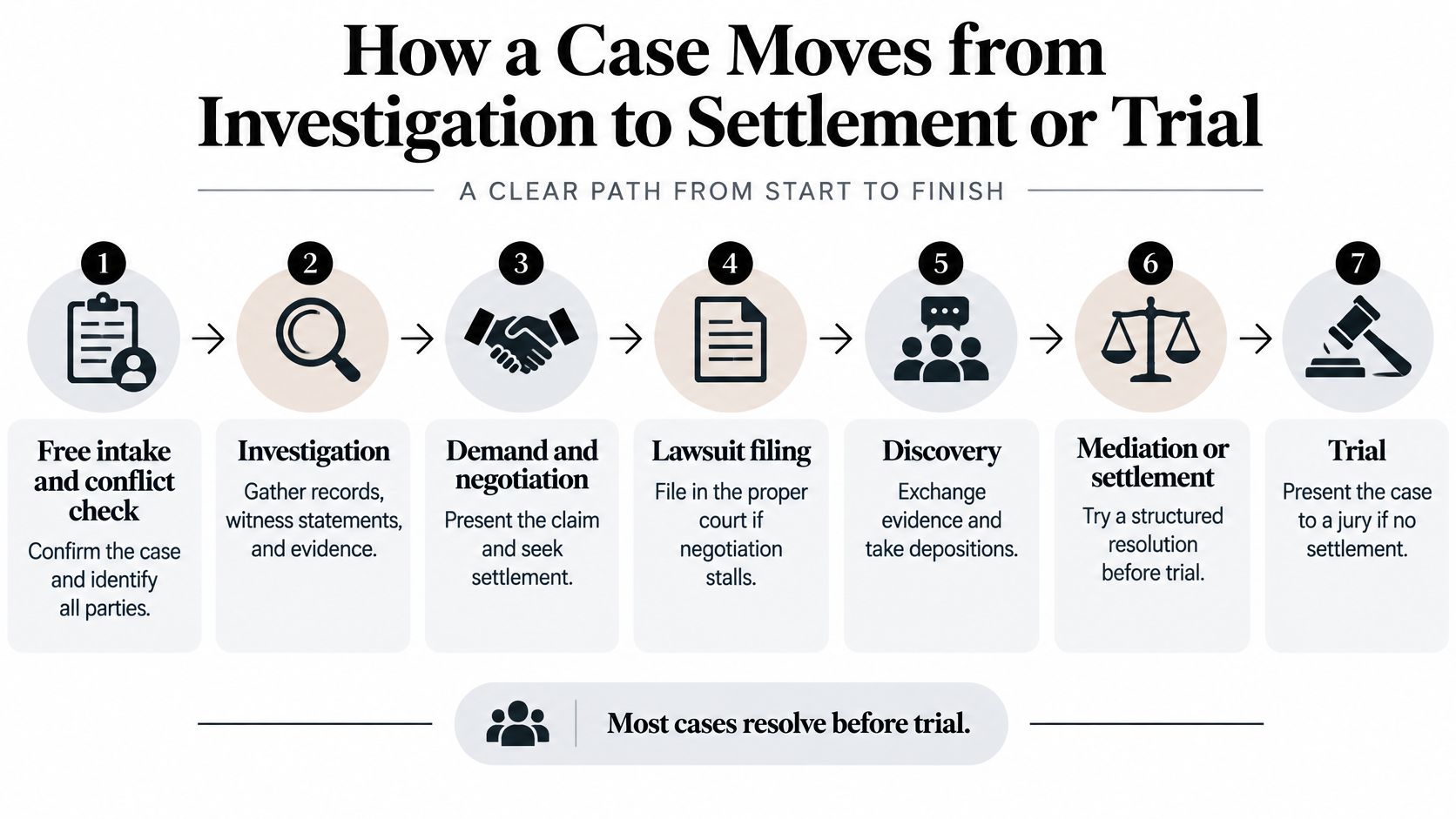
- Free intake and conflict check. The first conversation confirms what happened, who the eligible relatives are, and whether the firm can represent the family without a conflict. Nothing is filed at this stage.
- Investigation. Records requests go out, the crash report is analyzed, photographs are collected, and an expert may be retained to reconstruct the collision or review the medical cause of death. This stage commonly runs several months.
- Pre-suit demand. A documented demand package goes to the insurer or responsible party, setting out liability and each category of loss. Negotiation may follow for weeks.
- Filing suit. If the claim isn't resolved, it's filed in the Texas civil district courts, which is where a Harris County case would be heard. Filing protects the deadline while talks continue.
- Discovery. Written questions, document requests and depositions of witnesses and defendants follow. Discovery is usually the longest phase of a litigated case.
- Mediation. A neutral mediator meets with both sides and tries to find terms everyone can accept. Many cases resolve here.
- Settlement or trial. If terms are agreed, the case closes, with court approval required when a minor is a beneficiary. If not, a judge or jury weighs the causation and damages evidence at trial.
Our civil attorneys practice Texas civil law and work with the procedural and substantive law of Texas civil courts, and the team has negotiated, mediated and litigated a wide range of family law and estate planning cases. That experience matters most in the middle stages, where a case either builds pressure toward resolution or stalls.
Timing expectations are worth stating plainly. Investigation and discovery take months, not weeks, and a trial date depends on the court's calendar rather than on anyone's preference. Families who expect a fast answer often mistake a quiet stretch for a stalled case.
What the family controls is narrower than the process, and more important than it looks. Prompt records, honest answers about the deceased person's income and daily role, and a clear list of statutory beneficiaries all speed the work up. Our civil litigation process guide explains how those stages play out in Harris County courts.
Choosing a Wrongful Death Lawyer in Atascocita
Hiring a lawyer after a death is a trust decision, made under pressure, often within weeks of a funeral. A good lawyer welcomes the questions and answers them without rushing you toward a signature.
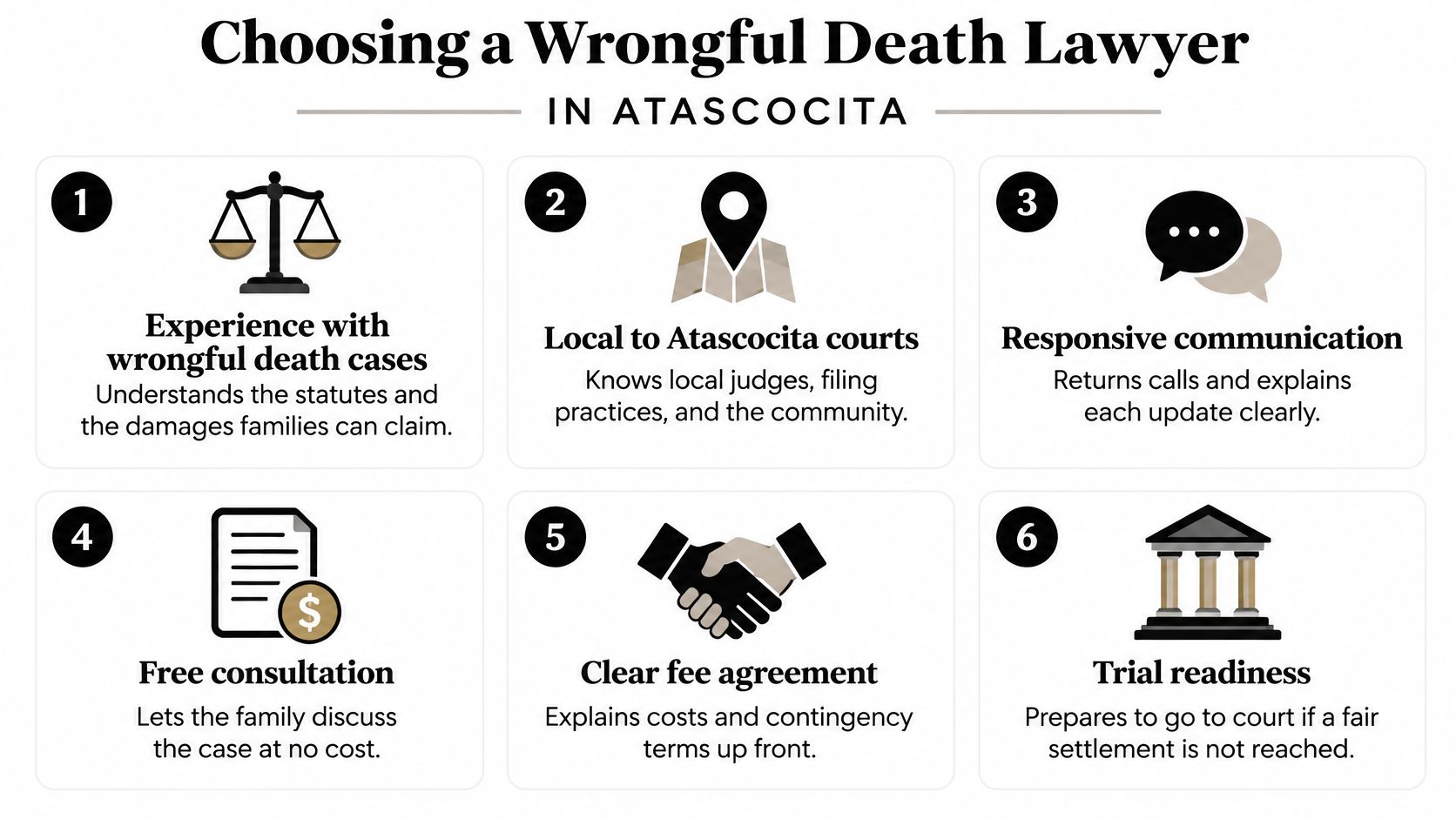
Ask each lawyer the same seven questions and compare how specific the answers are:
- How much of your practice is wrongful death and fatal-crash work? General injury experience isn't the same as handling statutory beneficiaries and survival claims.
- Which court would hear this case? Familiarity with Harris County courts and Texas civil procedure shows up in how a lawyer talks about filing and scheduling.
- Who exactly will you represent? The spouse, the children, the estate, or all of them. Get the answer in writing.
- How are fees and costs handled? Ask what comes out of a recovery and what the family pays if there is none.
- Will you pursue every possible defendant? Employers, vehicle owners, maintenance providers and property owners are easy to overlook.
- How reachable are you? An Atascocita office where the family can sit down in person, plus an online contact option, makes a difference over months of work.
- What's a realistic timeline, and what can't you promise? Any lawyer who guarantees an outcome is telling you something about how they practice.
Interview at least two lawyers with that same list. The comparison is more useful than any single conversation, because it shows you who explains the deadline, the beneficiary rules and the evidence plan clearly, and who recites a sales pitch.
Here's the perspective of the attorney whose name is on our Atascocita office:
Attorney Bryan Fagan: "We meet people at some of the worst times in their lives and help them."
Families handling a claim alongside a broader injury practice sometimes ask how the paperwork gets organized across providers and insurers. Tools like the ProPlaintiff AI paralegal platform give a useful picture of how medical records and demand packages are assembled in personal injury work.
You can review the Atascocita office contact options and reach the team online before scheduling a visit. The attorneys listed for the Atascocita office are Byron Shaw and Teresa J. Glascoe, and the firm serves families in Atascocita, Humble, Harris County and the greater Houston area.
Book Your Free Consultation in Atascocita
Talking through what happened doesn't commit your family to anything. It gives you a clear picture of where the claim stands, who is entitled to file, and what the calendar requires.
The initial consultation with the Law Office of Bryan Fagan – Atascocita TX Lawyers is free. Schedule it by calling 281-519-3083, by completing the online contact form, or by visiting the Atascocita office in person.
Bring three things beyond the records already gathered. First, the eligible-relatives list with each person's relationship and whether an estate has been opened. Second, every insurance letter or adjuster call you've received so far, even the ones that seemed routine. Third, the photos, messages and witness names collected during the first thirty days.
At that first meeting, the lawyer reviews the two-year deadline, confirms who the statutory beneficiaries are, and maps the evidence plan, so the family leaves with a next step rather than a stack of unknowns. Bring your questions about fees, timing and who decides settlement terms. Those answers belong in the first conversation.
The clock started on the date of death and it's running. A call this week is a practical step toward protecting the claim and giving your family one less thing to carry alone.
The Law Office of Bryan Fagan – Atascocita TX Lawyers represents families in Atascocita, Humble and across Harris County in wrongful death and survival claims, handling the deadline analysis, beneficiary questions and evidence preservation that decide whether a case holds together. If your family lost someone because of another person's conduct, our team can review the facts, explain who may file and start preserving records before they disappear. Visit the Law Office of Bryan Fagan – Atascocita TX Lawyers online to schedule a free consultation at the Atascocita office.