Skip to content

The roofer has stopped returning your calls, your Atascocita home still needs repairs, and you're wondering whether a lawsuit would help or just create another bill. Or perhaps you're on the other side: someone has served you with court papers, and you don't know what you're supposed to do next.
The civil litigation process turns a private dispute into a series of decisions governed by court rules and deadlines. Understanding those decisions helps you protect your position, manage costs, and recognize when legal advice can prevent a mistake you can't easily undo.
The Civil Litigation Process at a Glance
A Texas civil case follows a recognizable route: investigate, file, serve, respond, exchange evidence, seek rulings, and resolve the dispute. Think of it as a road trip. You can identify the stops, but traffic, detours, and the court's calendar affect when you arrive.
Discovery, motion practice, and scheduling often account for much of the work between filing and resolution. A lawsuit doesn't mean an immediate courtroom hearing.
The process map shows the central stages.
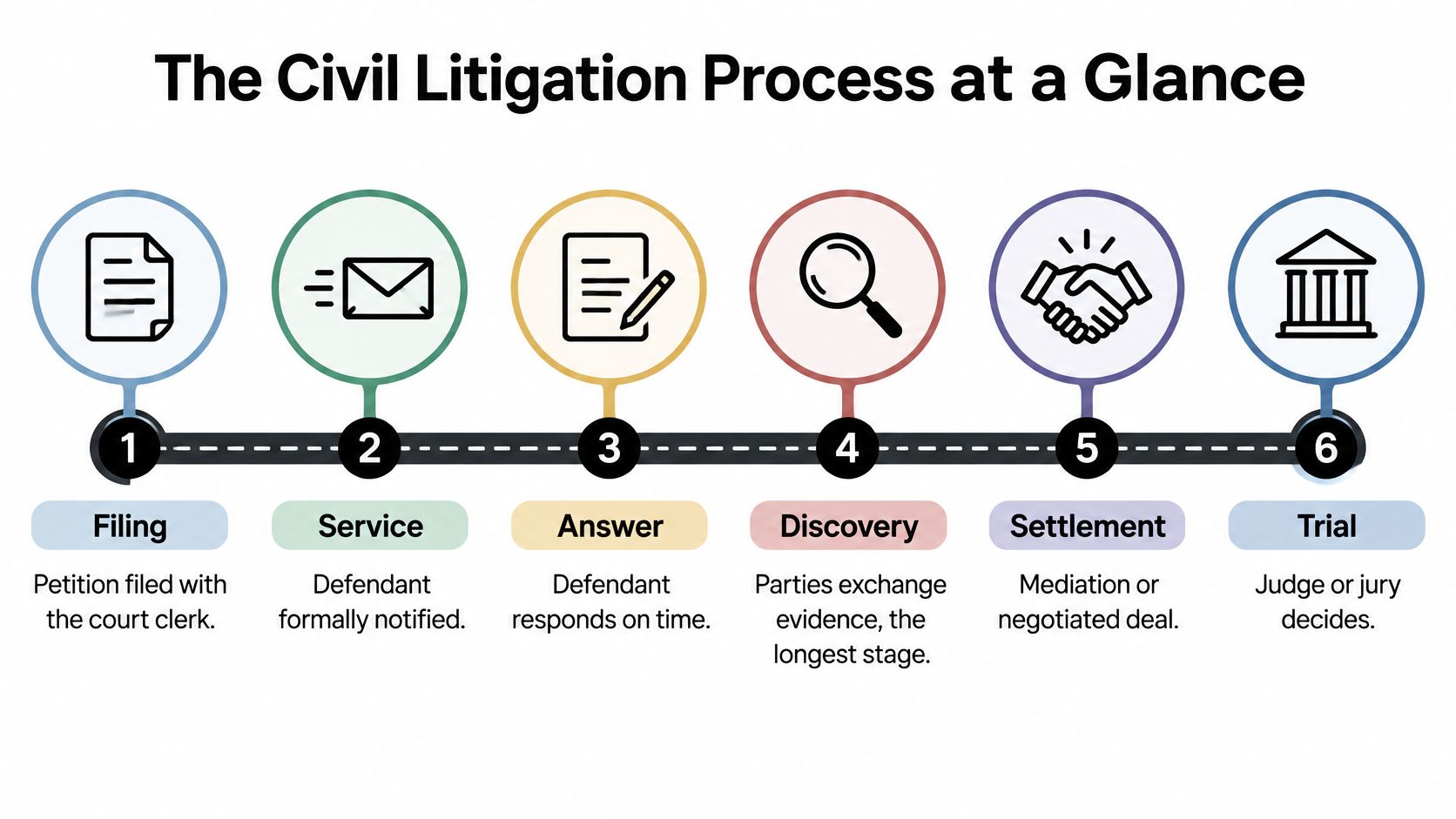
Civil case stages and typical timing in Texas
These are planning guides, not promised completion dates. The answer deadline also differs by court, so don't apply a district-court deadline to justice court papers.
| Stage | What happens | Typical timing |
|---|---|---|
| Pre-suit investigation and demand | Gather records, evaluate the claim, send a demand letter | Often 2 to 8 weeks |
| Petition filed and defendant served | Original petition filed; citation issued and served | Days to a few weeks after filing |
| Answer and early pleadings | Defendant answers; special exceptions may narrow claims | In many district and county court cases, 10 a.m. on the Monday after 20 days from service; justice court uses a different deadline |
| Discovery | Disclosures, written questions, documents, depositions | Often several months, governed by the discovery plan |
| Motions and mediation | Summary judgment motions; voluntary or court-ordered mediation | Mid-case, according to hearing availability and court orders |
| Pretrial and trial setting | Prepare exhibits and witnesses for a jury or bench trial | Controlled by the docket; contested cases can run past a year |
| Judgment and post-trial | Judgment, post-trial motions, possible appeal | Weeks to months, longer if appealed |
| Collection and enforcement | Pursue available liens, garnishment, or other remedies | Can extend the dispute well beyond judgment |
Following an unfinished roofing job
Say an Atascocita homeowner pays a roofer who leaves the job unfinished. Before suing, the homeowner collects the contract, payment records, photographs, and completion estimates, then considers a written demand.
If negotiations fail, the homeowner files a petition and arranges service. Service starts the defendant's response clock. An answer leads to evidence exchange, possible motions, and settlement discussions; an unresolved case may proceed to trial, judgment, and enforcement.
These stages overlap, and settlement can occur along the way. Harris County electronic filings go through eFileTexas to the clerk of the court hearing the case, whether that's a justice court, county court at law, or district court. Self-represented parties should confirm their permitted filing options with that clerk.
Choosing the Right Court and Your Filing Deadline
A claim can be strong on its facts and still run into trouble if it starts in the wrong court or misses its filing deadline. Jurisdiction is a court's legal authority to hear a case. Venue is the proper county or location. Both choices affect what happens next.
For claims within its jurisdiction, a justice court generally handles disputes of $20,000 or less. The Harris County JP court small claims guide for Atascocita residents explains that option. Harris County civil county courts at law generally hear claims up to $250,000 within their statutory jurisdiction. District courts hear larger disputes and many complex or family matters, though jurisdiction can overlap.
Some qualifying suits seeking $250,000 or less fall under the expedited actions procedures in Texas Rule 169, excluding specified items such as interest. These procedures use tighter discovery and trial-setting rules. A party cannot opt out on its own; removal requires a proper legal basis. Choosing a court is therefore a decision point, not just paperwork.
Identify the deadline before negotiating
Common limitations periods include:
- Personal injury and property damage: Commonly two years, subject to the claim and applicable exceptions.
- Contract claims: Generally four years, though the legal theory, agreement, and facts matter.
Other notice rules or filing deadlines may be shorter. Read about exceptions to personal injury filing deadlines, but don't rely on an exception as a reason to wait. Negotiations can continue while the clock runs, and waiting too long may leave no time to file.
Suppose a Humble business owner waits three years to sue over an unpaid invoice. That delay does not automatically bar an ordinary contract claim, but another legal theory or a special deadline could change the result. The relevant starting point is usually the injury, breach, or other event that legally triggered the claim, not the day the person decided to act.
Family disputes call for a different jurisdictional analysis. Grandparents' Rights in Atascocita concerns custody and visitation rights for grandparents in Harris County, rather than an ordinary small-claims dispute. When the court or deadline is uncertain, checking before filing can help prevent an early mistake from shaping the entire case.
How to File and Serve a Civil Lawsuit
Service is formal notice of the lawsuit. A demand letter or an angry text doesn't replace it, even if the other person already knows you intend to sue.
The delivery of court papers is a procedural step with consequences for both sides.

Prepare the claim before filing
Send an appropriate demand. State what happened, the relief you seek, and a response deadline. Check whether the claim requires special notice, and don't let negotiations consume the filing period.
Preserve the evidence. Collect contracts, photographs, texts, invoices, and payment records. Keep original electronic files rather than relying only on cropped screenshots.
Draft the original petition. Identify the correct parties, jurisdiction, venue, supporting facts, legal claims, and requested relief. Where applicable, include the Rule 47 monetary relief category; the petition should tell the court what legal wrong you're asking it to remedy.
File with the proper clerk. Use eFileTexas where required, pay the filing fee, or submit the appropriate request for relief from court costs if eligible. Save the accepted filing and confirmation, not merely the upload receipt.
Complete service and verify the record
Request citation and arrange authorized service. Service may involve an authorized certified-mail procedure, a constable, or a private process server. Don't assume you can personally mail the papers and satisfy the rules; confirm the constable precinct serving Atascocita for service of process when choosing that route.
Calendar the correct answer date. Check the court, citation, service date, and applicable rule. Have counsel verify the calculation rather than copying a deadline from another case.
Evaluate default only after checking service. If no answer arrives, a default judgment request still requires a proper record and any necessary proof. A silent defendant doesn't automatically establish the amount of damages.
For additional visual context, the following video accompanies the filing discussion.
Digital tools can help track documents and tasks. IamVera.AI's discussion of verified AI support for litigation offers context for evaluating those tools, but a lawyer still needs to check legal authorities, filing requirements, and deadlines.
Service warning: Defective service can undermine or void a default judgment. Keep the citation and return of service in the case file.
Discovery Rules and Evidence Fights in Texas
Discovery isn't a license to ask for everything.
Discovery is the formal exchange of information needed to prove claims and defenses. The Texas Rules of Civil Procedure allow courts to limit discovery to what's reasonable and necessary, rather than treating every requested record as automatically discoverable.
Start with the disputed fact. In the roofing example, the relevant questions might be what work the contract required, what the roofer completed, and what reasonable completion or repair will cost.
Match the tool to the question
- Initial disclosures: Rule 194 requires covered parties to exchange specified basic information early without waiting for discovery requests. Justice court and certain other proceedings follow different procedures.
- Interrogatories: Written questions answered under oath can identify who supervised the roofing work or approved a change.
- Requests for production: Seek contracts, project photographs, invoices, emails, texts, and other relevant records.
- Requests for admission: Ask the other side to admit or deny specific propositions. Under the ordinary rule, unanswered requests can be deemed admitted after 30 days, subject to applicable exceptions and orders.
- Depositions: Witnesses give sworn testimony, with limits governed by the applicable discovery plan. A deposition can clarify disputed conversations that documents don't resolve.
- Third-party subpoenas: Obtain appropriate evidence from people or organizations outside the lawsuit, with required notice and procedural protections.
Rule 190 organizes discovery into levels. Level 2 generally serves as the default when another applicable plan or court order doesn't control; an individualized order may adjust the scope and schedule.
Narrow requests save more than review time
Ask the roofer for project invoices, communications with the homeowner, and the job schedule. A demand for every email the business has ever sent is harder to justify and more expensive to answer.
A useful evidence chart pairs each disputed issue with a document or witness. For incomplete work, that might mean dated photographs and the replacement contractor's estimate; for payment, it might mean bank records and receipts.
Document organization also matters. Tools that organize legal filings with numbered pages, such as PDFWix's Bates-numbering feature, can give each produced page a stable reference. Keep an untouched original set and check for privileged information before sharing anything.
Preserve first, then collect
Send a litigation hold when a dispute makes litigation reasonably foreseeable. Identify relevant people, devices, accounts, and records, and suspend automatic deletion where needed.
If a request is excessive, explain the actual problem: irrelevant material, duplication, excessive search scope, or disproportionate burden. Support the objection with concrete information rather than merely calling the request burdensome. Don't ignore the response deadline while discussing scope.
Motions That Shape a Case Before Trial
A motion asks a judge to rule on a specific issue. Some address how the case proceeds; others can end a claim before trial. When one arrives, identify the relief requested and the hearing or submission procedure within the first day. Then work backward from the response deadline to determine what evidence and legal arguments you need.
Common checkpoints
- Special exceptions: Often raised early, these challenge unclear or legally deficient pleadings. The court may require a party to clarify or amend them.
- Plea to the jurisdiction: Challenges the court's authority to hear the dispute. A response may require legal analysis and evidence.
- Texas Citizens Participation Act motion: Seeks dismissal of qualifying claims involving protected activity, subject to statutory coverage and exceptions. Its ordinary filing window is within 60 days after service, though the applicable circumstances require careful review.
- Traditional summary judgment: Asks for judgment as a matter of law under the applicable standard, based on the absence of a genuine issue of material fact.
- No-evidence summary judgment: After adequate time for discovery, challenges whether evidence supports specified elements the opposing party must prove.
- Motion to compel: Seeks a court order about missing or inadequate discovery responses, usually after efforts to resolve the disagreement.
- Motion in limine: Usually addressed before trial, this asks counsel to approach the judge before mentioning specified potentially prejudicial matters. It does not itself finally exclude evidence.
Why a no-evidence motion needs more than a denial
Suppose a business disputes a customer's claim for lost profits. The business files a no-evidence motion challenging whether the customer has evidence of the amount of lost profits. The customer's response needs evidence that addresses that specific element. Repeating that the business caused harm will not fill the gap.
A response should connect competent evidence to each challenged element. Depending on the dispute, that may include business records and testimony explaining how they support the claimed loss. A bare estimate, without support that meets evidentiary requirements, may not answer the challenge.
Under the ordinary summary judgment rule, a response is due at least seven days before the hearing unless the court permits otherwise. Check the governing rule, court order, and hearing procedure. The hearing date is not automatically the filing deadline.
Deadline discipline: Calendar the response date, evidence-preparation date, and hearing separately. Preparing exhibits and supporting evidence can take longer than drafting the argument.
A judge can decide a motion without a full trial. Treat each motion as a decision point: a missed response date or unsupported evidence can narrow or end a claim before trial. Track the deadline, identify what the motion challenges, and match each response point to the evidence that supports it.
What Litigation Costs and Who Pays It
In Texas, each side usually pays its own attorney's fees unless a statute or contract permits shifting them. Winning doesn't automatically make the other side reimburse everything you spent.
Chapter 38 of the Texas Civil Practice and Remedies Code can allow attorney-fee recovery for certain contract claims when its requirements are satisfied. Recoverability still needs a separate analysis, including whether the defendant can pay.
Litigation cost items and who usually pays
| Cost item | What drives the amount | Who usually pays |
|---|---|---|
| Filing fees | Court and claim type; due when the petition is filed | Filing party, recoverable only in some cases |
| Service fees | Constable, private process server, or certified mail | Party requesting service |
| Deposition and transcript costs | Number of depositions and their length | Usually the party taking the deposition |
| Expert fees | Engineers, medical experts, damages analysts | Party retaining the expert |
| Mediator fee | Hourly or per-session rate | Usually split between the parties |
| Attorney fees | Hours and rate, or an agreed flat fee | Each side unless a statute or contract shifts them |
For a hypothetical Humble business dispute, suppose a plaintiff recovers $12,000 but spends $15,000 in unrecovered attorney's fees. That leaves the plaintiff financially worse off even before other expenses.
Budget by stage, not just by the hoped-for judgment. Ask what it will cost to investigate, exchange essential evidence, mediate, and prepare for trial, and identify when the budget should be reassessed.
Your participation affects the bill
- Keep documents organized: Provide complete records in searchable folders where possible.
- Respond on time: Late discovery creates avoidable attorney work and may expose you to sanctions.
- Attend required events: Prepare for depositions and mediation rather than arriving without reviewing the facts.
- Maintain contact: Tell counsel promptly when your phone number, address, or availability changes.
- Stay offline about the dispute: Public posts can become evidence and complicate negotiations.
A qualifying written settlement offer under Chapter 42 can shift certain litigation costs when statutory conditions are met and the eventual judgment is significantly less favorable. Have counsel evaluate a formal offer before rejecting it.
Finally, assess collectability before spending heavily. A favorable judgment may require additional enforcement work, and legal protections can limit which assets are available.
How to Decide Between Settling and Going to Trial
Settlement deserves serious consideration when the expense and uncertainty of continuing outweigh the gap between the parties' positions. Trial may be necessary when the other side won't offer reasonable terms or when enforceable court relief is essential.
A desire to prove a point is understandable, but it shouldn't replace a cost-and-risk assessment. A trial judgment also doesn't necessarily create a broader legal precedent.
The choice involves both money and control.
Settlement or mediation compared with trial
| Factor | Settlement or mediation | Trial |
|---|---|---|
| Timing | Weeks to months once scheduled | Often many months to years |
| Cost | Mediator fee plus preparation and fees already spent | Full trial preparation, expert, and courtroom costs |
| Who decides | The parties shape the terms | A judge or jury decides |
| Outcome certainty | A known agreement, subject to performance | Risk of loss or a smaller award |
| Privacy | Terms can include confidentiality protections | Hearings and filings are generally public |
| Appeal | Usually intended to resolve the dispute, subject to enforceability issues | Appeal may follow judgment and add time |
Prepare for mediation as carefully as a hearing
A mediator is neutral and helps the parties evaluate possible agreements; the mediator doesn't decide who wins. Under applicable Harris County-area local court procedures, some courts automatically refer long-docket cases to pretrial mediation, while others require mediation before granting a civil jury-trial date or a hearing expected to last more than two hours.
Bring the documents that support your position: contracts, photographs, invoices, medical records when relevant, and communications. Calculate supported damages and discuss your acceptable settlement range privately with counsel.
Consider terms beyond the payment amount. A settlement may address installment security, repair obligations, mutual releases, confidentiality, or dismissal after payment rather than before it.
For northeast Harris County businesses, business dispute resolution can involve protecting an ongoing relationship as well as resolving the immediate claim.
Choose according to the problem
- Clear liability and a modest claim: Explore early settlement before litigation expenses consume the potential recovery.
- Strong evidence but an inadequate offer: Mediate with a documented valuation and a realistic negotiating position.
- A need for enforceable court relief: Prepare for litigation while considering whether an agreed order could meet the same goal.
Common Questions About Texas Civil Suits
Can I handle my case myself?
Texas generally permits individuals to represent themselves, but choosing claims, presenting admissible evidence, and evaluating settlement require legal judgment. Federal-court research reported by Law360 found self-represented litigants won fewer than 1% of cases; that federal finding isn't a prediction for an individual Texas lawsuit.
Do I need a lawyer for a justice court claim?
Justice court is designed to be more accessible, and individuals may appear without counsel. A counterclaim, business-entity representation issue, or disputed legal theory can still make an early consultation worthwhile.
Can a case be dismissed before trial?
Yes. Jurisdictional challenges, dismissal motions, and summary judgment can end or narrow a case, while special exceptions may require corrections to pleadings. Read every filed motion promptly and get help identifying what response it requires.
Do I have to settle at mediation?
No. You can decline an agreement, although you must comply with applicable orders concerning attendance and participation. Review proposed terms carefully before signing.
A settlement should reflect an informed choice, not exhaustion or pressure to sign something you don't understand.
Confirm Your Deadlines and Book a Free Consultation
If you've been served, the calendar is already running. Settlement discussions do not pause your response obligations, so keep track of what is due even while the parties talk.
Create one calendar for the case and collect the papers that establish each date. If you are unsure about a deadline, flag it for prompt legal review rather than guessing. A missed answer date or a problem with service can affect what options remain.
Check the dates that matter
- Service date: Record when and how the papers were delivered. Keep the envelope and all accompanying documents.
- Answer date: Confirm the deadline that applies in the court hearing your case.
- Limitations date: Identify the filing deadline for any claim you may bring.
- Discovery deadlines: Track requests that need responses and any court-ordered exchanges.
- Court settings: Add mediation, hearings, conferences, and trial settings to the calendar.
Bring the petition or demand letter, citation, contracts, a timeline of events, and a list of available evidence to your consultation. Explain what outcome matters most, such as a prompt settlement, recovery of a documented loss, or a focused defense. These priorities help frame decisions about the next step and the time and cost involved.
Prepare for a focused consultation
Bring any notices or court orders that show what is due next, along with questions about deadlines, service, or evidence. A lawyer can help identify which date needs attention first and whether a demand, mediation, or continued litigation fits your circumstances. Those choices can depend on the case's stage, the records available, and your practical priorities.
A free consultation at the Atascocita office can help clarify which court is involved, what deadlines need immediate attention, and what steps may follow. It can also help you identify the likely costs to discuss before deciding whether to settle or continue toward trial.
The Law Office of Bryan Fagan – Atascocita TX Lawyers provides civil litigation guidance for local residents. Visit Law Office of Bryan Fagan – Atascocita TX Lawyers to schedule a free consultation at the Atascocita office and discuss your papers, deadlines, and practical options.