You've finished the work, sent the invoice, and waited. Then you waited some more. Calls go to voicemail, texts get a vague promise, and the balance still sits unpaid while your own bills come due. For many people in Atascocita and Humble, that's the moment a letter of demand for money owing stops sounding like legal jargon and starts sounding like the next sensible step. Done well, it's calm, documented, and clear. Done poorly, it can create a dispute you didn't need.
What a Letter of Demand Does in Texas
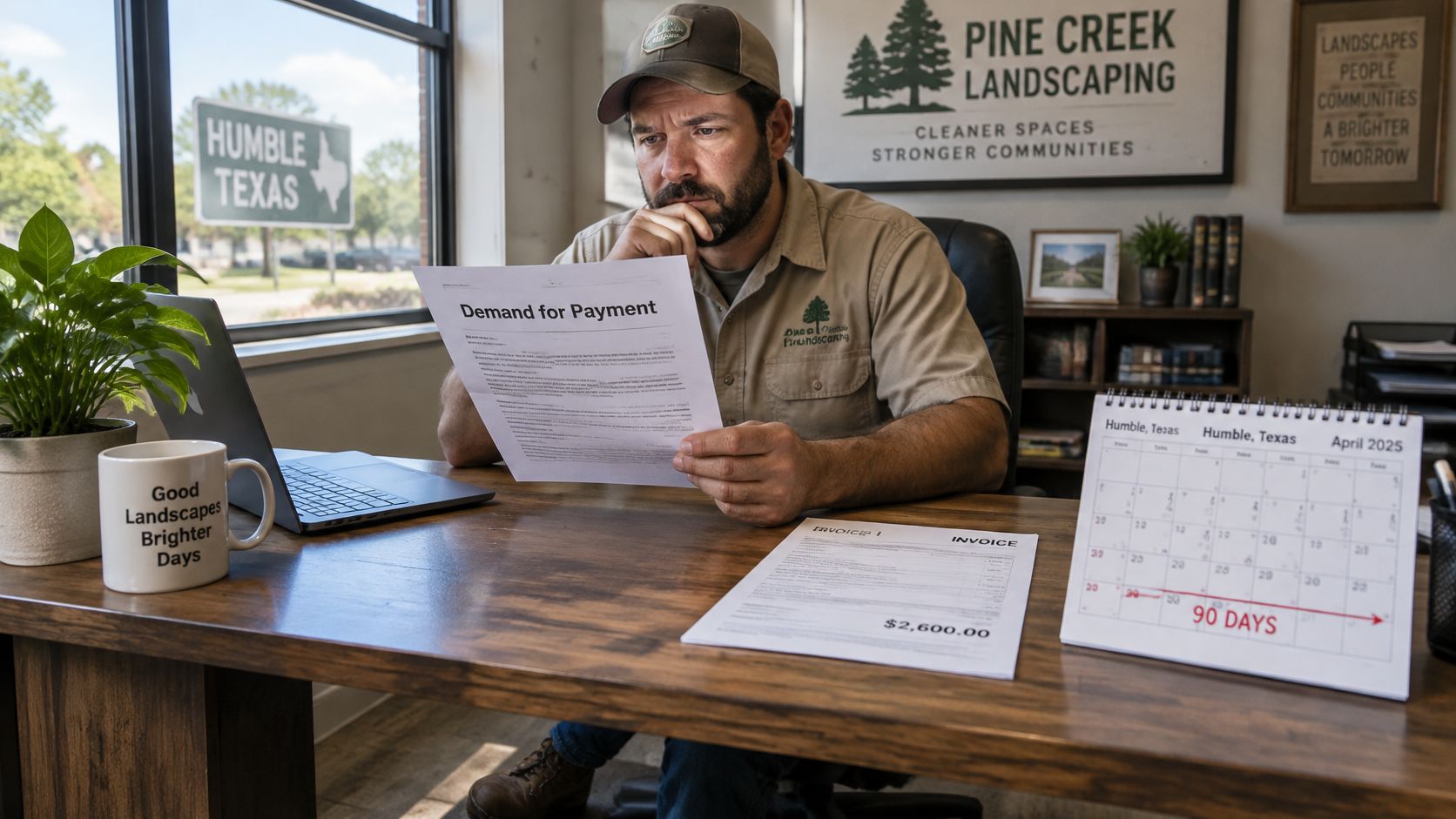
Say a Humble roofing company finished a $2,600 job and has heard nothing for ninety days. A letter of demand for money owing is a written request for payment sent before a lawsuit. It is a private demand, not a court filing. It creates no lien, and it does not pause the deadline you have to sue. What it does is put the debt in writing, name an exact amount, and give the other side a firm date to respond.
That last point trips people up most. Giving someone 10 or 14 days to pay does not extend the deadline to file suit. A Texas demand letter guide notes Texas generally allows four years for suits involving debts, stated or open accounts, and most contract claims, while property-injury claims generally have a two-year period, and justice courts generally handle civil claims up to $20,000, exclusive of interest.
| Claim type | Filing window | What it means for the demand |
|---|---|---|
| Debts, open accounts and most contract claims | 4 years | Measured from accrual, often the first missed payment, not the date of the letter |
| Property-injury claims | 2 years | Shorter window; a demand should not delay a filing decision |
| Civil claims in justice court | Up to $20,000, excluding interest | Larger balances usually belong in county or district court |
If the amount is disputed or your file is thin, wait. Review your contract rights and possible breach of contract remedies first, because the number in your letter becomes the number you have to defend. Send a shorter, accurate letter you can stand behind.
Gather and Verify Proof Before You Write
The most common mistake is demanding a number nobody can support. Many recipients don't pay because they doubt the debt, not because they've decided to refuse. If your letter omits an account-level accounting or a clear way to dispute it, you're inviting a challenge instead of a check.
That risk isn't theoretical. The CFPB 2025 consumer response annual report shows approximately 387,400 debt-collection complaints in 2025, and CFPB materials identify "I need more information about this debt" and "I do not owe this debt" as the two most-downloaded consumer letters. I read that as a practical warning. Build the folder first.
| Document | What it proves | Where to find it |
|---|---|---|
| Signed contract or written agreement | The obligation and its payment terms | Email, project files, signed estimate |
| Invoices and statements | Principal amount and due dates | Accounting software, billing portal, sent-mail folder |
| Payment history and credits | Net balance after all payments and credits | Bank deposits, ledger, check copies |
| Prior requests and replies | Notice given and any dispute raised | Email and text threads, call notes |
| Assignment or transfer papers | The right to collect for a purchased or inherited account | Purchase agreement, estate or transfer records |
| Interest and fee clauses | The contractual or statutory basis for any charge | Contract terms, statute, written fee schedule |
Two Checks That Catch Senders Out
First, confirm the exact legal entity that holds the right to collect. If the account was bought, assigned, or inherited, get the transfer papers before you write. If you're unsure which collector or creditor now holds an account, a practical guide on how to find and verify collection debt can help you trace the current holder before you address anyone.
Second, confirm the account hasn't already been partly paid or credited elsewhere. Say a Humble homeowner paid a contractor by check, but the payment never posted to the ledger. A demand for the full invoice would look careless, and the canceled check would end the argument.
Loan paperwork deserves the same care, which is why understanding the difference in a promissory note vs loan contract matters before you claim terms that aren't in your document.
You're not ready to write until a stranger could follow your folder from agreement to balance due without asking you a question.
If the recipient disputes the amount in writing, pause escalation, review your records, and correct anything that's wrong. Only then should you resume. That pause protects your credibility, and it often separates an honest billing dispute from a true refusal to pay.
How to Draft the Letter Step by Step
The drafting process is easier to follow when you see the order laid out visually.
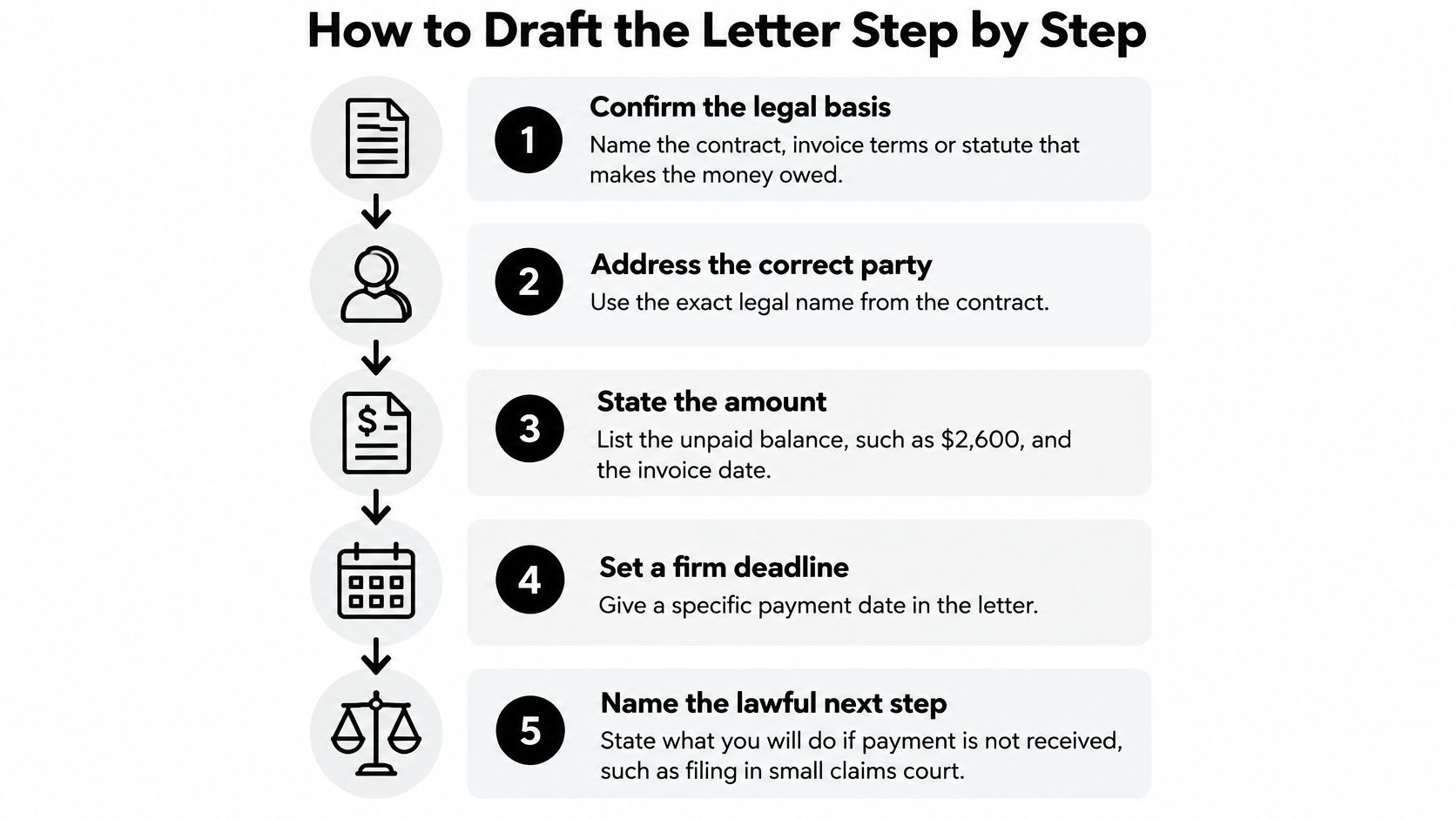
In Texas, your letter should identify the legal basis of the claim, state the amount with reasonable accuracy, attach or summarize supporting records, and calculate any permitted interest separately. The Texas Civil Practice and Remedies Code Chapter 38 also matters if you may seek attorney fees, because the claimant must be represented by counsel, present the claim to the opposing party or an authorized agent, and allow 30 days to elapse without tender of the just amount owed.
The Seven Drafting Steps
Confirm the legal basis. Name the contract, invoice terms, or statute that makes the money owed, and say why it's due now. Don't ask the reader to guess which agreement you're enforcing.
Address the correct party. Use the legal name from the contract, add the authorized agent if one is known, and use the address shown in the contract or last billing record. A letter to a trade name or former owner is easy to brush aside.
State the amount so it can be traced. List principal first, then credits, then interest separately with its basis and calculation date. For the landscaping example, that might read: principal $2,600, less $0 in credits, plus interest calculated through a stated date, for one net total. Never bury fees inside principal.
Set the payment deadline. Give a precise calendar date. When Chapter 38 attorney fees may be sought, allow at least 30 days after presentment without tender of the amount owed. A shorter deadline may feel forceful, but it won't help a fee claim.
Give payment instructions. State the exact payee name, where to send payment or how to transfer it, and the invoice number to reference. I would repeat those details near the signature so nobody has to hunt for them.
Reserve your rights without overreaching. Say you may file suit and seek the amounts the law allows if payment isn't received. Don't threaten criminal action over an ordinary civil debt, and don't imply fees or interest are automatic when each needs a contractual or statutory basis.
Sign, date, and keep a complete copy. Save the signed letter with every attachment exactly as sent. Presentment can be oral, but a written letter creates an auditable record of content, delivery, and the start date for the 30-day period.
If you dictate a first draft and clean it up on screen, practical guidance on voice typing for attorneys can help you keep names, dates, and figures consistent before anything is mailed. Read the final version aloud once. Any number you stumble over needs checking.
This short video walks through the same drafting mindset in spoken form, which can help you check that your letter sounds firm without sounding reckless.
The inflated or poorly documented total is the technical failure I would guard against most. A demand that discloses what's claimed with reasonable accuracy gives the recipient a fair chance to pay, dispute, or settle, and it gives you a record that still looks sound if a judge reads it later.
A Sample Letter You Can Adapt
Read a sample from the top down, asking what each part protects. Start with your letterhead and date, then a reference line with the invoice or account number. That reference line does quiet work. It tells the recipient's bookkeeper, spouse, or attorney exactly which account you're discussing.
Your opening sentence should state who is owed what, and why. For the landscaper, that means naming the company, the customer, the property where the work was done, and the unpaid invoice. Follow it with a short paragraph summarizing the contract or service, including when the work was authorized, when it was completed, and when payment was due.
Next comes the itemized block, which is where Texas court practice offers a useful model. The Texas Rules of Civil Procedure state that Texas Rule of Civil Procedure 508 requires a debt claim pleading to state the effective interest rate claimed, explain whether the rate is based on the contract or statute, and identify the dollar amount of interest claimed as of a specified date. If the debt was assigned or transferred, the petition must also state that fact, provide the transfer date, identify prior holders, and name or describe the original creditor.
What Your Itemized Block Should Show
- Principal balance: The contract or invoice amount before credits.
- Credits and payments: Every amount already received, subtracted openly.
- Interest: The rate, its contract or statute basis, and the calculation date.
- Assignment history: The original creditor and transfer details, if the account changed hands.
- Net amount due: One figure the reader can rebuild from the lines above.
After the numbers, give the payment deadline and payment methods, including the exact payee name and invoice reference. Then add one sentence inviting the recipient to send any written dispute or accounting question to a named contact. That sentence doesn't weaken you. It shows good faith and may surface a correctable error early.
Close with a brief reservation of rights, your signature, and a list of attachments. Before signing, check the contract's notice clause, adjust any court reference to the county where the work or payment was due, and reconcile the figures one final time. A sample gives you an outline. Your evidence folder has to supply every fact inside it.
Wording Mistakes That Weaken Your Demand
Compare two sentences. "Pay $4,200 within 10 days or face criminal charges" sounds forceful, but it threatens a consequence that doesn't fit an ordinary civil debt. A stronger version states the $4,200 balance, gives a specific payment date, and names the lawful next step, such as filing a civil claim if payment isn't received.
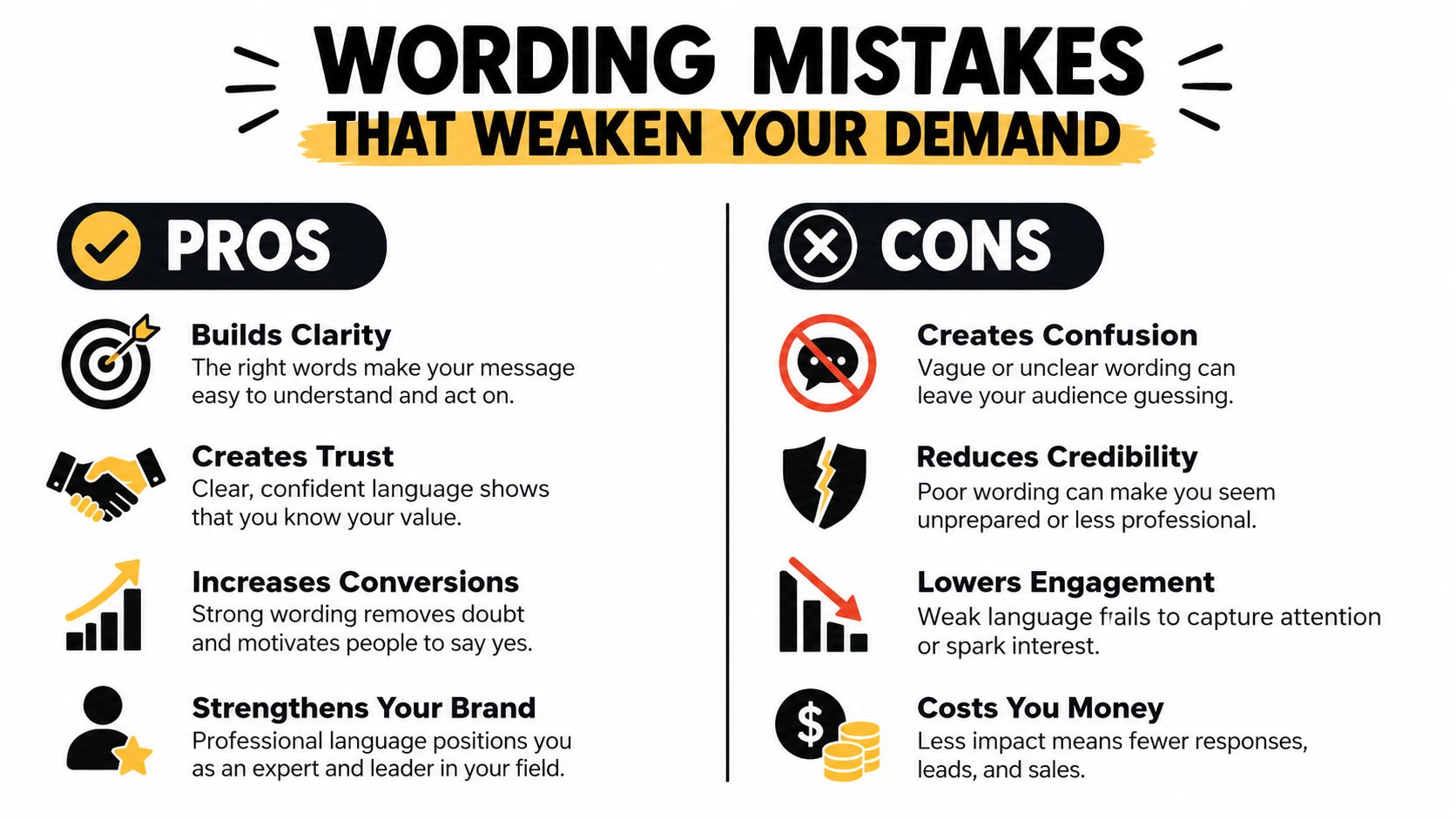
The mistakes that do the most damage are usually easy to spot once someone names them.
- An inflated or unexplained total: Replace a single mystery figure with principal, credits, and interest shown separately.
- Fees or interest with no basis: Remove any charge you can't tie to the contract or a statute.
- An impossible deadline: Give enough time for the recipient to review records, arrange funds, and respond.
- Disputed and undisputed sums combined: Separate them, or the dispute will swallow the part that isn't contested.
- Criminal threats over a civil debt: State the civil remedy you are prepared to pursue.
- An old address: Confirm the mailing address from the contract or most recent billing record.
- Repeated calls or texts after a written dispute: Log the dispute, investigate it, and reply with records instead of pressure.
The tone that works is firm, factual, and short, with one clear request. Longer isn't stronger. Angrier isn't stronger either. Each extra accusation gives the recipient something to argue about that has nothing to do with paying you.
If a sentence would embarrass you in front of a judge, rewrite it.
I would also cut any promise you aren't prepared to keep. If you say you'll file on a date, be ready to make that filing decision on that date. Empty threats teach the other side to ignore the next letter, including the serious one.
How to Send It and Keep Proof of Delivery
Delivery method is evidence.
I recommend certified mail with return receipt as the default, paired with a first-class copy kept in the file and an email copy with the sent record saved. Together, the tracking record, signed receipt, and timestamped message show what was sent, when it went out, and who accepted it. Staple the signed card and the tracking printout to a copy of the letter itself so the proof travels with the document it proves. If the envelope comes back unclaimed or refused, save it unopened, since the postmark and refusal notation document the attempt.
| Method | Proof it creates | Best use | Watch for |
|---|---|---|---|
| Certified mail with return receipt | Tracking record and signed return receipt | Default for most demands | Unclaimed or refused mail still needs a backup copy |
| First-class mail copy | Mailing copy kept in the file | Companion to certified mail | Shows you mailed, not that it arrived |
| Email copy with saved sent record | Timestamped message and attachments | Fast supplement to paper delivery | Read receipts are unreliable; do not rely on them |
| Hand delivery by process server or constable | Signed affidavit or return of service | High-value demands or when the recipient avoids mail | Higher cost and scheduling time |
If your office still sends a copy by fax, save the transmission record with the mailing proof. A plain guide to understanding fax confirmation reports can help staff read those pages correctly instead of assuming every confirmation proves the full letter arrived.
A Practical Escalation Timeline
On day one, mail the initial notice with a concrete deadline, a lump-sum payment option, and an installment option that requires written acceptance. From days 2 to 30, log any written dispute, pause escalation, review the ledger, and correct the account if you were wrong.
Texas does not hand private creditors a required schedule, so borrow one that already works. The Texas administrative collection model in 43 Tex. Admin. Code Section 5.10, which applies to debts a state agency collects, uses sequential deadlines: 30 days after notice for delinquency, a first demand within 30 days after delinquency, and a final demand no later than 60 days after the first demand. I use the same pacing for private letters because it gives the recipient two documented chances to pay or dispute before a filing decision.
When the deadline passes, review responses through about day 45. If none arrives, send a documented final demand with a firm date, then make the filing or counsel-review decision you prepared for. Put that decision date on the calendar the same day the final letter goes out.
Decide Whether to Call an Atascocita Attorney
Some demands are straightforward enough to send yourself. Others carry early warning signs, and these are the triggers that most often mean counsel should review the file first.
A common example is the disputed account. You mail a demand on an unpaid invoice, and the debtor answers with canceled checks and a competing version of the contract. Once that happens, the strength of your wording stops mattering; what decides the outcome is whether your documents still prove the balance. The same caution applies to an account that was purchased or inherited, where a gap in the transfer chain can weaken the demand before anyone answers it.
The remaining triggers are easier to spot on paper:
- The balance points beyond justice court. County or district court is the more likely forum, and your Harris County JP court small claims guide for Atascocita residents can help you judge whether that court still fits.
- The limitations period is close to running. Waiting for one more reply could cost you the claim entirely.
- You want Chapter 38 attorney fees. Recovering fees under that statute requires representation by counsel.
- A final demand was already ignored. At that point the key decision is whether and where to file.
When two or more of these apply at once, my recommendation is to pause the letter and get a review first.
The Law Office of Bryan Fagan in Atascocita serves Atascocita, Humble, and northeast Harris County in civil disputes, and its attorneys can review your evidence folder before a letter goes out. The firm also handles Texas family, criminal, and estate planning matters, including a Child Support Attorney in Atascocita service for establishing, modifying, and enforcing child support in Harris County.
If you're in Atascocita, Humble, or northeast Harris County and you're unsure whether your demand is documented well enough to send, the Law Office of Bryan Fagan – Atascocita TX Lawyers can review your contract, invoices, and payment records and help you decide whether the next step is a revised demand, a negotiated payment plan, or a timely filing. Schedule a consultation at the Atascocita office before deadline pressure becomes a limitations problem, and bring the documents from your checklist, your total and how you calculated it, and the key contract, invoice, and payment dates.