You had dinner near Atascocita, you pulled back onto FM 1960, and the lights came on behind you. The officer asked you to step out. Now you're home with a citation, a temporary driving permit, and a clock you didn't know was running.
A DWI arrest in Humble, Kingwood, or northeast Harris County isn't one case. It's two. The criminal charge moves through the county courts. The license case moves through the Texas Department of Public Safety, often on a shorter deadline. The arrest paperwork is rarely the whole file. Video, lab records, bond orders, and driving history have to be lined up before anyone can say what the case is.
A DWI defense lawyer's job is to do that lining up, one piece at a time, without treating the officer's report as the last word.
What a DWI Defense Lawyer Actually Does for You
Stay with that stop for a minute. You're on FM 1960 after dinner in Atascocita. The officer says you were weaving. You're not sure you were. You're not sure what you said next. You're not sure what Monday looks like.
A DWI defense lawyer doesn't start by accepting that account. The State has to prove each required element, including that you were operating a vehicle in a public place while intoxicated. If one element isn't proved beyond a reasonable doubt, the charge doesn't stand.
Think of a building inspector walking a house before signing off. The inspector isn't assuming the house is unsafe. The inspector also won't approve it without checking every beam. Counsel does the same with the stop, the tests, and the paperwork.
That work usually falls into three jobs.
The stop and the evidence. Counsel compares the report with video, timing, and how the tests were given.
The driver-license case. DPS can move a suspension on its own track, apart from any verdict.
The criminal case. Negotiation or trial comes after the file is reviewed, not before.
Enforcement is intense for a reason. In 2024, an estimated 11,904 people, 30% of all U.S. traffic fatalities, were killed in alcohol-impaired-driving crashes, according to the National Highway Traffic Safety Administration. Those figures describe crashes. They don't decide whether a particular driver in Atascocita, Humble, or Kingwood was impaired.
The same arrest can look different once the video and the paperwork are on the table.
Texas DWI Penalties Harris County Drivers Face
Exposure depends on the charge level, what was in the car, the test result, and your record. The ranges below come from the charging structure in Penal Code Chapter 49. They still have to be checked against the current statute and the facts of your stop. An alleged number on a printout isn't the same thing as a proved result at the legally relevant time.
| Offense level | Typical exposure | What triggers it |
|---|---|---|
| First offense DWI | Class B misdemeanor; 72-hour minimum confinement | Standard DWI charge with no aggravating factor |
| First offense with open container | Minimum confinement rises to six days | Open container in the driver's immediate possession |
| First offense with high test result | Class A misdemeanor | Alcohol concentration of 0.15 or more at analysis |
| Second DWI | Class A misdemeanor; 30-day minimum confinement | Prior DWI conviction on record |
| Third or subsequent DWI | Felony exposure once the priors are proved | Two or more prior DWI convictions |
| Intoxication assault | Third-degree felony | Serious bodily injury to another person |
| DWI with child passenger | State jail felony | Child under 15 in the vehicle |
Why the same arrest isn't the same case
A first offense is ordinarily a Class B misdemeanor, with a 72-hour minimum confinement. If the prosecution proves an open container was in the driver's immediate possession, that minimum rises to six days. Testing that shows an alcohol concentration of 0.15 or more at the time of analysis raises the offense to a Class A misdemeanor. For a driver stopped near Atascocita, Humble, or another Harris County community, the alleged result, the timing of the test, and what was inside the vehicle can change the row you're on.
Prior history shifts the row again. A 2026 quarterly DPS report recorded 24,331 DWI arrests. 7,474 involved people with previous DWI arrests, an arrest recidivism rate of 30.72%. The same report listed 848 convictions, including 216 people with previous DWI convictions, a conviction recidivism rate of 25.47%. An arrest isn't a conviction, and those two totals don't measure the same cases.
Find your row by pulling two things first: your actual driving and criminal history, and the test result with the time it was taken. Then ask whether a listed prior is a final conviction, an old arrest, or something DPS has wrong. That check is what tells you whether the charge is a first-offense profile or something with more punishment, bond conditions, and less room to negotiate.
Field Tests, Breath Results and Other Evidence to Question
A driver pulled over on FM 1960 may face two separate proceedings after a DWI arrest: the criminal case and the DPS license case. Evidence from the stop matters in both, but the arrest paperwork may leave out details that appear on the video, in test records, or in the lab file. A lawyer compares those pieces before drawing conclusions.
The stop has to be lawful
Officers need a lawful basis to stop a car and probable cause to arrest. Compare the report's account of weaving, speed, or an equipment violation with dash and body camera footage. If the report describes a wide turn but the video shows the car staying in its lane, that difference deserves examination. It may matter in a hearing or at trial.
Field tests are a protocol, not a hunch
The NHTSA standardized field sobriety test battery consists of Horizontal Gaze Nystagmus, Walk-and-Turn, and One-Leg Stand. The standardized field sobriety test manual reports original validation results at a 0.10 threshold of 77% for HGN, 68% for Walk-and-Turn, and 65% for One-Leg Stand. Later research at the 0.08 threshold reported 88%, 79%, and 83%, respectively, with the three-test battery supporting correct arrest decisions about 91% of the time. Those figures describe study results, not a conclusion about a particular Atascocita or Humble driver.
The setting can affect how a test looks. On a sloped FM 1960 shoulder, a driver performing the Walk-and-Turn may struggle to keep a straight line because the surface tilts underfoot. A curb, passing headlights, or poor lighting can also make it harder to follow instructions or perform the test as intended. The officer's training, instructions, observations, and recording help show whether the test followed the manual's protocol.
A number still has a timeline
Breath and blood evidence depends on more than the result printed on a page. Counsel may check the time between driving and testing, instrument records, operator certification, the blood draw, chain of custody, and the lab file. The legal blood alcohol limit in Texas is a legal threshold. It does not answer whether the sample and the testing process support the reported result. A per-se allegation depends on that result, while an impairment allegation also relies on driving, observations, field tests, and timing.
Drug and marijuana evidence raises a related but distinct issue: a positive test may show detection without establishing impairment at the time of driving. National safety materials report that toxicology reporting for fatally injured drivers ranged from over 90% completeness to under 10%, averaging about 60% in the cited 2019 data. That context does not establish what happened in an individual case. Timing, dose, tolerance, lab method, and the driving evidence still need to be examined together.
| Evidence | What counsel requests or checks | What it can reveal |
|---|---|---|
| Dash and body camera video | Full recording from the stop through booking, including any gaps | Driving behavior, test instructions, and the driver's demeanor |
| Field sobriety test records | Officer training certification, clues marked, test surface, and lighting | Whether tests followed the standardized protocol |
| Breath test records | Instrument calibration, operator certification, and observation period | Reliability of the number and the timing of the test |
| Blood test records | Warrant or consent, draw procedure, chain of custody, and lab report | Whether sample handling supports the reported result |
| Dispatch and stop logs | Timeline of the call, the stop, and the arrest | Whether the officer's account is internally consistent |
| Drug and marijuana toxicology | Substance identified, quantity, detection window, and lab method | Whether the result shows impairment at the time of driving |
Request the full video, training records, and lab packet early. The citation summarizes an arrest; it does not necessarily capture every detail needed to reconcile the record.
License Suspensions, Deadlines and Administrative Hearings
The criminal case and the license case don't wait on each other. The charge goes through the county court. The license case runs through DPS and the Administrative License Revocation program. You can have a license problem while the criminal case is still sitting on a docket in Harris County.
What implied consent actually means
Texas treats a person arrested for an alleged intoxication offense as having consented to a breath or blood test. The officer has to explain that a refusal may be used later and may trigger suspension. A Fourteenth Court of Appeals opinion is one place that framework shows up in a real DWI record. A refusal means more than "no test." It can become both prosecution evidence and a separate civil suspension. The warning language, whether you were under arrest, and whether the paperwork matches the video all matter.
Under the ALR program, a license may be suspended when a driver refuses or fails to complete a blood or breath test, or when a noncommercial driver provides a test showing a blood alcohol concentration of at least 0.08%. You generally have 15 days after receiving the suspension notice to request an administrative hearing. If you don't request one, the suspension takes effect on the 40th day after service of the notice. For someone arrested in Atascocita, Humble, or elsewhere in northeast Harris County, missing that date creates a license problem before any verdict.
What the hearing is for
At the hearing, counsel can examine the basis for the stop and the arrest, the test request, the warnings, and the test or refusal record. A timely request keeps the license question on its own track while the criminal case is still pending. If you may qualify, ask about an occupational license after a DWI in Atascocita and about any ignition interlock order already in the bond paperwork.
DPS suspension materials list different periods by the type of event and your record. Read the notice you received. Don't assume your neighbor's period is yours.
| Situation | Suspension period | What to do |
|---|---|---|
| First refusal of a breath or blood test after DWI arrest | 180 days | Request an ALR hearing within 15 days of the notice |
| Refusal with an alcohol or drug enforcement contact in the past 10 years | Two years | Pull the full driving record before the hearing |
| First failed test by a noncommercial driver (0.08% or more) | 60 days under DPS materials | Confirm the period on the notice you received |
| Failed test with a prior conviction for specified intoxication offenses | 120 days | Check prior conviction records for accuracy |
| Hearing requested within 15 days of notice | Suspension generally held pending the hearing outcome | Confirm the hearing date and bring all paperwork |
| No hearing requested within 15 days | Suspension takes effect on day 40 after service | The deadline is the step to protect |
A hearing request filed on day 16 doesn't rewind the notice. The date on the envelope is the date that counts.
Steps to Take in the First Two Weeks After an Arrest
A stop near Lake Houston or FM 1960 can leave you trying to piece together the night while two separate processes begin: the criminal case and the DPS license case. A missed license deadline can affect your driving privileges before a criminal verdict. Start by preserving the details and paperwork that help counsel compare what happened with what the records say.
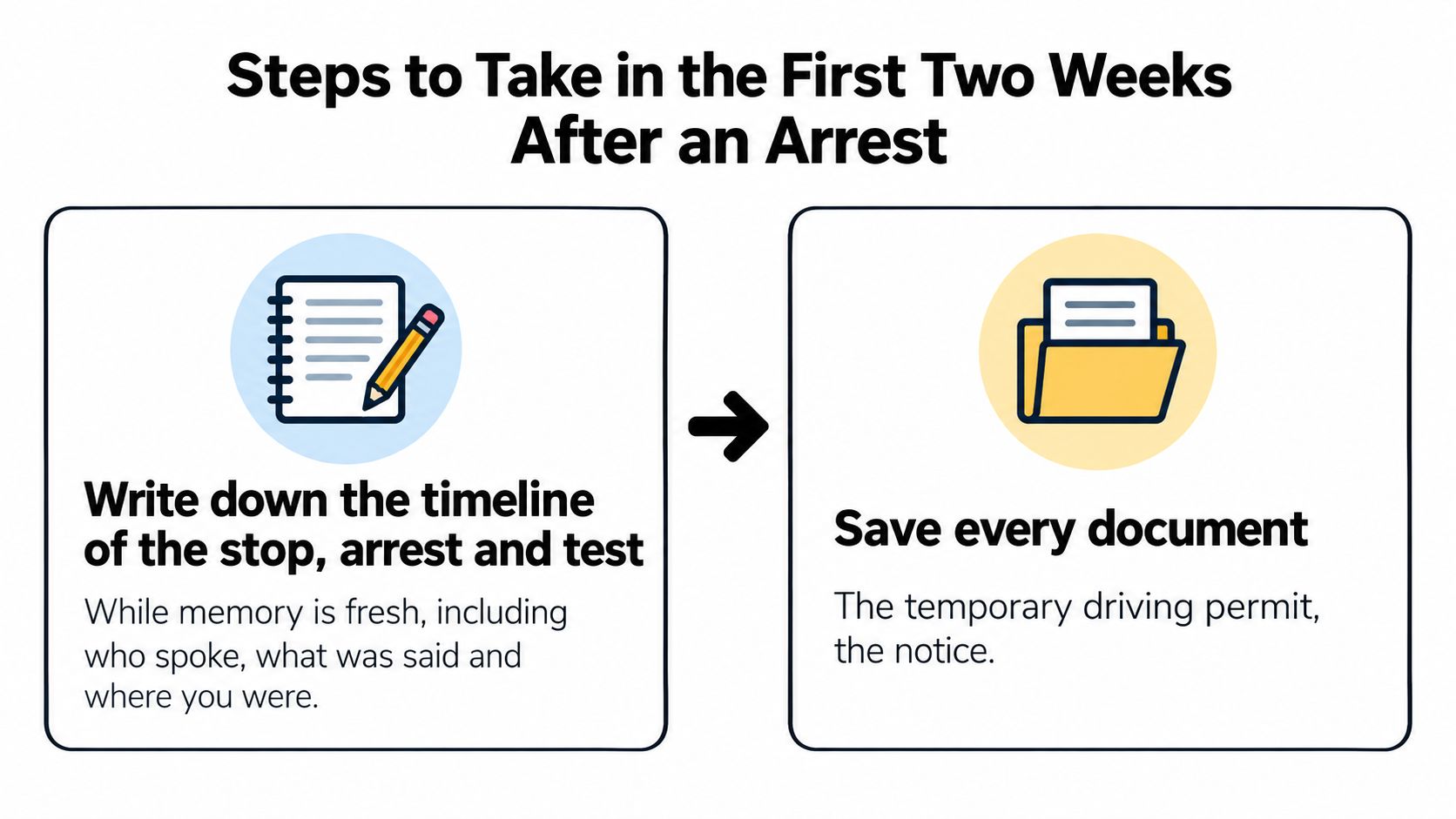
- Write the timeline while it's fresh. Record who spoke, what was said, where you were, and how much time passed between the stop and any test. Include details that may seem small. They can be harder to recall later.
- Save every document. Put the temporary driving permit, suspension notice, bond paperwork, and citation in one folder. If a family member posted bond, keep the receipt there too. Some families arrange paying Houston bail bonds online, so save the related confirmation and release documents rather than relying on scattered texts.
- Save the suspension notice to your phone and set a reminder for day 14. Keep the original notice with your other papers. A reminder gives you time to confirm the required action with counsel before the deadline, rather than relying on memory.
- Read the bond conditions the same day. Check for reporting requirements and any orders you need to follow. Keep a copy where you can find it quickly, and ask your lawyer to explain language you do not understand.
- Ask counsel to request the evidence early. This may include dashcam and body-camera video, breath or blood records, and blood-kit paperwork. Preserve your own messages, receipts, and location information too, in case they help establish the timeline.
- Compare the arrest paperwork with your driving and court records. The arrest record may not show the full history or later case outcomes. The 2025 Texas Impaired Driving Plan describes gaps in linking arrests, court dispositions, and outcomes, while reporting improvements are intended to make some information easier to track. Ask counsel to check for a missing disposition or an incorrect order, since either could affect driving privileges or sentencing. The plan also describes circumstances in which an interlock may be required at bond or after a case outcome.
- Stop posting about the night. Avoid discussing the case with officers or prosecutors without counsel. Social media posts can be found and considered alongside other evidence.
- Speak with a lawyer before your first court setting. Bring the timeline, notices, bond conditions, and any records you have gathered. A lawyer can help compare the paperwork across both tracks and identify what still needs to be checked.
What a DWI Case Costs and How Long It Takes
A driver arrested in Atascocita may face two separate bills and two timelines: legal work in criminal court, and the cost and deadline tied to a DPS license case. The attorney fee depends on the work the case requires. A misdemeanor and a felony can involve different levels of preparation. Other factors include a prior record, whether the ALR hearing is included, the amount of video and lab material, the number of court settings, whether the case ends in a plea or goes to trial, and whether an expert is needed.
Court fines, court costs, bond fees, and ignition interlock charges are separate from attorney fees. Ask for a written agreement explaining whether the fee is flat, hourly, or a retainer, and which hearings and appearances it covers. A criminal defense retainer can explain what the first payment includes and what may cost extra. At a consultation, ask how the proposed fee relates to your charge, record, and case needs rather than relying on a general price list.
What Sets the Case Calendar
The DPS notice gives one firm deadline. Criminal court dates depend on the court's schedule, how quickly records arrive, and whether either side contests the evidence. For example, an arraignment in a Humble driver's case might come within days or weeks of arrest, while reviewing extensive video and lab records can take longer.
| Stage | Typical timing | What drives the length |
|---|---|---|
| ALR hearing request | Within 15 days of the suspension notice | Fixed deadline set by the DPS notice |
| Arraignment and bond setting | First days to weeks after arrest | Booking timing and court availability |
| Discovery and evidence review | Weeks or longer, depending on records | Amount of video, lab records, and subpoenaed material |
| Pretrial motions and plea talks | Weeks to months, depending on the case | Motion hearings and prosecutor review |
| Trial setting | Months or longer, depending on the docket | Court calendar and whether the case is contested |
| Resolution or appeal | Depends on the outcome and any appeal | Plea, dismissal, verdict, or appeal |
These estimates are examples, not promises. The criminal case can still be pending while the license process moves ahead. Missing the DPS deadline may affect driving privileges before a criminal verdict, so budget for the attorney fee and separate court costs, and keep the administrative deadline on its own calendar.
Plea Options, Deferred Adjudication and Ignition Interlock
Not every DWI case is tried. Likely outcomes depend on the evidence, the prior record, and how that county court handles these files. No lawyer can promise a particular result.
Dismissal happens when review shows a real evidence problem, such as a missing video segment or an incomplete lab packet. It isn't the starting assumption.
A negotiated plea to a reduced charge is a conversation that uses that same review. Before you accept a lesser offense, you should understand the record that plea leaves behind. Reading about understanding your options before a conviction is a useful way to see how a deferred outcome differs from a finding of guilt, even though Texas practice isn't identical to every other state.
Deferred adjudication means the court defers a finding of guilt while you complete conditions. Finishing successfully can lead to dismissal. Probation terms, and sometimes an interlock, can still apply while the case is open.
Conviction and sentencing puts you back on the penalty row that matches the proved charge and the priors. That is why the history check comes before any plea decision.
An ignition interlock is a breath-test device the car may require before it starts, with regular reporting. Courts and DPS can order one at different stages. The device cost is separate from attorney fees. If a final order is missing from the statewide record, license reinstatement can stall, so confirm each order in writing.
Choose Your DWI Defense Lawyer and Book a Free Consultation
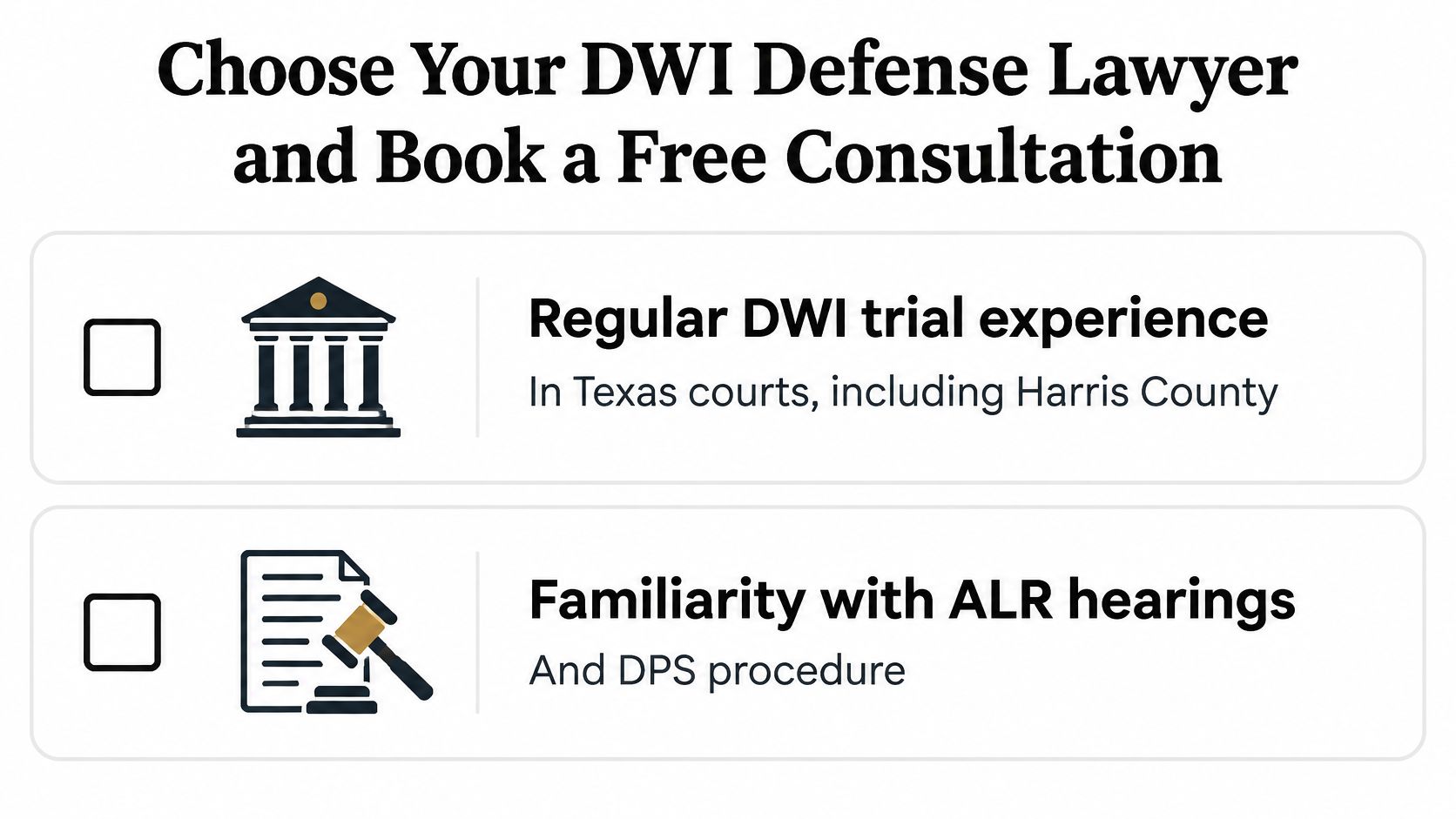
Start by checking whether the lawyer regularly handles DWI trials in Texas courts, including Harris County, and knows the separate DPS license process. Those two qualifications are shown in the checklist below.
Ask how the lawyer will review the evidence, what the fee agreement covers, and how you can reach them with questions. Board certification in criminal law from the Texas Board of Legal Specialization is something you can verify. Be cautious if someone guarantees an outcome, urges you to plead before reviewing available video, gives unclear fee terms, or has no plan for the license deadline.
Bring the papers you have, such as the citation, suspension notice, bond paperwork, and a written timeline. If you already have video, bring that too. In Atascocita or Humble, the arrest record may not tell the whole story. Ask how the lawyer will compare it with available video, test records, and DPS paperwork, since the criminal case and license case move on separate tracks. A missed administrative deadline can affect your license before the criminal case reaches a verdict.
Use the consultation to ask what may happen next, which evidence needs closer review, and what the ALR date means for your license. Read about what affects attorney consultation pricing so you can ask whether the first meeting is free and what any later fee covers.
The Law Office of Bryan Fagan – Atascocita TX Lawyers represents people charged with DWI in Atascocita, Humble, and Harris County. You can ask about a free consultation at its Atascocita office. A DWI arrest may also prompt a child-protection inquiry, which is a separate matter. A CPS Defense Attorney in Atascocita handles a different kind of case for families facing a CPS investigation.
A consultation can help you sort the criminal case from the DPS license case and identify records that may not match. If you have a suspension notice, bring it and ask what can still be done before the administrative date passes.