 Skip to content
A late-night call from the Harris County Jail can turn an ordinary evening in Atascocita upside down. A parent in Humble answers the phone. A spouse grabs a charger, keys, and a notebook. Someone asks the question almost every family asks within minutes: How do we pay for a lawyer, and what will that cost us right now?
That question is stressful because it lands at the worst possible time. You may still be trying to figure out where your loved one is being held, when the first court setting will happen, or whether the charge is a misdemeanor or a felony. At the same time, you're being asked to make a fast decision about legal help in a system that doesn't wait for anyone to feel ready.
If you're trying to understand a criminal defense attorney retainer fee in Atascocita, Humble, or northeast Harris County, you're not alone. This part of the process often feels confusing because people assume the first payment is either the full price of the case or a mysterious charge with no clear purpose. In reality, it's usually the first practical step toward getting a lawyer involved quickly.
Criminal cases move fast in the early days. Evidence has to be reviewed. Court dates have to be tracked. Prosecutors, police reports, and release conditions can all affect what happens next. That's why understanding the money side matters. It helps you make a clear decision instead of an anxious one.
Families looking for local guidance often begin by learning how to find a good criminal defense attorney before they compare fee structures or sign anything.
Your First Step After an Arrest in Atascocita
A common local situation looks like this. Someone is stopped near FM 1960, or arrested after an argument, or booked after a DWI investigation in the Humble area. By the time the family starts making calls, they're already behind emotionally. They want answers immediately, but most of the legal process still feels out of reach.
The first useful step is to slow down just enough to gather the basics. You need the full name of the person arrested, where the case is being handled, the charge if known, and whether there are upcoming release or court issues. Once you have that, the next question becomes whether a private lawyer can step in right away.
Why the retainer matters early
A retainer fee isn't just about money. It's what usually allows the attorney to begin work now instead of later. In a Harris County criminal case, those early hours often matter because legal strategy starts before a trial date is ever discussed.
Practical rule: The sooner a lawyer can review the case, the sooner your family gets advice grounded in the facts instead of rumors from the hallway or social media.
A local lawyer can help you sort through immediate concerns such as:
- Bond questions: Whether release conditions need attention
- Court logistics: Which Harris County court may handle the matter
- Case posture: Whether the charge appears routine or more complex
- Family impact: Work, driving, school, parenting time, and household stress
That last point gets overlooked. Criminal charges often spill into family law and civil concerns too. A pending case can affect a divorce, custody dispute, or even a CPS matter. At our Atascocita office, we also see how legal problems overlap. The same household may need help with criminal defense today and questions about custody, support, or estate planning tomorrow.
What to do before calling a lawyer
Bring order to the chaos with a short list:
- Write down the arrest details you know.
- Avoid discussing the facts publicly or online.
- Gather paperwork from the jail, bond company, or court if you have it.
- Prepare to ask about the retainer without embarrassment. It's a normal part of hiring counsel.
That conversation may feel uncomfortable. It shouldn't. Many individuals facing criminal charges in Harris County have never hired a defense lawyer before.
What Exactly Is a Criminal Defense Retainer Fee
A criminal defense attorney retainer fee is an upfront payment that lets a lawyer begin work on your case and reserve time for the early demands that follow an arrest. In Harris County, those early demands can come fast. A court setting may be added quickly, bond conditions may need review, and the lawyer may need to start gathering records before the case develops further.
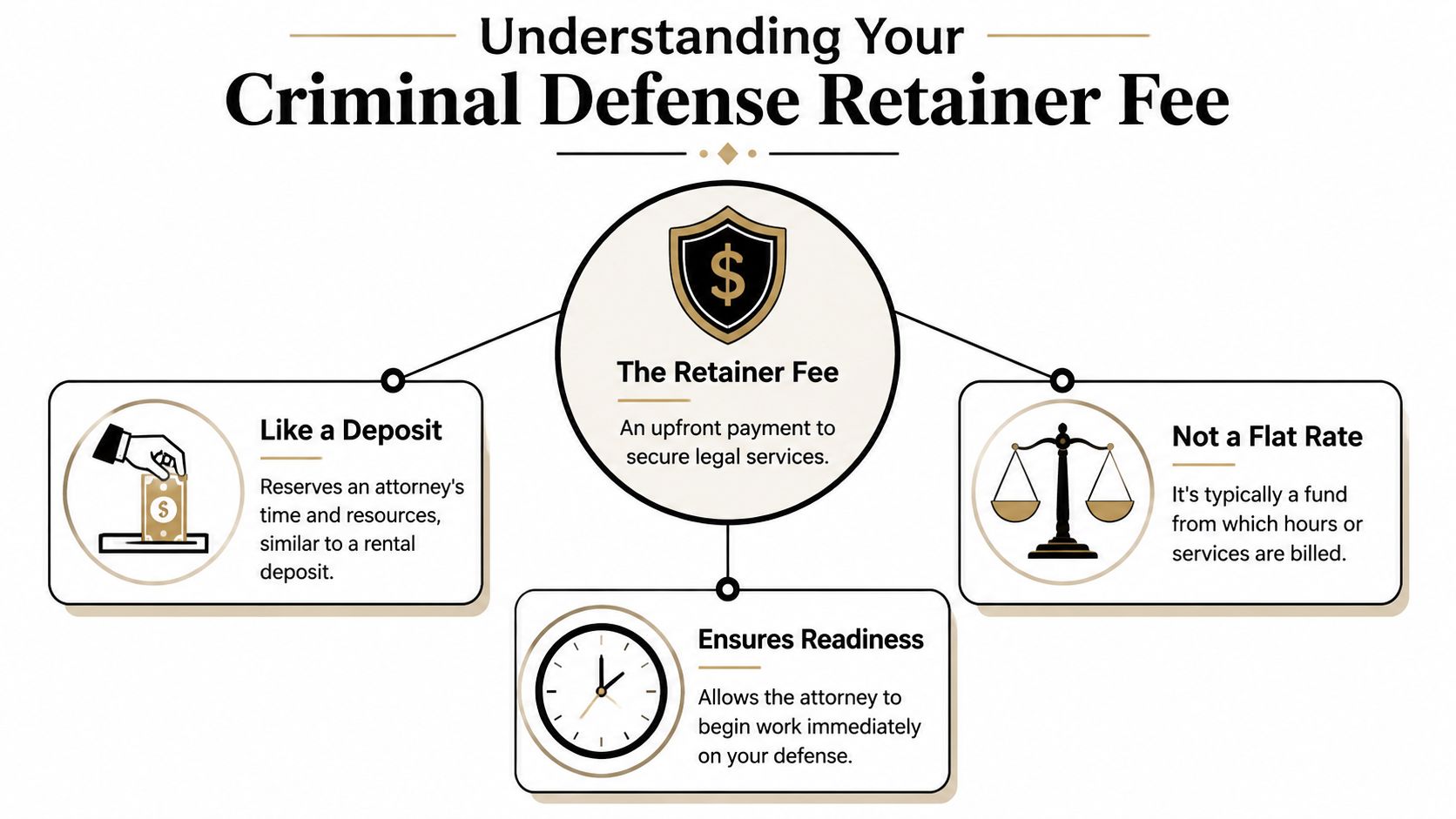
A retainer works much like a starting fund
For many Atascocita and Humble families, the easiest way to understand a retainer is to view it as the money that gets the attorney to work now, not later. It gives the lawyer a pool of funds to draw from under the fee agreement while the first tasks are being handled.
Those first tasks may include reviewing the charging paperwork, checking Harris County court information, speaking with you or your family, analyzing deadlines, and giving advice about what to do next. If you are hiring a Harris County criminal defense lawyer for a local case, the retainer is often what allows that work to start immediately instead of waiting until every question about the full cost is answered.
What people often misunderstand
The word “retainer” causes confusion because it sounds more mysterious than it is.
Many clients assume one of these ideas is always true:
- the retainer is the full price for the entire case
- the lawyer gets to keep every dollar no matter what work is done
- every expense connected to the case is included in that first payment
In many criminal matters, none of those assumptions is safe. A retainer is often an advance payment tied to hourly billing or another defined fee arrangement. Depending on the agreement, the funds may be placed in a trust account and earned as work is completed. If part of the money is not earned, Texas rules may require different treatment of that balance based on the contract and how the fee was structured.
That is why the written agreement matters so much. It tells you whether the payment is a true advance deposit, a flat fee for a defined stage of the case, or a different arrangement allowed under Texas practice.
A retainer usually pays for legal work to begin right away and for attorney time to be available during the opening stage of the case.
Why this matters in Texas and Harris County
Local practice shapes how valuable that early availability can be. In Harris County, criminal cases often move through busy courts with their own schedules, settings, and expectations. A lawyer may need to check where the case landed, determine what happened with bond conditions, and start advising you before small mistakes become bigger problems.
That does not mean every case will become expensive or complicated. It means the first phase of a criminal case often requires prompt, focused work. The retainer supports that first phase.
Families sometimes ask why lawyers use retainers in criminal defense but may quote other legal work differently. The answer is that each type of case has its own workflow and risk. Even in non-criminal matters, clear fee agreements are still part of good practice. For example, Prenuptial & Postnuptial Agreements in Atascocita involve planning and document drafting instead of emergency court response, but clients still need a clear explanation of what the fee covers.
A good retainer agreement should leave you with fewer surprises, not more.
Common Fee Structures and Typical Costs in Harris County
A family in Atascocita may call two lawyers about the same arrest and hear two very different price quotes. That usually does not mean one quote is fair and the other is not. It often means the lawyers are pricing different levels of risk, different amounts of work, or different stages of the case.
In Harris County, that difference shows up quickly. A case set in a busy misdemeanor court may be priced one way. A felony filed downtown at the Criminal Justice Center, with more witnesses, more records, or a real chance of trial, is often priced another way. For many local families, the clearest starting point is a conversation with a Harris County criminal defense attorney who handles these courts regularly and can explain how the fee matches the likely path of the case.
Here is a quick visual comparison:
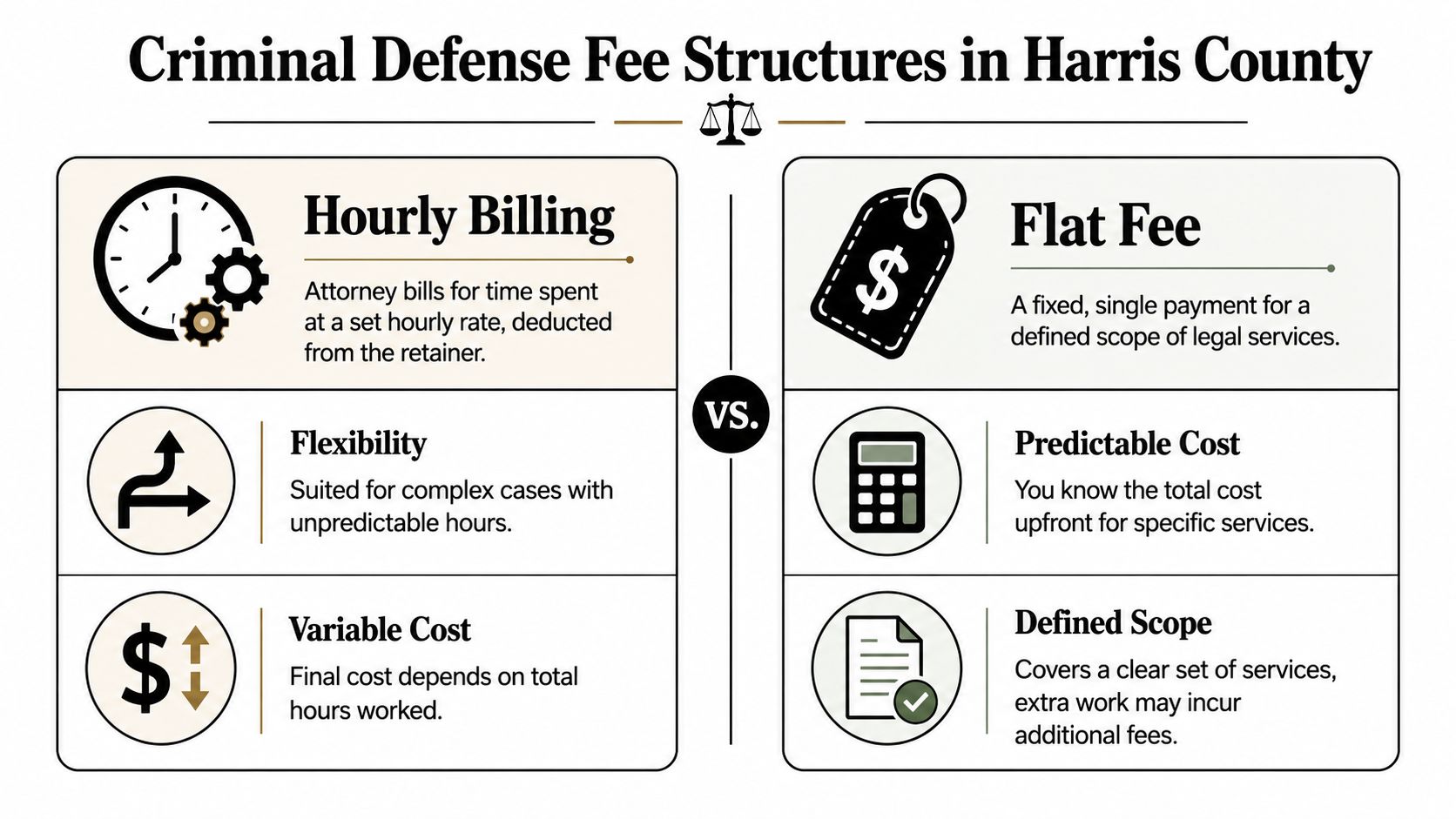
Hourly billing against a retainer
Hourly billing works like a prepaid work account. You place money in trust up front, and the lawyer charges time against that amount as the case develops, if the agreement uses that structure under Texas practice.
This model is common where the road ahead is hard to predict. A lawyer may not know at the start whether the case will involve body camera review, witness interviews, contested motions, repeated court settings, or plea negotiations that stretch over months. In Harris County, that uncertainty is common in cases such as:
- Felony assault allegations with conflicting witness stories
- Theft or fraud cases involving business records, phone data, or surveillance
- Cases with spillover problems affecting immigration status, professional licensing, or family court matters
For a family trying to budget, the practical question is simple. How much work is likely before the next major checkpoint in the case? An hourly retainer gives the lawyer room to start immediately while keeping the billing tied to time spent.
Flat fees for defined stages
Flat fees are more like paying for a defined job instead of paying by the hour. In criminal defense, that often means a lawyer charges one amount for a clearly described stage, such as pretrial representation in a misdemeanor case.
That structure can make monthly planning easier for households in Humble and Atascocita. It can also reduce anxiety because you know the fee for the agreed work at the start. The tradeoff is that the written agreement has to be precise. If the case later requires a jury trial, a contested suppression hearing, or work in a related matter, those services may be billed separately.
A first-offense misdemeanor may fit a flat fee more easily than a felony with many unknowns. The label matters less than the details on paper.
Typical cost ranges people often ask about
Families usually want a ballpark number before they schedule a meeting. That is understandable, especially after bond costs, missed work, and the stress of getting a loved one home.
National fee surveys can give broad context, and Zabrisk's overview of criminal lawyer fees and retainers describes common patterns such as lower starting fees for many misdemeanors and much higher starting fees for serious felony cases. In Harris County, the same general pattern holds. Misdemeanors often cost less than felonies. Cases likely to go to trial often cost more than cases expected to resolve earlier.
Several local factors tend to affect the quote:
- Charge level: misdemeanor, state jail felony, or higher felony
- Court location and pace: county criminal courts and felony district courts often involve different demands
- Evidence volume: videos, phone downloads, financial records, and multiple witnesses all add work
- Urgency: quick bond issues, protective orders, or early intervention with prosecutors can increase front-end time
- Trial risk: jury preparation takes far more attorney time than a routine reset or negotiated resolution
For many Harris County residents, a useful rule of thumb is this: the more moving parts in the case, the less likely a low, simple quote will cover everything you need.
Criminal charges can also trigger other legal problems at home. A parent facing an arrest may soon be dealing with school concerns, custody questions, or a CPS contact. If that is happening in your household, CPS Defense Attorney in Atascocita explains how those investigations can overlap with a criminal matter and create added legal expense.
A short explainer can also help if you want another overview of how fee structures generally work:
What Your Retainer Fee Covers and What It Does Not
One of the biggest sources of frustration in criminal cases is a simple misunderstanding. The client thinks the retainer covers everything. The law firm thinks the agreement clearly limits what is included. Trouble starts when nobody slows down and defines the boundary.
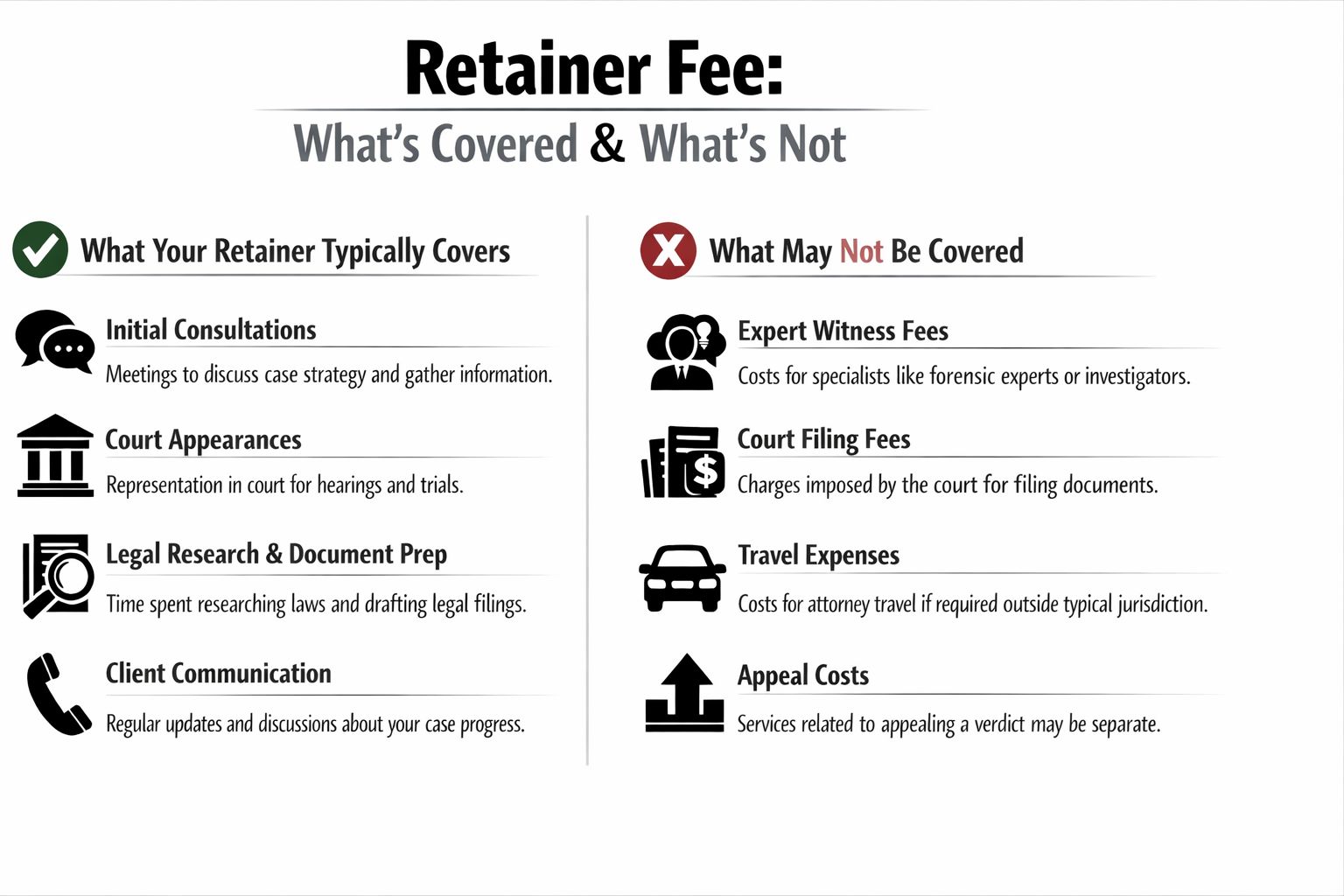
What is often included
In many cases, the retainer covers the attorney's professional time on the core defense. That often means work such as:
- Initial case review: Reading the charge, hearing your account, and identifying immediate issues
- Legal research and drafting: Preparing motions, notices, and strategy documents
- Routine court appearances: Showing up for hearings tied to the agreed scope
- Communication: Calls, emails, meetings, and updates about case movement
- Negotiation: Discussions with the prosecutor about evidence, resolution, or scheduling
This is why families sometimes underestimate what they're paying for. The courtroom appearance may be short, but the preparation behind it often is not.
What may cost extra
Third-party and expanded-scope expenses are where people often get surprised. A retainer may not include:
- Expert witnesses
- Private investigators
- Special testing or records retrieval
- Travel outside the normal area
- Appeals or post-conviction work
- Court-imposed costs that aren't attorney fees
Criminal defense retainer fees are advanced deposits used to secure representation and cover anticipated hourly or flat-fee work. Factors that can increase the starting retainer include the severity of the offense, the need for expert witnesses, pretrial investigations, and the likelihood of trial, which can push initial retainers well above $15,000 in complex matters, according to MTV Law's discussion of average criminal retainer fees.
Questions that prevent billing surprises
Before you sign, ask the lawyer to separate the fee into two buckets.
| Bucket | What to ask |
|---|---|
| Core legal services | What attorney work is included in the retainer or flat fee? |
| Extra expenses | What costs are billed separately if they become necessary? |
Ask for plain-English examples. “If this case needs an investigator, how is that billed?” is a better question than “Are expenses extra?”
This matters in Harris County because two cases with the same charge can move very differently. One may resolve through negotiation. Another may need witnesses, motion practice, and extensive review.
Billing Practices Refunds and Texas Ethics Rules
A family in Atascocita may scrape together bond money, call a lawyer the same day, and then wonder what happens to that retainer after the case settles down. That question is fair. In Harris County, you should know whether your money is being held for future work, treated as earned for a flat-fee stage of the case, or left over and refundable at the end.
Texas ethics rules matter here because the label on the fee is not enough by itself. What controls is how the fee agreement is written and how the money is handled in real life. A retainer often works like a prepaid balance for legal work. If the lawyer has not earned all of it, the remaining portion is usually returned. If the agreement says part of the fee becomes earned at a certain stage, the contract should say that plainly.
That is why the written agreement matters so much.
A careful billing process usually includes:
- A written fee agreement that says whether the charge is hourly, flat fee, or a mixed arrangement
- Clear language about where the money goes first and when the lawyer may transfer earned funds
- Billing statements or status updates so you can match the work performed to the charges
- Terms about refunds explaining what happens if the case ends early, is dismissed, or new counsel takes over
- A warning about replenishment if the initial deposit runs low in an hourly matter
For Harris County residents, the practical question is simple: can you explain this fee arrangement to a spouse, parent, or sibling after the consultation? If not, ask the lawyer to slow down and walk through it line by line. A good explanation should sound plain, not technical.
Refunds are where confusion shows up. Some criminal matters end faster than expected. Charges get reduced, a case resolves at the first setting, or a client switches attorneys. In those situations, the answer is not always “full refund” or “no refund.” It depends on the contract, the work already completed, and whether the fee was earned as the case progressed.
Texas lawyers also have rules against charging illegal or clearly unreasonable fees. That does not mean every high fee is improper. Serious felony cases in Harris County can require heavy time investment, multiple court appearances, and urgent client contact. It does mean you have the right to ask how the amount was set and what part, if any, could be returned if the representation ends early.
If cost is a major concern, some families also compare private counsel with the differences between a public defender and a private attorney before deciding how to proceed.
One option local residents sometimes consider is the Law Office of Bryan Fagan – Atascocita TX Lawyers, which handles criminal defense as well as family law, estate planning, and civil litigation for people in Atascocita, Humble, and Harris County. For some households, that matters because an arrest can overlap with child custody issues, protective orders, or other legal problems that affect the same budget.
Before you sign, ask for two things in writing: how the lawyer will bill, and how any unearned money will be treated. Those two answers clear up a lot of stress before the case even begins.
Negotiating Your Fee and Exploring Payment Options
A lot of people feel awkward asking about price. They worry the lawyer will think they aren't serious, or that talking about money will offend someone. In criminal defense, that fear usually makes things harder, not easier.
Fee conversations are normal. A lawyer can't structure a workable agreement unless you speak openly about what you can afford and what kind of payment schedule is realistic for your household.
How to ask without feeling confrontational
Try language like this:
- “Can you explain whether this is hourly or flat fee?”
- “What would make the fee go up from here?”
- “Do you offer payment arrangements?”
- “What costs are separate from the retainer?”
- “What happens if the case becomes more complex?”
Those questions are direct, respectful, and useful. They also help you compare private representation with other options, including the issues discussed in public defender vs private attorney.
Practical ways families manage the first payment
Different firms may accept different payment methods or offer different structures. The key is to ask early rather than assume. If someone in your family can contribute, say that. If you need the lawyer to phase the payment around bond costs or household bills, say that too.
A better consultation usually happens when the client is candid. The lawyer doesn't need a polished financial speech. The lawyer needs a real picture of what you can do now and what you may need help arranging.
What not to do
Don't agree to a fee you don't understand just because you feel rushed. Don't leave the meeting without knowing whether the amount discussed is a retainer, a flat fee, or the first of several payments. And don't stay silent if the numbers don't make sense to you.
The right question is not “Can I afford to ask about the fee?” The right question is “Can I afford not to understand it?”
Key Questions to Ask Before You Sign the Agreement
A parent from Humble calls after a late-night arrest in Harris County. Bond has to be addressed, work starts in a few hours, and a fee agreement is sitting on the desk waiting for a signature. In that moment, the goal is simple. Slow the conversation down enough to understand what you are agreeing to.
A good retainer agreement should read like clear directions, not like a puzzle. If the lawyer explains one thing in the consultation but the contract says something broader or vaguer, stop and ask about it. In Harris County criminal cases, small wording choices can affect who appears in court, what stages of the case are covered, and when more money may be requested.
One practical way to prepare is to treat the agreement like an estimate for major home repairs. You are not only asking, "What is the price?" You are also asking, "What work is included, what is extra, and what happens if the job gets bigger than expected?"
Checklist for Your Attorney Consultation
| Category | Question to Ask |
|---|---|
| Fee structure | Is this a flat fee, an hourly retainer, or a combination of both? |
| Scope | Does this fee cover arraignment, pretrial settings, motions, plea negotiations, and trial, or only part of the case? |
| Court coverage | Will you personally appear in my Harris County court, or will another lawyer from your office handle some settings? |
| Extra costs | Are investigators, expert witnesses, transcripts, and filing costs billed separately? |
| Retainer handling | Will my money stay in a client trust account until earned, or is any part considered earned when paid? |
| Refunds | If the case ends early, how do you determine whether any unearned amount is refunded? |
| Replenishment | If the retainer gets low, when would I need to add funds, and how much notice would I get? |
| Appeals and bond issues | Are bond hearings, probation matters, motions to revoke, or appeals included, or would those require a new agreement? |
| Local experience | How often do you handle charges like mine in Harris County courts serving this area? |
| Communication | Who should my family call for updates, and how quickly are calls usually returned? |
| Next steps | What should I do in the next 24 to 72 hours to avoid making the case harder? |
Some questions matter more in Harris County than families first realize. For example, many cases involve several court settings before the case is resolved. Ask whether every setting is covered. Ask whether a trial setting changes the fee. Ask whether work related to bond conditions, protective orders, or no-contact orders is included if those issues come up.
People also forget to ask how representation ends. That matters. If the case is dismissed, reduced, or resolved with probation, ask whether the agreement covers later cleanup work such as early termination questions, nondisclosure advice, or expunction screening, if those options become available under Texas law.
Write your questions down before the meeting.
Stress makes it easy to miss the one sentence that changes the whole financial picture. A written list also helps relatives who are helping pay the retainer stay on the same page, especially when several family members in Atascocita or Humble are trying to make fast decisions together.
The goal is to leave the consultation knowing three things clearly. What the lawyer will do. What the fee covers. What could change the cost later.
If you need straightforward answers about a criminal defense attorney retainer fee or you're facing related family, civil, or estate concerns in Atascocita or Humble, schedule a free consultation with Law Office of Bryan Fagan – Atascocita TX Lawyers. Our office helps residents of northeast Harris County understand their options, ask the right questions, and take the next step with clarity.


