 Skip to content
Divorce often starts with a quiet conversation at the kitchen table in Atascocita or Humble. One spouse says, “I don't want this to turn ugly.” The other says, “I agree, but I also don't want to get steamrolled.” Both worries are valid.
A lot of Harris County families assume divorce has only two settings. Friendly and unrealistic, or hostile and headed for court. Texas law gives families another option. It's called collaborative divorce, and for the right couple, it creates a structured way to resolve the case privately, respectfully, and with legal support on both sides.
That matters when you share children, a home, retirement accounts, or a business interest. It also matters when you still have to see each other at school events, extracurricular activities, or family gatherings in northeast Harris County after the divorce is final. A process that lowers conflict at the beginning can make life more manageable later.
If you're searching for Collaborative Divorce Texas options because you want clarity without chaos, this guide is for you. I'm going to walk through how the process works, where people get tripped up, and when collaborative divorce is a smart choice for families in Atascocita, Humble, and the surrounding Harris County area.
A More Peaceful Path for Your Atascocita Divorce
A couple in Atascocita may already know the marriage is ending, but still agree on a few important things. They want the children to stay stable. They want to keep private family matters out of a courtroom. They want to divide property fairly without turning every disagreement into a fight.
That doesn't mean the divorce is easy. It means the couple is looking for a process that can hold hard conversations without making them harsher than they need to be.
Collaborative divorce fits that need better than many people realize. It isn't an informal promise to “be nice.” It's a formal process designed around negotiation, problem-solving, and informed decision-making. Instead of gearing up for hearings and trial, both spouses work with their own lawyers in a private setting to reach a settlement.
What this feels like in real life
For many families in Humble and Atascocita, the appeal is practical. You may want a parenting plan that matches school pickup, work schedules, and life in Harris County traffic. You may need a property division plan that accounts for a house, retirement, debts, or one spouse handling most of the finances during the marriage.
Collaborative divorce gives room for those details.
Collaborative divorce doesn't require spouses to be friends. It requires them to stay engaged in a settlement process built around solutions instead of courtroom positioning.
Why local families often ask about it
People in this area often come in with the same concern. They don't want a “messy divorce,” but they also don't want to make a legal mistake by being too trusting. That's exactly why collaborative divorce can be helpful when it fits.
It gives each spouse independent legal advice. It creates a structured setting for exchanging information. And it keeps the focus on reaching workable agreements before the final uncontested court step.
If that sounds more manageable than a contested courtroom battle, you're not imagining it. For some Harris County families, it is.
Understanding Collaborative Divorce Under Texas Law
Texas doesn't treat collaborative divorce as a casual variation of settlement talks. Texas has a formal statutory framework for collaborative divorce in the Collaborative Family Law Act, codified in Texas Family Code Chapter 15, as described in this explanation of Texas collaborative law and Chapter 15 requirements.
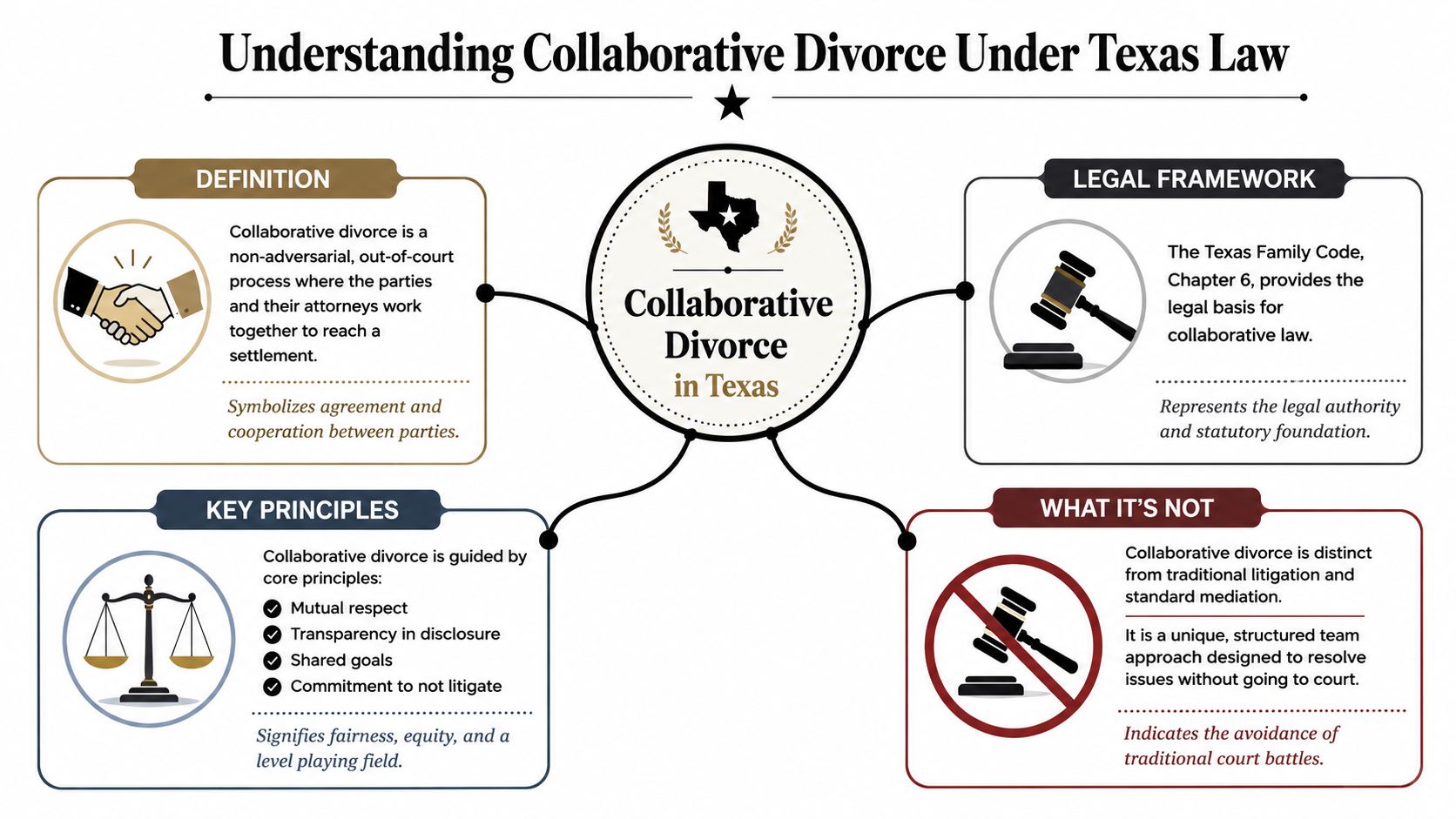
That legal structure matters because it tells you what collaborative divorce is, and what it isn't. This isn't just two spouses hoping to work things out. It's a recognized legal process with required steps.
The participation agreement
Under Texas law, the process begins with a written participation agreement signed by both spouses, and it identifies each spouse's collaborative lawyer before the process starts, as noted in the Chapter 15 overview linked above. Think of that agreement as the blueprint for the case.
If traditional litigation is like two contractors fighting over plans in front of a judge, collaborative divorce is more like hiring a team to build a workable solution together. The agreement sets the ground rules for that team effort.
Those rules usually center on:
- Working outside court: The spouses commit to resolving issues through private meetings rather than contested hearings.
- Using identified counsel: Each spouse has a lawyer for the collaborative process from the start.
- Sharing information: The process is built around full disclosure rather than courtroom discovery battles.
For readers looking for local representation, Divorce Lawyer in Atascocita, TX is a family law service page for divorce representation in Atascocita and Harris County.
The rule that surprises most people
The most important feature is the withdrawal rule. If the collaborative process fails and one party later goes to court, the collaborative lawyers must withdraw from the case under the statute, according to the same Chapter 15 discussion linked above.
That can sound harsh at first. In practice, it's what gives the process its backbone.
Practical rule: In collaborative divorce, your lawyers are there to help settle the case. They are not there to prepare quietly for a future trial while meetings go on.
This changes incentives. It pushes everyone toward serious negotiation instead of using the process as a warm-up round for litigation. It also helps explain why collaborative divorce is legally distinct from standard mediation. The structure is different, the commitment is different, and the role of the attorneys is different.
The Collaborative Divorce Process Step by Step
Clarity regarding the path ahead often brings a sense of relief. Collaborative divorce in Texas is a multi-professional case-management model that commonly includes joint meetings, voluntary information exchange without formal discovery, and coordinated input from neutral financial and mental-health professionals. Guidance discussing that workflow also notes that the pre-settlement process can take several months, especially when appraisals, business valuations, or complex asset division are involved, as explained in this overview of how the collaborative divorce process works in Texas practice.
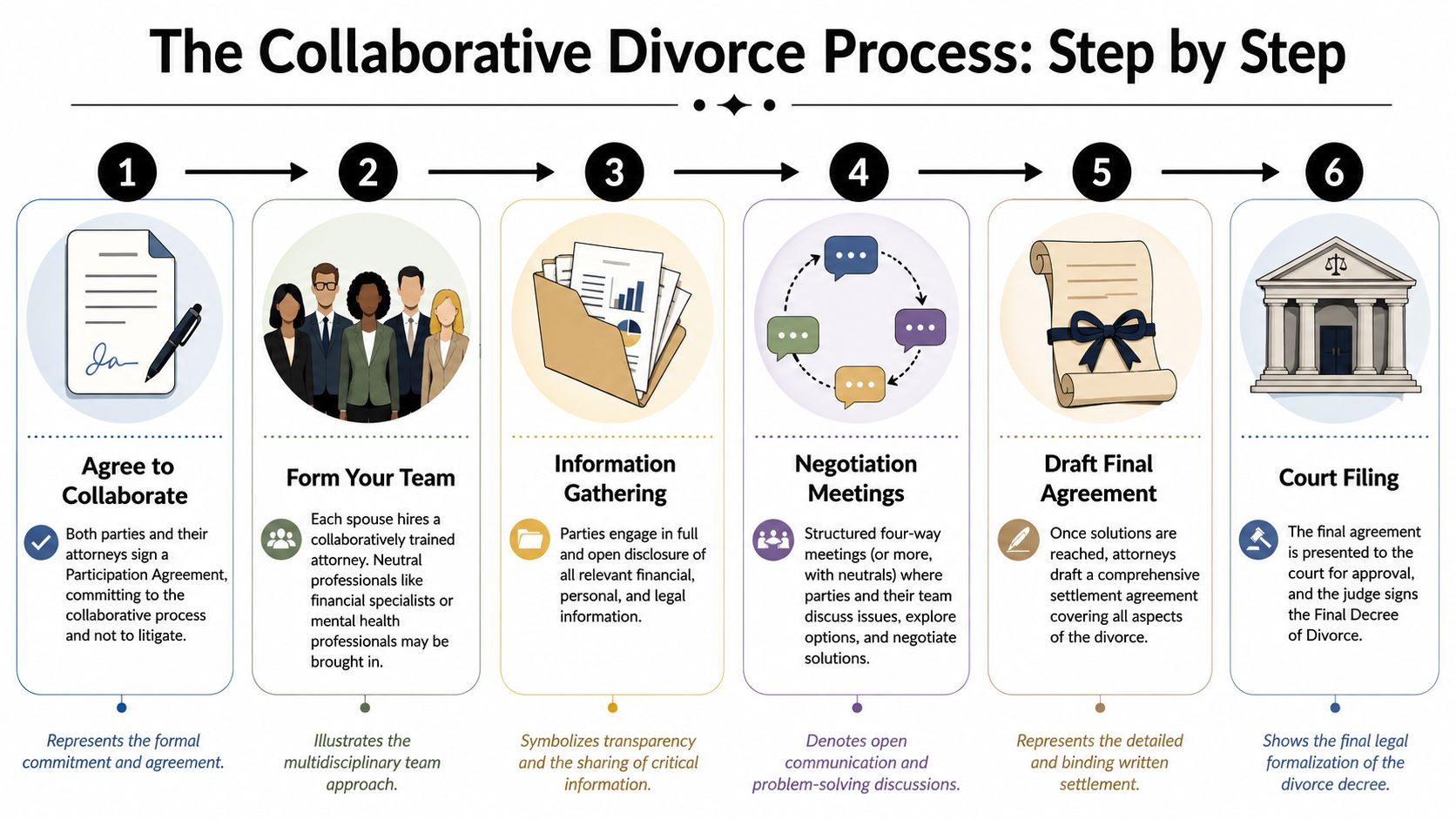
Step one through step three
Each spouse chooses a collaborative lawyer
You don't share one attorney. Each person needs independent legal advice. The lawyers help determine whether the process fits the facts of the case.The first joint meeting sets the tone
At the beginning, everyone usually meets together and signs the participation agreement. During this meeting, expectations get clearer. How will information be exchanged? What issues need immediate attention? Are there children's schedules, temporary expenses, or valuation questions that need to be organized first?The team is built around the case
Some divorces only need the spouses and lawyers. Others benefit from a neutral financial professional, a neutral mental-health professional, or both. These neutrals aren't there to “take sides.” They help organize information, reduce confusion, and support better decisions.
A local example helps. If a couple in Humble owns a house, has retirement assets, and disagrees about how future co-parenting should work, the collaborative team may use one neutral to help with finances and another to help with communication and parenting issues. That often keeps discussions focused.
Here's a visual overview of how those stages fit together:
What voluntary information exchange looks like
People often hear “no formal discovery” and worry that it means “less protection.” That's not the idea. In a collaborative case, the spouses exchange information voluntarily rather than through subpoenas, depositions, and court-enforced discovery requests.
That may include:
- Financial records: Bank statements, retirement information, debt information, and income documents.
- Property details: Mortgage information, appraisals, and business valuation materials when needed.
- Parenting facts: School schedules, activity calendars, childcare realities, and proposed possession schedules.
This part only works when both spouses participate openly. If one spouse withholds information, the process can stall quickly.
Where the real work happens
Most collaborative cases move through a series of meetings. Some are four-way meetings with both spouses and both lawyers. Others include the neutral professionals.
Those meetings usually focus on the big questions first:
| Issue | What the team tries to accomplish |
|---|---|
| Children | Build a parenting plan that works in real life |
| Property | Identify what exists, how to value it, and how to divide it |
| Support | Discuss child-related expenses and any support issues |
| Practical transition | Plan for housing, insurance, and post-divorce finances |
The technical advantage of the collaborative model is simple. The team tries to reduce uncertainty before final documents are drafted.
The final stage
Once the spouses reach agreement, the lawyers prepare the settlement paperwork and then the final divorce decree. Even in a collaborative case, the divorce still ends in a court-filed decree at the uncontested stage. The judge's role is usually limited compared to contested litigation because the hard decisions were already resolved privately.
For many families in Atascocita, that's the appeal. The court finalizes the result, but the family shapes it.
Collaborative vs Litigation vs Mediation in Texas
People often compare these three options as if they're basically interchangeable. They're not. Each one solves a different problem.
Collaborative divorce is a team-based settlement process with lawyers involved from the start. Litigation is court-centered and judge-driven when spouses can't resolve disputes on their own. Mediation is a facilitated negotiation process that may happen with or without broader settlement support.
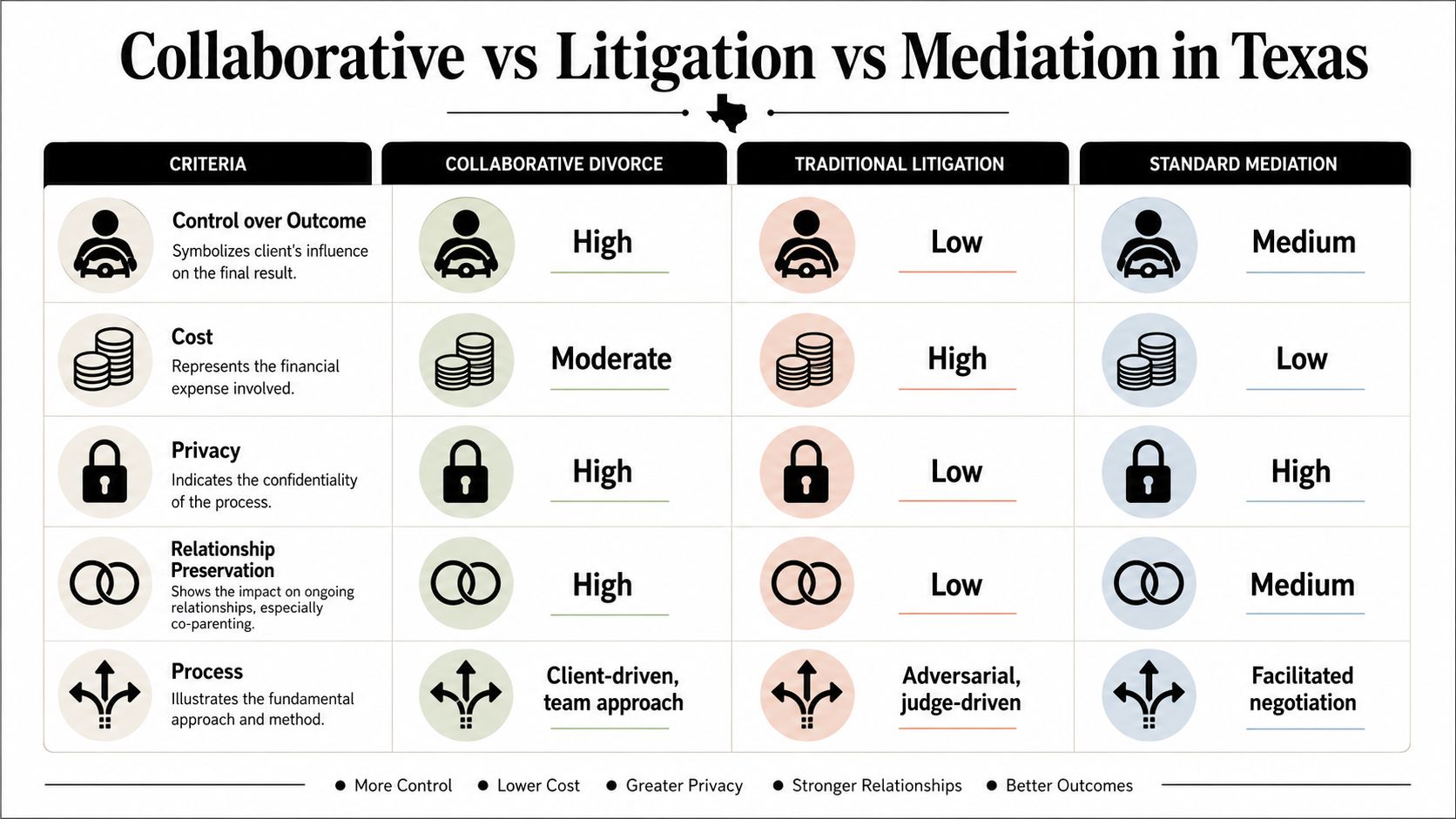
A side-by-side look
| Factor | Collaborative divorce | Traditional litigation | Standard mediation |
|---|---|---|---|
| Control over outcome | High. Spouses negotiate terms with legal guidance. | Lower. A judge may decide disputed issues. | Medium. Spouses negotiate, often in a shorter format. |
| Privacy | High. Most work happens in private meetings. | Lower. Court filings and hearings shape the case. | High. Negotiations are generally private. |
| Relationship impact | Often better for long-term co-parenting when both people participate in good faith. | Often harder on communication because the process is adversarial. | Depends heavily on the couple's communication style. |
| Structure | Team approach with lawyers and, when needed, neutral professionals. | Formal motions, discovery, hearings, and trial preparation. | One mediator facilitates discussion, but doesn't represent either spouse. |
The key difference between collaborative divorce and mediation
Readers often get confused: mediation is not the same thing as collaborative divorce.
In mediation, the mediator is neutral and helps the parties negotiate. In collaborative divorce, each spouse has a lawyer specifically participating in a structured settlement process from the beginning, and neutral professionals may join the team to help solve financial or parenting issues before final documents are prepared.
If you want to compare that alternative more closely, this page on divorce mediation in Atascocita, Texas gives a separate look at the mediation path.
When litigation is the better tool
Litigation gets a bad reputation because it's stressful. But sometimes it's the right tool. If someone won't disclose financial information, refuses to negotiate in good faith, or there's a need for court intervention, litigation may protect the family better than a cooperative model.
That doesn't make collaborative divorce a lesser process. It just means you need the right process for the right facts.
A peaceful process is only helpful when it still protects you.
Is Collaborative Divorce Right for Your Atascocita Family
This is the question that matters most. Not whether collaborative divorce sounds civilized. Not whether it's popular. The essential question is whether it fits your family's actual dynamics.
Collaborative divorce can be a strong choice when both spouses want a respectful process and are prepared to participate openly. It can be a poor choice when one spouse controls the information, controls the money, or controls the tone of every discussion.
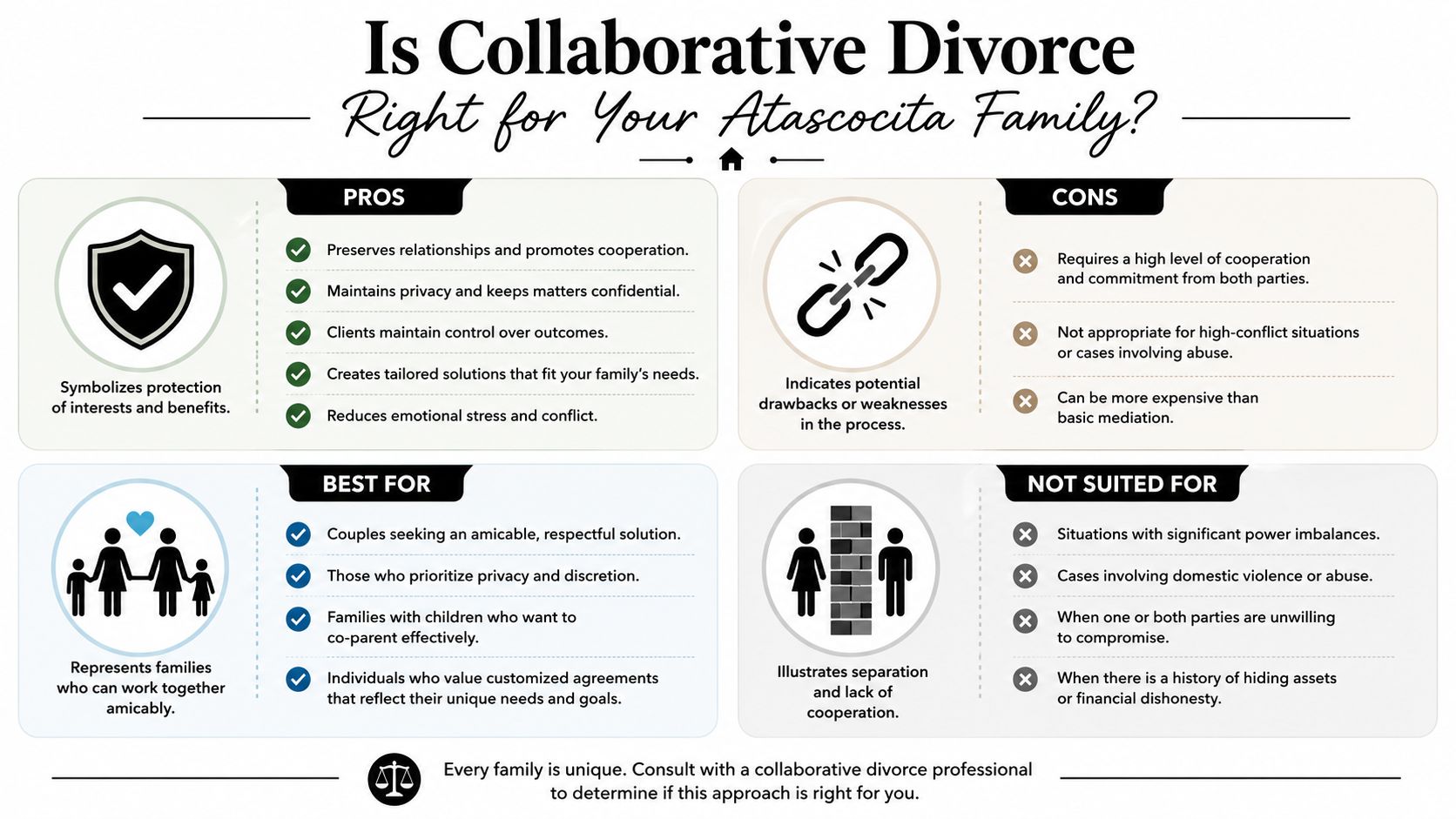
Signs the process may fit
Ask yourself whether these statements feel true:
- We both want to avoid court if possible: That shared goal helps keep negotiations moving.
- We can discuss hard topics without intimidation: You don't have to agree on everything, but both people need room to speak freely.
- We're willing to disclose finances openly: The process depends on transparency.
- We care about future co-parenting: Collaborative work can help parents create child-focused routines and communication habits.
- We want practical solutions: This is often useful when a family needs custom arrangements rather than one-size-fits-all positions.
A couple in northeast Harris County with school-age children may care less about “winning” and more about preserving school stability, planning exchanges, and creating a schedule that works with work shifts and extracurricular activities. Collaborative divorce can support that kind of planning.
Red flags that deserve serious attention
Texas family lawyers should screen carefully for situations where collaboration may not protect a client well enough. The collaborative process can be strategically worse than litigation when one spouse needs formal discovery, temporary court orders, or stronger means to surface information, as discussed in this article about when collaborative divorce may not be the right fit.
That warning matters in real life.
Consider litigation, or at least a very cautious legal review, if any of these are present:
- Financial secrecy: One spouse handles all accounts and gives vague or shifting explanations.
- Fear or coercion: You're scared to disagree in person, even in a professional setting.
- Urgent need for court orders: You need immediate rulings to protect children, finances, or daily stability.
- Chronic bad-faith behavior: The other spouse stalls, withholds, or uses “cooperation” as a way to avoid accountability.
Hard truth: If you need the court's power to get information or protection, collaborative divorce may be the wrong tool.
A simple self-check
If you're in Atascocita or Humble and you're unsure, start with these two questions:
- Can both spouses participate without intimidation or hidden agendas?
- Can both spouses make full financial disclosure without being forced by the court?
If the answer to either is no, collaborative divorce may not be the safest path. A good family lawyer should tell you that plainly.
Typical Timelines and Costs in Harris County
The honest answer to “How long will this take?” is that it depends on the issues that need to be resolved. Collaborative cases often move more predictably than contested litigation because the spouses aren't waiting for every decision to be driven by a crowded court calendar. But they still take time to do properly.
The process can take several months, especially when the case involves appraisals, business valuations, parenting disputes, or complex asset division, as noted earlier in the discussion of Texas collaborative workflow. In Harris County, that means patience still matters. A careful agreement usually takes longer than a rushed one.
What tends to affect cost
Collaborative divorce usually involves paying for problem-solving on the front end rather than paying for repeated courtroom conflict on the back end. Costs often rise or fall based on factors like these:
- Complex finances: A house, retirement assets, separate property claims, or a business can require more analysis.
- Use of neutral professionals: Financial or mental-health neutrals can add cost, but they may also reduce confusion and narrow disputes.
- Level of cooperation: Cases move more efficiently when both spouses provide information promptly and stay engaged.
- Number of unresolved issues: Parenting disagreements and valuation questions usually require more meeting time.
If you want a practical overview of fee-related considerations, this guide on divorce lawyer costs in Atascocita, TX can help frame the discussion.
Don't overlook insurance and post-divorce logistics
One issue people miss until late in the process is health insurance. Texas legal guidance notes that Texas law does not require an insurer to keep an ex-spouse on a plan after divorce, so coverage can end unless COBRA or another arrangement is available. The same guidance also notes that this issue should be negotiated carefully in the final decree, even in a collaborative case, as explained in this discussion of insurance plans and divorce in Texas.
That's a good example of why timeline and cost aren't the only questions. A solid collaborative agreement should also cover real-world transition issues, including insurance, support, and who is responsible for child-related medical costs.
Begin Your Collaborative Divorce with a Trusted Atascocita Attorney
Collaborative divorce gives some families a better way to end a marriage. Not a painless way, because divorce is still hard. But a more controlled, more private, and more constructive way.
For Harris County families, the biggest advantage is often this: you don't hand the important details of your children, property, and future routines to a courtroom fight unless you have to. You work through them with structure, legal guidance, and a process designed to reach settlement.
Choose a lawyer who will screen the fit honestly
The right collaborative attorney won't push this process on every client. They should ask careful questions about transparency, safety, communication, and financial access. They should also tell you when litigation or another approach makes more sense.
If you're comparing your options, this resource on how to choose a family lawyer in Atascocita, Texas is a useful starting point.
For local residents, the Law Office of Bryan Fagan – Atascocita TX Lawyers provides family law services for people in Atascocita, Humble, and Harris County, including divorce-related representation.
What to bring to a first conversation
If you're considering collaborative divorce, gather a short set of basics before you meet with a lawyer:
- A family snapshot: Marriage date, children's ages, and current living arrangements.
- A property list: Home, vehicles, debts, retirement accounts, and any business interests.
- Your concerns: Communication issues, money access, parenting worries, or fears about disclosure.
- Your goal: Privacy, stability for children, faster resolution, or understanding whether collaboration is safe in your case.
That first conversation should leave you with more clarity, not more pressure.
If you live in Atascocita, Humble, or nearby northeast Harris County and you're trying to decide whether collaborative divorce is the right path, talking it through with a local family lawyer can save you from choosing a process that doesn't fit your situation.
If you're ready to discuss your options, schedule a free consultation with Law Office of Bryan Fagan – Atascocita TX Lawyers. Our Atascocita office works with local families who need clear guidance on divorce, custody, and next steps, including whether collaborative divorce makes sense for their case.


