Skip to content
When you’re facing a divorce, it’s easy to feel like you’re heading straight for a bitter courtroom battle. But for families here in Atascocita, Humble, and across northeast Harris County, it doesn't have to be that way. Texas divorce mediation offers a different path—a structured, private process where a neutral professional helps you and your spouse negotiate a fair agreement, putting you in control of your family's future.
A More Human Approach for Atascocita and Humble Families
The end of a marriage often brings the fear of having a stranger in a courtroom make life-altering decisions for your family. For countless people in our community, that thought alone adds a huge layer of stress to an already difficult time. Thankfully, Texas law strongly encourages a more private and constructive alternative: divorce mediation.
Think of mediation not as a fight, but as a guided conversation. It's a process where you, your spouse, and your respective attorneys sit down with a trained, neutral mediator. Their one and only job is to help you find common ground on the tough issues—like dividing property, creating a parenting plan for your children, and arranging financial support. The goal is to solve these deeply personal matters together, instead of handing that power over to a judge.
You Stay in the Driver's Seat
Perhaps the single biggest advantage of mediation is that it keeps the decision-making power exactly where it belongs: with you, the two people who know your family best. This is never more critical than when children are involved.
Here’s why so many families in our area choose this route:
- It’s Private: Court hearings are public record. Mediation sessions are completely confidential.
- You Have Control: You get to shape the final agreement to fit your family's real life, whether that’s creating a co-parenting schedule that works with the Humble ISD calendar or fairly dividing assets you built together in our community.
- It's More Efficient: Mediation is almost always faster and significantly less expensive than gearing up for a full-blown trial.
This process works so well that courts in Harris County and the surrounding areas often require couples to try mediation before they will even consider scheduling a final trial.
What's Happening Locally
While Texas has seen a gradual decline in the overall divorce rate, a large percentage of divorces still involve children under 18. This trend really underscores the need for a process like mediation, which is designed to minimize conflict and create stability for kids. For families right here in Atascocita, choosing a cooperative path can make an incredible difference in everyone's emotional and financial health.
Ultimately, mediation gives you and your spouse a framework to build separate futures on a foundation of respect, not resentment. Understanding what a mediator actually does is the first step toward a successful outcome. To get a better sense of their role, you can learn more about what a divorce mediator does and how they guide these critical conversations.
How the Texas Divorce Mediation Process Works
Knowing what to expect in a Texas divorce mediation can turn a daunting unknown into a series of manageable steps. For families in Atascocita and across Harris County, understanding the roadmap provides a much-needed sense of control during an otherwise uncertain time. While no two cases are identical, most mediations follow a predictable and structured path.
Think of it less like a single, high-pressure event and more like a structured conversation with a clear beginning, middle, and end. It all starts with preparation and, ideally, finishes with a legally binding agreement that lets everyone in your family move forward.
Stage 1: The Orientation Phase
The day usually kicks off with a joint orientation session, either in person or online. This is where the mediator sets the stage. They’ll introduce themselves, lay out the ground rules—especially confidentiality—and clarify what everyone hopes to accomplish. It’s a critical moment for establishing a productive, cooperative tone for the day.
The mediator will make one thing crystal clear: they aren’t a judge and won’t be picking sides. Their job is to guide the conversation, help you and your spouse find common ground, and brainstorm creative solutions for the issues where you’re stuck. It’s standard practice for you and your attorney to be in one room (or virtual breakout room) while your spouse and their attorney are in another. This setup helps keep emotions in check and the focus on problem-solving.
This flowchart shows how mediation fits into the broader divorce process, acting as a crucial off-ramp from the traditional courtroom battle.
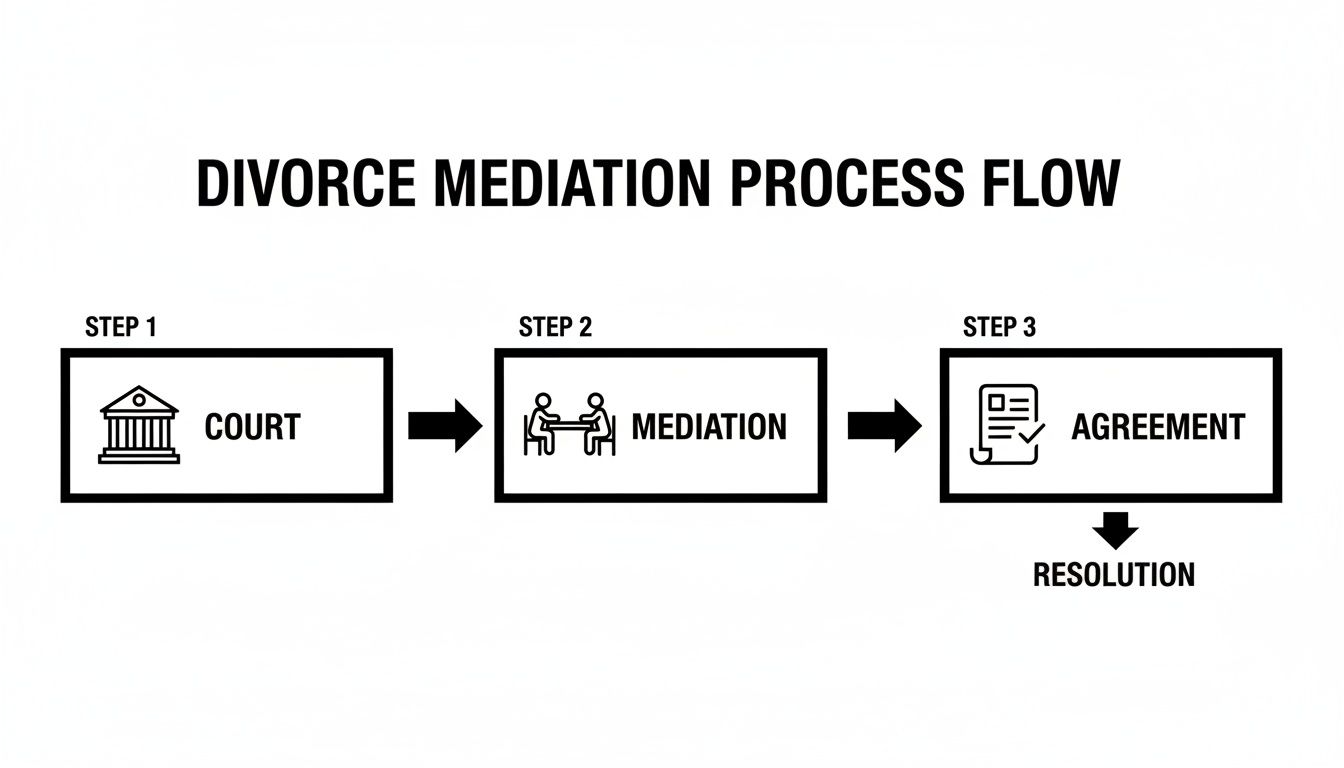
As you can see, mediation gives you the power to craft your own resolution instead of leaving it in the hands of a judge.
Stage 2: Information Gathering and Negotiation
With the ground rules established, the real work begins. The mediator starts by gathering the necessary information to tackle the key issues of your divorce, which typically include:
- Financial Disclosures: Getting a full inventory of all marital assets and debts—everything from the mortgage on your Humble home to retirement accounts and credit card balances.
- Parenting Plans: Hammering out the details of conservatorship (custody), creating a possession schedule, and deciding who has the authority to make key decisions for your kids.
- Support Needs: Calculating potential child support and spousal maintenance based on the specific guidelines set out in Texas law.
This stage is all about communication, but it’s rarely direct. The mediator moves between the two rooms in a process called a "caucus," carrying proposals and counter-offers back and forth. This shuttle diplomacy is incredibly effective. It allows for frank discussions with the mediator and prevents the direct conflict that so often derails negotiations. Your attorney is your guide here, advising you on the legal ins and outs of each offer and helping you formulate responses that protect your future.
In Texas, an incredible 90% of divorce cases that enter mediation end in a settlement. This success rate is a powerful testament to the process; with the right guidance, most couples can find a way forward without a judge having to make the decisions for them.
Stage 3: Finalizing the Agreement
As you start checking issues off the list—you’ve agreed on the house, the custody schedule, the support amount—the mediator and attorneys begin to draft the Mediated Settlement Agreement (MSA). This is the legally binding document that locks in every decision you've made. The entire point of the day is to produce a comprehensive Divorce Settlement Agreement template that resolves all outstanding issues.
You and your attorney will go over every line with a fine-tooth comb to ensure the document perfectly matches your understanding. Once you, your spouse, and both attorneys sign the MSA, it becomes irrevocable and legally binding. That finality is a huge benefit; the decisions you made are now set in stone and cannot be easily challenged later. The signed MSA is then filed with the court and incorporated into your Final Decree of Divorce, officially closing the chapter on your divorce with a resolution you had a direct hand in creating.
Why Choose Mediation Over a Court Battle
When you think about divorce in Atascocita, your mind might jump straight to a tense courtroom drama. But the truth is, a public, drawn-out court battle is just one way to go—and for most families, it's far from the best path. Texas divorce mediation offers a completely different approach, one grounded in privacy, control, and crafting real-world solutions instead of just trying to "win."
Choosing mediation over litigation isn't just a legal strategy; it's about choosing a process that protects your family's dignity and empowers you to build your own future. Instead of handing over control to a judge who doesn't know you, you and your spouse sit down with a neutral guide to create an agreement that actually fits your family.
You Control the Outcome
In a traditional court case, the final say is completely out of your hands. A judge, who has only a brief snapshot of your family's life, will issue binding orders that you have to live with. This can easily result in parenting schedules or financial arrangements that are impractical or simply don't make sense for your day-to-day reality.
Mediation flips that script. You and your spouse are in the driver's seat. You get to craft solutions that work for your life. For instance, a standard court order might not consider the specific calendar for Humble ISD. In mediation, however, parents can design a possession schedule that lines up perfectly with school holidays, early release days, and extracurricular activities.
Your Family’s Privacy Is Protected
Divorce filings in a Harris County courthouse are public records. That means intensely personal details about your finances, parenting disagreements, and other sensitive information can be accessed by anyone. For many people, this public exposure adds a layer of stress and embarrassment to an already difficult time.
Mediation, on the other hand, is a completely confidential process.
- What you discuss in the mediation room stays in that room.
- Your financial documents and personal history are kept private.
- While the final agreement is filed with the court, the entire negotiation process remains shielded from public scrutiny.
This level of privacy creates a safe space, allowing you to negotiate honestly without worrying about what others might think. It preserves your family's dignity.
Significant Savings in Time and Money
Let's be blunt: litigation is incredibly expensive and it moves at a snail's pace. The costs of attorney fees, court filings, and expert witnesses can quickly skyrocket into tens of thousands of dollars, eating away at the very assets you're trying to divide. On top of that, court dockets are notoriously crowded, meaning a contested divorce can easily drag on for a year or more.
Mediation is almost always faster and far more cost-effective. By working through issues in a day or two of focused negotiation, you can finalize your divorce in a fraction of the time and for a fraction of the cost. That financial efficiency means you get to keep more of your marital estate, giving both you and your spouse a much stronger financial footing as you start your new chapters. A solid grasp of your assets is crucial here, and you can learn more about what is community property in Texas in our detailed guide.
The Big Picture: Mediation is not about one person winning and the other losing. It's about finding a win-win solution that allows both parties to move forward with their lives on fair and stable terms, which is especially vital when children are involved.
By championing cooperation over conflict, Texas divorce mediation provides a smarter, healthier path for families right here in our community.
Mediation vs. Litigation: A Comparison for Harris County Families
When you lay the two options side-by-side, the advantages of mediation for most families become crystal clear. It’s a shift from a process that someone else controls to one that you and your spouse direct.
| Factor | Divorce Mediation | Court Litigation |
|---|---|---|
| Control | You and your spouse make the final decisions. | A judge makes the final decisions for you. |
| Privacy | Completely confidential and private. | Public record, open to anyone. |
| Cost | Significantly less expensive. | Can become very costly with high legal fees. |
| Timeline | Much faster, often resolved in days or weeks. | Can take many months, or even years. |
| Tone | Collaborative and cooperative. | Adversarial and confrontational. |
| Solutions | Customized to your family’s specific needs. | Based on rigid legal standards and formulas. |
Ultimately, the table highlights a fundamental choice: do you want a process designed for conflict, or one designed for resolution?
How to Prepare for a Successful Mediation
Success in Texas divorce mediation doesn’t just happen. It’s earned through careful and honest preparation. When you walk into that room knowing your finances, your priorities, and your non-negotiables, you can negotiate from a position of strength and clarity. For families in Atascocita and Humble, this prep work is what transforms a daunting process into a productive path forward.
Think of it like this: you wouldn't build a house on a shaky foundation. The more effort you put into preparing, the stronger and more lasting your final agreement will be.
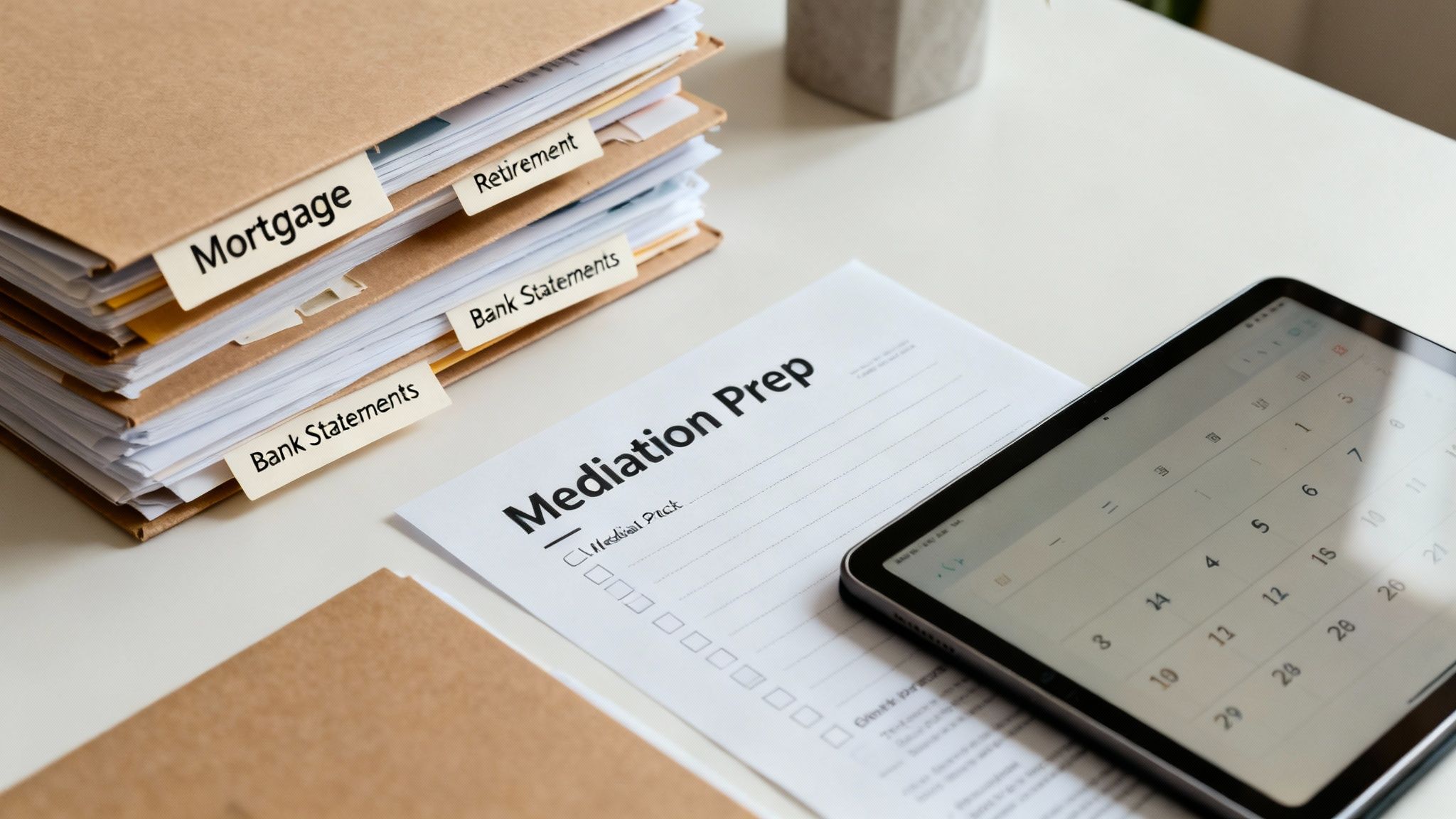
Gather Your Financial Documents
First things first, you need a complete and organized picture of your marital finances. A mediator can’t help you divide assets and debts that are hidden or unclear, so transparency is key. Your first job is to collect and sort through all the relevant financial paperwork before the big day.
This is about more than just making a pile of paper. It’s about understanding the financial story of your marriage. You and your attorney will use these documents to get a real-world value for your marital estate and craft a fair proposal.
Your document checklist should include things like:
- Proof of Income: Recent pay stubs, W-2 forms, and tax returns for you and your spouse.
- Property Records: Deeds and current mortgage statements for any real estate you own, like your home in Atascocita.
- Account Statements: All bank account statements, retirement plan information (401(k)s, IRAs), and investment portfolio reports.
- Debt Information: A clear list of what you owe, including statements for credit cards, car loans, and any other outstanding debts.
- Valuations: Recent appraisals for valuable items such as vehicles, jewelry, or collectibles.
Having this information ready prevents delays and ensures your negotiations are built on solid facts, not just guesswork.
Clarify Your Goals and Priorities
Beyond the dollars and cents, a successful mediation hinges on knowing what truly matters to you. Before you ever sit down at the table, take some time—ideally with your attorney—to map out your ideal outcome. What are your absolute must-haves? Where can you afford to be flexible?
This isn't about drawing up a list of demands. It's about setting your own priorities so you can negotiate with purpose.
Think through these key areas:
- Parenting Plan: What kind of custody schedule will genuinely work best for your children? Who should have the final say on major decisions about their school or health?
- Property Division: Is keeping the family home in Humble the most important thing, or would you be better off with a larger share of the retirement accounts?
- Financial Support: What do you realistically need for child support or spousal maintenance to ensure you can land on your feet?
When you know what your top priorities are, you can focus your energy on the issues that will shape your future the most.
A key to success is approaching mediation with an open and cooperative mindset. Your goal is not to "win" but to find a fair and workable resolution that allows both you and your spouse to move forward with dignity and financial security.
Work Closely with Your Attorney
Finally, and this is crucial, work closely with a skilled family law attorney. The mediator is a neutral third party; they cannot give you legal advice. Your attorney, on the other hand, is your advocate. Their sole job is to protect your rights and look out for your best interests.
A good lawyer will help you see the strengths and weaknesses in your case, build a smart negotiation strategy, and review the final Mediated Settlement Agreement to make sure it’s legally sound. Walking into that room with a trusted advisor by your side gives you a level of confidence and clarity you simply can't get on your own. For a deeper look at this important stage, you can learn more about how to prepare for divorce mediation in our detailed guide.
If you are facing a divorce in Atascocita or the surrounding Harris County communities, The Law Office of Bryan Fagan is here to help you prepare for a successful mediation. Contact us today for a free consultation to discuss your case and learn how we can support you.
Breaking Down the Costs of Divorce Mediation
Let's talk about one of the biggest worries in any divorce: money. The thought of legal bills piling up with no end in sight is enough to keep anyone up at night. For families here in Atascocita and Humble, this is a very real concern.
This is exactly where divorce mediation shines. It’s not just a calmer, more respectful way to end a marriage; it’s also a much more predictable and manageable path financially. Think of it less as a cost and more as a smart investment in getting your family to a fair resolution without draining your savings.
Understanding How Mediators Charge
So, how does it work? In Harris County, most mediators charge a straightforward hourly rate. The final bill simply depends on how long it takes to reach an agreement.
The best part? This cost is almost always split right down the middle, 50/50, between you and your spouse. Suddenly, the expense becomes far more manageable than each of you paying for your own attorney to fight it out in court.
In Texas, you can generally expect a mediator’s rate to fall between $100 and $300 per hour. For a complete case, the total cost often lands somewhere between $500 and $3,000. Compare that to the $15,000 (or much, much more) that a contested divorce heading to trial can easily rack up. Because mediation is so focused, many couples can resolve everything in a single day, putting a stop to months of back-and-forth legal fees. You can get more details on how divorce mediation costs can be shared or reduced on bryanfagan.com.
What Influences the Final Cost
Of course, not every divorce is the same. A few key things can influence how much time you'll need with the mediator, which directly affects the final cost.
The main factors that drive the price are:
- Complexity of Your Assets: If you're dividing a house, a couple of bank accounts, and a 401(k), things can move pretty quickly. A case with a family business, rental properties, or complex investments will naturally take more time to sort out.
- Child Custody Issues: When kids are involved, the conversation requires more care and detail. Crafting a parenting plan that truly works for both parents and, most importantly, the children, is time well spent.
- Your Level of Cooperation: This one is huge. The more you and your spouse can come to the table ready to find common ground, the faster you'll get to a resolution. High-conflict situations simply need more of the mediator's time to help bridge the gaps.
Honestly, the biggest factor you can control is your own mindset. If you walk in prepared and willing to negotiate, you are actively working to make the process more efficient and less expensive.
When you're discussing finances, it's also crucial to be aware of protections that might be available, such as innocent spouse relief. These are the kinds of financial details where having a knowledgeable attorney by your side is absolutely essential.
A Smart Investment for Your Future
When you put the numbers side-by-side, the choice is pretty stark. On one hand, you have the clear, contained cost of mediation. On the other, you have the open-ended, unpredictable expense of a court battle.
Mediation gives you a financial framework you can plan for, allowing you to build a fair settlement without destroying your nest egg in the process. This financial stability means preserving more of your assets for your family, giving both of you a much better foundation to start your next chapters.
For families right here in our Atascocita community, that kind of peace of mind is priceless. If you have questions about the costs or want to see if mediation is the right fit for your situation, contact The Law Office of Bryan Fagan – Atascocita TX Lawyers for a free, no-obligation consultation.
Guiding Your Family to a New Beginning

We've walked through the ins and outs of Texas divorce mediation, but knowing the process is one thing; taking that next step is another entirely. For families here in Atascocita, Humble, and across Harris County, mediation isn’t just an alternative to court—it's a chance to choose a more private, affordable, and respectful path forward.
Think of it as choosing to build your family’s next chapter on a foundation of cooperation, not conflict.
Having an experienced local attorney in your corner is non-negotiable. They're not there to start a fight; they're there to protect your rights, make sure you understand every option on the table, and help you forge an agreement that actually works for your family's future.
Taking the First Step Toward Resolution
The idea of moving forward can feel like a mountain to climb, but you don't have to do it alone. The right legal guidance turns that overwhelming uncertainty into a clear, actionable plan. A good attorney makes sure you walk into mediation fully prepared for what’s ahead.
This process gives you and your spouse the power to make the critical decisions, such as:
- Designing a stable co-parenting plan that puts your kids first.
- Figuring out a fair and just division of your property.
- Building a secure financial future for you and your children.
Choosing mediation is more than just a legal tactic; it’s a commitment to finding a peaceful way forward. It offers a controlled, respectful setting where you can close one chapter with dignity and start the next one with real confidence and stability.
By working together, you can create a final agreement that’s truly customized to your family’s unique situation. In the long run, this approach saves not just money, but a tremendous amount of emotional energy, too.
Your Local Legal Partner in Atascocita
If you're ready to explore what mediation could look like for you, we invite you to contact The Law Office of Bryan Fagan – Atascocita TX Lawyers for a free, confidential consultation. Let our team hear your story, answer your questions, and help you take that first crucial step toward a positive new start for your family.
Common Questions About Divorce Mediation
Even when you have a good grasp of the basics, it's completely normal to have more specific questions pop up. For our neighbors here in Atascocita and Humble, getting clear answers is the first step toward walking into the process with confidence. Let's break down some of the most common questions we hear about Texas divorce mediation.
Is a Mediated Agreement Legally Binding in Texas?
Yes, and that’s one of its biggest strengths. When you and your spouse sign the Mediated Settlement Agreement (MSA), along with your attorneys, it becomes irrevocable.
What does that mean? It means neither of you can just wake up the next day and change your mind. The MSA is then filed with the court and becomes the foundation for your Final Decree of Divorce, making it a fully enforceable court order. This finality is huge—it gives you a clear path forward and lets you start your next chapter without looking back.
Do I Still Need an Attorney if We Use a Mediator?
One hundred percent, yes. It's a mistake to go into mediation without your own lawyer. Think of it this way: the mediator is like a neutral referee in a game. Their job is to keep the conversation moving and fair, but they can't coach either team or tell you which plays to make.
Your attorney is your personal coach and advocate. They are there for one reason: to protect your best interests.
Here’s what your lawyer does in mediation:
- They’re your advocate: Their only loyalty is to you and your goals.
- They give you legal advice: They’ll tell you if a proposed deal is fair under Texas law or if you can do better.
- They help you strategize: They make sure you’re negotiating from a place of knowledge and strength, not emotion.
Going in without an attorney is like flying blind. You wouldn't know your full rights or what you might be giving up.
What Happens if We Cannot Agree on Everything?
That’s a very common worry, but it’s not an all-or-nothing situation. Even partial progress is a win.
Let's say you successfully hammer out agreements on your property, vehicles, and retirement accounts but hit a wall when it comes to the holiday visitation schedule. You've still saved an incredible amount of time, money, and stress. The only issue left for the judge to decide is that one remaining point, making your court case much simpler and far less costly than if you had to fight over every single thing from scratch.
Can Mediation Work for High-Conflict Divorces?
It might seem counterintuitive, but the answer is often yes. In fact, mediation can be a game-changer in highly contentious divorces. A skilled mediator is trained to handle conflict, de-escalate tension, and manage difficult dynamics.
One of the most effective tools they use is called "caucusing." The mediator will separate you and your spouse into different rooms and shuttle back and forth between you. This "shuttle diplomacy" prevents direct arguments and allows for more honest, productive conversations. It's often in these separate sessions that breakthroughs happen, leading to a resolution that seemed impossible just hours before.
Navigating the specifics of mediation requires a knowledgeable guide who knows the ins and outs of the Harris County court system. At The Law Office of Bryan Fagan – Atascocita TX Lawyers, we're here to provide that guidance. Schedule your free, confidential consultation today by visiting our Atascocita family law website.