Say a Harris County deputy stops you on FM 1960 near West Lake Houston Parkway on a Friday night. You answer the questions, you agree to a breath test, and you sign the paperwork. A few days later the citation comes back with a word you didn't expect: felony.
Nothing about that drive felt different from any other traffic stop. What changed is the classification, and classification is where every felony DWI case in Atascocita begins. The prison range, the courtroom, the bond conditions, the license consequences and the defense strategy all follow from which statute the State says you violated.
This is a plain explanation of how that works in Harris County, written for the neighbor who just got the paperwork and doesn't know what to ask yet. Start with the trigger, then the range, then the courtroom, then the first 72 hours.
What Makes a DWI a Felony in Atascocita
Felony DWI in Texas is not one crime. The Texas Judiciary's annual statistical report defines felony DWI to include offenses under Penal Code Sections 49.04, 49.045, and 49.09, plus motor-vehicle-related intoxication assault under Section 49.07. That means two people can both be charged with a felony DWI and share almost nothing in common. One has two old convictions on the enhancement file. One had a 12-year-old in the back seat. One is accused of injuring someone in a crash.
The scale is real. Texas courts recorded 8,935 new felony DWI cases in fiscal year 2022, according to the same report, and new misdemeanor and felony DWI filings had generally declined over the preceding five years. Read those numbers as a statewide baseline, not a local count. Public summaries don't isolate Atascocita-specific felony DWI filings, so the honest answer is that these cases run through the Harris County criminal-justice system and the statewide data is the most reliable public measure available.
Why the label matters: an ordinary first-offense DWI is generally treated separately from felony DWI in statewide court statistics, so the felony figure describes a different population of cases than the misdemeanor docket.
The court that will hear the case
Atascocita is unincorporated. There's no city court with a felony docket waiting for you. A felony DWI arrest on FM 1960 or West Lake Houston Parkway is filed in a Harris County district court, not a municipal court and not a county criminal court at law. Look at the cause number on your paperwork and confirm the court assignment, because that single detail tells you where to appear, which prosecutors handle the file, and how bond gets reviewed.
Two clocks running at once
Texas law can turn an ordinary DWI into a felony when the conduct falls within Penal Code Sections 49.04 through 49.08, and the consequences aren't limited to jail or prison exposure. A conviction may also affect your driver's license and your ability to get to work, which is why the license suspension provisions in the Texas Transportation Code run on their own schedule.
That's the two-track reality heard about too late. The criminal case moves through district court. The administrative license case moves through the Texas Department of Public Safety. They don't wait for each other, and avoiding jail does not restore ordinary driving privileges.
Penalties and Sentencing Ranges for Felony DWI
The degree of the offense sets the two numbers that matter most: the confinement range and the fine cap. Everything else in a sentence, including community supervision, treatment conditions and interlock requirements, gets built on top of those two.
| Felony level | Prison or state jail range | Maximum fine | Driver license consequence |
|---|---|---|---|
| State jail felony (DWI with passenger under 15; school crossing zone DWI) | 180 days to 2 years in a state jail | $10,000 | Suspension plus interlock-restricted driving under Transportation Code 521.246 |
| Third-degree felony (third or subsequent DWI; DWI after one intoxication-manslaughter conviction; intoxication assault) | 2 to 10 years in TDCJ | $10,000 | Suspension plus interlock-restricted driving under Transportation Code 521.246 |
| Second-degree felony (intoxication manslaughter) | 2 to 20 years in TDCJ | $10,000 | Suspension plus interlock-restricted driving under Transportation Code 521.246 |
| First-degree felony (intoxication assault on certain protected officials) | 5 to 99 years or life in TDCJ | $10,000 | Suspension plus interlock-restricted driving under Transportation Code 521.246 |
Read the table from left to right and one pattern jumps out. The fine cap never changes. What changes is the confinement range, and that range is set entirely by which felony level the facts of the arrest land in.
Here is the same information in a format you can screenshot and bring to a consultation.
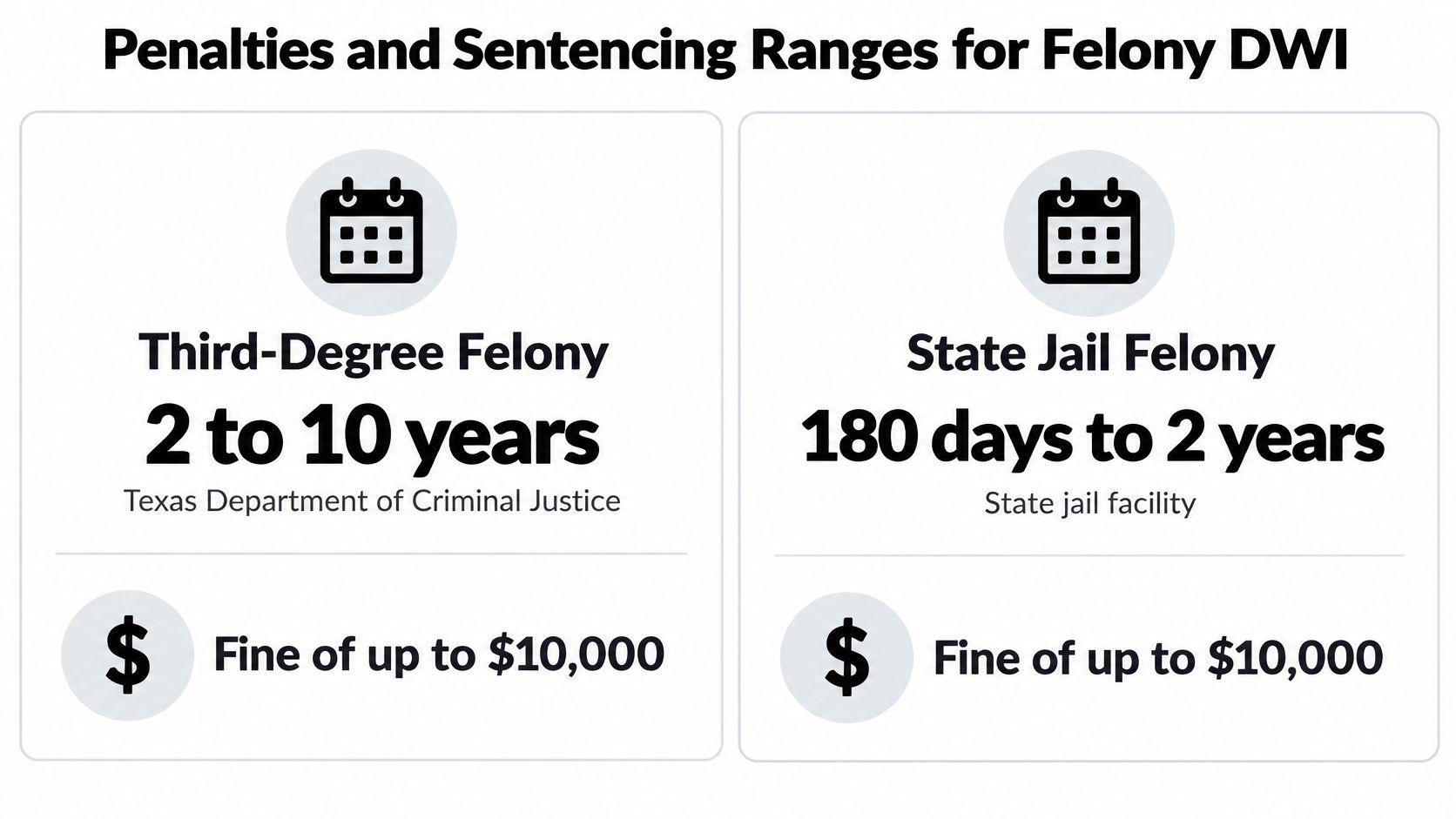
Why prior convictions decide the range
The State enhances a DWI because of convictions it can prove, and proof means certified judgments and plea documents, not a printout of someone's arrest history. Each alleged predicate gets tested against Penal Code 49.09, including whether an out-of-state offense is substantially similar to a Texas DWI and whether the record identifies the right person. An arrest that never led to a conviction does not move the range. That single distinction is where enhancement fights are won or lost.
The volume behind these prosecutions is large. The Texas Department of Public Safety's 2024 DWI summary recorded 85,858 DWI charges in 2024, compared with 85,002 in 2023. The same report counted 6,723 arrests involving people with previous DWI arrests out of 22,023 in the third quarter of 2024, an arrest recidivism rate of 30.53 percent. Repeat allegations are common enough that prosecutors check prior history in nearly every DWI file, so assume yours has already been pulled.
This overview of the felony DWI process walks through how the case itself gets built.
What happens to your license
Separate from any criminal sentence, a conviction can trigger suspension, and Texas uses an ignition-interlock device that requires a deep-lung breath analysis and makes the vehicle impractical to operate when ethyl alcohol is detected. Under Transportation Code Section 521.246, a judge must restrict a person to an interlock-equipped vehicle when that person is already under an interlock restriction, including one imposed as a bond condition, or when the license has been suspended, revoked, or canceled after a conviction under Penal Code Sections 49.04 through 49.08.
Notice what that means across every row of the table above. The statute does not care whether the conviction is a state jail felony or a first-degree felony. The interlock restriction follows the same logic at each level, which is why the license column reads the same way all the way down.
A special restricted license after a qualifying DWI-related suspension is limited to a vehicle equipped with an interlock, and the Texas Department of Public Safety statute sets the application fee at $10. The restriction is both mechanical and documentary. You carry a court order, and your vehicle carries the equipment that enforces it every time you turn the key.
The Felony DWI Pathways and How Each One Is Proven
Many assume felony DWI means three DWIs. That's the most common pathway, not the only one, and treating it as the only one is how families get blindsided. A first arrest can land in felony territory with no priors at all if a child was in the car or someone was hurt. That's why the right first question is not "how bad is a felony DWI" but "which statute did the State cite," because the answer determines the punishment range, the evidence that matters, and the defenses available.
Five pathways and what each one requires
| Pathway | Statute | Felony level | What the State must prove |
|---|---|---|---|
| Third or subsequent DWI | Penal Code §49.09 | Third-degree felony | Two qualifying prior intoxication-related convictions, plus intoxication while operating a motor vehicle in a public place |
| DWI after one intoxication-manslaughter conviction | Penal Code §49.09 | Third-degree felony | A single prior intoxication-manslaughter conviction plus a new DWI |
| DWI with a passenger younger than 15 | Penal Code §49.045 | State jail felony | Passenger's age established by reliable records, plus intoxication and operation |
| Intoxication assault | Penal Code §49.07 | Third-degree felony (first-degree if serious bodily injury to certain protected officials) | Serious bodily injury caused by intoxication while operating a motor vehicle |
| Intoxication manslaughter | Penal Code §49.08 | Second-degree felony | Death caused by intoxication while operating a motor vehicle |
Two things stand out in that table. First, prior convictions have no expiration date for enhancement purposes, so a case from 15 or 20 years ago can still raise a new arrest to a felony. Second, some pathways require no priors at all. The DPS summary of Texas DWI offenses classifies DWI with a passenger younger than 15 as a state jail felony and identifies serious bodily injury to certain protected officials as a first-degree felony circumstance under Chapter 49, and the current text of Penal Code Chapter 49 sets out each offense element the State must establish.
Where the proof usually breaks
Each pathway carries its own pressure point, and the facts that select the pathway also select the defense.
Prior convictions: certified judgments, plea papers, identity matching, finality, and whether an out-of-state case is substantially similar. An arrest that never became a conviction doesn't enhance anything. Clerical errors in old records are more common than people expect, and a mismatched name or a case that was never final can strip the enhancement away entirely.
A child passenger: the child's age, verified from reliable records rather than an officer's estimate at the scene.
An injury allegation: whether the injury meets the serious bodily injury threshold, plus medical records and accident reconstruction on causation. Intoxication proof and causation proof are separate fights. The State can win one and lose the other, and losing causation changes the charge itself.
Intoxication itself: breath or blood reliability, machine maintenance records and chain of custody. If you want the background on how the State measures impairment, our guide to the legal blood alcohol limit in Texas explains the thresholds.
While the criminal case works through these questions, the license side keeps moving on its own track, with its own deadlines and restrictions, whether or not the felony charge is ever resolved.
Body-camera video, crash-scene evidence and dispatch records disappear on their own schedule. Ask counsel to send preservation letters in the first week, not the first month.
What to Do in the First 72 Hours After a Felony DWI Arrest
The first three days set the tone for everything after. Work through this in order, even if you only get through part of it.
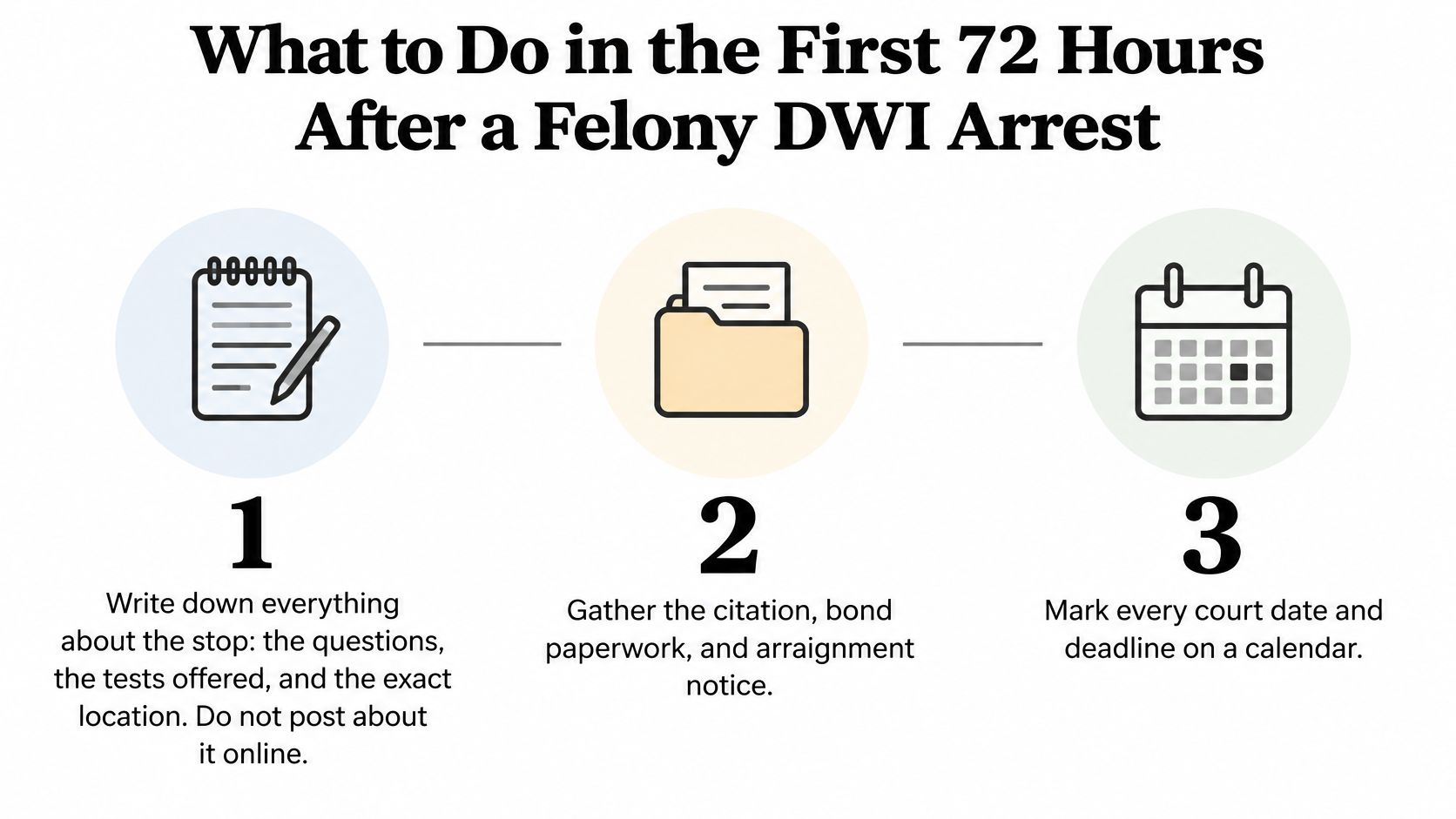
- Write down everything about the stop while it's fresh. Where you were, what the officer asked, which tests were offered, whether you refused anything, what you ate and drank and when. Then stop talking about it. Social media posts and group texts get screenshotted and end up in discovery.
- Build one folder. The citation, bond paperwork, arraignment date, tow receipt and any DPS notice about your license all go in the same place. You will be asked for these repeatedly.
- Talk to a defense attorney before you talk to investigators or prosecutors. Statements made early are hard to walk back.
- Read the bond conditions line by line. If an interlock was ordered as a bond condition, that restriction is operating before any conviction exists.
- Handle the license on its own track. The Texas DPS guide to alcohol-related offenses separates administrative license revocation suspensions, conviction-based suspensions, interlock restrictions and occupational-license procedures. DPS states that an occupational license issued after an ALR suspension or a DWI conviction carries an interlock restriction regardless of whether the criminal court separately ordered one.
- Plan transportation now. Work, medical appointments, school pickup and court dates all assume a car. Texas law includes a narrow employment exception allowing operation of a vehicle without an approved interlock installation when the person is required to operate that vehicle in the course and scope of employment, under Transportation Code Section 521.346. Verify eligibility before relying on it, and carry documentation.
- Budget the near-term costs. Bond, interlock installation and monthly monitoring, towing and impound, and attorney fees. These hit within weeks, not months.
The rule that catches people: avoiding jail does not mean normal driving resumes. The administrative case keeps moving whether or not the criminal case resolves.
For families in northeast Harris County, where childcare and employment usually depend on driving, that transportation clock is the part that hurts first. Our DWI defense lawyers in Atascocita work both tracks together rather than treating the license as an afterthought.
From Arrest to Trial in Harris County
Here's the sequence, so the paperwork stops feeling random.
- Arrest and booking. A felony DWI in northeast Harris County moves through felony intake. Bond conditions can include an interlock order that operates before any conviction.
- Charging. The Harris County District Attorney's office reviews the file, and the case is filed in a district court rather than a county criminal court at law.
- Arraignment. The charge is formally read and pretrial issues begin.
- Discovery. The charging instrument, offense report, dash and body camera footage, breath or blood results and maintenance records, crash scene and medical records for injury-based charges, and certified prior judgments for enhancement.
- Pretrial motions. Challenges to the stop, the blood draw, the breath result and the enhancement record, plus any speedy-trial demand your lawyer decides to file.
- Plea negotiations or a trial setting.
- Sentencing, and any appeal.
Discovery is where these cases turn
The enhancement file deserves as much attention as the patrol video. Under Texas Penal Code Chapter 49, a new DWI under Section 49.04 is generally a third-degree felony when the prosecution proves two qualifying prior DWI-related convictions, carrying a range of 2 to 10 years in the Texas Department of Criminal Justice and a fine of up to $10,000. The technical question isn't how many arrests show up in a database. It's whether the State can establish qualifying convictions and prove intoxication while operating a motor vehicle in a public place.
Defense analysis separates arrest history from admissible conviction records, reads the judgment and plea documents for each alleged predicate, and tests whether those offenses legally qualify. Because felony cases are handled in Harris County district courts, the forum, discovery process, bond strategy and sentencing exposure all differ from what happened in any earlier misdemeanor case.
Ask the district clerk's office, or your attorney, to confirm the cause number and court assignment early. Felony docket dates, discovery orders and bond review settings don't follow the county criminal court at law schedule.
What you can do at every stage is simple and unglamorous. Keep the paperwork in one folder, write down every fact about the stop, and don't discuss the case with anyone but counsel.
Choosing a Local Atascocita DWI Attorney
Felony DWI is a classification fight before it's a trial fight, so the first thing to test in any consultation is whether the lawyer thinks that way.

Ask who will audit the certified prior judgments, and whether the office can move quickly on a bond reduction or an interlock modification if transportation falls apart. Experience in Harris County district courts matters specifically, because that's where these cases live.
Questions worth asking before you hire
- Who reads the priors? Ask directly who will pull the certified judgments and check identity, finality and out-of-state similarity.
- Does the office handle the license side? ALR deadlines, occupational-license petitions and interlock requirements shouldn't be handed off to a separate lawyer you never meet.
- How fast will someone review the charging instrument? You want a real answer with a timeframe, not a general promise.
- What discovery will you pursue? Dash and body camera, breath or blood maintenance records, and medical records where injury is alleged.
- How do we handle bond and transportation? Interlock planning is part of the case plan, not an administrative annoyance.
Families often ask about treatment options alongside the legal work, and the attorney referral process at Addiction Resource Center connects people with providers who coordinate with defense counsel. If you're weighing appointed counsel against hiring someone, our comparison of a public defender versus a private attorney lays out the practical differences.
The firm's Atascocita office is where Byron Shaw and Teresa J. Glascoe meet with clients, and it serves people across Harris County and the surrounding areas. Choose counsel you can reach and understand, because you'll be asking questions for months.
Schedule a Free Consultation With an Atascocita Attorney
Three things are now clear. A felony DWI is a classification question resolved by the specific statutory trigger, not by the headline. The punishment range follows from the degree in the table above. And the DPS license clock runs separately from the criminal case, whether or not you ever see a jail cell.
The initial consultation is free, and you can schedule it by calling 281-519-3083, completing the online contact form, or visiting the Atascocita office at 7702 FM 1960 Rd E, Suite 212, Humble, TX 77346, where Byron Shaw and Teresa J. Glascoe meet with clients.
What to bring
Bring the citation, the bond paperwork, any DPS notice about your license, the arraignment date, and a written timeline of the stop. If you have court documents from older cases, bring those too. The prior record is often the whole ballgame.
Our guiding philosophy is simple, and it comes from Attorney Bryan Fagan. "We meet people at some of the worst times in their lives and help them." Early clarity about the charge is the best protection available to you, and clarity is what a first meeting is for.
To every resident of Atascocita, Humble and northeast Harris County reading this at 2 a.m. with paperwork on the kitchen table, you're not the first person to sit there and you won't be the last. Book the consultation before the next court date, not after it.
A felony DWI charge in Atascocita turns on details that are easy to miss without someone reading the file closely, from the exact statutory trigger to the certified priors to the DPS deadline running alongside your court date. The Law Office of Bryan Fagan – Atascocita TX Lawyers handles felony DWI defense in Harris County district courts and the parallel license proceedings, and the first conversation costs nothing. Visit Law Office of Bryan Fagan – Atascocita TX Lawyers to schedule your free consultation at the Atascocita office.