Skip to content
Your child used to leave for school with a packed backpack, a decent attitude, and a routine that mostly worked. Now mornings in Atascocita feel like a scramble. One parent drops off late because of a work shift change. Homework gets left in the wrong house. A teacher from a Humble ISD campus emails again about missing assignments. Report cards slip. Your child starts saying they hate school, or they go quiet whenever school comes up.
That's often the moment a parent starts asking a hard question. Is this really just a rough patch, or is the current custody order making school harder than it needs to be?
For many families, the answer isn't about one dramatic event. It's about a pattern. The schedule that made sense a few years ago no longer fits the child's grade level, campus demands, extracurriculars, tutoring, or emotional needs. A long commute between homes starts cutting into sleep. Midweek exchanges break concentration. Two households follow two very different homework expectations. The child pays the price.
In Texas, a custody modification based on school concerns isn't about punishing the other parent. It's about whether the current arrangement still supports the child's day-to-day well-being. Courts look closely at school stability because school isn't separate from the rest of a child's life. It affects confidence, friendships, behavior, and emotional health.
Parents in Atascocita and Humble often wait too long because they don't want to seem overreactive. That hesitation is understandable. But if your child's attendance, grades, behavior, or school adjustment are changing in ways tied to the custody setup, that concern is legitimate. The law gives you a path to ask the court for a better arrangement. The key is knowing what is important, what evidence works, and how Harris County courts tend to evaluate these cases.
Is Your Custody Order Affecting Your Child's Success at School
At 6:40 on a school morning in Atascocita, a parent is looking for a missing backpack, the Chromebook is still at the other house, and the child is already anxious about being late again. By the time the teacher emails about another incomplete assignment, the problem no longer looks random. It looks like a custody schedule that no longer fits the school week.
That pattern matters in Harris County court.
Under Texas Family Code § 153.002, courts decide custody issues based on the best interests of the child. School stability is often part of that analysis. Judges regularly look at attendance, grades, behavior reports, and how well the child is functioning day to day. Those records give the court something concrete to measure.
In Atascocita and Humble, I often see this start with logistics, not conflict. One parent lives farther from campus. Exchanges fall on nights with heavy homework. A child gets to middle school or high school, and the old routine no longer leaves enough time for sleep, tutoring, athletics, or consistent study habits. Humble ISD schools track many of these problems clearly through attendance entries, grade portals, teacher notes, and disciplinary records. That local paper trail can make a school-based modification case much stronger than a parent's general frustration.
What school trouble often looks like in real life
School-related custody problems usually show up as a set of connected issues, not one dramatic event.
- Transportation problems: The child is late more often after overnights at one home because the commute to a Humble ISD campus is longer or less predictable.
- Two different school routines: One household checks homework, signs folders, and keeps up with teacher emails. The other does not.
- Exchange timing that disrupts the week: Midweek possession changes interfere with sleep, projects, tutoring, band practice, or test prep.
- Uncertainty about campus placement: A move or disagreement about where the child should attend creates instability and missed deadlines.
A judge does not expect perfect grades or flawless parenting. A judge does pay attention when the same problem appears across report cards, attendance logs, teacher messages, and parent testimony.
Practical rule: If a school can document the issue, a court can weigh it.
Why parents in Atascocita should take these signs seriously
Parents in this area often hesitate for understandable reasons. They do not want to make school stress into a legal fight. They hope the child will adjust. Sometimes that instinct is right.
Sometimes it is not.
If the problems line up with exchange days, commute burdens, inconsistent homework supervision, or repeated school absences, the custody order may be part of the problem. That is especially common in northeast Harris County, where even a reasonable parenting plan on paper can break down once real travel time, traffic, and campus demands are added to the week.
The strongest cases are usually not built around blaming the other parent. They are built around a simple point. The current schedule is interfering with the child's education, and there is a workable fix.
What a Harris County judge will want to know
A judge handling a modification case tied to school concerns usually focuses on practical questions like these:
| School concern | What the court is really asking |
|---|---|
| Falling grades | Is the decline connected to the current possession schedule or living arrangement? |
| Missed school | Are tardies or absences tied to transportation problems, exchange timing, or poor coordination? |
| Behavior at school | Is the child showing stress, fatigue, or instability that points back to the current routine? |
| Proposed change | Will the new schedule improve school consistency without creating a different problem? |
That last point often decides the issue. In Harris County, courts are usually more receptive when a parent comes in with a specific, school-focused solution. Examples include limiting midweek exchanges, assigning the right to determine the child's primary residence within the Humble ISD area, or adjusting pick-up times so the child can keep a steady school routine.
The Legal Grounds for Changing Your Custody Order in Texas
A parent in Atascocita usually reaches this point after a pattern sets in. The child is missing first period after a midweek exchange, homework is coming back incomplete, or a longer commute across the Humble area is starting to affect sleep and attendance. Frustration alone will not support a custody change in Texas. The court wants a legal reason tied to the child's welfare.
To modify an existing custody order, the parent asking for the change usually has to prove two things under Texas law. First, there has been a material and substantial change in circumstances since the last order. Second, the requested change is in the best interest of the child. Those are the two gates every school-related modification must pass through.

Material and substantial change in circumstances
Under Texas Family Code § 156.101, a court may modify conservatorship or possession if circumstances have changed enough since the prior order. You can read the statute directly through the Texas Legislature's text of Family Code Section 156.101.
In school cases around Atascocita and Humble, that change often shows up in practical ways:
- the child now needs tutoring, special education support, or a tighter school-night routine
- one parent has moved farther from the child's Humble ISD campus
- a work schedule changed, and morning drop-offs or after-school care are no longer reliable
- the child's stress, fatigue, or behavior problems are now affecting school performance
Courts look at change from the date of the last order, not from when the parents first started arguing. That detail matters. If the schedule was already difficult when the order was signed, the better argument is usually that the child's school needs or the family's logistics have changed enough that the old order no longer fits.
In some cases, the court may also order or consider a professional review. If you want to understand how that process works, this overview of when a custody evaluation may be used in a Texas modification case gives helpful context.
Best interest of the child
Even after a parent proves changed circumstances, the court still has to decide whether the requested fix helps the child. That standard comes from Texas Family Code § 153.002, which states that the child's best interest is the court's primary consideration. The statute is available through the Texas Legislature's text of Family Code Section 153.002.
For school-based cases in Harris County, judges usually focus on whether the proposed order creates a more stable week. A parent who asks for a change should be prepared to explain how the new schedule improves attendance, homework completion, sleep, transportation, and parent-school communication.
That does not mean the parent with the louder complaint wins. The stronger position is the one that solves a school problem without creating a new one.
How judges apply “best interest” to school problems
Educational stability covers more than report cards. In practice, courts often weigh issues such as:
| Legal concern | What it looks like in a school case |
|---|---|
| Attendance and punctuality | Repeated tardies, missed first period, or absences tied to exchanges or transportation |
| Academic support | Whether the child has a realistic homework routine, tutoring access, and adult supervision on school nights |
| Emotional functioning | School reports of anxiety, acting out, shutdowns, or exhaustion connected to the current schedule |
| Continuity | Whether the child can stay anchored to the same campus, teachers, services, and peer group |
| Workability of the new order | Whether the proposed change is specific and realistic for both households |
For families in Humble ISD, local facts matter. A judge may care less about broad claims that a child needs “more stability” and more about concrete facts, such as whether the child can consistently get to an Atascocita Springs, Oaks, or Summer Creek feeder campus on time under the current schedule.
If your child is 12 or older
For children age 12 or older, Texas Family Code § 153.009 allows the judge to interview the child in chambers about the child's wishes regarding conservatorship or the person who can determine the primary residence. The statute appears in the Texas Legislature's text of Family Code Section 153.009.
That preference does not control the case. It is one factor. A teenager who can explain, in a grounded way, that the current plan is causing missed assignments, late arrivals, or difficulty staying involved in school activities may be more persuasive than a child stating a preference for one house.
The legal test in plain English
Here is the practical version:
| Legal requirement | Plain-English meaning |
|---|---|
| Material and substantial change | Something important is different now from when the current order was signed |
| Best interest of the child | Your proposed order improves the child's day-to-day life, especially at school, more than it disrupts it |
Parents often get stuck because they prove only half the case. They show the child is struggling, but they do not present a clear fix. Harris County courts usually respond better to a narrow, workable request than a vague complaint. If school records, parent portal entries, and teacher emails are starting to pile up, it helps to organize student records in one place so the timeline is clear before anything is filed.
How to Build an Evidence-Based Case for Your Child's School Needs
Your child gets off the bus in Atascocita with another missing-assignment notice, and you already know what the week looked like. Late drop-off on Monday. Homework left at the other house on Tuesday. A tutoring session missed on Thursday because the exchange ran long. In court, that story matters only if you can prove it with records that line up.
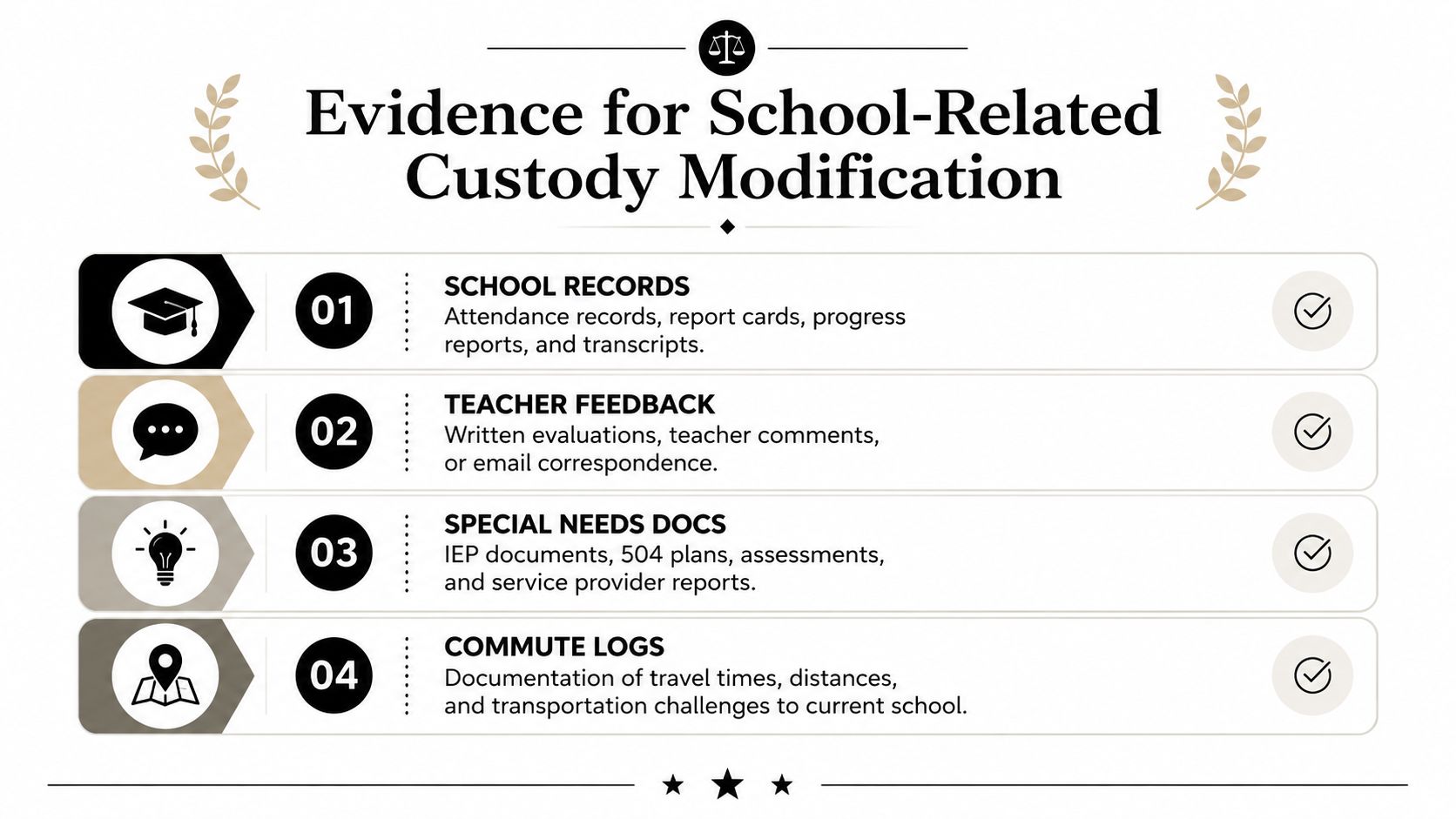
Parents often come into my office with genuine concerns and a phone full of screenshots. That is a start. What helps in a Harris County school-based modification is a file that shows a clear pattern, ties that pattern to the current possession schedule, and gives the judge a practical fix.
Start with the records Humble ISD already creates
For families in Atascocita and Humble, the best evidence usually comes from the school's own systems. Humble ISD parent portals, attendance records, gradebooks, counselor notes, and intervention documents are dated and neutral. Judges trust that more than a parent's summary.
Pull copies of:
- Report cards and progress reports: Show whether the problem is isolated or continuing across grading periods.
- Attendance records: Tardies, absences, and early checkouts often provide the full picture in school-week custody disputes.
- Disciplinary records: A sudden increase in behavior referrals can support a change in routine or supervision.
- Teacher comments: Written observations often explain why grades changed and when the problem started.
If you need a simple way to keep paperwork sorted by class, grading period, and communication thread, some parents use digital tools to organize student records in one place so they can hand their attorney a clean, usable file.
Save school communications in original form
Emails from teachers, counselors, assistant principals, reading specialists, and intervention staff can carry real weight. The useful ones usually answer three questions. What is happening, how often is it happening, and when did it start?
Good examples include messages about:
- missing or late assignments
- repeated tardiness
- fatigue, stress, or behavior changes seen at school
- requests for conferences, tutoring, evaluation, or support services
Keep the original email or portal message. Save it as a PDF with the date visible. Do not paraphrase it into your own notes unless you are adding a separate timeline for your lawyer.
Show how the current schedule affects services, not just grades
Some children are not failing classes. They are still losing ground because the current order makes school support harder to carry out. I see this often with children who need reading intervention, counseling support, ADHD accommodations, a 504 plan, or special education services.
Gather:
- current IEP or 504 paperwork
- ARD or support meeting notices
- evaluation reports from the school
- service logs or session summaries
- records showing missed services or inconsistent follow-through between homes
If the case develops into a broader review of parenting capacity or child needs, the court may consider a formal assessment. Parents should understand what a custody evaluation involves before they are in the middle of one.
Build a timeline around ordinary weekdays
It is at this point that many strong cases either come together or fall apart. A parent says the commute is too long or the routine is too disruptive, but there is no timeline showing the actual effect on school mornings and school nights.
Make a simple log for several weeks. Track the items that connect daily life to school performance.
| What to track | Why it matters |
|---|---|
| Morning departure and arrival times | Shows whether the child is regularly arriving late or rushed |
| Exchange days and homework completion | Connects transitions to missing work |
| Bedtime and sleep problems | Helps explain fatigue, focus issues, or classroom behavior |
| Tutoring, clubs, or intervention conflicts | Shows whether the current order blocks school support |
For Atascocita families, this can be especially important when one parent lives farther from the child's Humble ISD campus than the other. Distance alone does not win a modification. Repeated school impact tied to that distance can.
Compare your proposal to the current order
A judge needs more than proof that the present setup is hurting the child. The court also needs a realistic alternative that improves the school week without creating unnecessary disruption.
That proposed change might involve:
- keeping the child in one home on school nights
- changing exchange times so mornings are more stable
- assigning one parent primary responsibility for transportation
- protecting tutoring, intervention periods, or after-school help
- setting clearer rules for teacher and portal communication
The strongest request is usually narrow. It solves the school problem directly. In Harris County, broad complaints about the other parent tend to get less traction than a focused proposal supported by attendance records, grade trends, and consistent school communications.
Evidence that usually carries less weight
Parents are often surprised by what does not help much unless it connects back to school impact.
Less persuasive material includes:
- complaints about the other parent's attitude
- statements that the child is “happier” at one house without school proof
- social media posts that do not relate to attendance, homework, behavior, or services
- general arguments about fairness between parents
A good evidence file is plain, orderly, and easy to follow. If a judge can see the school problem on paper without listening to either parent argue about it, you are building the case the right way.
Navigating the Harris County Modification Process Step by Step
A parent in Atascocita often reaches this stage after a pattern becomes hard to ignore. The child is late more often during one possession period, assignments are missing after midweek exchanges, or Humble ISD staff keep emailing about the same problem. At that point, the question shifts from “Is this serious enough?” to “How do I fix the order the right way in Harris County?”
Step one, file the petition with a clear request
The case usually starts with a Petition to Modify the Parent-Child Relationship in the court that issued the current order, unless jurisdiction has changed. For many families in Atascocita and Humble, that means working through the Harris County family courts.
The petition needs to do two jobs. It must identify the change in circumstances and state the exact relief requested. In school cases, specificity matters. A request to “change custody” is too loose. A request to give one parent school-night possession, adjust exchange times, assign transportation duties, or give one parent authority over enrollment and school communication gives the judge something concrete to evaluate.
Parents sometimes make their own case harder by asking for every possible change at once. A narrower request often reads as more credible, especially when the problem is tied to attendance, homework completion, behavior reports, tutoring, or special education services.
Step two, serve the other parent correctly
After filing, the other parent must be formally served unless service is waived in a legally valid way. Friendly text messages and verbal notice do not replace service.
This is a common place where self-represented parents lose time. They assume the other parent will cooperate, put off formal service, and then miss school-related deadlines while the case stalls. If your concern involves the start of a new semester, transfer timing, or repeated attendance trouble, delay can matter.
Step three, decide whether temporary orders are needed
Some school problems cannot wait for a final hearing. If the child is missing class, bouncing between homes in a way that disrupts sleep, or at risk of losing support services because the parents cannot agree on who signs what, temporary orders may be worth requesting.
Temporary orders can address issues such as:
- which home the child stays in on school nights
- who handles morning drop-off and afternoon pickup
- who has authority to communicate with the campus and approve services
- how tutoring, counseling, or evaluations will be scheduled during the case
Judges usually want a practical reason for immediate relief, not a general claim that one parent is easier to work with. If you are getting ready for that hearing, this guide on how to prepare for a custody hearing can help you organize the basics.
Step four, prepare for mediation with a Harris County mindset
Many modification cases in Harris County go to mediation before a judge hears live testimony. That is often where school-based disputes get resolved, especially when one parent comes in organized and realistic.
For Atascocita and Humble families, the most useful preparation is local and school-specific. Bring Humble ISD attendance records, grade portal printouts, teacher emails, discipline notices if relevant, and a proposed calendar that matches the child's actual school week. If the child has a 504 plan or IEP, use the school's wording accurately. Parents sometimes describe services too loosely, which creates confusion in mediation. A practical iep accommodations and modifications list can help you use the right educational terms.
This overview may also help you visualize how custody issues are framed in practice:
Step five, be ready for the court's practical questions
If mediation does not end the case, the court will look closely at whether the requested change is supported by facts and whether it helps the child more than it disrupts the current routine. In Harris County, that can mean testimony from parents, school records, and sometimes added court tools such as an amicus attorney or a social study, depending on the dispute.
Judges often focus on plain questions. What is happening during the school week? How often is it happening? What part of the current order is causing the problem? Why is your proposed fix better for this child, in this school, right now?
Verbal side deals also create trouble here. If parents start following a new schedule without signing a new order, the old order still controls until the court changes it. I see this mistake often. One parent thinks the issue is resolved, then a disagreement over pick-up times, enrollment, or missed weekends turns the informal arrangement into a new conflict.
One practical point about legal help
A school-based modification case is usually won or lost in the details. The petition language, service, temporary relief request, mediation packet, and proposed final order all need to fit together.
Parents can handle some cases on their own, but many decide they want counsel once they see how much procedure matters in Harris County. One option local families consider is working with Law Office of Bryan Fagan – Atascocita TX Lawyers, which handles custody modification matters, including petitions and presentation of evidence tied to changes in a child's needs.
Effective Arguments for Mediation and the Courtroom
A strong school-based custody case is not a list of complaints. It is a focused explanation of how the current order affects the child and how a specific change would improve stability. That difference matters in mediation, and it matters even more in front of a judge.

What works in mediation
Mediation rewards parents who sound prepared, reasonable, and child-centered. It usually goes badly when a parent treats it like a chance to unload years of resentment.
Better language sounds like this:
- Focus on school function: “The current midweek exchange is disrupting homework completion and sleep before school.”
- Point to records: “The attendance logs and teacher messages line up with the exchange schedule.”
- Offer a practical fix: “I'm proposing one primary school-night home during the week and a weekend structure that preserves both parents' time.”
- Acknowledge the child's relationship with both parents: “I want the child to have strong contact with both of us, but the routine needs to support school.”
Weak mediation positions usually sound personal rather than educational. “I don't trust their judgment” is weak unless you tie it to a school problem. “Their new partner is a bad influence” is weak unless there is direct evidence connecting that issue to the child's school functioning.
If you're headed into mediation, this guide on how to prepare for divorce mediation can help you think through preparation and communication style, even if your case centers on modification rather than a divorce filing.
What judges tend to hear as persuasive
Courtroom persuasion is more structured. Judges usually want a clean chain of logic:
- The child is struggling in identifiable ways.
- The struggle appears in school records or credible third-party observations.
- The struggle is connected to the current custody arrangement.
- The requested modification is specific and likely to help.
That chain is stronger than broad emotional testimony.
Here is a useful comparison:
| Weak argument | Stronger argument |
|---|---|
| “My ex is impossible to deal with.” | “Because the exchange times change frequently, the child misses school support and arrives unprepared.” |
| “The child wants to live with me.” | “The child's daily routine is more consistent in the proposed schedule, which supports attendance and homework completion.” |
| “Their house is too far.” | “The current travel arrangement is interfering with punctual arrival and school-night rest.” |
How to talk about trade-offs honestly
Parents lose credibility when they pretend there is no downside to a requested change. Judges know every modification has trade-offs.
A more credible position sounds like this:
The proposed change will alter the weekly routine, but it keeps the child in a steadier school-night structure and reduces disruption tied to attendance and work completion.
That kind of argument signals maturity. It tells the court you understand the case is about problem-solving, not winning points.
The role of other professionals
In some cases, an amicus attorney, evaluator, or school professional may become important. When that happens, the parent who usually does best is the one who stays consistent. Don't give one version of events to the school, another in mediation, and another in court.
Keep your message simple:
- the problem is school-related
- the evidence is documented
- the requested change is limited to what the child needs
- the child should maintain a healthy relationship with both parents where possible
That is often the most effective posture in both negotiation and litigation.
Life After the Custody Modification A Smooth Transition
A new order solves the legal problem. It doesn't automatically solve the family transition. Once the court signs the modification, daily follow-through becomes the actual work.
Start with the practical basics. Give the school a copy of any parts of the order that affect educational decision-making, emergency contacts, pickup rights, or the child's primary residence. Update campus records, transportation arrangements, and after-school program contacts. If your child is changing campuses, move quickly but calmly so enrollment paperwork doesn't create fresh stress.
Help your child understand the change
Children usually do better when parents explain the new routine in simple terms. Keep the message focused on support and stability.
You can say things like:
- Keep it child-centered: “We made a new plan to help school feel easier and more predictable.”
- Avoid blame: “This isn't about choosing one parent over the other.”
- Explain the routine: “Here's where you'll be on school nights, and here's how weekends will work.”
Don't ask your child to defend the change to the other parent. Don't use them as the messenger for scheduling details.
Create consistency fast
The first few weeks matter. Build routines around bedtime, homework, device charging, backpacks, lunch prep, and transportation. If your child receives tutoring, counseling, IEP support, or extracurricular coaching, make sure both homes understand the schedule and expectations under the new order.
A few habits help families settle in:
- Use one calendar: Keep school dates, assignments, and activities in one shared system.
- Confirm logistics in writing: Exchanges, pickups, and special events should be clear.
- Watch the school feedback loop: Teachers and counselors can often tell you quickly whether the new routine is helping.
Keep co-parent communication businesslike
Not every co-parenting relationship becomes easy after a modification. That's normal. The goal is not perfect harmony. The goal is a stable school routine for the child.
Stick to facts, deadlines, and school needs. Short, respectful communication usually works better than long emotional messages. If the new order is clear, lean on the language of the order rather than reopening old arguments.
A well-handled transition can do more than improve grades. It can help your child feel settled again.
Frequently Asked Questions About School-Based Custody Modifications
A parent in Atascocita often asks this after the first bad report card or another attendance call from school: “Do I have enough to change the custody order, or am I just frustrated?” The answer depends on proof, timing, and whether the requested change solves a school problem in a concrete way.
Here are the questions I hear most often from parents in Atascocita, Humble, and the Humble ISD area.
| Question | Short Answer |
|---|---|
| Can I ask for a custody change because my child would do better at another public school? | Sometimes. You need more than a preference for a different campus. You need facts showing the proposed change would better serve your child's education and overall best interest. |
| What if I want private school instead? | That dispute is usually harder. Parents often disagree about cost, transportation, academic need, and whether private placement is actually necessary. |
| Does my child get to choose where to live? | A child age 12 or older can speak with the judge about preference in some cases, but the judge still decides based on the full record. |
| Can we agree on a new schedule without going to court? | You can agree informally, but the old order still controls until a judge signs a modified order. |
| Do I need school records if the problem is obvious? | Yes. Harris County judges usually want objective records, especially if the other parent denies there is a problem. |
| Can I file during the school year? | Yes. The court will weigh the benefit of acting now against the disruption of changing routines mid-year. |
One issue deserves extra attention. A different school, by itself, does not automatically justify a modification. Courts look at whether the current order is interfering with attendance, homework completion, special education services, behavior support, transportation, or day-to-day stability.
That is where local facts matter. In an Atascocita or Humble case, parents often need to show how the current possession schedule affects the child's actual school week. Tardies tied to long exchange routes, missed tutoring, inconsistent homework supervision, trouble getting to a Humble ISD campus on time, or repeated confusion about pickup authority can carry more weight than general statements that one home is “better for school.”
Parents also tend to overread a child's preference. Judges usually give more weight to patterns that adults can verify. Attendance records, grade trends, teacher emails, counseling notes, discipline reports, and details about who can reliably handle school-night structure usually matter more than a child saying one house feels easier.
Another common mistake is living under a handshake deal for months. That works until it does not. Then one parent falls back on the signed order, and the other parent has no enforceable protection for the routine the child has already been following.
Put any workable agreement into a signed court order while cooperation still exists.
If you are trying to decide whether your facts support a school-based modification, start by gathering the paper trail and looking closely at the school problem you need the court to fix. Law Office of Bryan Fagan – Atascocita TX Lawyers works with families in this area on custody modification issues tied to school stability, scheduling, and child-focused planning. A focused legal review can tell you whether you have a case worth filing or whether a narrower agreement may solve the problem faster.