Skip to content
If you're separated or divorced and both of you still live in Atascocita, the school question can feel strangely harder than people expect. You may be only a few miles apart, both inside Humble ISD, and still find yourselves stuck on the same issue every evening: who gets to decide where your child goes to school?
One parent may live closer to Lake Houston. The other may be nearer to FM 1960 or Beltway 8. On paper, that sounds convenient. In real life, it often creates a different kind of stress. Both parents can get to the school. Both want a say. Both think they're protecting the child's routine.
That tension sits at the center of many custody for parents living in same school district texas atascocita cases. The good news is that Texas law gives a framework for handling it. The challenge is learning what the court order says, how Harris County judges tend to view school stability, and what to do when co-parenting communication breaks down.
Navigating School Choices as Co-Parents in Atascocita
A familiar Atascocita situation goes like this. Your child has friends at their current elementary school, knows the front office staff, and has settled into a routine. Then parents separate. Both stay in the Humble ISD area. One parent assumes that because both homes are local, school won't become a legal issue.
Then enrollment season arrives.

One parent wants to keep the child where they are. The other wants a different campus, a charter option, or a school that's easier for morning drop-off. Suddenly the conversation isn't about backpacks and bus routes. It's about legal rights, enrollment paperwork, and whether your custody order gives either parent final authority.
Why same-district families still end up in disputes
Living in the same district helps with logistics, but it doesn't erase disagreement. In many Atascocita families, both parents remain active in homework, school pickups, teacher communication, and extracurriculars. That shared involvement is healthy for children, but it can also make each parent feel equally entitled to make the final call.
That confusion gets worse when people use everyday phrases like “I have primary” or “I'm the custodial parent” without looking at the exact language in the order. Texas courts care about the wording. Schools do too.
School conflict usually isn't about a building. It's about decision-making power, routine, and trust between parents.
What local parents usually want
Most parents in northeast Harris County aren't trying to “win” a school fight. They want practical answers:
- Can both parents talk to the school? Usually yes, unless a court order limits that right.
- Does the parent with primary residence automatically choose the school? Not always.
- If both homes are in Humble ISD, does the judge care? Yes, because district continuity often supports stability.
- What if the child is thriving where they already are? That often matters a great deal.
Daily life matters too. A judge may look at who gets the child ready in the morning, who attends parent conferences, and who can maintain a smoother weekday routine. For many families, community life is part of that picture. If you're trying to keep your child rooted in familiar activities as well as familiar classrooms, it can help to explore sports programs with JC Sports and think about how after-school commitments fit your parenting schedule.
When parents understand the legal terms behind these choices, the whole process gets less intimidating.
Understanding Texas Custody Terms in Harris County
Texas uses terminology that sounds formal and distant, but the concepts are more straightforward than they first appear. If you know the difference between decision-making rights and parenting time, you're already ahead of those reading their first court order.
Conservatorship means decision-making
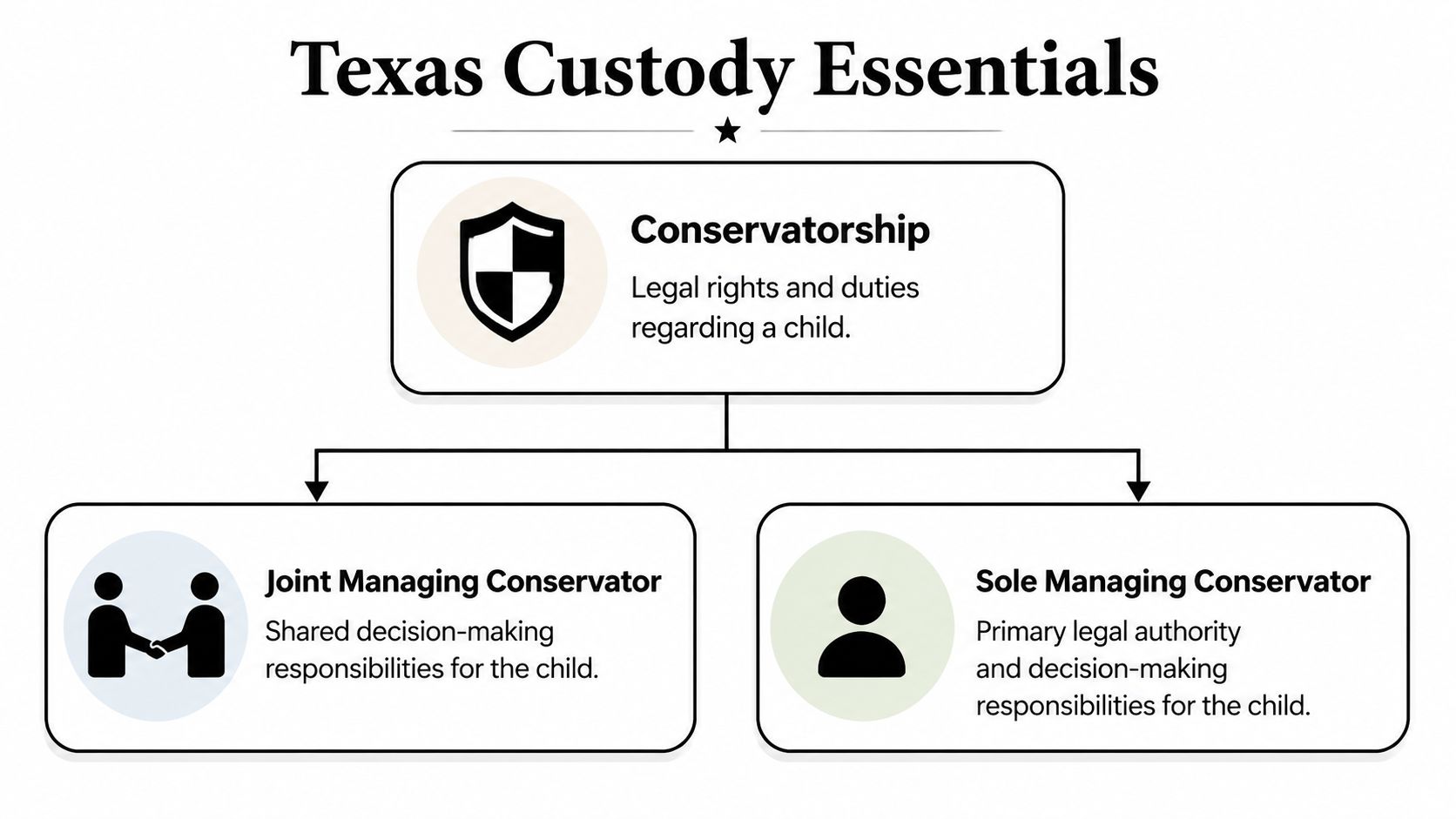
In Texas, conservatorship is the legal term for a parent's rights and duties regarding a child. Think of it as the authority side of parenting. It covers issues like education, medical care, and general welfare.
A simple way to think about it is this: conservatorship is the “board of directors” role in your child's life. It answers who gets a vote on major decisions.
The most common arrangement is Joint Managing Conservatorship, often shortened to JMC. In Texas child custody cases, including Atascocita and Harris County cases where parents live in the same school district, JMC is the overwhelmingly preferred arrangement and is presumed under Texas Family Code §153.002 unless there are compelling reasons for sole custody. It gives both parents shared decision-making on education, healthcare, and welfare, while the schedule for time with the child does not have to be exactly equal. Recent trends cited here also note that Harris County courts award shared parenting in over 60% of contested cases involving stable, local parents in these circumstances, according to this Texas family law analysis.
Possession and access means the schedule
Possession and access is the Texas term for when the child is with each parent. This is the calendar part. It covers school nights, weekends, holidays, and summer.
Parents often mix this up with conservatorship. They aren't the same thing. A parent can have less time on the calendar and still share important decision-making rights.
If you want a plain-English breakdown of that difference, this guide on legal and physical custody in Texas is a useful starting point.
Three terms that confuse parents most
Here are the phrases that usually cause the most misunderstanding in Harris County custody cases:
Joint Managing Conservator
Both parents usually share major rights and duties. That often includes school-related decisions unless the order says otherwise.Sole Managing Conservator
One parent has most major decision-making authority. Courts don't usually start here unless there are serious concerns.Primary residence
One parent may have the right to designate where the child primarily lives. That matters a lot, but it doesn't answer every school question by itself.
Practical rule: Read the actual order, not the nickname people give it. “Primary parent” can mean different things to different families.
Why this matters in Atascocita school cases
Parents often assume equal involvement means equal legal authority on every issue. Sometimes that's true. Sometimes the court order splits rights in a very specific way. One parent may hold the right to determine primary residence, while educational decisions remain joint. Another order may assign one parent independent educational authority.
That difference changes everything at registration time.
Here's a quick reference:
| Term | What it controls | What it does not automatically control |
|---|---|---|
| Conservatorship | Major parental rights and duties | The weekly schedule |
| Possession and access | Time with the child | Final say on school decisions |
| Primary residence right | Where the child mainly lives | Automatic school choice in every case |
For custody for parents living in same school district texas atascocita, this distinction is where many disputes either calm down or flare up. Once parents see that “time” and “authority” are separate, the next question becomes much more focused: who decides the school if both homes are in Humble ISD?
Who Decides the School When You Both Live in Humble ISD
The short answer is this: the court order decides first, and if the order isn't clear, the dispute usually turns on shared rights, stability, and the child's best interest.

In Texas Family Code §153.131, under Joint Managing Conservatorship, both parents share equal rights to make educational decisions, including school enrollment, unless a court order allocates that right differently under §153.134. Local practitioner insight described in this discussion of Texas school-decision authority says the child's current enrollment continuity, called the stability factor, weighs 40 to 50% in judicial rulings. That same source notes that adding a tie-breaker provision can significantly reduce litigation.
The parent with primary residence is important, but not all-powerful
A lot of parents believe the one who designates primary residence automatically picks the school. That's not always true. The right to establish primary residence can influence school choice because school zoning often follows the child's residence. But if the order says educational decisions are joint, both parents may still need to agree.
This point causes frustration for many. People often hear “primary” and assume it means having the “final say.” Texas orders often work in a more nuanced way than that.
If you're sorting out those labels, this explanation of the custodial and non-custodial parent roles can help you compare everyday language with the legal wording courts use.
Why Harris County judges focus on continuity
When both parents live inside Humble ISD, the fight often isn't about district lines. It's about whether changing campuses would help or disrupt the child.
Judges tend to care about questions like these:
- Has the child already settled into a school? Continuity matters.
- Which parent has been more involved in routines? Morning preparation, pickup, homework, and teacher contact all count.
- Would a school change disrupt friendships or academic support? Stability carries real weight.
- Can the parents cooperate? If not, the order needs more precision.
A judge usually isn't choosing the school a parent likes best. The judge is choosing the option that seems most stable and least disruptive for the child.
What a tie-breaker clause does
A tie-breaker provision is one of the most practical tools for same-district families. It doesn't remove both parents from the process. It names who gets the final say if good-faith discussion fails.
That tie-breaker might be one parent. In some negotiated orders, it may involve a structured step first, such as mediation or consultation with an agreed professional, before a final decision is made.
Here's how these arrangements often look in practice:
| Order language | What it means day to day |
|---|---|
| Joint educational decisions | Both parents must agree before changing schools |
| One parent has exclusive education right | One parent can make the final school decision |
| Joint with tie-breaker | Both discuss first, then a named person or process resolves deadlock |
For Atascocita parents, this matters because being in the same district can make judges more interested in preserving the current routine rather than reworking the child's school life from scratch. If one parent wants a change, the burden often becomes explaining why the change benefits the child more than staying put.
Resolving School Enrollment Disputes in Atascocita
When parents hit a wall over enrollment, the best response is usually a measured one. Acting too fast can create bigger problems, especially if one parent enrolls the child unilaterally and the other sees it as a violation of the order.
Start with the order and the paperwork
Before either parent argues about what's “fair,” look at the signed court order. Not the memory of what happened in mediation. Not the email summary. The actual language.
Focus on four items:
Educational rights
Does the order say decisions are joint, independent, or exclusive?Primary residence language
Who can designate residence, and is there a geographic restriction?Dispute resolution language
Is mediation required before filing?School records and communication rights
Can both parents contact teachers and receive records directly?
If the wording is vague, gather the practical facts too. Pull report cards, attendance records, notes from teachers, school calendars, and documentation of who has handled school transportation and homework.
Try a structured parent meeting
An informal argument in a driveway almost never fixes a school dispute. A short, focused meeting often works better. Some parents use OurFamilyWizard, TalkingParents, or a shared Google Doc to keep the discussion organized and documented.
A productive school discussion usually covers:
- Current performance: How is the child doing where they are now?
- Logistics: Who handles pickup, tutoring, and after-school care?
- Support needs: Does one campus offer better services for this child?
- Transition cost: What emotional or academic strain might come from changing schools?
Put your proposal in writing. Parents communicate more clearly when they have to explain the reason, the schedule, and the child benefit in one place.
Use mediation before asking a judge
In many Harris County family cases, mediation is a key step before trial. It gives both parents a chance to work with a neutral third party and build a more detailed solution than a judge may have time to create in a short hearing.
That solution can include items people forget to address, such as:
- who signs enrollment forms
- how teacher communications are shared
- who attends parent conferences
- what happens if the child later needs tutoring or a program change
Mediation also helps preserve working relationships. If you're going to co-parent through elementary, middle, and high school, that matters.
If court becomes necessary
If no agreement is possible, the judge will want specifics. General statements like “this school is better” don't usually carry much weight by themselves. Courts respond better to concrete evidence tied to the child's daily life.
Bring organized proof of things such as:
| Evidence | Why it matters |
|---|---|
| Attendance and report cards | Shows whether the child is stable or struggling |
| Teacher emails or conference records | Shows parent involvement and school needs |
| Maps or commute details | Shows which option is easier on the child |
| Existing routine records | Shows whether a change would interrupt consistency |
The central question stays the same: what arrangement serves the child's best interest with the least disruption? For local parents, the strongest cases usually connect legal rights to lived reality, not just preference.
Common Custody Scenarios for Atascocita Families
The law starts making more sense when you see how it plays out in ordinary family situations. These examples are fictional, but they reflect the kinds of school disputes parents in Atascocita and Humble often face.
Maria and David disagree about high school
Maria lives in one part of Atascocita. David lives elsewhere in the Humble area. Their teenager is nearing high school, and they disagree about which campus is the better fit. Maria prefers one school's academic environment. David wants the school tied more closely to the child's established social group.
Their custody order names both parents as joint managing conservators. One parent has the right to determine primary residence, but the order doesn't clearly give either parent exclusive educational authority.
That means neither side should assume they can decide alone.
A Harris County judge looking at this kind of dispute would likely focus on stability, the child's current feeder pattern, prior school involvement, transportation reality, and whether changing the expected path would create avoidable disruption.
Sarah and Tom disagree about charter versus zoned school
Sarah wants their child enrolled in a local charter option. Tom prefers the neighborhood elementary school in the Eagle Springs area. Both live within Humble ISD boundaries, so the problem isn't distance from the district. It's consent.
Texas Family Code §§153.132 and 153.133 separate the right to designate primary residence from educational decision-making. In same-district Atascocita and Humble cases, deadlock can still be a serious problem. According to this discussion of school choice disputes in Texas custody cases, JMC deadlock causes 25% of enrollment delays in Humble ISD reporting, and proactively filing an agreed order amendment with a tie-breaker clause can cut court time by 45% compared with litigation.
That doesn't mean every disagreement requires a courtroom. It does mean a vague order can turn a simple school decision into a stressful standoff.
When both parents remain active and local, the best orders don't just name rights. They explain what happens when the parents disagree.
Jordan and Alexis both want what feels “fair”
Jordan and Alexis live close enough to make equal possession practical. They assume fairness means the child should split everything equally, including school influence. But their child is thriving at the current campus, and one proposed change would mean a new teacher group, new commute pattern, and new after-school arrangements.
Courts often draw a line between what feels balanced for adults and what feels stable for children. Fairness matters. Stability often matters more.
Possession schedules that often fit same-district families
When parents live near one another, school-week logistics usually become easier. Some schedules support that better than others.
| Feature | Standard Possession Order (SPO) | 2-2-5-5 Week-About Schedule |
|---|---|---|
| School-week consistency | One parent usually handles more weekdays | Both parents often share weekdays more evenly |
| Number of exchanges | Fewer | More frequent |
| Fit for same-district homes | Often workable | Often helpful when parents live close and communicate well |
| Child adjustment | Can feel predictable | Can work well for children used to both homes |
Neither schedule is automatically better. The better choice depends on the child's age, each parent's work hours, school pickup options, and how reliably the parents communicate.
A better outcome often comes from better drafting
Many of these problems don't begin at school registration. They begin when the original order leaves too much unsaid.
A stronger order may address:
- School enrollment authority
- How parents share records and notices
- Whether mediation is required before a school change
- Who breaks a tie if no agreement is reached
That level of detail can save families months of stress and help children stay focused on school instead of adult conflict.
How to Modify Your Custody Order for School Reasons
Sometimes the current order just doesn't fit your child's needs anymore. A school issue may reveal that the language is too vague, too rigid, or based on circumstances that no longer exist.

In Texas, changing a custody order usually requires showing a material and substantial change in circumstances since the last order was signed. For school-related disputes, that might involve a child's changing educational needs, a long-term breakdown in joint decision-making, or a development that makes the current structure unworkable. A small move within the same area, by itself, often won't be enough.
When a modification may make sense
Parents usually consider modification when one of these problems keeps repeating:
- The order is silent on school choice and every registration season becomes a fight.
- The child now needs different academic support and the current arrangement doesn't allow timely decisions.
- One parent repeatedly blocks or bypasses joint decisions, making the order hard to follow in practice.
- The existing schedule no longer supports school success, attendance, or routine.
If that sounds familiar, reviewing your options for a custody agreement change in Texas can help you understand whether modification or enforcement is the better path.
The basic process in Harris County
A school-based modification usually follows a predictable legal path:
File a petition to modify
This asks the court to change part of the existing order.Serve the other parent
They must receive formal notice and a chance to respond.Exchange information
Parents gather school records, communications, calendars, and other relevant evidence.Attend mediation if required or ordered
Many disputes resolve here, especially when the main issue is future school authority.
After those steps, the court may hold a hearing if no agreement is reached.
A short explanation can also help if you're trying to picture what judges look for in modification cases:
What to ask the court to change
Some parents think modification means asking the court to rewrite everything. Often, a targeted fix works better.
You might request:
| Possible change | Why parents request it |
|---|---|
| Clarified educational authority | To avoid annual school fights |
| A tie-breaker provision | To resolve deadlocks without emergency filings |
| More precise residence language | To reduce enrollment confusion |
| Updated possession terms | To support school attendance and routine |
Ask for the narrowest change that solves the real problem. Courts usually respond better to focused requests than to broad, emotional ones.
A well-drafted modification can bring calm back to co-parenting. It can also spare your child from becoming the center of repeated adult disagreement.
Partner with an Atascocita Attorney Who Understands Your Community
School and custody decisions don't happen in a vacuum. They happen in neighborhoods, on bus routes, at Humble ISD campuses, and in the daily routines families are trying hard to protect. That local context matters.
Parents dealing with custody for parents living in same school district texas atascocita often need more than a general explanation of Texas law. They need practical guidance on how conservatorship language affects enrollment, how Harris County courts tend to view stability, and how to reduce conflict before it spills into the school year.
The right legal help can make that process more manageable. A local attorney can review the wording of your order, identify whether your issue involves interpretation, enforcement, or modification, and help you build a strategy around your child's actual needs rather than assumptions or pressure from the other parent.
If you're facing a disagreement about school choice, primary residence, or co-parenting rights in Atascocita or Humble, getting clear advice early can prevent expensive mistakes later. The goal isn't just to win an argument. It's to create a workable plan your child can live with.
Frequently Asked Questions About Custody and Schooling in Atascocita
Do both parents get access to school records in Humble ISD
Usually, yes. In most Texas custody orders, both parents keep rights to receive information about the child's education unless the court limits those rights. The best practice is to provide the school with the relevant court order so staff know how to handle communication and releases.
What if we disagree about extracurricular activities
Start by checking whether your order addresses extracurricular decision-making. If it doesn't, the answer often depends on whether the activity affects the other parent's time, transportation responsibilities, or costs. Keep the discussion child-focused and put proposals in writing so expectations stay clear.
Does a move to Huffman or Crosby ISD change everything
It can. A move outside the current district may affect school zoning, transportation, and any geographic restriction in your order. If the move changes how school decisions work in practice, you may need to review whether modification is necessary before making enrollment choices.
Do I have to give the school a copy of the custody order
In practical terms, yes, that's often wise. Schools need to know who may enroll the child, who can pick up records, and whether either parent has limits on decision-making authority. A current certified copy can prevent confusion at the front desk and reduce conflict during registration.
Can one parent change schools without telling the other
That depends on the wording of the order. If educational decisions are joint, acting alone can create legal problems. Even when one parent has stronger authority, surprise enrollment moves usually make co-parenting conflict worse and may invite court intervention.
If you're dealing with school enrollment, conservatorship questions, or a custody dispute in Humble ISD, the Law Office of Bryan Fagan – Atascocita TX Lawyers can help you understand your options and move forward with confidence. Schedule a free consultation to talk through your current order, your child's school situation, and the practical next step for your family.